ESIL Interest Group History of International Law

ESIL Interest Group History of International Law

Friday, 14 June 2019

BOOK: Joseph Matthias Gérard DE RAYNEVAL, The Last Waltz of the Law of Nations (transl. Jean ALLAIN) (Oxford: Oxford University Press, 2019). ISBN 9780198725138, $99.00


(Source: OUP)

Oxford University Press is publishing the first English translation of de Rayneval’s 1803 classic The Institutions of Natural Law and the Law of Nations.

ABOUT THE BOOK

This work is a translation of de Rayneval's 1803 classic The Institutions of Natural Law and the Law of Nations. Having been translated into Spanish shortly after its appearance, The Institutions was the reference point of international law for much of the French- and Spanish-speaking world during the Nineteenth Century. As a result, arguably, it is the single most important text of international law to appear between the 1814 Congress of Vienna and the 1919 Treaty of Versailles.

This, the first ever English translation of de Rayneval's The Institutions, provides the English-language world with the last text conceived of, and written, during the era of bilateral, European, Law of Nations; before the waltz into the Concert of Europe and the growth of multilateral diplomacy, with its end point today's United Nations.

De Rayneval is a product of the Ancien Régime who turned to writing The Institutionsafter having been purged from the Quai d’Orsay by the French Revolution. It may be said that in brokering the 1782 Peace of Paris which saw the United Kingdom recognise the United States of America, that Rayneval ended the war which his brother started; as it was Conrad-Alexandre de Rayneval who was the architect of the previous French policy of supporting, and later recognising, the American insurgence of the Thirteen Colonies.

Through his faithful translation and introductory essay, Jean Allain makes this classic work accessible to the new audience of the English-language World.

ABOUT THE AUTHOR/TRANSLATOR

Joseph-Mathias Gerard de Rayneval (1736-1812) was a French diplomat who worked extensively in England and the United States of America during the Revolutionary War, serving as under-secretary of state to Comte de Vergennes (Foreign Minister to Louis XVI).

Jean Allain is a Professor of Law at Monash University, based in Australia and Professor of International Law at the Wilberforce Institute, University of Hull, UK. He also holds an Extraordinary Professorship with the Centre of Human Right, Faculty of Law, University of Pretoria, South Africa.

Prof Allain is founding Editor of the Irish Yearbook of International Law, and author of four monographs and five edited volumes, including The Legal Understanding of Slavery: From the Historical to the Contemporary (Oxford University Press, 2012).

While completing his doctorate at the Graduate Institute of International Studies of the University of Geneva, Switzerland; he clerked for the first President of the International Criminal Tribunal for the former Yugoslavia.

More information here
(source: ESCLH Blog)

Thursday, 13 June 2019

CONFERENCE: Le traité de Versailles et le pacte de la SDN : un tournant dans l'histoire du droit international ? (Paris: Ecole Normale Supérieure, 28 JUN 2019)

(image source: ENS Droit/Twitter)

The École Normale Supérieure (Paris) is organising a conference on the Treaty of Versailles on 28 June 2019.

Click on the image above for the conference programme. Register through the Google Docs-form here.

Wednesday, 12 June 2019

CONFERENCE: The League of Nations and International law, 1919-1945 (Copenhagen: University of Copenhagen, 13-14 JUN 2019)

(image source: Copenhagen University)

Conference abstract:
The historiography of international law of the 19th and 20th centuries has grown rapidly in the last decades around the excellent work of the legal scholar Martti Koskenniemi and the new Journal of the History of International Law. However, this new wave of scholarship focuses primarily on intellectual history based on biographical studies of leading jurists. Generally, scholars of international legal history have not followed in the footsteps of recent historiographical developments in the fields of human rights or EU law, where historians have systematically used archival resources to go beyond intellectual history and explore the actual legal practice situated in different societal contexts. As a result, historiography of international law has to some extent neglected how the rise of international organisations, and in particular the foundation of the League of Nations (LoN) system, created new legal techniques and shaped the development of international law. Turning to the new historiography of international organisations a similar pattern emerges. While historians in the last decade have fundamentally reassessed the history of the League of Nations, they have not explored its legal dimension. The same goes for recent studies of the technical international organisations that were established from the mid-19th century onwards and became part of the LoN system after 1919. This conference wants to promote a new legal history that explores how the LoN system influenced the development of international law from 1919-1945 based on systematic research of international, state and private archives and a contextual approach to the object of study. The conference is meant to be a first meeting between researchers sharing the agenda outlined above. The aim is that methodological challenges can be identified and the contextual approach to legal history can be further refined. There will be a follow-up conference by the end of 2020 aimed to prepare the papers for a final publication with a leading international publishing house. The conference is open for participation of the general public. Please contact: Thomas Storgaard th.storgaard@hum.ku.dk
Program:
THURSDAY June 13
9.30-10.15 Welcome by Morten Rasmussen
10.15-11.45
The League of Nations system and International Law
  • Morten Rasmussen (Associate Professor, University of Copenhagen), The History of the Legal Section of the League of Nations, 1919-1925
  • Aden Knaap (Doctoral student, Harvard University), The Court of the Future: The Rise and Fall of World Courts, 1940-45
Discussant: Marcus Payk (Professor, Helmut Schmidt University Hamburg)
11.45-13.00 LUNCH
13.00-15.15
The League of Nations and International Law seen from state actors
  • Tomoko Akami (Associate Professor, Australian National University): Making imperial polities anomaly: the Japanese Association of International Law and the League of Nations
  • Andrei Mamolea (PhD, Visiting Fellow at the Max Planck Institute for European History, Frankfurt): The Uruguayan approach to International Law during the   League of Nations Era
  • Thomas Storgaard (Doctoral student, University of Copenhagen): Unlocking the technology of international law within the German Foreign Office, 1914 – 1920
Discussant: Haakon Ikonomou (Associate Professor, University of Copenhagen)
15.15-15.45 COFFEE
15.45-17.15
The shape of international law and legal discourse
  • Megan Donaldson (Junior Research Fellow, University of Cambridge): The Edges of Law: Boundaries of Legal Discourse in the League of Nations
  • Leonard Smith (Professor, Oberlin College & Conversatory), Sovereignty and mandates in legal discourse
Discussant: Jan Lemnitzer (Assistant Professor, University of Southern Denmark)
18.00-21.00 DINNER Restaurant Marv og Ben
14 June
8.30-9.00 Publication plans by Morten Rasmussen
9.00-10.30
Lawyers and legal networks I
  • Henri de Waele (Professor, Radboud University): A New League of Extraordinary Gentlemen? The Professionalisation of International Law Scholarship and Practice in the Netherlands, 1919-1940
  • Jens Wegener (Post.doc., Ruhr-Universität Bochum): International Lawyers of Peace: The League, Philanthropy and the Making of a Transnational Social Space
Discussant: Jean-Michel Guieu (Associate Professor, Université de Paris 1 Panthéon-Sorbonne)
10.30-10.45 COFFEE
10.45-12.15
Lawyers and legal networks II
  • Karin van Leeuwen (Assistant Professor, University of Maastricht): Promoting a 'common international concept' of international law: the Hague Academy and international law teaching, 1923-1940
  • Rasmus Søndergaard (Post.doc., Georgetown University): International Law and the League: The Life and Work of Manley O. Hudson
Discussant : Morten Rasmussen (Associate Professor, University of Copenhagen)
12.15-13.30 LUNCH
13.30-14.45
League of Nations policies and international law I
  • Omer Aloni (Post.doc. University of Potsdam): Early Environmentalism and Diplomacy at the Birth of Modern International Law: The League of Nations, 1919-1939
  • Nicholas Mulder (Doctoral student, Columbia University): League of Nations Sanctions and the Creation of Public War, 1925-1931
Discussant: Daniel Maul (Associate Professor, Oslo University)
14.45-15.15 COFFEE
 15.15-16.45
League of Nations policies and international law II
  • Marilena Papadaki (Scientific Associate, K. Koufa Foundation): The Protection of Individual and Minority Rights within the LoN Framework: the case of Nicolas Politis (1872-1942)
  • Michel Erpelding, Developing a systematic case-law on individual and minority rights: the role of Felix Calonder (1863-1952) as President of the Mixed Commission for Upper Silesia (1922-1937)
Discussant: Jan Lemnitzer (Assistant Professor, University of Southern Denmark)
17.00-18.00
Conclusion
Marcus Payk (Professor, Helmut Schmidt University Hamburg), Jan Lemnitzer (Assistant Professor, University of Southern Denmark) and Morten Rasmussen (Associate Professor, University of Copenhagen)

Read more here.

Tuesday, 11 June 2019

CALL FOR PAPERS: Frieden aushandeln in der Frühen Neuzeit (1500-1800) - Rhetoriken - Praktiken - Strategien (Marburg: University of Munster/University of Marburg, 7-9 MAY 2020); DEADLINE 15 JUL 2020

(image: Cardinal Richelieu by Philippe de Champaigne; Source: Wikimedia Commons)


Numerous conflicts emerging between individuals, social groups, communities and states marked early modern life. Just as numerous were strategies and rhetoric of peacemaking. For a long time historical peace studies have focused on political conflicts and peace building processes. Although recent works have looked at cultural perspectives and social practices of conflict negotiation not only in diplomacy but also in other social contexts, different conflict levels and peace processes are usually considered detached from each other - research links between those levels are rare. Although researchers have pointed out that the question of a shared core of early modern peace concepts is a desideratum, (e.g. Schmidt-Voges, 2010, Stuart Caroll 2011) a systematic comparison has not yet been undertaken. 

This conference aims at juxtaposing different spaces and levels of peacemaking in order to work out analogies, common references and frameworks as well as transfer processes. The spaces are close social circles (house, neighbourhood and friendship) the community (protests, uprisings, civil wars, and colonial conflicts) and the intergovernmental level in European, colonial and non-European contexts. The conference aims for bringing together researchers from different disciplines working on early modern societies and historical peace studies to discuss analogies and differences in the patterns of knowledge, perceptions and action in conflict resolution and peace processes.

We understand peace not as an essentialist state of being but as a dynamic and space-related process of communication and attribution. In order to make peace, the actors had to resort to shared concepts of peace as frameworks of reference. This offers links and starting points for a comparative approach. Analysing the different peace processes (successful as well as failed ones) according to the following categories shall facilitate comparisons between the different spaces and levels of action.
- Rhetoric: which semantics and codes do the actors use? In which discourses are they involved, to which systems of knowledge and legitimization do they refer? What kind of media is used? Which rhetoric is conveyed and how?
- Practices: which rituals are central to the different phases of peacemaking? Which practices enable or prevent peace? Which forms of symbolic communication accompany conflict resolution?
- Strategies: how do actors use rhetoric and practices in concrete situations to assert their interests? What role do asymmetrical relations of domination and social hierarchies play here?
The conference will take place from the 7th to the 9th of May in 2020 at the Philipps-University of Marburg. Its concept is an interdisciplinary and thematically transnational one; therefore, contributions from all disciplines working on early modern topics (1500-1800) (e.g. history, social and cultural sciences, art history, literature, theology) are welcome.
Proposals for a 30-minute presentation paper should not exceed one page and include a short Curriculum Vitae. Young researchers are explicitly invited to apply.
Please send your proposals until July 15, 2019 to: ng1@uni-marburg.de.
(Source: HSozKult)

Monday, 10 June 2019

BOOK: David BOUCHER, Appropriating Hobbes: Legacies in Political, Legal, and International Thought (Oxford: Oxford university Press, 2018), 247 p. ISBN 978-0-19-881721-5,

(image source: OUP)

Book abstract:
The aim of this book is not to trace the changing fortunes of the interpretation of one of the most sophisticated and famous political philosophers who ever lived, but to glimpse here and there his place in different contexts, and how his interpreters see their own images reflected in him, or how they define themselves in contrast to him. The main claim is that there is no Hobbes independent of the interpretations that arise from his appropriation in these various contexts and which serve to present him to the world. There is no one perfect context that enables us to get at what Hobbes ‘really meant’, despite the numerous claims to the contrary. He is almost indistinguishable from the context in which he is read. This contention is justified with reference to hermeneutics, and particularly the theories of Gadamer, Koselleck, and Ricoeur, contending that through a process of ‘distanciation’ Hobbes’s writings have been appropriated and commandeered to do service in divergent contexts such as philosophical idealism; debates over the philosophical versus historical understanding of texts; and in ideological disputations, and emblematic characterizations of him by various disciplines such as law, politics, and international relations. The book illustrates the capacity of a text to take on the colouration of its surroundings by exploring and explicating the importance of contexts in reading and understanding how and why particular interpretations of Hobbes have emerged, such as those of Carl Schmitt and Michael Oakeshott, or the international jurists of the seventeenth, eighteenth, and nineteenth centuries.
On the author:
David Boucher is Professor of Philosophy and International Relations, Cardiff University
More information with Oxford Scholarship Online.

Friday, 7 June 2019

BOOK: Heikki HAARA, Pufendorf's Theory of Sociability: Passions, Habits and Social Order [The New Synthese Historical Library] (Heidelberg: Springer, 2019), XII + 188 p. ISBN 978-3-319-99324-9, € 63,03

(image source: Springer)

Book abstract:
This book centres on Samuel Pufendorf’s (1632–1694) moral and political philosophy, a subject of recently renewed interest among intellectual historians, philosophers and legal scholars in the English-speaking world. Pufendorf’s significance in conceptualizing sociability in a way that ties moral philosophy, the theory of the state, political economy, and moral psychology together has already been acknowledged, but this book is the first systematic investigation of the moral psychological underpinnings of Pufendorf’s theory of sociability in their own right. Readers will discover how Pufendorf’s psychological and social explanation of sociability plays a crucial role in his natural law theory. By drawing attention to Pufendorf’s scattered remarks and observations on human psychology, a new interpretation of the importance of moral psychology is presented. The author maintains that Pufendorf’s reflection on the psychological and physical capacities of human nature also matters for his description of how people adopt sociability as their moral standard in practice. We see how, since Pufendorf’s interest in human nature is mainly political, moral psychological formulations are important for Pufendorf’s theorizing of social and political order. This work is particularly useful for scholars investigating the multifaceted role of passions and emotions in the history of moral and political philosophy. It also affords a better understanding of what later philosophers, such as Smith, Hume or Rousseau, might have find appealing in Pufendorf’s writings. As such, this book will also interest researchers of the Enlightenment, natural law and early modern philosophy.
On the author:
Heikki Haara is a postdoctoral researcher at the University of Helsinki. He has been a visiting researcher at the Universities of California, Berkeley and Oxford. Currently, he works in the Academy of Finland’s centre for excellence, Reason and Religious Recognition. 

Thursday, 6 June 2019

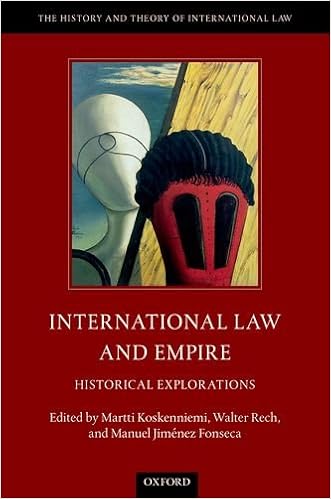
REVIEW: Alberto RINALDI reviews Martti KOSKENNIEMI, Walter RECH & Manuel JIMÉNEZ FONSECA (eds.), International Law and Empire: Historical Explorations (Oxford: OUP, 2017) (American Journal of Legal History Advance Articles)

(image source: Blogger)

First paragraph:
In recent years there has been a real flourishing of historical studies with a focus on international law’s past. The so called ‘turn to history’ is precisely the kind of terrain in which the present volume - in the form of a collection of essays - is situated, as the book explores the various, ambivalent ways in which international law has dealt with and is related to ‘Empire’, understood as a set of manifold practices, discourses, social manifestations, struggles, spaces and people.The authors - coming from a wide range of backgrounds from postcolonial studies to political philosophy - are in fact interested in looking at those episodes, events, theories, and texts...
Read more with Oxford Journals.
See earlier for on this blog for the book description.