ESIL Interest Group History of International Law

ESIL Interest Group History of International Law
Showing posts with label World War I. Show all posts

Wednesday, 24 March 2021

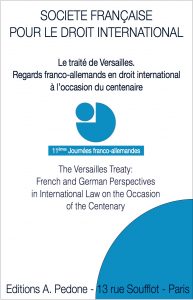
BOOK: Société Française pour le Droit International (dir.), Le traité de Versailles. Regards franco-allemands en droit international à l’occasion du centenaire – The Versailles Treaty: French and German Perspectives in International Law on the Occasion of the Centenary [SFDI, Journées] (Paris: Pedone, 2020), 320 p. ISBN 9782233009562, € 44


(image source: SFDI)

Society presentation: 
La Société française pour le droit international a été créée à la suite du colloque organisé les 17-18 mars 1967 à Strasbourg sous la présidence de Suzanne Bastid. A l’issue de ce colloque consacré aux Problèmes de l’enseignement et de la recherche en droit international en France face aux besoins de la pratique, Michel Virally a proposé « la création d’un groupement scientifique destiné à favoriser l’étude et le progrès du droit international et permettant aux enseignants, chercheurs et praticiens de se rencontrer à intervalles réguliers ». La nouvelle Société a été créée en octobre 1967, avec pour siège Strasbourg et un statut d’association de droit local.

Read more here

(source: Prof. dr. Daniel-Erasmus Khan, Universität der Bundeswehr) 


Friday, 12 March 2021

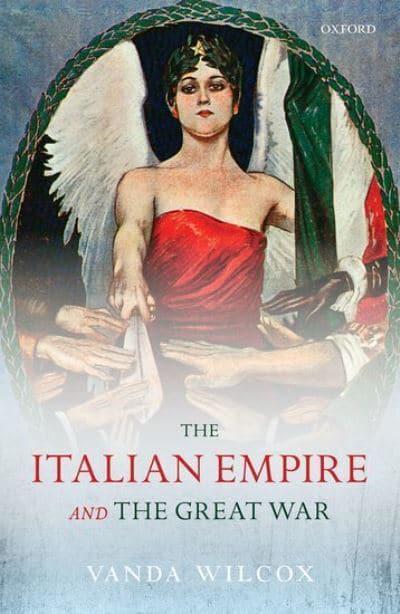
BOOK: Amanda WILCOX, The Italian Empire and the Great War (Oxford: OUP, 2021), 288 p. ISBN 9780198822943, € 38,14


(image source: Blackwells)

Book abstract:
The Italian Empire and the Great War brings an imperial and colonial perspective to the Italian experience of the First World War. Italy's decision for war in 1915 is contextualised in light of Italian imperial ambitions from the late nineteenth century onwards, and its conquest of Libya in 1911-12. The Italian empire was conceived both in conventional terms as a system of settlement or exploitation colonies under Italian sovereignty, and as an informal global empire of emigrants; both were mobilised in support of the war in 1915-18. The war was designed to bring about 'a greater Italy' both literally and metaphorically. In pursuit of global status, Italy endeavoured to fight a global war, sending troops to the Balkans, Russia, and the Middle East, though with limited results. Italy's newest colony, Libya, was also a theatre of the Italian war effort, as the anticolonial resistance there linked up with the Ottoman Empire, Germany, and Austria to undermine Italian rule. Italian race theories underpinned this expansionism: Vanda Wilcox examines how Italian constructions of whiteness and racial superiority informed a colonial approach to military occupation in Europe as well as the conduct of its campaigns in Africa. After the war, Italy's fate at the Peace Conference is examined in an imperial framework to show that the 'mutilated victory' was an imperial as well as a national sentiment. Events in Paris are analysed alongside the military occupations in the Balkans and Asia Minor as well as the efforts to resolve the conflicts in Libya, to assess the rhetoric and reality of Italian imperialism.

(source: Blackwells

Monday, 23 March 2020

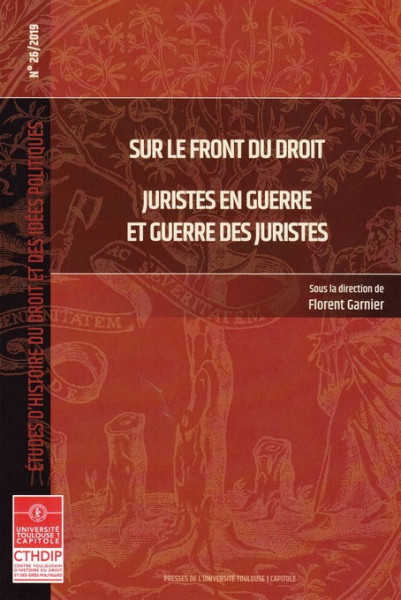
BOOK: Florent GARNIER (dir.), Sur le front du droit. Juristes en guerre et guerre des juristes [Etudes d'Histoire du Droit et des Idées Politiques; 26] (Toulouse: Editions de l'Université Toulouse 1-Capitole, 2020), 140 p. ISBN 978-2-3617-0203-8, € 15

(image source: univ-droit)

Book abstract:
Cet ouvrage rassemble sept contributions d'un cycle de conférences organisé à l'occasion de la commémoration du centenaire de la Première Guerre mondiale par le Centre Toulousain d'Histoire du Droit et des Idées Politiques en collaboration avec le Collège supérieur de droit et l'École Européenne de droit de l'Université Toulouse Capitole. Trois temporalités sont présentées et analysées, elles intéressent les juristes en guerre et la guerre des juristes. Tout d'abord l'action, la réflexion et la pratique au quotidien de juristes plongés dans ce conflit sont mises à jour. La Grande Guerre a aussi été un temps particulier d'adaptation et d'application du droit pour répondre aux circonstances exceptionnelles. Enfin, la guerre prend place dans un mouvement long de renforcement du rôle de l'État.
Table of contents:
Florent Garnier, Des juristes en action.
Michaël Amara, Le combat du Président Wellens ou le difficile exercice de la Justice militaire belge durant la Première Guerre mondiale.
Aurélien Antoine, L'influence de la Première Guerre mondiale dans l'affirmation de la discipline du droit public au Royaume-Uni.
Aurore Gaillet, Le droit public allemand et la Première Guerre mondiale.
Gerd Hankel, L'impact de la Première Guerre mondiale sur le concept de droit international public en Allemagne.
Annamaria Monti, Les juristes italiens et la guerre : pistes de recherche.
Antoine Sené, De la propagande internationale à la diplomatie culturelle. Professeurs et facultés de droit, agents de la politique extérieure française pendant la Grande Guerre.
Wanda Mastor, La Cour suprême des États-Unis et la Première Guerre mondiale. Histoire du miroir d'un désamour. 
(source: univ-droit)

Thursday, 21 November 2019

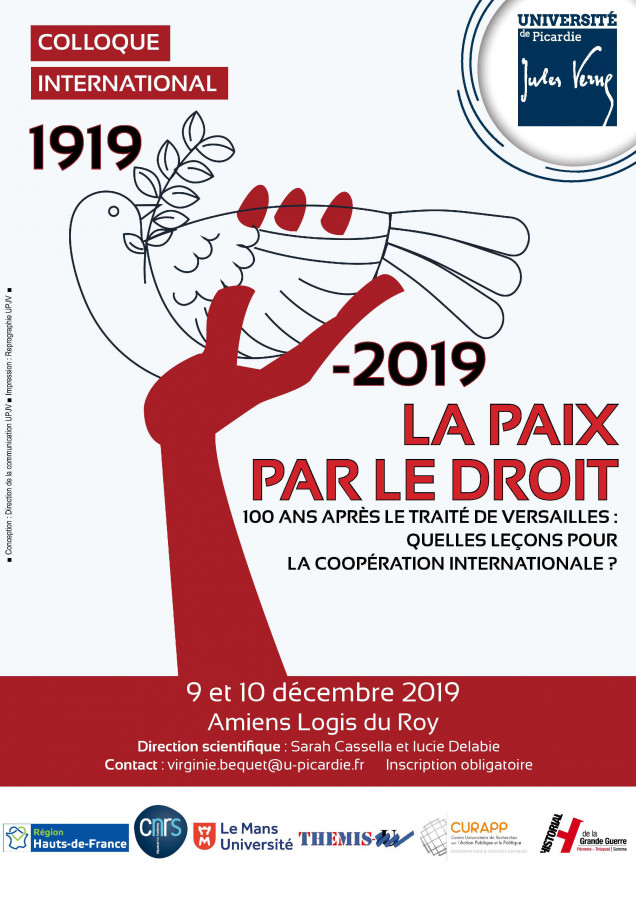
CONFERENCE: 1919-2019, La paix par le droit. 100 ans après le traité de Versailles: quelles leçons pour la coopération internationale ? (Amiens: université de Picardie, 9-10 DEC 2019)

(image source: univ-droit)

Lundi 9 décembre 2019


12h30 : Accueil des participants
13h30 : Propos introductifs - Le projet de paix par le droit au XXIe siècle : apports et limites de l’expérience d’entre-deux-guerres

Panel- Permanences et mutations du modèle de coopération multilatérale perspective doctrinale

13h45 : Les juristes internationalistes français et la construction de la paix dans l’entre-deux-guerres 
Jean-Michel Guieu, Maître de conférences en histoire contemporaine des relations internationales, Université Paris 1 Panthéon-Sorbonne
Les Etats-Unis, la paix par le droit et la coopération multilatérale Lucie Delabie, Professeure en droit public, Université de Picardie Jules Verne (UPJV)
Que reste-t-il de la fédération européenne imaginée durant l’entre-deux-guerres ? 
Christine Manigand, Professeure d’histoire contemporaine, Université Sorbonne Nouvelle- Paris 3

Perspective institutionnelle

L’Académie de la Haye, symbole de la paix par le droit hier et aujourd’hui Yves Daudet, Président du Curatorium de l’Académie de droit international de La Haye
La contribution de la période d’entre-deux-guerres au développement d’un modèle d’organisation internationale Marie-Clotilde Runavot, Professeure en droit public, Université de Perpignan via Domitia
La coopération économique et financière durant l’entre-deux-guerres et ce qu’il en reste 
Sylvain Schirman, Professeur d’histoire des relations internationales, Université de Strasbourg
15h45 : Débats
16h00 : Départ pour Péronne
17h30 : Visite de Historial de Péronne
19h00 : Keynote : L’héritage de la Grande guerre au plan international John Horne, Professeur d’histoire, Trinity College, Dublin

Mardi 10 décembre 2019


8h30 : Accueil

Table Ronde 1 - La contribution de la société des nations et de l’entre-deux–guerres au règlement pacifique des différends

9h00 : Le rôle des juridictions internationales dans la préservation de la paix Guillaume Le Floch, Professeur en droit public, Université de Rennes 1
La Cour permanente de Justice internationale : héritage et rupture dans le contentieux international Jean-Marc Thouvenin, Secrétaire général de l’Académie de droit international de la Haye
L’apport de la période d’entre-deux-guerres au développement de l’arbitrage international : les promesses de l’arbitrage international François Mailhé, Professeur en droit privé, UPJV
Les modes diplomatiques de règlement des différends depuis la SDN, continuité et renouveau ; point de vue politiste Thomas Lindemann, Professeur de science politique, Université de Versailles St-Quentin-en-Yvelines
10h20 : Débats
10h50 : Café

Table Ronde 2 - Les limitations du recours à la contrainte

11h00 : Négocier la paix ? Le traité de paix à l’épreuve de la prohibition de l’emploi de la force 
Romain Le Boeuf, Professeur en droit public, Université Aix-Marseille
La règle et l’exception : la légitime défense depuis 1919
Sarah Cassella, Professeure en droit public, Le Mans Université
La non reconnaissance des occupations territoriales illégales : du Mandchoukouo (1932) à la Crimée (2014) Anne Lagerwall, Professeure de droit, Université Libre de Bruxelles
La résurgence de la doctrine de la guerre juste dans le Pacte SDN sous le masque juridique des « guerres licites » 
Eric Wyler, Maître de conférences en droit public, Université Paris II Panthéon–Assas
12h20 : Débats

12h45 : Déjeuner

Table Ronde 3 - Coopération internationale et minorités

14h15 : Les leçons des mandats internationaux face aux enjeux contemporains : regards croisés Jean-Baptiste Pierchon, Maître de conférences en histoire du droit, Le Mans Université
Giovanni Distefano, Professeur de droit, Université de Neuchâtel
Les mécanismes de protection des minorités durant l’entre-deux-guerres et la construction d’un régime juridique international effectif Mouloud Boumghar, Professeur en droit public, UPJV, détachement Galatasaray
16h00 : Débats
16h30 : Conclusions Serge Sur, Professeur émerite en droit public, Université Paris II Panthéon-Assas


Colloque organisé sous la direction scientifique de Sarah Cassella et Lucie Delabie

Inscription obligatoire - Contact virginie.bequet@u-picardie.fr

(source: univ-droit)

Wednesday, 23 October 2019

BOOK: Lisa BECKENBAUGH, The Treaty of Versailles. A Primary-Document Analysis (Santa Barbara: ABC Clio, 2018) ISBN 978-1-4408-5909-0, 83 USD

(image source: ABC Clio)

Book abstract:
An indispensable resource on the Treaty of Versailles, one of the most influential and controversial documents in history, this book explains how the treaty tried to solve the complex issues that emerged from the destruction of World War I. This carefully curated primary source collection includes roughly 60 documents related to the signing of the Treaty of Versailles. By collecting all of the most significant documents in one volume, it allows readers to hear the original arguments surrounding the treaty and to explore the voices of the people involved at the Paris Peace Conference. Moreover, it allows readers to engage with the documents so as to better understand the complex motivations and issues coming out of World War I and highlights the differences between the victors and identifies the problems many countries had with the treaty before it was even signed. The documents are organized in chronological order, providing a blueprint to help students to understand all of the significant events that led to the treaty, as well as the vast repercussions of the treaty itself. In addition to the Treaty of Versailles itself, documents include such significant primary sources as the Sykes-Picot Agreement, the Balfour Declaration, the Treaty of Brest-Litovsk, President Woodrow Wilson's Fourteen Points, and Germany's response to the treaty.
On the author:
Lisa L. Beckenbaugh, PhD, is assistant professor of military and security studies at Air University's Air Command and Staff College. She received her MA from St. Cloud State University and her PhD from the University of Arkansas. Dr. Beckenbaugh has taught at a variety of undergraduate and graduate civilian institutions. She also served as the interim project lead and military analyst II for the Operational Leadership Experiences Project under the aegis of the Combat Studies Institute at Fort Leavenworth and was a Post-Graduate Historical Research Fellow at the Defense POW/Missing Personnel Office. 
More information with the publisher

Wednesday, 16 October 2019

BOOK REVIEW: Holger HEHRING reviews Jörn LEONHARD, Der überforderte Frieden. Versailles und die Welt 1918-1923 (München: Beck 2018) (Francia Recensio 2019/3

(image source: Deutschlandfunk)

First paragraph:
In January 1918 – the war had not ended yet – the Vienna paper »Der Morgen« published a cartoon that showed the »Babylonian peace tower«: on it and around it a plethora of political leaders, citizens, slogans, and banners compete for attention. They demand, for example, »democracy«, »freedom of the seas«, and in the background, we can spot a campaigner calling for »Africa to the Africans«. Readers can find this cartoon and an interpretation of it in Jörn Leonhard’s awe-inspiring monumental history of peace making after the First World War (p. 133).
Read more on Francia Recensio's website.
 

Monday, 8 July 2019

JOURNAL: Diplomacy and Statecraft XXX (2019), Issue 2 [Of War and Peace: Aspects of British Policy and the Treaty of Versailles]

(image source: idrottsforum)

Michael Dockrill: Historian of the Versailles Treaty: 7 November 1936-17 August 2018 (Brian Holden Reid)
Abstract:
The Treaty of Versailles is one of the twentieth century’s most controversial international agreements; and British policy towards the settlement with defeated Germany equally so. British policy at the Peace Conference stemmed from war aims developed after 1914 – desultory because of unexpected total war. In this process after December 1916, Prime Minister David Lloyd George controlled policy-making and, by late 1918, had general aims involving German territorial losses, disarmament, and paying for the war. Despite distrusting Foreign Office professionals, Lloyd George and his Downing Street advisors at Paris relied on non-professional experts through informal networks below them. One was James Headlam-Morley about the future of Danzig; and several pre-war historians also contributed in a profound way, their experiences stimulating the establishment of diplomatic history as a field of academic research and the emergence of the nascent discipline of international relations. On bigger issues, like Anglo-American naval rivalry that emerged at the Conference, Lloyd George sparred with President Woodrow Wilson. And as only Lloyd George of the Big Four survived politically after the Conference, development of his ideas and policies during the war and after played a major role in post-war international politics. Some issues at Paris have not received needed attention like the restitution of cultural objects in German possession: the Koran of Caliph Othman and the Skull of Sultan Mkwawa. Finally, after the war, the Treaty’s impact on both Britain’s enemy, Germany, and its ally, France profoundly affected the European balance of power.
Introduction: Of War and Peace: Aspects of British Policy and the Treaty of Versailles (B.J.C. McKercher & Erik Goldstein)
Abstract:
 The Treaty of Versailles is one of the twentieth century’s most controversial international agreements; and British policy towards the settlement with defeated Germany equally so. British policy at the Peace Conference stemmed from war aims developed after 1914 – desultory because of unexpected total war. In this process after December 1916, Prime Minister David Lloyd George controlled policy-making and, by late 1918, had general aims involving German territorial losses, disarmament, and paying for the war. Despite distrusting Foreign Office professionals, Lloyd George and his Downing Street advisors at Paris relied on non-professional experts through informal networks below them. One was James Headlam-Morley about the future of Danzig; and several pre-war historians also contributed in a profound way, their experiences stimulating the establishment of diplomatic history as a field of academic research and the emergence of the nascent discipline of international relations. On bigger issues, like Anglo-American naval rivalry that emerged at the Conference, Lloyd George sparred with President Woodrow Wilson. And as only Lloyd George of the Big Four survived politically after the Conference, development of his ideas and policies during the war and after played a major role in post-war international politics. Some issues at Paris have not received needed attention like the restitution of cultural objects in German possession: the Koran of Caliph Othman and the Skull of Sultan Mkwawa. Finally, after the war, the Treaty’s impact on both Britain’s enemy, Germany, and its ally, France profoundly affected the European balance of power.
The Quest for Stability: British War Aims and Germany, 1914–1918 (B.J.C. McKercher)
Abstract:
British war aims concerning Germany developed haphazardly during the Great War of 1914–1918. The vicissitudes of unexpectedly conducting total war–one lasting more than four years–periodically deflected their consideration. Inter-Allied diplomacy and pressures from non-governmental lobbyists from Central–Eastern Europe seeking independent states to succeed the Habsburg, Romanov, and Wilhelmine empires forced reconsideration at crucial moments, for instance, after the advent of the nascent Bolshevik regime in Russia in late 1917 to early 1918. So, too, did British public opinion. Nonetheless, the British government had a clear general strategy: return stability on the European continent. In this context, the prime minister after December 1916, David Lloyd George, became central. Beyond the general aim, however, he wanted to avoid firm commitments over a range of issues touching Germany to give him flexibility in negotiating with the other Allied leaders at the eventual Peace Conference. Thus, less concerned with the minutiae of transforming war aims involving German territorial losses, disarmament, and paying for the war, he looked to make deals that might lack strategic purpose.
“A House of Cards Which Would Not Stand”: James Headlam-Morley, the Role of Experts, and the Danzig Question at the Paris Peace Conference (D.B. Kaufman)
Abstract:
Recent years have witnessed increasing interest amongst international historians on the influence by experts on foreign policy decision making. Most work thus far has concentrated on American foreign policy since 1945, but this analysis broadens the focus to consider the impact of experts on British decision makers through the use of informal networks below the level of Cabinet ministers whilst debating the future of the city of Danzig at the Paris Peace Conference of 1919. It shows that despite a tendency by the protagonists to interpret their actions as subverting the official role and function of the Foreign Office, sufficient evidence can be found to suggest that through the use of back-channels to David Lloyd George, the prime minister, via Philip Kerr, his private secretary, some officials, such as James Headlam-Morley, within the Office managed to influence high-level decision making at Paris.
“The Light of History”: Scholarship and Officialdom in the Era of the First World War (T.G. Otte)
Abstract:
This analysis examines the interplay between academia and officialdom during the First World War and its immediate aftermath. The role of more especially historians prior to and during the Paris Peace Conference of 1919 and the degree to which they succeeded—or failed—to affect decision making have been examined in some considerable detail by recent scholarship. Far less attention has been paid to the impact of individual historians’ experience of employment in war-time government agencies on their post-war scholarly pursuits. The effect of the war on historical scholarship, in fact, was profound. Not the least, it stimulated the establishment of diplomatic history as a distinct field of academic research and the emergence of the nascent discipline of international relations led by scholars who had served in wartime intelligence. 

Lloyd George and the American Naval Challenge: “The Naval Battle of Paris” (John H. Maurer)
Abstract:
In the immediate aftermath of the First World War, naval competition loomed between Great Britain and the United States. This American naval challenge frustrated Britain’s leaders, who were determined to hold onto their country’s hard-won standing as the world’s leading sea Power. Britain’s Prime Minister David Lloyd George chose the setting of the negotiations at the Paris Peace Conference to force a showdown with American leaders in an attempt to curtail their naval shipbuilding. Much to Lloyd George’s chagrin, the Americans proved obdurate in negotiations. President Woodrow Wilson and his naval advisors refused to stop the American buildup of large and powerful capital ships that called into question Britain’s naval mastery. The deadlocked talks between American and British naval leaders threatened to wreck the peace negotiations and the establishment of the League of Nations. To prevent a breakdown in Anglo-American relations at Paris, Sir Robert Cecil and Colonel Edward House negotiated an agreement that pledged both countries to work towards a settlement of their naval competition. This analysis examines Lloyd George’s motivations and actions in provoking this confrontation to defeat America’s naval challenge in what would later become known as the naval battle of Paris. 
From Caxton Hall to Genoa via Fontainebleau and Cannes: David Lloyd George’s Vision of Post-War Europe (Alan Sharp)
Abstract:
Only David Lloyd George of the Big Four survived to play a major role in early post-war diplomacy, remaining as British premier until October 1922. This analysis assesses the development of his ideas and policies with particular reference to his war aims speech of 5 January 1918, his Peace Conference Fontainebleau Memorandum of 25 March 1919, and the paper handed to the French premier, Aristide Briand, at Cannes on 4 January 1922. John Maynard Keynes accused Lloyd George of being “rooted in nothing,” but Edward House’s grudging acknowledgement that “With all his faults, he is by birth, instinct and upbringing, a liberal” seems a fairer assessment. He attempted to put his ideas, based on self-determination, trade, disarmament, and a broad sense of what was just, into practice in his ambitious attempt to re-engage Germany and the Soviet Union into the mainstream of international politics at the 1922 Genoa Conference. By then his credibility with his French counterparts and Tories at home was much depleted. Furthermore, he neglected laying the tedious but necessary foundations on which to build his vision and the constraints of international and domestic politics thwarted his proposed panacea to post-war problems. 
Cultural Heritage, British Diplomacy, and the German Peace Settlement of 1919 (Erik Goldstein)
Abstract:
Restitution of cultural objects was one of the topics covered in the Treaty of Versailles and the related peace treaties. Britain made specific claims in Article 246 relating to the Koran of Caliph Othman and the Skull of Sultan Mkwawa, whilst the Foreign Office considered other claims. Britain’s policy on cultural restitution influenced growing international norms, but it should also be seen in the context of Britain’s wider diplomatic concerns, stretching from the time of Castlereagh into the post-Second World War era. 
Great Britain in French Policy Conceptions at the Paris Peace Conference, 1919 (Peter Jackson)
Abstract:
During the First World War, France and Britain forged the most intimate and comprehensive political, economic, and military alliance in history. The contributions of Britain and its Empire had been vital to France’s survival as a Great Power. A continuation of the wartime Entente was therefore pivotal to a wider strategy of embedding French security in a trans-Atlantic community of democratic Powers including the United States. But neither Britain nor the United States were ready to commit to using force to uphold the European order established at Paris. British political and policy elites reverted to pre-war cultural reflexes that prioritised Imperial considerations and assumed that France posed the chief threat to British interests 
Germany, Versailles, and the Limits of Nationhood (Conan Fischer)
Abstract:
As a defeated Great Power, Germany faced exceptional challenges after the First World War. These ranged from domestic revolution to grudging compliance with a peace treaty whose terms Germans almost universally regarded as unjust and unworkable. Franco-German relations quickly assumed particular significance in this regard as each country sought to secure its vital interests at the other’s expense; a confrontation that culminated in the Ruhr Crisis. However, there had been intermittent attempts to address security concerns through collaboration rather than confrontation and, after the Ruhr Crisis beginning in January 1923, these efforts rapidly gained momentum. The German and French foreign ministers, Gustav Stresemann and Aristide Briand, developed a trusting relationship as they strove to locate Franco-German rapprochement within the wider context of European integration. Stresemann’s death in 1929 did not stop this process that, under severe pressure from the Great Depression, finally imploded in early 1932. 
 (source: Taylor & Francis)

Thursday, 13 June 2019

CONFERENCE: Le traité de Versailles et le pacte de la SDN : un tournant dans l'histoire du droit international ? (Paris: Ecole Normale Supérieure, 28 JUN 2019)

(image source: ENS Droit/Twitter)

The École Normale Supérieure (Paris) is organising a conference on the Treaty of Versailles on 28 June 2019.

Click on the image above for the conference programme. Register through the Google Docs-form here.

Monday, 20 May 2019

CONFERENCE: La Conférence de la Paix de Paris de 1919. Les défis d’un nouvel ordre mondial (Paris/Versailles: DHI/Ministère des Affaires Étrangères/Centre de Recherche du Château de Versailles, 5-8 JUN 2019)


Conference abstract:
L’ombre portée du traité de Versailles, signé le 28 juin 2018, a longtemps laissé à l’arrière-plan la conférence de la Paix qui s’ouvrit à Paris le 18 janvier 1919 et se clôtura le 21 janvier 1920. Comme ce fut le cas pour le Bicentenaire du Congrès de Vienne, en 2015, l’occasion est donnée par le colloque des 5-8 juin 2019 de redécouvrir cette assemblée diplomatique sans précédent, réunie, il y a exactement un siècle, pour définir les fondements du nouvel ordre international au sortir de la Première Guerre mondiale. Conçu dorénavant comme un ordre mondial, et non plus européen, ses principes fondamentaux - respect du Droit, égalité souveraine des États, autodétermination, libéralisme économique, diplomatie ouverte, égalité raciale - furent discutés, retenus ou rejetés par les 32 négociateurs réunis à Paris mais aussi par les associations issues de la société civile, présentes en nombre au moment de la conférence. Ce « premier Congrès mondial » de l’histoire, comme il fut qualifié à l’époque, et qui rassembla de fait de nombreux États latino-américains, quelques États asiatiques et de très rares États d’Afrique, laissa néanmoins sur le bord de la route les États colonisés ou placés sous mandats qui demeurèrent exclus de cette société internationale au fonctionnement fondamentalement inégalitaire. De la conférence n’en ont pas moins découlé les grandes organisations internationales qui posèrent les fondements de la diplomatie multilatérale du XXe siècle, à commencer par la Société des Nations et l’Organisation internationale du travail, et de nouvelles pratiques internationales qui seront au cœur des débats.
Conference programme here.

 Organising commitee:
Laurence Badel (université Paris 1 Panthéon-Sorbonne), Eckart Conze (Universität Marburg), Axel Dröber (Institut historique allemand), Jean-Michel Guieu (université Paris 1 Panthéon-Sorbonne), Norman Ingram (Concordia University), Peter Jackson (University of Glasgow), Stefan Martens (Institut historique allemand), Matthias Schulz (université de Genève), William Mulligan (University College Dublin)
 Practical information:
Inscription obligatoire selon les jours :
  • par mail pour les journées du 5 au 7 juin (en précisant les sessions auxquelles vous souhaitez vous inscrire)
Lieux du colloque :
  • Mercredi 5 juin et jeudi 6 juin : Institut historique allemand (Hôtel Duret-de-Chevry, 8 rue du Parc-Royal, 75003 Paris)
  • Vendredi 7 juin : Institut historique allemand (Paris) et ministère de l’Europe et des Affaires étrangères (Hôtel du ministre, 37 quai d’Orsay, 75007 Paris)
  • Samedi 8 juin : auditorium du château de Versailles (Versailles) (plan d’accès)
More information on the website of the Centre de Recherche du Château de Versailles.

Tuesday, 7 May 2019

CONFERENCE: Colloque La Belgique et les traités de paix, de Versailles à Sèvres (1919-1920) (Brussels: Academy Palace, 9-11 MAY 2019)


JEUDI 9 MAI

9 h 15
Accueil
Didier Viviers (Secrétaire perpétuel de l’Académie royale de Belgique)

9 h 30
Introduction
Michel Dumoulin (UCLouvain ; Académie royale de Belgique)

9 h 45
Exposé général : Les traités de paix, entre promesse d’un ordre nouveau et politiques de puissance
Sylvain Schirmann (IEP de Strasbourg)

DÉCIDEURS – Présidence de séance :
Gerd Krumeich (Universität Düsseldorf)

10 h 30
Albert, Léon, Paul et les autres : acteurs ou spectateurs des traités de Paix ?
Vincent Delcorps (UCLouvain)

11 h 00
Pause

11 h 15
Les tensions au sein du corps diplomatique belge à la veille de la Conférence de la Paix
Michaël Auwers (Universiteit Antwerpen)

11 h 45
La délégation belge à Versailles : des négociations au Pacte de la SDN
Vincent Genin (KU Leuven ; EPHE)

12 h 15
Débat/pause repas

14 h
Le Parlement, les partis politiques et la Conférence de la Paix
Emmanuel Gerard (KU Leuven)

14 h 30
La première des « puissances à intérêts particuliers » ? La Belgique dans les décisions et représentations des Alliés lors de la Conférence de la Paix de 1919
Vincent Laniol (Université Paris 1 Panthéon-Sorbonne)

15 h 00
« Le véritable grand succès obtenu… ». Versailles et les exigences d’annexion formulées par la Belgique en 1918-1919. La perspective néerlandaise
Wim Klinkert (Nederlandse Defensie Academie, Breda ; Universiteit van Amsterdam)

15 h 30
Face au Heraus ! : regards allemands sur « poor little Belgium » (1918-1920)
Christoph Brüll (Université du Luxembourg)

16 h 00
Pause

16 h 15
Les intérêts économiques belges à l’étranger entre débâcle et opportunités
Michel Dumoulin (UCLouvain ; Académie royale de Belgique)

16 h 45
Un formidable butin de guerre facile à enlever ? La « conquête » belge des usines sidérurgiques du Grand-duché de Luxembourg (1918-1921)
Charles Barthel (Archives nationales du Luxembourg)

17 h 15
Débat

VENDREDI 10 MAI

REVENDICATIONS – Présidence de séance :
Laurence Badel (Université Paris 1 Panthéon-Sorbonne)

9 h 00
Les réparations : des objectifs de reconstruction au marchandage interallié
Rolande Depoortere (Archives générales du Royaume)

9 h 30
La « désannexion » d’Eupen-Malmedy. Une « injustice » ?
Philippe Beck (UCLouvain)

10 h 00
Au-delà du fleuve. La Belgique et la liberté de navigation du Rhin (1918-1920)
Étienne Deschamps (Archives historiques du Parlement européen à Luxembourg)

10 h 30
Le tribunal comme espace de revendications : vérité, reconnaissance et justice (1919-1925)
Ornella Rovetta (ULB)

11 h 00
Pause

11 h 15
Le tout et son contraire : des buts de guerre coloniaux aux accords Orts-Milner
Pierre-Luc Plasman (UCLouvain)

11 h 45
Les traités de paix, un tournant pour le droit du travail dans les colonies africaines ?
Pierre Tilly (UCLouvain-Mons)

12 h 15
Versailles et les questions ouvrières : la paix par la justice sociale
Pierre-Olivier de Broux (Université Saint-Louis Bruxelles)

12 h 45
Débat/pause repas

OPINIONS (1) – Présidence de séance :
Francis Balace (ULiège)

14 h
La Conférence de la Paix au prisme de la presse belge
Catherine Lanneau (ULiège)

14 h 30
Une occupation amicale : les alliés en Belgique entre 1918 et 1919
Matthew Haultain-Gall (UCLouvain)

15 h 00
Versailles dans les carnets intimes des anciens occupés
Emmanuel Debruyne (UCLouvain)

15 h 30
Les collaborations économiques et leurs répressions
Florent Verfaillie (AGR/CegeSoma ; UGent) et Dirk Luyten (AGR/CegeSoma)

16 h 00
Pause

16 h 15
Un milliard de francs supplémentaire pour les finances publiques ? La mise sous séquestre et la liquidation des biens appartenant à des ressortissants allemands après la Première Guerre mondiale
Pierre-Alain Tallier (Archives Générales du Royaume)

16 h 45
Le cardinal Mercier et la paix : bilan et lumières nouvelles
Luc Courtois (UCLouvain)

17 h 15
La franc-maçonnerie belge et l’après-guerre : le cosmopolitisme mis à l’épreuve
Anaïs Maes (VUB)

17 h 45
Débat

SAMEDI 11 MAI

OPINIONS (2) – Présidence de séance :
Christoph Brüll (Université du Luxembourg)

9 h 00
L’armée belge et le service militaire généralisé
Tom Simoens (Ecole royale militaire)

9 h 30
C’était au temps où les Belges rêvaient : le Comité de politique nationale
Francis Balace (ULiège)

10 h
Les historiens belges, la sortie de guerre et les traités de 1919-1920 : esprit de revanche ou esprit de conciliation ?
Geneviève Warland (UCLouvain)

10 h 30
Pause

10 h 45
L’immédiat après-guerre dans les lettres belges francophones : la question des revues
Laurence Boudart (Archives et Musée de la Littérature)
« Laat af de galante handkus aan de muze ». De doorwerking van het linkse activisme in de Vlaamse literatuur
Dieter Vandenbroucke

11 h 15
La « question allemande » au moment des « traités de paix » dans les revues littéraires et intellectuelles en Belgique
Hubert Roland (UCLouvain)

11 h 45
Les Jeux Olympiques d’Anvers : hommage à la Belgique héroïque ?
Dries Vanysacker (KU Leuven)

12 h 15
Débat

12 h 45
Conclusions générales
Catherine Lanneau (ULiège)


More information on the Académie Royale's website.

Friday, 5 April 2019

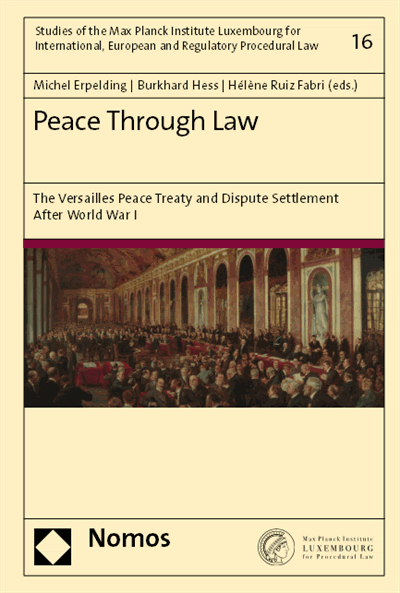
BOOK: Michel ELPERDING, Burkhard HESS & Hélène RUIZ FABRI (eds.), Peace Through: Law The Versailles Peace Treaty and Dispute Settlement After World War I [Studies of the Max Planck Institute Luxembourg for International, European and Regulatory Procedural Law, Bd. 16] (Baden-Baden: Nomos Verlag, 2019), ISBN 978384529916, OPEN ACCESS


Book abstract:
Den Vertrag von Versailles als ein Beispiel von „Frieden durch Recht“ darzustellen, mag rückblickend als Provokation erscheinen. Und doch bestechen der Versailler und die anderen Pariser Friedensverträge von 1919–1920 noch heute durch die schiere Vielfalt und Neuartigkeit der durch sie auf den Plan gerufenen völkerrechtlichen „Experimente“ sowohl substantieller als auch verfahrensrechtlicher Natur. Obwohl viele dieser „Experimente“ auch das Völkerrecht und die internationale Streitbeilegung in der Zeit nach dem Zweiten Weltkrieg grundlegend beeinflusst haben, sind sie heute kaum noch ein Teil des kollektiven Gedächtnisses. Die in diesem Buch vereinigten juristischen und historischen Forschungsarbeiten geben einen Gesamtüberblick über die Art und Weise wie die Pariser Friedensverträge die internationale Streitbeilegung in der Zwischenkriegszeit sowohl substantiell als auch verfahrensrechtlich geprägt haben. Die in diesem Buch enthaltenen Darstellungen teilweise in Vergessenheit geratener internationaler Gerichte und ihren Entscheidungen werden durch Archiv- und Bildmaterial zusätzlich untermauert.
See also conference videos earlier on this blog.

Read the full book on the Nomos website.

Friday, 22 March 2019

ARTICLES: EJIL XXIX (2018), Issue 4: International Law and World War One

(image source: Oxford Journals)

The most recent issue of EJIL, the organ of the European Society of International Law, contains several articles of the symposium International Law and World War One.

The Law of Military Occupation from the 1907 Hague Peace Conference to the Outbreak of World War II: Was Further Codification Unnecessary or Impossible ? (Thomas Graditzky)
Abstract:
World War I is commonly perceived as having had a profound impact on international law. Such a general perception, be it justified or not, might in any event prove erroneous when looking at specific areas of this law. A focus on the law governing military occupation reveals a notable absence of change over the course of the war and the subsequent interwar period. In search of possible reasons, this article first looks at various opportunities that emerged – but were not ultimately seized – to adapt treaty law in the period between the two world wars. It then assesses whether changes had in fact occurred through other channels such as customary international law or treaty interpretation. Based on the observation that no meaningful change intervened, can it be concluded that, on the whole, the Hague regulations on military occupation met stakeholders’ expectations and therefore were not altered? The author suggests, rather, that the equilibrium founded in The Hague in 1899 (and confirmed in 1907) on the lines of tension between the states involved remained operational throughout the period under scrutiny.

The Impact of World War I on the Law Governing the Treatment of Prisoners of War and the Making of a Humanitarian Subject (Neville Wylie & Lindsey Cameron)
Abstract:
This article evaluates the impact of World War I on the development of international humanitarian law (IHL) regarding the treatment of the prisoner of war (POW). In contrast to traditional scholarship, which overlooks the war’s significance on the jus in bello, we argue that in the area of POW law, the changes brought about by the war were significant and long-lasting and led to the creation of a POW convention in 1929 that set IHL onto a markedly different path from that followed before 1914. Although the process was only completed with the signing of the four Geneva Conventions in 1949, many of the distinguishing features of modern POW law had their roots in the experience of captivity during World War I and the legal developments that followed in its wake. In particular, the scale, duration and intensity of wartime captivity after 1914 gave rise to a conceptual shift in the way POWs were perceived, transforming their status from ‘disarmed combatants’, whose special privileges were derived from their position as members of the armed forces, to ‘humanitarian subjects’, whose treatment was based on an understanding of their humanitarian needs and rights.
More information with Oxford Journals.

Thursday, 28 February 2019

ARTICLE: John HORNE, "End of A Paradigm ? The Cultural History of the Great War", Past & Present CCXLII, 1 (Feb 2019), 155-192

(image source: Past & Present)
Abstract:
Cultural history has dominated the study of the Great War for 25 years. Since all intellectual paradigms have a life-cycle, it seems important to ask whether this one can still innovate. Cultural history has achieved much. It has shown how the war was represented (by artists and intellectuals, ideologies and ‘war cultures’). It has gone further by making the recovery of the experiences of the war the core of its agenda. Cultural historians have revealed what the first mass event of the 20th century meant for soldiers, women and hitherto neglected groups such as prisoners and occupied populations. They have also re-situated the conflict in new ‘time frames’ and in the new spatial relationships intrinsic to a global war. The result, however, has been an analytically descriptive history that has played down the causal history emphasized by traditional political and military studies. Yet these kinds of history provide the ‘master narratives’ of the First World War. Should cultural history continue to operate in a semi-parallel universe? Renewal seems necessary, and to achieve this, cultural historians might engage more with other historical fields. Three short examples, in demographic and military history, illustrate how this could be done.
 Read the article on Oxford Scholarship.

Tuesday, 5 February 2019

JOURNAL: International Affairs, Vol. 95 (No.1), 2019


(Source: OUP)

The latest issue of the journal International Affairs is dedicated to “World Politics 100 Years After the Paris Peace Conference”.

Contents:

World Politics 100 Years After the Paris Peace Conference
Margaret MacMillan, Anand Menon, & Patrick Quinton-Brown, Introduction: world politics 100 years after the Paris peace conference
First paragraph:

One hundred years ago the Treaty of Versailles, the centrepiece of a set of treaties and agreements collectively known as the Paris peace settlements, was signed in the glittering Hall of Mirrors in the former home of France's Sun King. For some, the war those settlements brought to an end was a distinct period in international relations, one dominated for the preceding century by a European state system that had endured since the Middle Ages

Barry Eichengreen, Versailles: the economic legacy
Abstract:
From the standpoint of international economic relations, the key implications of the Versailles Treaty were as follows. Signatories committed their countries to reconstructing a free and open multilateral trading system such as had existed before the First World War. Other economic institutions and arrangements, as distinct from the trading system, were noteworthy only to the extent that they worked towards this paramount goal. Moreover, in so far as those other arrangements, starting with the gold standard and international financial relations, had been integral to the success of the prewar trading system, there was a presumption that they too should be reconstructed along prewar lines. This approach was subject to multiple conflicts and contradictions. It did not take account of how the economic world had changed, creating a mismatch between prewar institutions and postwar circumstances. It enshrined—indeed, it gave legal content to—the conventional wisdom that to the victor go the economic spoils by imposing that self-same reparations burden on Germany and the other defeated Central Powers. It highlighted the conflicted nature of American attitudes towards management of the international economic system. And it did not give the Soviet Union, ultimately to emerge as the second of the twentieth century's two Great Powers, a seat at the table. While seeking to avoid exaggerating the parallels, I argue that the structure of international economic relations in the wake of the Cold War resembles in important respects the structure of those relations after the First World War.

Glenda Sluga, Remembering 1919: international organizations and the future of international order
Abstract:
Several of the world's intergovernmental organizations have now existed for longer than many nation-states. The centenary of the peacemaking that ended the First World War offers the opportunity of making good policy use of new histories that inform us about the shifting horizon of international expectations, the social dimensions of international thinking and international political cultures, their nation-state roots, and the sum of this relatively marginalized international past. The aim of this article is to draw together the various strands of the new historical work undertaken in the last decade in order to orientate 1919 as a moment that launched the world into a century of often profound discussion about international organizations as necessary instruments of multilateralism. This discussion sometimes dwindled, and it did not prevent wars. However, it had significant impacts: from the spectrum of ideas it brought to bear on the question of how to solve the world's most serious problems, to the practices of international governance it helped introduce. As importantly, the international order shaped in 1919 created unprecedented political spaces for representing the diverse interests of the world's populations, even the stateless. At crucial moments in the twentieth century, world-scale solutions to world-scale problems gave people ideas—even when the window of opportunity was small. If this history is good for anything, I argue that it might be for orientating our present in relation to that international past, and how we begin to imagine the future of the international order, as we know it.

Oona A. Hathaway & Scott J. Shapiro, International law and its transformation through the outlawry of war
Abstract:
The First World War was the last great war of what we have called the ‘old world order’—the legal regime that European states adopted in the seventeenth century and spent the next three centuries imposing on the rest of the globe. This order formed the basis of what scholars call ‘classical international law’. But this body of rules differed starkly from the ones that govern today: the old world order did not just sanction war, it relied on and rewarded it. States were permitted to wage war to right any legal wrong, and the right of the victors to extract territory and treasure from the losers was legally guaranteed. That all began to change when the nations of the world decided to outlaw war in the 1928 Kellogg–Briand treaty. As a result, the rules governing international behaviour have transformed radically—indeed, they are the polar opposite of what they once were. This article describes the decision to outlaw war and the transformation it unleashed in the world order generally, and in international law specifically. We argue that a simple but perplexing fact—that modern international law prohibits states from using force to enforce international law—is key to understanding international law and state behavior in the modern era.

Joseph S. Nye, Jr, The rise and fall of American hegemony from Wilson to Trump
Abstract:
A century ago, Woodrow Wilson changed America's place in the world when he sent two million men to fight in Europe, but America withdrew into isolationism in the 1930s. After the Second World War, Harry Truman and others created a framework of permanent alliances and multilateral institutions that became known as the ‘liberal international order’ or ‘Pax Americana’. Those terms have become obsolete as descriptions of the US place in the world, but the need for the largest countries to provide public goods remains. An open international order covers political–military affairs; economic relations; ecological relations; and human rights. It remains to be seen to what degree these depend on each other and what will remain as the 1945 package is unpacked. Wilson's legacy of developing international institutions continues to make sense. Leadership is not the same as domination, and it will need to be shared. There have always been degrees of leadership and degrees of influence during the seven decades of American pre-eminence after 1945. Now with less preponderance and a more complex world, American exceptionalism in terms of its economic and military power should focus on sharing the provision of global public goods, particularly those that require ‘power with’ others. Wilson's century old insights about international institutions and a rules-based order will remain crucial, but America's place in that world may be threatened more by the rise of populist politics at home than the rise of other powers abroad.

Jane Burbank & Frederick Cooper, Empires after 1919: old, new, transformed
Abstract:
1919 was not the death knell of empires: it opened new imperial possibilities. The empires of the losers were destroyed; victors added new territories and a new element—the mandate—to their repertoires; Japan was recognized as a major imperial actor; the Soviet Union constituted a new form of empire; Germany, chafing at its exclusion from the world of empires, created the Third Reich; the US, after promoting a new international order, developed its own way of exercising power at a distance. This article describes the varied trajectories of empires in the decades after the First World War. It notes changes in discourse and international institutions after 1919, but argues against fitting 1919 into a linear narrative of ‘empire to nation-state’. Self-determination proved a problematic concept both where it was implemented and where it was not. The forced breakup of the Ottoman Empire led to conflicts that have yet to be resolved. Anti-colonial movements fought oppression, but often sought alternatives to both old-style empires and the territorial state. Colonial empires were able to contain challenges, refine their methods of rule and claim international legitimacy. It took another catastrophe for colonial empires to be fundamentally threatened—by a war that was more the result of the reconfiguration of empires after 1919 than of their decline. The Japanese takeover of southeast Asia began the unraveling of European empires after 1945. Even then, political possibilities that reach well beyond the national continued to shape our world.
Lawrence Freedman, The rise and fall of Great Power wars
Abstract:
The Great War now stands as the prime example of the folly of war, an exercise in futility that was terrible in its slaughter. Yet this did not mark the end of Great Power wars. The victors believed that Germany should be penalized for its role in starting the war but this created a new set of grievances that Hitler played upon. In addition, while the norm of self-determination was an attempt to address grievances before they led to violence, the breakup of the old continental empires after 1919 was accompanied by great violence. Something similar happened as a result of the irresistible processes of decolonization after 1945. The growth of civil wars is one reason why the Great War was not the war to end all wars. As the potential gains from war declined the costs increased. The First World War picked up and accentuated tendencies in military practice, particularly when it came to targeting civilians, which had been in play before 1914. These then set the terms for the next war to be even more destructive. This was particularly true as aircraft were introduced into war as being most suitable for use against urban populations. Although this was not confirmed by the practice of air power during the Second World War, which did not achieve the anticipated strategic effects, the concluding introduction of nuclear weapons and the immediate surrender of Japan did lead to a decisive change in perceptions of the costs of Great Power war.
Yuen Foong Khong, Power as prestige in world politics
Abstract:
Power is shifting from the West to the East. Asia is experiencing the initial throes of this shift, where the key protagonists are the United States, the established power or hegemon, and China, the rising challenger and peer competitor. This article argues that the ongoing geopolitical competition between the United States and China is best viewed as a competition over the hierarchy of prestige, with China seeking to replace the US as the most prestigious state in the international system within the next thirty years. Although the competition is a global one, with China having made significant economic–political inroads into Africa, Latin America and even Europe, Asia is where China must establish its prestige or ‘reputation for power’ in the first instance. China seeks the top seat in the hierarchy of prestige, and the US will do everything in its power to maintain its pole position, because the state with the greatest reputation for power gets to govern the region: it will attract more followers, regional powers will defer to and accommodate it, and it will play a decisive role in shaping the rules and institutions of international relations. In a word, the state at the top of the prestige hierarchy gets to translate its power into the political outcomes it desires with minimal resistance and maximum flexibility.
Rosemary Foot, Remembering the past to secure the present: Versailles legacies in a resurgent China
Abstract:
In the century since the signature of the Treaty of Versailles, China's international status and material condition have been fundamentally transformed. The People's Republic has become powerful in ways that probably would have astonished the leaders of the early Republic of China, first established in 1911. These changes do not mean, however, that there are not potent legacies from China's nineteenth-century and Versailles-era experiences. In particular, the Versailles agreement showed China that gaining full membership of the international society of states would not be easy, despite its having joined the Allied side in the war effort. China's failure to gain either restitution of the territory of Shandong or proper acknowledgement of its status as a legally sovereign state added to the Chinese distrust of the West and Japan born out of their exploitative activities in China. The subsequent May Fourth nationalist demonstration of 1919 was the first of many prominent displays of nationalist outrage, a sentiment that provided opportunities for exploitation by successive Chinese governments. The article shows how the trials associated with removing China's unequal status in international politics condition and, in some respects, deform Chinese attitudes towards international politics to this day. In particular, it asks why China's remarkable resurgence has not changed official Chinese perceptions of world order, the tenor of its relations with other states and its view of its own place in international society more fundamentally than has in fact been the case
Erik Jones & Anand Menon, Europe: between dream and reality?
Abstract:
European political development since the Treaty of Versailles has gone through four phases. The interwar period was a time of democratic weakness and ethnic conflict that culminated in the Second World War. What followed was a period of division and yet also integration, particularly in western Europe. Western Europeans sought to transcend the nation-state through the promotion of the rule of law. The end of the Cold War suggested the victory of this civilizing mission, but that suggestion was not entirely convincing—not because of the re-emergence of ethnic conflict, but because of the increasing tension between popular and representative democracy. The economic and financial crisis brought that tension to the surface and placed a great strain on the wider integration project. The challenge is how to interpret this arc in the narrative of European history. Was unification always a dream while division remains a reality?

Margaret MacMillan & Patrick Quinton-Brown, The uses of history in international society: from the Paris peace conference to the present
Abstract:
History has been used—and abused—for centuries. Yet the more familiar notion of ‘history's lessons’—a notion which tends to make most historians uncomfortable, and which surely demands thoroughgoing skepticism—is far from exhaustive of history's uses in the practice and study of international relations. One important and timely subject is the more constitutive role of history in international deliberations over the creation, fragmentation and transformation of nation-states. What follows is a historical comparison of the changing ways in which the past has been used to frame the terms and content of such debates. While we will be exploring the uses of history as a guide or teacher, we propose to examine more specifically and at greater length the growth and persistence of newer uses: first, to bolster claims to independence and territory; and second, in demanding restitution in the form of financial reparations, apologies and other social privileges. By examining the ways in which history was used 100 years ago at the end of the First World War and in recent episodes of the Cold War and post-Cold War eras, we hope to show continuities and differences. What specialists must appreciate is that history is being used and will continue to be used not only within the confines of the academy, but within international society itself, where it may serve as a foundation for arbitrating political disagreements. If anything, non-specialist and popular reliance on history has grown, possibly because other forms of authority have attenuated.

(Source: ESCLH Blog)