ESIL Interest Group History of International Law

ESIL Interest Group History of International Law
Showing posts with label historiography. Show all posts

Monday, 21 June 2021

JOURNAL: Forum on "Historiography, Ideology, and Law" (History & Theory, LX (2021), Issue 2, 185-405


(image source: Wiley)

Historiography, Ideology and Law: an Introduction (Justin Desautels-Stein & Samuel Moyn) (DOI 10.1111/hith.12207)

Abstract:

This is an introduction to a forum on historiography, ideology, and law. The basic question weaving this forum together concerns the meaning of the term “critical” in the domain of critical legal history, a question that is deeply familiar to historians of all stripes. Ultimately, whether you are a lawyer doing historical work, a historian interested in law, or a historian of a different sort altogether, there is no hiding from the question of context and, critically, the ideological stakes in choosing an answer to that question.

 On the domestication of Critical Legal History (Justin Desautels-Stein & Samuel Moyn) (DOI 10.1111/hith.12208)

Abstract:

Among many of today's legal historians, there is a relatively new and generally unreflective understanding of the relationship between history and method. The landscape is everywhere marked by a tendency to eschew big thinking, grand theory, and programmatic approaches to historical explanation and social transformation. In the place of the grand theory approach to law and history, there is a preference for the minimalist, the pragmatic, the particularistic, and the quotidian. What this normal science of today's legal historiography makes obvious is a kind of attachment to particular kinds of problems with particular sorts of built-in solutions. The result for today is intellectual stagnation, a routinized and thoroughly domesticated mode of revealing contingency. Oddly, the fascination with contingency, and its deadening affair with a minimalist pragmatism, is itself a result of the triumph of what continues to be called “critical legal history.” Ostensibly due to an interface between critical legal studies and the historical discipline, the rise and triumph of critical legal history hides a secret: the whole idea of a reigning critical appreciation for contingency seems to be a misnomer. Sure, some may say that “things might have been otherwise.” But what this intellectual settlement demands is obedience to its qualification: “things might have been otherwise, but they weren't, and so let's get on with doing what works.” Although so-called critical legal history seduces adherents with promises of edgy progressivism, the actual malaise of our minimalism seems in fact to suggest just the opposite. It is a quiescent and even quietistic method in practice, counseling in its conservatism against higher-order proposals that might ever make good on the discovery that nothing is natural. In the end, either we must accept that critical legal history in the United States is a lot less politically explosive than we once thought—given its deradicalization and domestication today—or that people have been mistaken about what critical legal history was, is, and ought to be.

Law and the Time of Angels: International Law's Method Wars and the Affective Lives of Disciplines (Natasha Wheatley) (DOI 10.1111/hith.12209)

Abstract:

Recent method wars in international legal scholarship turn on the problem of law in time. Rejecting historians' focus on context and their “policing of anachronism,” prominent legal scholars like Anne Orford and Martti Koskenniemi have argued that the workings of modern law are not governed by the narrow strictures of sequential chronology and that legal scholars require alternate methods that reflect law's transfer of meaning through time. Contextualism, in this reckoning, represents a misguided methodological straightjacket that stifles critique by quarantining meaning and power in discrete historical silos; the embrace of anachronism, conversely, would foster a revitalized history of international law intimately connected with the political imperatives of the present. This essay uses the debate as an opening into a fuller exploration of law in history and in time. In considering the idiosyncratic way law frames time, sequence, and duration, it explores the connection between law's transtemporal transfers and its very mode of reproduction. To speak of law's capacity to escape context and travel through time is another way of describing its normativity: the laws of the past that survive to exert a normative force in the present are not, in their law-ness, past—they are simply present law. The essay suggests some ways to make that temporality itself the object of analysis (rather than naturalizing and affirming it, as Orford has, or, conversely, dismissing it as bad history, as some historians have). It draws on the history of science to generate an account of law's temporal habitus as a disciplinary knowledge tool, a kind of epistemic virtue that is intimately involved in law's internal criteria for truth and falsity.

Theorizing Constitutional History (Maeve Glass) (DOI 10.1111/hith.12210)

Abstract:

The historical study of American constitutional law has long rested on a conceptual framework that divides the past into linear units of analysis. Constitutional time unfolds according to discrete eras defined by changes in political leadership and governance, whereas constitutional space typically appears divided into bordered jurisdictions and regional sections. Despite the prominence of this conceptual framework, scholars have yet to ask how, why, and to what effect it became the paradigmatic mode of study. In the absence of close study, the framework instead appears as a neutral embodiment of the constitutional order. This essay offers a preliminary sketch of how theories of knowledge production, and particularly Louis Althusser's theory of law as an ideological apparatus, can help to move beyond this facile assumption. By returning to a selection of landmark judicial opinions and legal treatises from the long nineteenth century and analyzing their discursive practices in relation to the dominant modes of production, this exploratory essay suggests a striking possibility: that the paradigm that we have assumed to be a primordial part of the constitutional order only emerged in its current iteration in the late nineteenth-century shift from a plantation mode of production rooted in enslaved labor to an industrial mode of production rooted in wage labor. As these sources indicate, leading jurists in America's age of conquest and enslavement regularly analyzed questions of state power and rights by organizing time according to chains of title rooted in dispossession based on race and space according to the geographic circuits of capital. Effective in naturalizing the strict racialized hierarchy integral to the production and circulation of export commodities, this discourse of tethering institutions to the history of property acquisition and the movement of commodities began to shift with the formal abolition of slavery and rise of intensive industrialization, as a new generation of legal academics created a paradigm of institutional time and space that, by erasing material histories of structural inequality, made it possible to reconstitute an old social order predicated on racial classifications of whiteness.

Family Law Matters (Judith Surkis) (DOI 10.1111/hith.12211)

Abstract:

This essay analyzes how new histories of family law help to dismantle developmentalist accounts of legal, economic, and political modernity. Far from being backwaters, they have recently emerged as sites of theoretical and practical innovation. Recombining methodologies from genealogy to social reproduction theory and psychoanalysis, they do more than denaturalize categories, destabilize familiar narratives, and demonstrate ideological contradictions (although they do that too). Motivated by a sense of what is lost theoretically and politically by the family's historical and juridical marginalization, they reinvigorate legal history by locating the problem of the family at the center of broader critical projects.

 Proximate Causation in Legal Historiography (Simon Stern) (DOI 10.1111/hith.12212)

Abstract:

The variety of legal history published in general-interest law journals tends to differ from the variety published in history journals. This study compares the two varieties by examining footnote references in five general-interest law journals and footnote references in two journals of legal history. In the law journals, cases and statutes accounted for the single largest group of footnotes (approximately 35%), followed by references to other law journal articles (nearly 25%). In the legal history journals, these two categories accounted for less than 20% of all references; primary and secondary historical materials predominated in the footnotes. To be sure, legal decisions and law journal articles can also be historical sources: rather than being used as evidence of what the law is, they might be studied for what they reveal about legal reasoning or rhetoric in an earlier age. However, in most legal historical research that attends primarily to cases and statutes, these materials figure as evidence of the state of the law at that time. When the analysis relies on legal sources to trace the development of a certain doctrine and treats them as sufficient to account for that development, the result is the distinctive style of research that I seek to contrast against approaches that cast the net of historical inquiry more widely. To account for these different approaches, I suggest that law professors rely on a notion of proximate causation as a historiographic method. According to this approach, legal developments are proximately caused by other developments in the legal sphere, and other social and cultural developments play more attenuated roles, such that their influence is less significant. By proposing this explanation, I hope to draw more attention to assumptions about causation in legal historiography and to question their persuasive force.

(read further: Wiley) 

(source: ESCLH Blog)

Friday, 21 May 2021

INTERVIEW: « Nous assistons à la mort d’un certain type d’histoire », conversation avec Dipesh Chakrabarty (Le Grand Continent, 13 APR 2021)


First paragraph:

Au moment où nous commençons cette interview, le canal de Suez est bloqué depuis 48 heures par un énorme porte-conteneurs, qui bloque de facto 12 % du commerce mondial. Est-ce une simple anecdote ? Ou est-ce un symptôme de ce que vous analysez comme la crise de la mondialisation ? Ce n’est pas la première fois qu’un porte-conteneurs est au cœur d’un accident, ce qui ne devrait pas être une surprise puisque ces navires ont joué un rôle très important dans le processus de mondialisation. En tant que tels, ils ont participé au passage à l’Anthropocène en modifiant notre environnement à grande échelle. Pour qu’un porte-conteneurs s’équilibre, il doit absorber d’énormes quantités d’eau, qu’il transporte d’une région du monde à l’autre. Cela signifie qu’ils déracinent des espèces marines d’une partie du monde et les transportent vers une autre, introduisant ainsi des espèces invasives. La structure de ces navires, ainsi que l’intensification de la mondialisation qu’ils incarnent, ont joué un rôle déterminant dans la manière dont la mondialisation modifie la nature et l’environnement, faisant d’eux une partie intégrante de la crise environnementale.

Read further on Le Grand Continent. 

Tuesday, 16 February 2021

ARTICLES: Henri DE WAELE & Janne NIJMAN on international legal history (EJIL XXXI (2020), Issue 3)

(image source: OUP)


A New League of Extraordinary Gentlemen? The Professionalization of International Law Scholarship in the Netherlands, 1919–1940 (Henri de Waele) (open access)

Abstract:

Despite the historical turn in the study of public international law and the advance of comparative approaches, still too little attention is paid nowadays to specific national traditions. This holds, inter alia, for the scholarly views and practices in the Netherlands during the first half of the 20th century. This article seeks to shed light on the experiences here at the advent of the League of Nations and its tentative ‘new world order’. Offering a meso-level analysis, it portrays the leading protagonists during the 1920s and 1930s, aiming to provide a snapshot of how their discipline and activities underwent an unexpectedly swift professionalization. This process is perceived to have run along three distinct vectors – academic, societal and diplomatic/bureaucratic – which are each examined in turn. Novel opportunities stemming from the rise of the international judiciary, especially the two Permanent Courts established on Dutch soil, are looked at separately. The research delivers a greater insight into the inter-war era and the challenges faced by (academics from) smaller nations, enabling us to situate underexplored local experiences within a global frame, and offering useful lessons for (the writing of) international law history more generally.

Marked Absences: Locating Gender and Race in International Legal History (Janne Nijman) (open access)

Abstract: 

This article was sparked by a critical reading of Henri de Waele’s article ‘A New League of Extraordinary Gentlemen? The Professionalization of International Law Scholarship in the Netherlands, 1919–1940’, and aims to offer an alternative perspective on this period in the history of Dutch international legal scholarship. While it appreciates the author’s examination of Dutch international law scholarship during the interwar period and concurs with the idea that this scholarship needs to be examined more closely, it argues that doing history today requires us first to raise ‘the woman question’, especially in the context of the so-called ‘professionalization’ of international law in the 1920s and 1930s, and second to include Dutch colonialism as an important backdrop to the work of the interwar international law scholars. I will give some pointers and illustrations to support this argument. The specific Dutch material brought to bear aims to show more generally the importance of questioning rather than reproducing traditional historiography, within which ‘the woman question’ and ‘the colonial question’ were left unmentioned. As such this article also deals with the issue of expanding and remaking international legal history as an issue of present and future purport

Wednesday, 9 September 2020

ARTICLE: Liliana OBREGÓN, Peripheral Histories of International Law (Annual Review of Law and Social Science XV (2019), 437-451


(image source: wikimedia Commons)

 Abstract:

"Peripheral international legal histories are considered a new subfield of the discipline's historiography, though there is no defined canon, chronology, or accepted set of theoretical questions or conflicts. Despite the absence of an established literature, this review argues that peripheral histories of international law challenge the linear narrative that a European international legal system was unquestioned and easily incorporated by the new non-European states that surged in the nineteenth and twentieth centuries. This overview looks at several forms of approaching the literature that differ in methodology but share a (partial or complete) challenge to a coherent universal international law and a homogeneous forward-looking global project."

(source: Annual Review of Law and Social Science) 

Tuesday, 7 April 2020

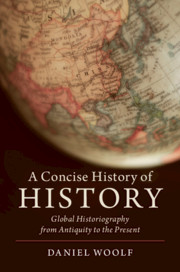
BOOK: Daniel WOOLFE, A Concise History of History. Global Historiography from Antiquity to the Present (Cambridge: CUP, 2020), 358 p.ISBN 9781108444859, 22,99 GBP

(image source: CUP)

Abstract:
This short history of history is an ideal introduction for those studying or teaching the subject as part of courses on the historian's craft, historical theory and method, and historiography. Spanning the earliest known forms of historical writing in the ancient Near East right through to the present and covering developments in Europe, Asia, Africa and the Americas, it also touches on the latest topics and debates in the field, such as 'Big History', 'Deep History' and the impact of the electronic age. It features timelines listing major dynasties or regimes throughout the world alongside historiographical developments; guides to key thinkers and seminal historical works; further reading; a glossary of terms; and sample questions to promote further debate at the end of each chapter. This is a truly global account of the process of progressive intercultural contact that led to the hegemony of Western historiographical methods.
On the author:
Daniel Woolf is Professor of History at Queen's University, Ontario. He is the author of several books, including A Global History of History (Cambridge, 2011), the award-winning The Social Circulation of the Past (2003), Reading History in Early Modern England (Cambridge, 2001), and The Idea of History in Early Stuart England (1991). He is a Fellow of the Royal Historical Society, of the Society of Antiquaries of London, and the Royal Society of Canada.µ

(more information on Cambridge Core)

Friday, 21 February 2020

ARTICLE: Janne NIJMAN, "An Enlarged Sense of Possibility for International Law: Seeking Change by Doing History" (forthcoming in: Ingo VENZKE (ed.), Situating Contingency in International Law)

(image source: KULeuven)

Abstract:
This chapter explores the so-called ‘Turn to History’ in international legal scholarship. Interest in the intellectual history or ‘history of ideas’ of international law has surged around the last turn of the century. Nijman contextualises this development and stages three possible approaches of why and how to study ideas and theories of the past. A central proposition is that the field of ‘History and Theory of international Law’ ultimately aims to establish a dialogue between international legal thought then and now. In this way (and by employment of e.g. the Cambridge School method) a critical distance emerges with respect to our own international legal thinking and its underlying political and moral ideas. The meaning of international law ideas changes through time and use – in the study thereof lies the critical potential and value for our own thinking. As such, ‘doing history’ comes with what Quentin Skinner calls ‘an enlarged sense of possibility’.
The chapter argues for a ‘doing history’ that liberates us from the hegemonic constraints that past thought and beliefs may place on our imagination. It builds on Roberto Mangabiera Unger’s image of ‘frozen politics’ and ‘false necessity’ to argue that change of our institutions is possible. In short, the chapter argues that doing history produces awareness of the contingency of received beliefs, values and institutions, and as such produces a sense of possibility – and arguably – responsibility. It suggests/recognises a capacity to reimagine and act. It is transformative and empowers to establish (institutional) change and get our (global) act together. An empowerment we desperately need. The chapter ends by alluding at the change sought: Unger and Ricoeur are brought together in a brief argument for the reinmagination of just institutions.
Read more on SSRN.
(source: International Law Reporter)

Monday, 29 April 2019

CHAPTER: Ignacio DE LA RASILLA DEL MORAL, "Grotian Revivals in the Theory and History of International Law", in: Randall LESAFFER & Janne NIJMAN (eds.), The Cambridge Companion to Hugo Grotius (Cambridge: CUP, forthcoming)

(image source: Wikimedia Commons)

Abstract:
This chapter examines how the title of founder of the law of nations was bestowed upon Grotius and how the liberal internationalist interpretation of the existence of a Grotian tradition in international law came into being. It also reviews the extent to which both historical constructs have been challenged by new historical research and contemporary re-interpretations of Grotius’ works and figure. The chapter is divided into three parts. The first part accompanies the reception of Grotius by international lawyers from the time of the discovery of his De Jure Praedae in 1864 to the establishment of the Grotius Society in England during the First World War. The second part examines the revivals of Grotius among international lawyers in the aftermaths of both world wars and considers a number of Grotius-related historiographical developments during the Cold War period. The third part examines how, in recent decades, on the one hand Grotius has become more mainstreamed and further institutionalised as a global symbol of international law while on the other hand his reputation has suffered from him being labelled a handmaiden of European colonialism and exploitation. The concluding section reflects on the lasting fame of the ‘miracle of Holland’ among international lawyers and suggests that the history of international law as a research field should now take a break from Hugo Grotius.
Read the fulltext on SSRN.
(source: International Law Reporter)

Friday, 19 April 2019

JOURNAL: Journal of International Economic Law XXII (2019), No. 1 [Debate Section: History of International Economic Law]

(image source: Oxford Journals)

Beyond History and Boundaries: Rethinking the Past in the Present of International Economic Law (Rafael Lima Sakr, SIEL/JIEL/OUP Essay Prize Winner)

Abstract:
History and boundaries are the foundations of international economic law (IEL) as a professional and intellectual field. History is often told to support a wide variety of present projects, norms, and ideas by appealing to the past. Boundary is a technique frequently used to map and defend an exclusive domain for applying the IEL expertise to a broad range of programmes, rules, and theories. This article first describes how history and boundaries interact to produce a ‘traditional’ view of IEL past and present place in the world economy. This interaction structures how lawyers assert the authority and legitimacy of IEL in global economic governance. It then argues that the commitments of the traditional approach to Anglocentrism and Modernism limit lawyers’ ability to understand and solve the present-day issues, since it produces lessons only in support of the dominant programmes, norms, and ideas under contestation. Consequently, it constrains, instead of empowers, lawyers’ imagination. Building on this critique, the article outlines an alternative approach devised to rethink the IEL field and, more importantly, which past or new projects, norms, and theories do or do not count (or should or should not count) as part of it. It concludes with reflections on how we might go about reimagining IEL in response to the contemporary challenges to global economic governance.

The Historical Lens in International Economic Law (Steve Charnovitz)
Abstract:
In recent years, scholars of international law have reemphasized historical research in new writings. The essay by Rafael Lima Sakr takes note of this scholarly trend in international economic law, and offers some cogent thoughts on the benefits and disadvantages that have eventuated from such use of historical material. Because the scholarship of Steve Charnovitz regarding the field of international economic law serves as a focal point in Sakr's essay, this short article provides me an opportunity to respond. This article explains why my scholarship has deployed a historical lens to analyze public policy challenges and to analyze the international institutions that have been established to help governments and private actors address those challenges. In addition, my article expresses my agreement with Sakr that scholars should be careful to avoid an unduly narrow perspective on what history is relevant for any particular project.
More information with Oxford Journals.

(source: ESCLH Blog)

Saturday, 19 May 2018

REMINDER: JHIL Conference February 2019: Politics and the Histories of International Law (MPIL Heidelberg; DEADLINE 31 MAY 2018)


We have the following Call for Papers for a conference on “Politics and the Histories of International Law” by the Max Planck Institute for Comparative Public Law and International Law.

CONFERENCE THEME

L’histoire n’est pas une religion. L’historien n’accepte aucun dogme, ne respecte aucun interdit, ne connaît pas de tabous. Il peut être dérangeant. - LIBERTÉ POUR L’HISTOIRE, 2005

Almost all scholarship on international law and its history has political implications. Some say that international legal scholarship is inevitably ideological in nature and that its findings depend on concealed political preferences. Put differently, legal scholarship could be nothing more than the pseudo-objective defence of ruling ideologies. Most famously, Hans Kelsen had denounced a ‘tendency wide-spread among writers on international law’ to produce ‘political ideology’. Kelsen sought to escape this by writing books of a ‘purely juristic character’ (Principles of International Law, 2nd ed. 1967, ix). In his foreword to the commentary on the UN Charter of 1950, he stressed that ‘separation of law from politics in the presentation of national or international problems is possible’ (The Law of the United Nations, 1950, viii).

Many nowadays doubt that purging international legal scholarship of politics would work. In 2004, Martti Koskenniemi put this as follows: ‘The choice is not between law and politics, but between one politics of law, and another. Everything is at stake, but not for everyone’ (EJIL 16 (2005), 123).
So, which factors ‘politicise’ international legal scholarship? The first factor is that the object under investigation is itself a political matter. International law has throughout its history been political, because its content depends on the political power of the parties negotiating the treaties, and because it transports political values.

Scholars themselves cannot completely avoid being more or less political actors, because their value judgements, which are inescapable, often carry political implications. However, an important difference between doing scholarship and doing politics lies in the authors’ main intention: It is, ideal-typically, not the primary purpose of scholarship to make politics and unbounded evaluation but to generate knowledge − which could then be used politically, by the author herself or by others. Along this line, most scholars of history seek to uncover various aspects of past events and debates and to contextualise them, thereby realising a modicum of objectivity and neutrality. Some consciously try to avoid judgment, while others are more prone to judging deliberately and to employing historical insights in contemporary political debates.

Research on the history of international law is not only inherently political but moreover specifically ‘risk-prone’. Writing on topics such as genocide, state of exception, failed states, humanitarian intervention, asymmetrical war, or cyber-attacks is especially liable to being used and abused by participants in political controversies. In fact, when it comes to writing history, the fight over master narratives is especially fierce, among governments, in different academic camps, and between governments and academics. The notorious example are memory laws which consecrate specific views on atrocities of the past (especially genocidal massacres) and which sometimes additionally criminalise the denial of those atrocities. These attempts to close historical debates by law have been criticised by historians, most famously in the petition ‘Liberté pour l‘histoire’ by French historians reacting against various French memory laws.

To conclude, the interpretations of historical events are almost inescapably political, and potentially have the power to shape international relations: ‘On résiste à l’invasion des armées; on ne résiste pas à l’invasion des idées’ (Victor Hugo, Histoire d’un crime, 1877/2009, 639). It is against this background that the rights and responsibilities of those researching on the history of international law should be seen.

The JHIL invites scholars to engage with the questions of the role of politics and ideology in the historiographies of international law. We welcome propositions for papers which address methodological questions, as well as case studies or historiographical analyses that focus on certain contentious subjects within the field of international law and its history

PRACTICAL MATTERS

  • Date: The conference will last from Friday morning, 15 February to Saturday noon (16 February 2019). It will start with an informal get-together on Thursday evening, 14 February.
  • Venue: Max Planck Institute for Comparative Public Law and Public International Law, Im Neuenheimer Feld 535, D-69120 Heidelberg, Germany.
  • Scholars who would like to present a paper at the conference are invited to submit a title and abstract (250–500 words) to the managing editor of the JHIL (submissions.jhil@mpil.de) before 1 June 2018. Abstracts will be assessed by the editors of the JHIL with involvement of the journal’s Academic Advisory Board. A decision on acceptance of the abstract will be communicated by 1 July 2018.
  • Authors of accepted abstracts will be requested to submit their draft papers by 1 February 2019. The draft will be circulated among participants (authors and admitted engaged listeners).
  • Final versions of the papers will be due by 30 March 2019. Papers will then be submitted to the normal review procedure of the JHIL, online at: editorial manager.com/jhil.
  • See the “Instructions for authors” online at: brill.com/files/brill.nl/specific/ authors_instructions/JHIL.pdf.
  • The Max Planck Institute will cover the costs of the accommodation of accepted paper presenters (up to three nights) and will offer a needs-based subsidy towards travel costs.
  • An additional call for engaged listeners will be issued shortly.
  • For updated technical information on the conference see mpil.de/en/pub/ publications/periodic-publications/jhil.cfm.


For more information, please visit the website of the Max Planck Institute for Comparative Public Law and International Law

(source: ESCLH Blog)