ESIL Interest Group History of International Law

ESIL Interest Group History of International Law

Wednesday, 11 September 2019

CALL FOR PAPERS: “The Hope of Ages is in the Process of Realization” – Establishing a World Court, 1920-1922 (Nijmegen, 11-12 June 2020) (DEADLINE: 15 December 2019)


We learned of a call for papers for a workshop at the University of Nijmegen on the establishment of the Permanent Court of International Justice. Here the call:

We are approaching the centenary of the first ‘World Court’: between 1920 and 1922, experts and diplomats prepared the Statute of the Permanent Court of International Justice (PCIJ), the first ‘World Court’, located in The Hague. Their work drew on the efforts of prior generations of international lawyers and activists, and yet resulted in something new and lasting: a permanent court of potentially general jurisdiction, whose basic structures have remained unchanged for nearly a century. While the PCIJ itself has remained the subject of continuous inquiry, many questions and decisions relating to its establishment have remained understudied. These include:

– The role of key protagonists in the drafting of the PCIJ’s Statute (including, but not limited to, the Advisory Committee of Jurists);
– The role of civil society and of non-European nations in the establishment phase;
– The response of the Dutch government and society to the proposed establishment of a(nother) ‘Hague court’;
– Contemporary views and predictions of the future Court’s role and relevance.

To understand these issues and to close gaps in our understanding of the PCIJ’s ‘establishment phase’, Professors Christian J. Tams (University of Glasgow) and Henri de Waele (Radboud University) will host a two-day workshop in Nijmegen, The Netherlands, on 11-12 June 2020.
As part of this workshop, we invite applications for paper presentations from scholars of international law, history, international relations, and related disciplines.

Interested applicants should submit an abstract of no more than 750 words by 15 December 2019 to the following address: pcijconference@ru.nlPlease include your name, affiliation and email address with the abstract, and indicate succinctly why you feel it offers a novel angle.
The full text of the call is available here.

(source: ESCLH Blog)

Tuesday, 10 September 2019

SYMPOSIUM: The League of Nations and International Law during the Interbellum (Brussels: Royal Flemish Academy of Belgium for the Arts and Sciences/VUB/KUL, 25-26 OCT 2019)

(image source: Wikimedia Commons)

Symposium presentation:
The Committee for Legal History of the Royal Flemish Academy of Belgium of the Arts and Sciences, the Research Group CORE (VUB) and the Research Unit Roman Law and Legal History of the University of Leuven organize a two-day symposium (“Contactforum”) at the Royal Academy on the League of Nations and International Law in the Interbellum on 25 and 26 October 2019. Established researchers from various disciplines (law, history, sociology) will address issues of sovereignty and jus ad bellum, international organisation, colonialism, workers’ rights, minorities, investment law, cultural heritage protection, public opinion and national scholarly traditions through the paradigm of the Versailles Peace Treaties and the nuanced and complex story of the League of Nations, which is often classified as a mere unsuccessful predecessor of the United Nations.

Program:
Friday, 25 October 2019 (Palace of Royal Flemish Academy of Belgium for Science and Arts)
13:00
: Welcome by Prof. dr. Dirk Heirbaut (UGent/Instituut voor Rechtsgeschiedenis; President of the Committee for Legal History)

13:10:  Welcome by Prof. dr. Randall Lesaffer (Tilburg/iHilt – KULeuven/Onderzoekseenheid Romeins Recht en Rechtsgeschiedenis) – Dr. Inge Van Hulle (Tilburg/iHilt) en Prof. dr. Frederik Dhondt (VUB/UAntwerpen)
13:30-14:45: Panel 1- Prof. dr. Giulio Bartolini (Roma Trè), “The League of Nations and Italian International Law scholars”
- Dr. Camilla Boisen (NYU Abu Dhabi) and Chris Allsobrook (Fort Hare University), “'The Development of Segregated Trusteeship in Africa and its Role in Decolonisation”
14:45-15:15: Coffee break
15:15-16:30: Panel 2- Prof. dr. Péter Kovács (ICC), “Historical and Legal Sources: The Protection of Minorities under the Auspices of the League of Nations”
- Dr. Martyn Housden (University Bradford), “Who were the most progressive: statesmen, international staff or nationality leaders? A discussion of the slow emergence of the international law of minority rights after the First World War.
16:30-17:00: Coffee Break
17:00-18:15: Panel 3- Dr. Vincent Genin (KULeuven/FWO), “Belgian Lawyers and the International Labour Organization (1920-1940)”
- Prof. dr. Agatha Verdebout (Université Catholique de Lille), “The Doctrinal Debates on the Concept of ‘War’ in the LN Covenant of the League of Nations and the Evolution of the Law on the Use of Force in the Interbellum”
18:15: Intermediate reflections by Prof. Dr. Frederik Dhondt.
19:30: Conferencedinner at the university foundation
21:00:
 Facultative social activities in the city centre of Brussels


Saturday, 
26 October 2019 (Palace of Royal Flemish Academy of Belgium for Science and Arts)

08:30
 Welcome

08:45-10:00: Panel 4- Dr. Megan Donaldson (Cambridge University), “Diplomacy by other means: international law, international lawyers, and the practice of codification”
- Dr. Sebastian Spitra (Universität Wien) , “The League of Nations and Cultural Heritage”
10:00-10:15: Coffee Break
10:15-12:00: Panel 5- Dr. Rose Parfitt (Kent University), “The Process of International League-al Reproduction”
- Prof. Dr. Morten Rasmussen (University of Kopenhagen) & Dr. Karin Van Leeuwen (Maastricht University), “Promoting the general interest in international law? Joost Adriaan van Hamel and the early years of the League of Nation’s Legal Section (1920-1925)”
- Dr. Klaas Dykmann (University of Roskilde), “Pan Americanism and its Imprint on the League of Nations”
12.00: Final Remarks (Prof. Dr. Randall Lesaffer)
Practical information:
 The congress
The congress takes place at Koninklijke Vlaamse Academie van België voor Wetenschappen en kunsten, Hertogsstraat 1, 1000 Brussel
For more information about the location and how to reach it, click here
The dinner

The Dinner takes place at universitaire stichting, Egmontstraat 11, 1000 Brussel

More information and registration here.


Monday, 9 September 2019

PRE-CONFERENCE MEETING: New Histories of Sovereigns and Sovereignties (Athens: ESIL 2019 Annual conference, 12 SEP 2019)

European Society of International Law

Interest Group on the History of International Law

New Histories of Sovereigns and Sovereignties
ESIL Athens 2019 Meeting


Faculty Club, Academias 48, 10672 Athens

(for directions see: https://esilathens2019.gr/venues/)


08.15-08.30
Welcome and Introduction

8.30-10.30
Panel One: Sovereignty before the Twentieth Century

Greg Ablavsky (Stanford) — ‘Species of Sovereignty: Native American Nationhood, the United States, and International Law, 1783–1795’

Connor McBain (Glasgow) — ‘Parcel of Rogues in a Nation: The Story of the Darien Company and the Forgotten Role of Corporate Sovereignty in Scots Colonisation of the “New World”’

Commentator: Markus Beham (Passau)

————
10.30-11.00 Coffee break

11.00-13.00
Panel Two: Sovereignty in the Twentieth Century

Diane Marie Amann (Georgia) — ‘Intersectional Sovereignties: Dr Aline Chalufour, Woman at Nuremberg — and at Paris, Ottawa, and Dalat’

Tsvetelina van Benthem (Oxford) — ‘Sovereignty, Sanctions and Functionalism’

Commentator: Jan Lemnitzer (University of Southern Denmark)

13.00-13.30
Future IG events


Friday, 6 September 2019

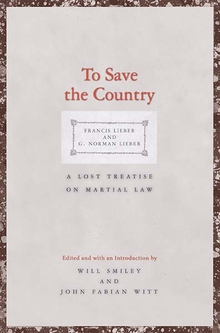
BOOK: Will SMILEY and John Fabian WITT, eds., To Save the Country : A Lost Treatise on Martial Law (New Haven: Yale University Press, 2019). ISBN 9780300222548, $55.00


Yale University Press has published a recently rediscovered book by Abraham Lincoln’s law of war expert Francis Lieber.

ABOUT THE BOOK

A Civil War-era treatise addressing the power of governments in moments of emergency

The last work of Abraham Lincoln’s law of war expert Francis Lieber was long considered lost—until Will Smiley and John Fabian Witt discovered it in the National Archives. Lieber’s manuscript on emergency powers and martial law addresses important contemporary debates in law and political philosophy and stands as a significant historical discovery.

As a key legal advisor to the Lincoln White House, Columbia College professor Francis Lieber was one of the architects and defenders of Lincoln’s most famous uses of emergency powers during the Civil War. Lieber’s work laid the foundation for rules now accepted worldwide. In the years after the war, Lieber and his son turned their attention to the question of emergency powers. The Liebers’ treatise addresses a vital question, as prominent since 9/11 as it was in Lieber’s lifetime: how much power should the government have in a crisis? The Liebers present a theory that aims to preserve legal restraint, while giving the executive necessary freedom of action.

Smiley and Witt have written a lucid introduction that explains how this manuscript is a key discovery in two ways: both as a historical document and as an important contribution to the current debate over emergency powers in constitutional democracies.

ABOUT THE EDITORS

Francis Lieber (1798–1872) was professor at Columbia College who advised Abraham Lincoln on the law of war. G. Norman Lieber (1837–1923), Francis’s son, taught law at West Point. Will Smiley is an assistant professor of humanities at the University of New Hampshire. John Fabian Witt is the Allen H. Duffy Class of 1960 Professor of Law at Yale Law School and the Head of Yale’s Davenport College.

More info here 
(source: ESCLH Blog)

Thursday, 5 September 2019

CONFERENCE: A Century of Internationalisms – The Promise and Legacies of the League of Nations (Lisbon, 18-20 September 2019)


(Source: IHC)

The Universidade Nova de Lisboa is organizing a conference on the League of Nations later this month. The provision programme can be found here

This international conference aims to contribute to renew the interest and improve the knowledge of the League of Nations (LoN) and its impact in this last century marked by strong waves of internationalism and globalization, but also of crisis and nationalist reactions.

A multilateral institution such as the LoN is the ideal object for a truly global and connected history that goes beyond national historiographical traditions. That is what we intend to do with this conference, through presentations on these themes by 65 speakers affiliated with 60 institutions from 18 different countries.

The death toll of millions in World War I (1914-1918) led to an effort at the 1919 Paris peace conference to design a new international order with new norms and institutions. The creation in 1920 of the first permanent multilateral organization in the form of the League of Nations, the direct predecessor of the UN, was the most ambitious and controversial result of this effort. Although the LoN eventually failed to achieve its main goal of preventing a World War II, it did imprint, and does help to better understand the multiple dimensions of global life in the two decades of its existence. Many of these issues, which will be dealt with in the different panels of this conference, continued to be of great relevance up to today: from refugees to gender issues, from empires to their complex legacies, from territorial conflicts to terrorism, from workers’ rights to global financial system.

All info on the conference can be found here

(See call earlier on this blog)

(source: ESCLH Blog)

Tuesday, 3 September 2019

BOOK: Stephen ALLEN, Daniel COSTELLOE, Malgosia FITZMAURICE, Paul GRAGL & Edward GUTRIP (eds.), The Oxford Handbook of Jurisdiction in International Law [Oxford Handbooks] (Oxford, OUP, 2019), 624p. ISBN 9780198786146, 125 GBP


Table of contents:

  • Stephen Allen, Daniel Costelloe, Malgosia Fitzmaurice, Paul Gragl, & Edward Guntrip, Introduction: Defining State Jurisdiction and Jurisdiction in International Law
  • Kaius Tuori, The Beginnings of State Jurisdiction in International Law until 1648
  • Stephane Beaulac, The Lotus Case in Context - Sovereignty, Westphalia, Vattel, Positivism
  • Nurfadzilah Yahaya, The European Concept of Legal Jurisdiction in the Colonies
  • Stephan Wittich, Immanuel Kant and Jurisdiction in International Law
  • Helen Quane, Navigating Diffuse Jurisdictions: An Intra-State Perspective
  • Paul Schiff Berman, Jurisdictional Pluralism
  • Mariana Valverde, Deepening the Conversation Between Sociolegal Theory and Legal Scholarship About Jurisdiction
  • Shaun McVeigh, Critical Approaches to Jurisdiction and International Law
  • Cedric Ryngaert, Cosmopolitan Jurisdiction and the National Interest
  • Paul Gragl, Jurisdictional Immunities of the State in International Law
  • Dino Kritsiotis, The Establishment, Change, and Expansion of Jurisdiction through Treaties
  • Uta Kohl, Territoriality and Globalization
  • Alex Mills, Private law Regulation and Private Interests in Public International Law Jurisdiction
  • Kimberly Trapp, Jurisdiction and State Responsibility
  • Stephen Allen, Enforcing Criminal Jurisdiction in the Clouds and International Law's Enduring Commitment to Territoriality
  • Wouter Vandehole, The 'J' word: Driver or Spoiler of Change in Human Rights Law?
  • Edward Guntrip, International Investment Law, Hybrid Authority and Jurisdiction Daniel Costelloe, Concepts of State Jurisdiction in the Contentious and Advisory Jurisprudence of the International Court of Justice and the Permanent Court of International Justice
  • Georg Kerschischnig & Blanca Montejo The Evolving Nature of the Jurisdiction of the Security Council - a Look at Twenty-First Century Practice
  • Kirsten Schmalenbach, International Criminal Jurisdiction Revisited
  • James Summers, Jurisdiction and International Territorial Administration
Book abstract:
The Oxford Handbook of Jurisdiction in International Law provides an authoritative and comprehensive analysis of the concept of jurisdiction in international law. Jurisdiction plays a fundamental role in international law, limiting the exercise of legal authority over international legal subjects. But despite its importance, the concept has remained, until now, underdeveloped. Discussions of jurisdiction in international law regularly refer to classic heads of jurisdiction based on territoriality or nationality, or use the SS Lotus decision of the Permanent Court of International Justice as a starting point. However, traditional understandings of jurisdiction are facing new challenges. Globalization has increased the need for jurisdiction to be applied extraterritorially, non-State forms of law provide new theoretical challenges and intersections between different forms of jurisdiction have become more intricate. This Handbook provides a necessary re-examination of the concept of jurisdiction in international law through a thematic analysis of its history, its contemporary application, and how it needs to adapt to encompass future developments in international law. It examines some of the most contentious elements of jurisdiction by considering how the concept is being applied in specific substantive and institutional settings.
More information with OUP.

(source: International Law Reporter)

Monday, 2 September 2019

BOOK: Alexandra HARMON, Reclaiming the Reservation: Histories of Indian Sovereignty Suppressed and Renewed [Emil and Kathleen Sick Book Series in Western History and Biography] (Washington: University of Washington Press, 2019), 424 p. ISBN 9780295745855, 35 USD


Book description:
In the 1970s the Quinault and Suquamish, like dozens of Indigenous nations across the United States, asserted their sovereignty by applying their laws to everyone on their reservations. This included arresting non-Indians for minor offenses, and two of those arrests triggered federal litigation that had big implications for Indian tribes’ place in the American political system. Tribal governments had long sought to manage affairs in their territories, and their bid for all-inclusive reservation jurisdiction was an important, bold move, driven by deeply rooted local histories as well as pan-Indian activism. They believed federal law supported their case. In a 1978 decision that reverberated across Indian country and beyond, the Supreme Court struck a blow to their efforts by ruling in Oliphant v. Suquamish Indian Tribe that non-Indians were not subject to tribal prosecution for criminal offenses. The court cited two centuries of US legal history to justify their decision but relied solely on the interpretations of non-Indians. In Reclaiming the Reservation, Alexandra Harmon delves into Quinault, Suquamish, and pan-tribal histories to illuminate the roots of Indians’ claim of regulatory power in their reserved homelands. She considers the promises and perils of relying on the US legal system to address the damage caused by colonial dispossession. She also shows how tribes have responded since 1978, seeking and often finding new ways to protect their interests and assert their sovereignty.
On the author:
Alexandra Harmon is professor of American Indian studies at the University of Washington. She is the author of Rich Indians: Native People and the Problem of Wealth in American History and editor of The Power of Promises: Perspectives on Pacific Northwest Indian Treaties.
(source: International Law Reporter)