ESIL Interest Group History of International Law

ESIL Interest Group History of International Law

Sunday, 25 February 2018

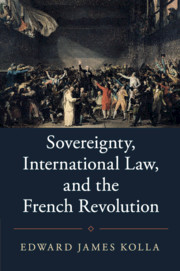
BOOK REVIEW: Joshua MEEKS reviews Edward James KOLLA, Sovereignty, International Law, and the French Revolution [Studies in Legal History Series] (Cambridge: Cambridge University Press, 2017) [H-Diplo]

(image source: CUP)
 
Joshua Meeks (Northwest University) reviewed Edward James Kolla's recent book on the French Revolution, Sovereignty and International Law (CUP 2017, see announcement on the ESCLH blog).

First paragraph:


One of the more common conceptions of diplomacy during the French Revolution is that the revolutionaries attacked tradition in the name of liberty and disregarded international law and conventions as they attempted to export radical revolution throughout Europe. In Sovereignty, International Law, and the French Revolution, Edward James Kolla pushes back against this idea, arguing that though the revolutionaries were willing to adapt and in some cases ignore established legal traditions, they did so not in a conscious attempt to replace international law with a revolutionary variant. Instead, he explains in both breadth and detail how the principles of popular sovereignty espoused by the revolutionaries shaped the principle of self-determination in international law through a contingent, contradictory, and often haphazard process. Through case studies ranging from Corsica to the Netherlands, Kolla elucidates a thoughtful argument that combines a rigorous approach to international law with a well-crafted historical narrative.
Read the full review here.
(source: H-Diplo mailing)

Friday, 23 February 2018

SYMPOSIUM: The Parisian peace treaties (1919-1920) and the emergence of modern international law (JHIL/Tilburg University, 17 May 2018)


The Parisian peace treaties (1919-1920)
and the emergence of modern international law
The Journal of the History of International Law –
Tilburg University – 17 May 2018
Conveners: Jan Lemnitzer and Randall Lesaffer

The conference is organised under the auspices of The Journal of the History ofInternational Law by i-Hilt (Institute for the History of International Law@Tilburg) and the Department of Roman Law and Legal History of the University of Leuven.

Venue: Ruth First auditorium (C 186), Cobbenhagen Building,
Tilburg University, The Netherlands
Costs: € 50,00

Registration for the symposium until 10 May
 

Programme of the Parisian Peace Treaties, 17 May 2018
9.30                       Reception with coffee and tea
9.50                       Welcome by Randall Lesaffer
10.00-12.00        Session I: Versailles as a revolution in international law
 - Jan Lemnitzer (University of Southern Denmark): Woodrow Wilson, Versailles and the freedom of the seas
- Kirsten Sellars (Chinese University of Hong Kong): World War I,  Wilhelm II, Article 227 and the crime of aggression
- Leonard Smith (Oberlin College and Conservatory): Sovereignty under the League of Nations mandate
                         
12.00-13.30        Lunch

13.30-15.00        Session II: Was Versailles a harsh peace treaty?
- Markus Payk (Humboldt University): ‘The absence of honeyed and generous phrases’: a survey of the preambles and other declarative phrases in the Paris peace treaties of 1919-1920
- Nicholas Mulder (Columbia University), Expropriation and economic warfare in the Versailles treaty
- Laura Rathmanner (Vienna University): Responsibility and reparations in the peace treaty of Saint-Germain-en-Laye
- Vincent Genin (University of Liège): Belgium’s delegation at the Parisian peace conference. Between international law and national aims               
15.30-16.00       Coffee break, refreshments

16.00-17.30        Session III: Versailles and the politics of international law
- Duncan Kelly (Cambridge University): International law as politics at Versailles
- Frederik Dhondt (Free University Brussels/Antwerp University): Permanent is not eternal! The hibernation of Belgian neutrality between conceptual change and practical continuity
- Tony Carty (Tsinghua University): China in the Versailles peace treaty                                                      

Tuesday, 20 February 2018

CALL FOR PAPERS: War as a driving force of History. 19th and 20th centuries (Alicante: Asociación de Historia Contemporána, 20-22 Sep 2018) DEADLINE 1 MAR 2018

War as a driving force of History. 19th and 20th centuries
(image  source: Wikimedia Commons)
Panel within the 14th Conference of the Spanish Association of Contemporary History (Alicante, Spain, 20-22 September 2018; 
Miguel Alonso Ibarra (Universitat Autònoma de Barcelona)
Daniel Aquillué (Universidad de Zaragoza)
Historically, war has played an essential role in the various political, social and cultural transformations occurred in the world. The different revolutions and the conflicts resulting from them; colonial wars waged by European powers in Africa, America and Asia; the two world wars; the multiple European civil wars (Russia, Finland, Ireland, Spain, Italy, Greece, Yugoslavia); military interventions in the frame of international mandates (Yugoslavia, Iraq); and other conflicts between non-state actors (paramilitary violence in low-intensity wars), form a bloody range of episodes which have shaped in a very significant way the historical evolution of the European continent and other geographical contexts. They have generated processes whose echoes are still heard nowadays: populations’ displacements, social and political violence, state repression, genocides, ethnic reconfigurations, emergence of new national realities, nationalism, social transformations due to military mobilisation, or new social and political identities, among many others. An aspect emerging always present in History but that reaches its peak during the 19th and 20th centuries (total war), when the huge dimensions of armed conflicts spurred many processes of political, social and ideological transformation.
Within this frame, our aim is to analyse war as a key historical driving force of the contemporary era. We seek to offer a debate environment for researchers and scholars working not only on armed conflicts, but also about processes of violence, of social change or of national development emerged in the contexts of, as precedent or as a product of wars. The limits of armed conflicts; the category/concept of civil war and its various uses; the specificity of certain types of war –total war, fascist war–; the transformations of territory and state structures generated by armed conflicts; the evolution of war as the driving force of social progression or regression during the 19th and 20th centuries; social, political and cultural identities exported from war and their influence on individuals and societies; revolutions, paying special attention to the war-linked consequences they had; nineteenth-century guerrilla and its relationship with twentieth-century terrorism; nineteenth-century paramilitary forces (like Spanish Somatén) and their connection with fascist paramilitarism; postwars as a moment of historical impasse in which there is a reactive violence against the defeated; peace as a concept which changed throughout two centuries; or the role of memory in these traumatic warlike pasts, would be questions and topics that will have a place within this panel, albeit not the only ones. Finally, we also seek to boost transnational and comparative approaches through the participation of researchers and scholars coming from other latitudes, in order to conform a debating group as rich and heterogeneous as possible. Thereby, rather than the traditional exposition of papers, we aim to develop a debate focused on concepts and categories of analysis, essential tools in our job as historians.
Individual submissions should include a title, an abstract of no more than 100 words, and a brief biography including your name, institutional affiliation (if applicable), and e-mail contact. Languages accepted are English and Spanish (as well as the languages than can be used in the panel's debate) Please submit your proposal/abstract to miguel.alonso.ibarra@gmail.com or danielaquillue@gmail.com by March 1st, 2018. Notice of acceptance will be sent within ten days from the deadline.

CONFERENCE: „Brüchiger Frieden? 100 Jahre Friedensvertrag von Brest-Litowsk" (Berlin: Deutsche Gesellschaft e.V., 12 Apr 2018), DEADLINE 6 APR 2018

„Brüchiger Frieden? 100 Jahre Friedensvertrag von Brest-Litowsk"
(image source: Wikimedia Commons)
Die Tagung findet am Donnerstag, den 12. April 2018, in den Räumlichkeiten der Deutschen Gesellschaft e. V. in Berlin statt. Die wissenschaftliche Konferenz wird durch die Beauftragte der Bundesregierung für Kultur und Medien gefördert.
Anlässlich des 100. Jahrestages der Vertragsunterzeichnung widmet sich die Tagung den Auswirkungen des Vertrages von Brest-Litowsk auf die Zwischenkriegszeit. Dieser Vertrag brachte Polen, den baltischen Staaten und kurzzeitig auch der Ukraine ihre Unabhängigkeit und eine Phase nationaler und kultureller Blüte. Doch die Friedensverträge von Brest-Litowsk aus dem März 1918 und der Vertrag von Versailles von 1919 waren eine hohe Belastung für die junge Demokratie der Weimarer Republik und der Mittelmächte. Aus ihrem Geist nährten sich Revanchismusabsichten, Nationalsozialismus und die Vernichtungsideologie des „Lebensraums im Osten“.
Die Konferenz möchte diese fatalen deutschen Entwicklungen und insbesondere ihre Auswirkungen auf die Staaten Ostmitteleuropas und des östlichen Europas aufzeigen. Das Jubiläum bietet Anlass, die Jahre 1918/1919 und die Folgen für die Zwischenkriegszeit in den europäischen Kontext zu stellen und die Zusammenhänge nationalstaatlicher Entwicklungen aufzuzeigen. Dabei sollen unterschiedliche Perspektiven europäischer Wissenschaftlerinnen und Wissenschaftler einfließen.

Programm

09:00 Uhr Anmeldung und Registrierung
10:00 Uhr Begrüßung Dr. Andreas H. Apelt, Deutsche Gesellschaft e. V.
Themenblock I: Folgen des Vertrages von Brest-Litowsk für das Europa der Zwischenkriegszeit
10:15 Uhr Impulsvortrag Prof. Dr. Frank Grüner, Universität Bielefeld
11:00 Uhr Podiumsdiskussion
- Prof. Dr. Frank Grüner
- Dr. Markus Pöhlmann, Universität Potsdam
- Dr. Peter März, Bayerisches Staatsministerium für Bildung
- und Kultus, Wissenschaft und Kunst
- Moderation: Tamina Kutscher, Chefredakteurin bei „dekoder“
12:30 Uhr Mittagspause
Themenblock II: Brest-Litowsk in den nationalen Erinnerungskulturen bis zur Gegenwart
14:00 Uhr Impulsvortrag Vougar Aslanov, Schriftsteller
14:45 Uhr Podiumsdiskussion
- Vougar Aslanov
- Juri Durkot, Journalist und Publizist
- Dr. Leonid Klimov, Wissenschaftsredakteur bei „dekoder“
- PD Dr. Peter Oliver Loew, Deutsches Polen-Institut
- Moderation: Tamina Kutscher
16:15 Uhr Kaffeepause
Themenblock III: Der Vertrag von Brest-Litowsk und das heutige Verhältnis zwischen Deutschland und Russland
16:30 Uhr Schlussbemerkung Dr. Jörg Morré, Deutsch-Russisches Museum Berlin-Karlshorst
17:00 Uhr Ende der Veranstaltung
(source: HSozKult)
(more information here)

CONFERENCE VIDEOS: “Peace Through Law: The Versailles Peace Treaty and dispute settlement after WWI” (Luxemburg, 6-8 Dec 2017)

(image source: Wikipedia)

The MPI for International, European and Regulatory Procedural Law (Luxemburg) has posted the videos of its conference on World War I on its YouTube Channel, e.g. opening address below:


The full conference program can be found here.

(source: International Law Observer)

BOOK: Jennifer PITTS, Boundaries of the International: Law and Empire (Cambridge (Mass.): Harvard UP, 2018), 304 p. ISBN 9780674980815, € 40,5

(image source: Harvard UP)

Book abstract:
It is commonly believed that international law originated in relations among European states that respected one another as free and equal. In fact, as Jennifer Pitts shows, international law was forged at least as much through Europeans’ domineering relations with non-European states and empires, leaving a legacy still visible in the unequal structures of today’s international order.
Pitts focuses on the eighteenth and nineteenth centuries, the great age of imperial expansion, as European intellectuals and administrators worked to establish and justify laws to govern emerging relationships with non-Europeans. Relying on military and commercial dominance, European powers dictated their own terms on the basis of their own norms and interests. Despite claims that the law of nations was a universal system rooted in the values of equality and reciprocity, the laws that came to govern the world were parochial and deeply entangled in imperialism. Legal authorities, including Emer de Vattel, John Westlake, and Henry Wheaton, were key figures in these developments. But ordinary diplomats, colonial administrators, and journalists played their part too, as did some of the greatest political thinkers of the time, among them Montesquieu and John Stuart Mill.
Against this growing consensus, however, dissident voices as prominent as Edmund Burke insisted that European states had extensive legal obligations abroad that ought not to be ignored. These critics, Pitts shows, provide valuable resources for scrutiny of the political, economic, and legal inequalities that continue to afflict global affairs.
Table of contents:
  • 1. Introduction: Empire and International Law
  • 2. Oriental Despotism and the Ottoman Empire
  • 3. Nations and Empires in Vattel’s World
  • 4. Critical Legal Universalism in the Eighteenth Century
  • 5. The Rise of Positivism?
  • 6. Historicism in Victorian International Law
  • Epilogue
  • Notes
  • Acknowledgments
  • Index

About the author:
Jennifer Pitts is Associate Professor in the Department of Political Science at the University of Chicago. 

Sunday, 18 February 2018

BOOK: Anthony CARTY & Janne NIJMAN (eds.), Morality and Responsibility of Rulers: European and Chinese Origins of a Rule of Law as Justice for World Order (Oxford: OUP, 2018), 496 p. ISBN 9780199670055, £80

(image source: OUP)

Book abstract:
The history of ideas on rule of law for world order is a fascinating one, as revealed in this comparative study of both Eastern and Western traditions. This book discerns 'rule of law as justice' conceptions alternative to the positivist conceptions of the liberal internationalist rule of law today. The volume begins by revisiting early-modern European roots of rule of law for world order thinking. In doing so it looks to Northern Humanism and to natural law, in the sense of justice as morally and reasonably ordered self-discipline. Such a standard is not an instrument of external monitoring but of self-reflection and self-cultivation. It then considers whether comparable concepts exist in Chinese thought. Inspired by Confucius and even Laozi, the Chinese official and intellectual elite readily imagined that international law was governed by moral principles similar to their own. A series of case studies then reveals the dramatic change after the East-West encounters from the 1860s until after 1901, as Chinese disillusionment with the Hobbesian positivism of Western international law becomes ever more apparent. What, therefore, are the possibilities of traditional Chinese and European ethical thinking in the context of current world affairs? Considering the obstacles which stand in the way of this, both East and West, this book reaches the conclusion that everything is possible even in a world dominated by state bureaucracies and late capitalist postmodernism. The rational, ethical spirit is universal.
 Table of contents:
Introduction: The Moral Responsibility of Rulers: Going Back Beyond the Liberal 'Rule of Law' for World Order, Anthony Carty and Janne Nijman Part I: Law and Justice in Early Modern European Thought on World Order 1: The Universal Rule of Law in the Thought of the Late Medieval Jurists of Roman and Canon Law, Joseph Canning 2: 'The Law of Nations is Common to all Mankind': Jus gentium in Humanist Jurisprudence, Susan Longfield Karr 3: 'Cleare as is the Summers Sunne'? Scottish Perspectives on Legal Learning, Parliamentary Power and the English Royal Succession, Andrew RC Simpson 4: Humanism, the Bible, and Erasmus' Moral World Order, Xavier Tubau 5: Legislating for the 'Whole World that is, in a Sense, a Commonwealth': Conquest, Occupation, and the Obligation to 'Defend the Innocent', Anthony Pagden 6: Cardinal Richelieu between Vattel and Machiavelli, Anthony Carty 7: The Universal Rule of Natural Law and Written Constitutions in the Thought of Johannes Althusius, John Witte Jr. 8: Hugo Grotius and the Universal Rule of Law, Christoph Stumpf 9: Aquatopia: Lines of Amity and Laws of the Sea, Peter Goodrich 10: A Universal Rule of Law for a Pluralist World Order: Leibniz's Universal Jurisprudence and his Praise of the Chinese Ruler, Janne Nijman Part II: Law and Justice in Chinese Thought on World Order 11: Moral Rulership and World Order in Ancient Chinese Cosmology, Aihe Wang 12: 'Humane Governance' as the Moral Responsibility of Rulers in East Asian Confucian Political Philosophy, Chun-chieh Huang 13: Bridging the Western and Eastern Traditions: A Comparative Study of the Legal Thoughts of Hugo Grotius and Lao Zi, Hu Henan 14: The Hazards of Translating Wheaton's 'Elements of International Law' into Chinese: Cultures of World Order Lost in Translation, Emily Cheung and Maranatha Fung 15: Chinese Intellectuals' Discourse of International Law in the Late 19th Century and Early 20th Century, Tian Tao 16: The Crisis of the Ryukyus 1877-1882: Confucian World Order Challenged and Defeated by Western/Japanese Imperial International Law, Patrick Sze-lok Leung and Anthony Carty 17: Lost in Translation in the Sino-French War in Vietnam: From Western International Law to Confucian Legal Semantics: A Comparative-Critical Analysis of Chinese, French, and American Archives, Anna Baka and Lucy QI 18: The Sino-Japanese War and the Collapse of the Qing and Confucian World Order in the Face of Japanese Imperialism and European Acquiescence, Patrick Sze-Lok Keung and Bijun Xu 19: Confucianism and Western International Law in 1900: Li Hongzhang and Sir Ernest Satow Compared: The Case Study of the Crisis of Russia in Manchuria 1900-1, Jing Tan and Anthony Carty
More information with OUP.