ESIL Interest Group History of International Law

ESIL Interest Group History of International Law
Showing posts with label international investment. Show all posts

Tuesday, 31 August 2021

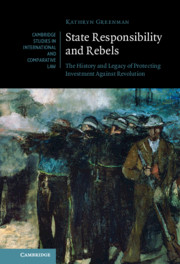
BOOK: Kathryn GREENMAN, State Responsibility and Rebels. The History and Legacy of Protecting Investment Against Revolution [Cambridge Studies in International and Comparative Law; 161] (Cambridge: Cambridge University Press, 2021), ISBN 9781009043779, 85 GBP


(image source: CUP)

Book abstract:
This book traces the emergence and contestation of State responsibility for rebels during the nineteenth and early-twentieth centuries. In the context of decolonisation and capitalist expansion in Latin America, it argues that the mixed claims commissions-and the practices of intervention associated with them-served to insulate economic order against revolution, by taking the question of who assumed the risk of harm by rebels out of the scope of national authority. The jurisprudence of the commissions was contradictory and ambiguous. It took a lot of interpretive work by later scholars and codifiers to rationalise rules of responsibility out of these shaky foundations, as they battled for the meaning and authority of the arbitral practice. The legal debates were structured around whether the standard of protection against rebels owed to aliens was nationally or internationally determined and whether it was domestic or international authority that adjudicated such standard-a struggle over the internationalisation of protection against rebels.
On the author:
Kathryn Greenman is Lecturer in Law at the University of Technology Sydney. She is a co-editor of Revolutions in International Law: The Legacies of 1917 (Cambridge University Press, 2021) with Anne Orford, Ntina Tzouvala and Anna Saunders.

(source: CUP) 


Monday, 17 June 2019

BOOK: Prabhash RANJAN, India and Bilateral Investment Treaties: Refusal, Acceptance, Backlash. (Oxford: Oxford University Press, 2019). ISBN 9780199493746, $65.00


(Source: OUP)

Oxford University Press is publishing a book dealing with the history of bilateral investment treaties (BITs) in India.

ABOUT THE BOOK

Many countries have started contesting international investment treaties that allow foreign corporations to sue sovereign States for alleged treaty breaches at international arbitration fora. This contestation has taken the form of either countries terminating their investment treaties or walking out of the investor-State dispute settlement (ISDS) system. India has also jumped on the contestation bandwagon. As a consequence of being sued by more than 20 foreign investors, India terminated close to 60 investment treaties and adopted a new model bilateral investment treaty (BIT) purportedly to balance investment protection with the host State's right to regulate. This book studies critically India's approach towards BITs by tracing its origin, evolution, and the current state of play. The book does so by locating it in India's economic policy in general and policy towards foreign investment in particular. India's approach towards BITs and its policy towards foreign investment were consistent with each other in the periods of economic nationalism (1947-1990) and economic liberalism (1991-2010). However, post 2010, India's approach to BITs has become protectionist while India's foreign investment policy continues to be liberal. In order to balance investment protection with the State's right to regulate, India needs to evolve its BIT practice based on the twin framework of international rule of law and embedded liberalism.

ABOUT THE AUTHOR

Prabhash Ranjan, Assistant Professor, Faculty of Law, South Asian University

Prabhash Ranjan teaches at the Faculty of Law, South Asian University, New Delhi.

TABLE OF CONTENTS

Foreword 
Acknowledgements 
1. Introduction
Phase I: Refusal 
2. Economic Nationalism: Refusal to Bilateral Investment Treaties
Phase II: Acceptance 
3. Economic Liberalism: Embracing Bilateral Investment Treaties
4. India's BITs: Mapping the Acceptance I
5. Mapping the Acceptance II
Phase III: Backlash 
6. BITs Come Home to Roost but No Philip Morris Moment Yet!
7. Mapping the Backlash: Once Bitten Many Times Shy!
8. The 2016 Indian Model BIT: Making the BIT Unworkable for Investors
9. Conclusion
Annexure 
Index 
About the Author

More information here
(source: ESCLH Blog)

Wednesday, 6 March 2019

ADVANCE ARTICLE: Jason YACKEE, "Investor-State Dispute Settlement at the Dawn of International Investment Law: France, Mauritania, and the Nationalization of the MIFERMA Iron Ore Operations" (American Journal of Legal History 2019)

(image source: OUP)

Abstract:
The case for the desirability of the modern system of investment treaty arbitration rests on certain stylized historical claims. Those claims serve to demonstrate that the pre-modern system of dealing with investor – state disputes was inferior compared to current arrangements, which allow foreign investors to initiate highly legalized (or “depoliticized”) arbitration against host state governments for alleged violations of investment treaties. The implication of the historical comparison is that we should accept, and perhaps even expand, investment treaty arbitration to avoid a return to a more dangerous practice. This article challenges the historicity of this standard story through an in-depth examination of an important but understudied episode of expropriation from the 1970s, Mauritania’s seizure of the MIFERMA iron ore operations. As I show below, politicized dispute settlement need not entail, nor even risk, resort to force. It can even be successful, especially where home and host state governments and the investor perceive mutual gains from continued cooperation. More generally, the article suggests the utility of micro-historical analysis of investor – state disputes as a methodology for gaining a more realistic understanding of how legal and diplomatic dispute settlement methods can interact to support negotiated outcomes.
Read more here.

Saturday, 6 December 2014

WORKSHOP: International Investment Law and History (Frankfurt, 13-14 March 2015)


The MPI for Comparative Public Law and International Law, the Johann-Wolfgang Goethe-University Frankfurt and the University of Glasgow's School of Law co-organize a workshop on International Investment Law and History on 13 and 14 March 2015.

As in previous years, the workshop will bring together academics and practitioners and provide them with a forum for open and frank exchanges. If you are interested in participating, please contact Sabine Schimpf, Merton Centre for European Integration and International Economic Order, University of Frankfurt, RuW, Grüneburgplatz 1, 60323 Frankfurt am Main, Germany.

The program can be found here. Speakers include Stephan Schill, Jochen von Bernstorff, our members Christian Tams, Jörg Kammerhofer, and others. Two panels address historical cases of investment law, going back to the 19th century.