ESIL Interest Group History of International Law

ESIL Interest Group History of International Law

Wednesday, 22 November 2023

CALL FOR PAPERS: Historical Networks Research Conference, "Visualization" (University of Lausanne, 8-10 July 2024, DEADLINE: 31 January 2024)

Description:

The Historical Network Research community is very pleased to announce the call for papers for the Historical Networks Research conference 2024 which will take place at the University of Lausanne (Switzerland), from Monday 8 July until Wednesday 10 July, 2024.

Historical networks

The phenomena studied by the historical sciences are, by their very nature, complex situations: they involve, for example, interwoven personal relationships, collective dynamics that structure social and cultural space, or political and economic systems that operate at local and global levels. The network metaphor is frequently used to describe this entanglement. In recent decades, however, historians have begun to think about ways of formalizing this approach, appropriating the concepts and tools of graph theory to provide a new perspective on archives. The application of formal network analysis to history is now a highly fertile field of experimentation and research. It can be used to analyze the geographical logics of major circulation networks, to highlight brokers in affiliation networks, to compile family trees to reveal their points of contact, to study the occurrences and co-occurrences of concepts in serial texts, to show the evolution of personal social networks, etc. And through a great deal of empirical work, the specific features that historical disciplines bring to network science become apparent: particular attention to the modeling of data that is often incomplete and uncertain, the need to take account of temporality in all its finesse, the necessity to find a language that allows mathematical results to be interpreted in a qualitative narrative.

In 2009, following a workshop dedicated to the application of social network analysis to history, a small community of practice, the Historical Network Research community, was created. It evolved into a series of workshops and then an international conference, of which the present edition is the 9th to date, after conferences in Hamburg, Ghent, Lisbon, Turku, Brno, Luxembourg and Mainz. 2013 saw the creation of the HNR Collective Bibliography, a central tool for sharing the community’s scientific output. In 2017, the first issue of JHNR, the Journal of Historical Network Research, was published, allowing everyone to share their research in Open Access. Other resources include a YouTube channel with recorded lectures and a newsletter.

Conference focus: Visualization

Network visualization is often the first thing to be seen, whether it’s an illegible but colorful node-link diagram, an elaborate sociogram, an austere matrix or a fancy flow map. Because of our discomfort with basing our interpretation on an object apparently built on somewhat subjective foundations, because they are very likely to be influenced by a graphic bias, we often relegate visualizations to a minor role in our exploratory approaches, preferring the cold (apparent) scientificity of graph metrics. But just because we see naive uses of network visualization doesn’t mean it can’t be a highly effective tool for understanding, exploring and communicating our research data. One of the ambitions of the conference is therefore to question our use of network visualization in history, a concern that will be reflected in particular in the workshops and keynotes.

Note that the HNR conference is open to all subjects involving network analysis in historical disciplines, so the thematic emphasis of this 2024 edition has no impact on the selection of contributions. The only effect will be that an image will be requested for each paper (after the review phase, if not included in the submitted abstract) to create a gallery that will be displayed during the conference to spark discussion about our network visualization practices.

Topics

For our 2024 conference, we welcome contributions discussing any historical period and geographical area. Authors may be historians, linguists, librarians, archaeologists, art historians, computer scientists, social scientists as well as scholars from other disciplines working with historical data. Topics may include, but are not limited to:Applications of network analysis to history, art history, ancient history, intellectual history, economic history, social history, media history, political history, history of religions, biography, public history, micro-history, postcolonial history, global history, archaeology, literary history, cultural history, etc.
Analysis of specific network types, such as geospatial networks, temporal and dynamic networks, bipartite networks, multi-layer networks, multiplex networks, etc.
Methodological contributions concerning the applicability of network analysis to history, including, for example, modeling, ontologies, linked data, the use of graph metrics, visual network analysis, etc.
Pedagogical contributions, presenting teaching scenarios, literacy questions, software or feature presentations, interfaces, etc.

Formats

Long papers

Long papers consist of a 20-minute presentation followed by 10 minutes of discussion, and are intended to present comprehensive research. An abstract of 500-1000 words is required, including at least 3 citations. It should contain a description of the paper’s subject and research questions, an overview of the data used and methods employed, a discussion of the research results and possibly the wider implication for network analysis in history.

Short papers

Short papers consist of a 10-minute presentation followed by 5 minutes of discussion, and are intended to present research in progress. An abstract of 300-500 words is required, including at least 3 citations. It should contain a brief description of the subject and the research questions, an overview of the data used and the methods employed, a discussion of any results or questions still open at this stage.

Submission guidelines

Abstracts must be submitted via the conference management platform (https://hnr2024.sciencesconf.org/) by January 31, 2024.

The author (or corresponding author in the case of multi-authored papers) must create an account on the platform and then fill in the form, copying the abstract in full text (no PDF or other attachments).

Abstracts can be written in English or French.

Citations should use the Chicago Manual of Style 17th Edition Author Date style (author-date in the text, then full reference at the end).

Including an image in the abstract is encouraged to allow a general discussion of our network visualization practices. If, for any reason, the submitted version does not contain any, authors of accepted papers will be invited to add an image and caption at a later stage. Abstracts and images will then be published on the conference website ahead of the event and archived in a book of abstracts on Zenodo.

Authors’ presence at the conference

Although it is possible to follow the conference via streaming, it is nevertheless an on-site event. By submitting a paper, authors are aware that at least one person will need to be in Lausanne to present it.

Important dates

31.01.2024 deadline for submissions

29.02.2024 notification of acceptance/rejection

01.03.2024 registration opening

30.06.2024 last possible registration for participants

8-10.07.2024 conference

31.08.2024 invitation of selected articles to JHNR
                                    
                                                More information with HNR.

Tuesday, 21 November 2023

CALL FOR PAPERS: "Arguing over Empire: Hugo Grotius, European Expansionism and Slavery" (University of Amsterdam, 7 June 2024, DEADLINE: 15 January 2024)

 Call for papers

Arguing over Empire: Hugo Grotius, European Expansionism and Slavery

Location: University of Amsterdam, Amsterdam Law Hub

Date: June 7th, 2024

Key-note: Prof. John Cairns (University of Edinburgh)

Workshop Theme

The workshop ‘Arguing over Empire: Hugo Grotius, European Expansionism and Slavery’ is part of a series of conferences organized by the Grotiana Foundation preceding the celebration in 2025 of the 400th anniversary of Grotius’ opus magnum On the Law of War and Peace (De iure belli ac pacis) published in 1625. Previous conferences in this series have dealt with, e.g., ‘Grotius’ Contribution to Commercial and Maritime Law’ and ‘Non-consequential theories of strict liability in historical perspective.’ The workshop is co-organized by the Paul Scholten Centre for Jurisprudence of the University of Amsterdam in cooperation with the Amsterdam Law Hub, with Grotiana, and with the ‘Servus-project’ funded by the NWO.

Hugo Grotius (1583-1645) is generally regarded as one of the ‘founding fathers of modern international law.’ However, he was also one of the early architects of Dutch colonial and imperial rule in the East Indies. Between 1604 and 1615, he served the Dutch East India Company (VOC) as a legal advisor and political lobbyist. In this capacity, he wrote memoranda and policy documents providing legal and political justifications for the Company’s commercial and military activities in monsoon Asia. In 1604, Grotius was commissioned by the VOC to write a treatise to defend the seizure of a Portuguese vessel off the coast of Johor (present-day Singapore). In the only published chapter of the treatise during his lifetime, titled The Free Sea (Mare Liberum), he argued that the Portuguese violated the natural rights of the Dutch by preventing them from sailing to the East Indies and engaging in trade with indigenous populations. As judicial recourse was lacking, even a private trading company such as the VOC could wage a ‘just war’ to enforce its natural rights. Grotian thinking about natural law, contracts and just war thus legitimized Dutch expansion overseas and the dispossession of the native.

Grotius’ On the Law of War and Peace is another case in point. Although the author was an exile in Paris by then, he relied on many years of practical experience as a VOC advisor and lobbyist in writing his magnum opus. In On the Law of War and Peace, he elaborates the views presented in On the Law of Prize and Booty by conceptualizing the natural rights to travel and free passage, the rights to settle in uninhabited lands and use natural resources, and the right to free trade between ‘persons at a distance’, invoked by Europeans to demand access to non-European markets and territories. On the Law of War and Peace also provides a legal justification of slavery as part of natural law and the law of nations. In the author’s view, those who are defeated in a just war can be enslaved under the law of nations, while human beings may also ‘voluntarily’ submit to slavery under natural law. Moreover, the children of the enslaved inherit the unfree status of their parents according to On the Law of War and Peace.

The aim of this workshop is to explore the many connections between Grotius’ thinking about natural law and the law of nations and his full-throated defense of European expansion overseas and slavery. We invite contributors to critically examine these connections by addressing the imperialist and colonialist readings of Grotius’ theory of natural rights, just war, property,

unequal treaties and alliances, monopoly contracts, slavery, and the role of private actors (e.g., trading companies). We specifically welcome contributions that engage with the following questions:

· What were non-European responses to, or engagement with, such imperialist and colonialist readings? For instance, how did East-Indian rulers receive and interpret, or indeed resist, Grotian conceptualizations of natural rights and (monopoly) contracts? Were alternative conceptualizations proposed to contest Grotius’ justification of slavery?

· What was the relationship between the ‘Grotian tradition of international law’ and colonial practices in the early modern and modern eras? How were Grotian discourses of international law used to justify colonial warfare, native dispossession and slavery in the Americas, Asia and Africa between the 17th and 20th centuries? For instance, how did Grotian ideas about natural law, freedom of trade and humanitarianism (protecting the oppressed from inhumane treatment) contribute to justifying colonial warfare, and what role did private trading companies play in these wars?

In addressing questions like these, we seek to understand the ambivalent relation between, on the one hand, Grotius’ innovate contributions to international law and humanitarianism, and, on the other hand, the use of his concepts to justify (Western) colonialism and imperialism.

Conditions

A paper proposal of max. 300 words should be sent to j.giltaij@uva.nl and m.dewilde@uva.nl. The deadline for submissions is January 15th, 2024. Applicants will be notified by February 26th, 2024 whether their paper proposal has been accepted or not. The organizing committee will use two criteria in the selection of paper proposals: intellectual quality and potential fit with the workshop theme. The workshop is meant to be interdisciplinary and small-scale, allowing plenty of time for discussion and interaction. Available slots are limited. However, the committee’s aim is to invite speakers from diverse backgrounds (age, geography, gender, and career status). The workshop takes place on location. Speakers who are unable to participate in person may do so online. Unfortunately, the organizing committee is not able to cover the costs of accommodation or travel. Selected speakers are requested to obtain funding themselves. Each speaker will be given a 30-minutes time slot, which includes 20 minutes for presentation and 10 minutes for questions and discussion. Our aim is to publish (revised versions of) the presented papers in a leading international journal related to Grotius, the history of international law, or the history of colonialism.

Organizing Committee

Inge Van Hulle (Leuven University and Max Planck Institute, Frankfurt am Main)

Martine van Ittersum (University of Dundee)

Jacob Giltaij (University of Amsterdam)

Jeroen Vervliet (Max Planck Institute, Luxembourg)

Marc de Wilde (University of Amsterdam)

Monday, 6 November 2023

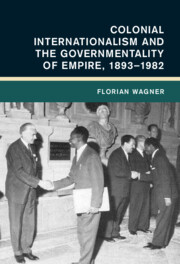
BOOK: Florian WAGNER, "Colonial Internationalism and the Governmentality of Empire, 1893–1982" (CUP, 2022)

Source: CUP


Description:

In 1893, a group of colonial officials from thirteen countries abandoned their imperial rivalry and established the International Colonial Institute (ICI), which became the world's most important colonial think tank of the twentieth century. Through the lens of the ICI, Florian Wagner argues that this international cooperation reshaped colonialism as a transimperial and governmental policy. The book demonstrates that the ICI's strategy of using indigenous institutions and customary laws to encourage colonial development served to maintain colonial rule even beyond the official end of empires. By selectively choosing loyalists among the colonized to participate in the ICI, it increased their autonomy while equally delegitimizing more radical claims for independence. The book presents a detailed study of the ICI's creation, the transcolonial activities of its prominent members, its interactions with the League of Nations and fascist governments, and its role in laying the groundwork for the structural and discursive dependence of the Global South after 1945.

Table of contents:

1 - “More Beautiful than the Nationalist Thought”?
pp 24-63
Colonialist Fraternization and the Birth of Transnational Cooperation

2 - A Transcolonial Governmentality Sui Generis
pp 64-109
The Invention of Emulative Development

3 - Politics of Comparison
pp 110-148
The Dutch Model and the Reform of Colonial Training Schools

4 - Cultivating the Myth of Transcolonial Progress
pp 149-172
The ICI and the Global Career of Buitenzorg’s Agronomic Laboratory

5 - The Adatization of Islamic Law and Muslim Codes of Development
pp 173-208

6 - Creating an “Anti-Geneva Bloc” and the Question of Representivity
pp 209-256

7 - Inventing Fascist Eurafrica at the Volta Congress
pp 257-280

8 - False Authenticity
pp 281-314
The Fokon’olona and the Cooperative World Commonwealth

9 - “That Has Been Our Program for Fifty Years”
pp 315-348
Sustained Development and Loyal Emancipation after 1945

Conclusion
pp 349-356

More information with CUP.

Tuesday, 3 October 2023

BOOK: Jenny BENHAM, "International law in Europe, 700-1200" (Manchester University Press, 2023)

Source: MUP

Description:

Was there international law in the Middle Ages? Using treaties as its main source, this book examines the extent to which such a system of rules was known and followed in the period 700 to 1200. It considers how consistently international legal rules were obeyed, whether there was a reliance on justification of action and whether the system had the capacity to resolve disputed questions of fact and law. The book further sheds light on issues such as compliance, enforcement, deterrence, authority and jurisdiction, challenging traditional ideas over their role and function in the history of international law.

International law in Europe, 700-1200 will appeal to students and scholars of medieval Europe, international law and its history, as well as those with a more general interest in warfare, diplomacy and international relations.

Table of contents:
Introduction
1 The sources of international law: treaties
2 That which is practised on a daily basis: displacement of people
3 The rules consistently obeyed: redress, amnesty, and transitional justice
4 Justifying action: law, responsibility, and deterrence
5 Resolving disputes: arbitration, mediation, and third-party intervention
Conclusion
Index

Author:
Jenny Benham is Senior Lecturer in Medieval History at Cardiff University

Visit the publisher's website for more information.

Friday, 29 September 2023

SPECIAL ISSUE: Histoire, économie & société 2023/3 (42e année), "Souveraineté économique, souveraineté politique" (Volume 3, 2023)


Source: Histoire, économie & société


Table of contents:

Page 4 à 6

Autour de la souveraineté économique

Éric Bussière


Page 7 à 22

La possibilité d’un port. Impasses économiques et espoirs déçus dans la ville internationale de Tanger (1912-1956)

Antoine Perrier


Page 23 à 43

Le CIC et Haïti (1875-1910)

Nicolas Stoskopf


Page 44 à 57

Les enjeux de l’industrie du billet de banque en guerre dans la France métropolitaine et son Empire colonial (1938-1945)

Mathieu Bidaux


Page 58 à 75

Défendre le « crédit » du billet : la Banque de France face aux opérations d’échange monétaire à la fin de la Seconde Guerre mondiale

Matéo Teixeira


Page 76 à 87

Coordonner les politiques économiques en Europe du plan Werner à Maastricht. Autour des conceptions de Jacques Delors

Eric Bussière

Thursday, 28 September 2023

BOOK: Catherine KESSEDJIAN, Olivier DESCAMPS, Teodolinda FABRIZI, "Au service du droit international: Les 150 ans de l’Association de droit international" (Éditions Panthéon-Assas, 2023)


Source: Editeurs Panthéon-Assas
Description:

Faire le bilan de 150 ans au service du droit international relève d’une gageure probablement insurmontable. Pourtant, il paraissait important de porter un regard rétrospectif, notamment sur ces femmes et ces hommes qui ont écrit les grandes heures de l’Association de droit international (ADI), apportant une contribution intellectuelle, à maints égards décisive, au droit international. Dans un monde en crise, à nouveau polarisé, il est urgent de retracer l’histoire et les apports de l’ADI au droit international.

Le livre a été conçu en trois parties. La première partie présente l’état du monde en 1873 pour tenter de comprendre le contexte dans lequel les fondateurs de l’ADI ont conçu cette société savante. La deuxième partie présente l’organisation et les personnalités qui l’ont fait vivre. La troisième partie analyse l’influence des travaux de l’organisation sur le développement du droit international.

Table of Contents:

Page 1 à 4
Pages de début

Page 4
Liste des contributeurs

Page 5 à 7
Foreword
Christine Chinkin

Page 9 à 12
Préface en quatre actes

Franck Latty
Page 13 à 34

Introduction
Olivier Descamps, Teodolinda Fabrizi, Catherine Kessedjian
Page 35 à 42

The Position of the Director of Studies
Alfred H. A. Soons

Partie I. Le moment 1873
Page 45 à 55
1873 : des mondes africains à la croisée des chemins
Jean-Pierre Bat

Page 57 à 68
The Latin American Context Around 1873
Paulo Borba Casella

Page 69 à 86
Le théâtre, miroir de la bourgeoisie européenne dans les trente dernières années du xixe siècle
Annamaria Cascetta

Page 87 à 99
Les mondes asiatiques en 1873
Frédéric Constant

Page 101 à 114
1873, à la croisée des mutations de l’ordre international
Isabelle Dasque

Page 115 à 130
La philosophie occidentale en 1873
Laurent Fedi

Page 131 à 149
La philosophie américaine en 1873 – D’un monde à l’autre
Mathias Girel

Page 151 à 162
La doctrine internationaliste en 1873
Jean-Louis Halpérin

Page 163 à 166
American Idealists and the Founding of the International Law Association
Mark Weston Janis

Page 167 à 197
International Law in 1873
Martti Koskenniemi

Page 199 à 213
Les arts à Paris en 1873 – Avant la tempête
Dominique Lobstein

Page 215 à 231
La justice internationale à la fin du xixe siècle
Raphaëlle Nollez-Goldbach

Page 233 à 248
Regards portés sur l’économie internationale en 1873
Jean-Pierre Williot

Partie II. Les branches de l’association
Page 251 à 256
The Albanian Branch (since April 2014)
Erjon Muharremaj, Fjorda Shqarri, Gentian Zyberi

Page 257 à 266
The American Branch
James A. R. Nafziger, John E. Noyes

Page 267 à 272
The Argentine Branch
Ricardo R. Balestra

Page 273 à 283
The History of the Australian Branch
Keith Suter

Page 285 à 294
The Austrian Branch
August Reinisch

Page 295 à 299
The Brazilian Branch – An Overview of its 73-Year History
Lucas Carlos Lima, Marcílio Franca, Aziz Tuffi Saliba

Page 301 à 312
The British Involvement in the ILA
Jeremy Carver

Page 313 à 322
ILA-Canada – A History of Innovation and Forward-Thinking on International Law
Konstantia Koutouki

Page 323 à 327
The History of the Caribbean Branch
Chantal Ononaiwu

Page 329 à 340
The Dutch Branch – Koninklijke Nederlandsche Vereeniging voor International Recht (KNVIR)
Arthur Eyffinger

Page 341 à 345
The History of the Finnish Branch
Gustaf Möller, Lina Tornberg

Page 347 à 358
Regard historien sur la Branche française (1925-2021)
Dzovinar Kévonian

Page 359 à 367
The German Branch – Deutsche Vereinigung für Internationales Recht (DVIR)
Stephan Hobe

Page 369 à 373
A Short History of the Hungarian Branch
Vanda Lamm

Page 375 à 383
The History of the Irish Branch
Patricia Conlan

Page 385 à 392
Italy and the ILA – A History Spanning over Three Centuries
Gabriella Venturini

Page 393 à 403
One Hundred Years of the ILA Japan Branch
Shinya Murase

Page 405 à 406
The Korean Branch – Introduction and Achievements
Chang-Wee Lee

Page 407 à 408
The Founding of the Nicaraguan Branch
Amílcar Navarro Amador

Page 409 à 413
The History of the Norwegian Branch – Norsk forening for internasjonal rett
Stian Øby Johansen, Geir Ulfstein

Page 415 à 418
The Pakistan Branch
Arshad Ghaffar

Page 419 à 426
The Polish Branch
Ewelina Cała-Wacinkiewicz, Jerzy Menkes, Joanna Nowakowska-Małusecka, Wojciech Sz. Staszewski

Page 427 à 430
The History of the Portuguese Branch
Manuel de Almeida Ribeiro

Page 431 à 434
The Singapore Branch
Daphne Hong

Page 435 à 438
The History of the South African Branch
Clea Strydom

Page 439 à 444
The Spanish Branch
Julio González-Soria

Page 445 à 451
A Short History of the Swiss Branch
Andreas R. Ziegler

Partie III. L’influence des travaux de l’ADI sur le développement du droit international

Page 455 à 465
The Contribution of the ILA Committee on International Trade Law
Frederick M. Abbott

Page 467 à 479
The ILA’s Human Rights Committee and the Progressive Development of International Law
Christina M. Cerna

Page 481 à 498
L’influence du travail de l’ADI sur le développement du droit international dans les domaines de la protection des biens culturels
Marie Cornu, Manlio Frigo

Page 499 à 513
The Contribution of the ILA to the Development of International Water Law
Joseph W. Dellapenna

Page 515 à 520
Framing International Law for Sustainable Development
Kamal Hossain

Page 521 à 533
L’influence des travaux de l’ADI sur le développement du droit international en matière de procédure civile et commerciale
Patrick Kinsch, Vincent Richard

Page 535 à 550
The Influence of the Work of the ILA’s Space Law Committee on the Development of International Law
Irmgard Marboe

Page 551 à 565
Le droit à réparation des victimes de violations du droit international humanitaire
Photini Pazartzis

Page 567 à 582
Investment Law
August Reinisch

Page 583 à 608
Major Developments in the Law of State Immunity since the ILA Revised Articles for a Convention on State Immunity Presented at the Buenos Aires Conference in 1994
Jürgen Bröhmer, Georg Ress

Page 609 à 621
The Contribution of the International Law Association to the Development of International Law in Relation to Climate Change
Sara L. Seck

Page 623 à 646
L’influence des travaux de l’ADI sur la pratique de l’arbitrage international
Julie Spinelli

Page 647 à 659
Committee on International Securities Regulation
Peter Willis SC

Page 661 à 665
Les conférences de l’ADI
The ILA Conferences
Peter Willis SC

Page 667 à 677
Building Tomorrow’s ILA
From the Perspective of the ILA’s Younger Members

Page 679 à 700
Les contributeurs

Page 701 à 706
Pages de fin

More details with the publisher.

Tuesday, 26 September 2023

SEMINAR & GRANT OPPORTUNITY: The Haiti Seminar /Le Séminaire Haïti: Money, Finance and Sovereignty, 1825-2025

 The Haiti Seminar /Le Séminaire Haïti

Money, Finance and Sovereignty

1825-2025

 The Haiti Seminar

While not exclusively centered on Haiti, the Haiti Seminar finds its motivation in the profound impact of the tragedy of Haiti's debt on collective memory, as underlined for instance in the series of articles the New York Times devoted in the Spring of 2022 to the legacy of Haiti's debt of 1826. Haiti's "odious debt" started with the indemnification of slave-owners imposed by the French government in 1825 as a condition for acknowledging Haiti's sovereignty. This episode serves as a pivot, a prime illustration of the importance of sovereign debt, and a significant case study.

Inspiration

Haiti's debt is particularly noteworthy due to its role in highlighting the intricate connections between money, debt, sovereignty, and international law. The mechanics of Haiti's so-called double debt -- on the one hand the reparations owed to former plantation owners for the loss of their property, and on the other hand, the financial debt which the state of Haiti owed to the investors who had subscribed to the bond issued to pay-off the indemnity -- summon crucial aspects of modern global capitalism.

While the original focus will be on Haiti's debt (to which we will keep returning), the Seminar intends to operate a broadening of the perspective, covering diverse historical experiences during the two centuries following the original settlement of Haiti's double debt. More broadly, the Seminar is meant to provide a venue for researchers interested in the international politics of debt, money and state-making. It will feature a combination of paper presentations (based on circulated drafts) and less frequently, round tables devoted for instance to the discussion of new books.

The Seminar takes an interdisciplinary approach, aiming to bring together scholars from diverse academic backgrounds. In particular, it will invite historians, economists and legal scholars to debate their perspectives and engage in fruitful exchanges. It seeks in particular to foster discussions that encompass both case studies and comparative approaches and enable to put in historical perspective questions of debt sustainability, debt forgiveness, conditionality, political control, etc.

Organization

The Haiti Seminar is led by Marc Flandreau at the University of Pennsylvania in partnership with the Graduate Institute of International and Development Studies in Geneva, and the School of Social Sciences and Government of the Tecnológico de Monterrey, Guadalajara. It is conceived to operate over a three-year period, commencing in 2023-24. The project will distribute a series of research grants. In particular, 10 Doctoral Prizes of 5,000 USD each will be awarded to registered PhD students located anywhere in the world and working on the history and economics of sovereign debt, a funding initiative supported by Crédit Mutuel, Paris. The Seminar takes place online on Thursdays at 12pm (Haiti Time)/ 6 pm (Paris Time). It will be concluded by an academic conference in the Summer of 2026.

Inquiries:  haiti.seminar@sas.upenn.edu 

Source: UPenn