ESIL Interest Group History of International Law

ESIL Interest Group History of International Law

Wednesday, 5 June 2019

BOOK: Guillaume HANOTIN, Ambassadeur de deux couronnes : Amelot et les Bourbons, entre commerce et diplomatie [Bibliothèque de la Casa de Velazquez] (Madrid: Casa de Velazquez, 2018), 608 p. ISBN 978-8490961797, € 49

(image source: Amazon)

Book abstract:
Amelot de Gournay, ambassadeur de Louis XIV à Madrid, incarna la forme la plus aboutie des nouvelles relations entre les monarchies de France et d'Espagne pendant la guerre de Succession après la mort de Charles II d'Espagne en 1700. Cette étude retrace les objectifs, les succès et les échecs d'une politique à partir de sa mise en oeuvre durant un conflit qui fut aussi une guerre civile, motivé également par des impératifs commerciaux et coloniaux.
On the author:
Ancien membre de l’École des Hautes études hispaniques et ibériques de la Casa de Velázquez, Guillaume Hanotin est maître de conférences à l’université Bordeaux Montaigne.
 (source: amazon)

Tuesday, 4 June 2019

BOOK: Owen TAYLOR, International Law and Revolution [Routledge Research in International Law] (London: Routledge, 2019), 192 p., ISBN 9780367076597, 115 GBP

(image source: Routledge)

Book abstract:
This book explores the historical inter-relations between international law and revolution, with a focus on how international anti-capitalist struggle plays out through law. The book approaches the topic by analysing the meaning of revolution and what revolutionary activity might look like, before comparing this with legal activity, to assess the basic compatibility between the two. It then moves on to examine two prominent examples of revolutionary movements engaging with international law from the twentieth century; the early Soviet Union and the Third World movement in the nineteen sixties and seventies. The book proposes that the ‘form of law’, or its base logic, is rooted in capitalist social relations of private property and contract, and that therefore the law is a particularly inhospitable place to advance revolutionary breaks with established distributions of power or wealth. This does not mean that the law is irrelevant to revolutionaries, but that turning to legal means comes with tendencies towards conservative outcomes. In the light of this, the book considers the possibility of how, or whether, international law might contribute to the pursuit of a more egalitarian future. International Law and Revolution fills a significant gap in the field of international legal theory by offering a deep theoretical reflection on the meaning of the concept of revolution for the twenty-first century, and its link to the international legal system. It develops the commodity form theory of law as applied to international law, and explores the limits of law for progressive social struggle, informed by historical analysis. It will therefore appeal to students and scholars of public international law, legal history, human rights, international politics and political history.
On the author:
Owen Taylor is an independent researcher, currently based in Marseille. He completed his doctorate in Law at SOAS, University of London
More information here.

Monday, 3 June 2019

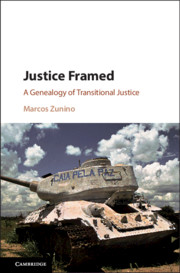
BOOK: Marcos ZUNINO, Justice Framed : A Genealogy of Transitional Justice (Cambridge: Cambridge University Press, 2019). ISBN 9781108475259, £ 85.00


(Source: CUP)

Cambridge University Press has published a book dealing with the history of transitional justice.

ABOUT THE BOOK

Why are certain responses to past human rights violations considered instances of transitional justice while others are disregarded? This study interrogates the history of the discourse and practice of the field to answer that question. Zunino argues that a number of characteristics inherited as transitional justice emerged as a discourse in the 1980s and 1990s have shaped which practices of the present and the past are now regarded as valid responses to past human rights violations. He traces these influential characteristics from Argentina's transition to democracy in 1983, the end of communism in Eastern Europe, the development of international criminal justice, and the South African truth commission of 1995. Through an analysis of the post-World War II period, the decolonisation process and the Cold War, Zunino identifies a series of episodes and mechanisms omitted from the history of transitional justice because they did not conform to its accepted characteristics.

ABOUT THE AUTHOR

Marcos Zunino, British Institute of International and Comparative Law

TABLE OF CONTENTS

1. Introduction
Part I. History:
2. The discourse of transitional justice: objects, concepts, actors and characteristics
3. The birth of transitional justice: emergence
Part II. Prehistory:
4. The myth of Nuremberg: origin
5. The Cold War impasse: descent
6. Conclusion
Bibliography
Index.

More information here
(source: ESCLH Blog)

Friday, 31 May 2019

ARTICLE: Henry JONES: Property, territory, and colonialism: an international legal history of enclosure (Legal Studies XXXIX (2019), No. 2, 187-203)

(image source: Cambridge Core)

Abstract:
This paper is concerned with how law organises and controls space. It offers a new history of enclosure in the context of early English colonialism. By drawing this connection, the paper opens up new lines of enquiry into how law organises and produces space at both the domestic and international scale.
Read more on Cambridge Core.

(source: ESCLH Blog)

Thursday, 30 May 2019

BOOK: Anne PETERS, Humanisme, constitutionnalisme, universalisme : Etude de droit international et comparé (Paris: Pedone, 2019), 240 p. ISBN 9782233009128, € 36

(image source: Blogger)

Abstract:
Le droit international et sa doctrine sont en pleine crise existentielle. C’est à leur chevet que se porte ce recueil d’articles signés par Anne Peters. Il faut repenser le droit international, écrit-elle. Pour cela, cependant, il faut repartir des fondamentaux, c’est-à-dire de l’épistémologie. Ici, les qualités et l’érudition de l’auteure comme internationaliste, constitutionnaliste et comparatiste apportent un regard original et très riche qui revisite non seulement le droit international mais également la manière dont il se pense. En particulier, l’auteure se livre à une critique des critiques faites au modernisme. S’il y a de vrais apports de la part de la critique post-moderne, elle y voit également des limites, contradictions et exagérations. Il faudrait donc tenir compte de ce mouvement pour le dépasser pour un « post-postmodernisme » qui emprunte ce qu’il y a de bon dans les divers courants de doctrine(s). Deux des directions proposées sont une nouvelle approche du constitutionnalisme mondial et une reformulation du droit international fondée sur le respect des droits de la personne humaine.
(source: ESCLH Blog)

Wednesday, 29 May 2019

ADVANCE ARTICLE: Brad HINSHELWOOD, Punishment and Sovereignty in De Indis and De iure belli ac pacis (Grotiana, 2019)

(image source: Brill)

Abstract:
Grotius’s theory of punishment provides a unique lens through which to view his evolving thought on sovereignty between De Indis and De iure belli ac pacis and the implications of that evolution for Grotius’s theory of the ius in bello. Throughout both works, Grotius attempted to leave open the possibility of private punishment and private warfare, a position not easily squared with prevailing views of sovereign authority. Initially, Grotius was content with a theory marrying the private right of punishment with more traditional Scholastic views of sovereignty through a transfer of the private right from individuals into the hands of the sovereign. This theory also adopted traditional views of subject responsibility for sovereign acts—and, by extension, the exposure of subjects to punishment for the acts of their sovereign. By the time of his mature work, however, Grotius turned away from natural law justifications for collective responsibility and collective punishment, denying that subjects had to answer for the acts of their sovereign as a necessary incident of the compact creating civil society. This led Grotius to refer virtually all forms of collective responsibility, such as reprisal or punishment exacted through war, to the law of nations. This sharp reduction of the natural consequences of the creation of sovereign power also enabled Grotius’s argument that the private right of war, and in particular the private right of punishment, remained available after the creation of civil society.
Real the full article with Brill.

Tuesday, 28 May 2019

CALL FOR PAPERS: Splendid Encounters IX: Struggle for Sovereignty? Small States and the Diplomacy of the Early Modern Period (Dubrovnik: University of Zagreb, 16-17 APR 2020); DEADLINE 15 JUN 2019

(image source: PreModern Diplomats)

Clearly, there is no universally accepted definition of a ‘small state’, as ‘small’ is quite an ambiguous concept. However, one possible approach would be to say that small states were those whose territory was significantly smaller than that of most other states, which often also implied limited military and/or political power. More precisely, one could say that small states were those whose lack of territory and resources caused them to usually negotiate from a position of weakness. This conference is dedicated to such ‘underdogs’ of Early Modern diplomacy who were routinely forced to engage in asymmetrical diplomatic relations.

Within the context of this broad definition, some of the key issues that Splendid Encounters 9 seeks to explore are:

  • defining a ‘small state’: the changing meanings of the concept both in Early Modern political discourse and in modern scholarship. Which were the criteria of considering a polity as a ‘small state’ (territory, population, military power or something else) especially in diplomatic context? How did these criteria change over time?
  • small states' strengths and weaknesses as diplomatic players: were there any specific strengths of small states which were due exactly to their small size and resources? What were the reasons for diplomatic victories of small states over their larger counterparts?
  •  struggle for sovereignty: ways in which small states sought to establish and legitimize their status as independent international subjects. Which strategies – ranging from political and legal treatises, ceremonies and symbols, all the way to alliances and warfare – did they employ in order to achieve the desired status and prestige? Which were the common obstacles they had to overcome?
  • dynamics of relations with great powers: specific diplomatic relations shaped by significant difference in territory and power between the two polities. Which were the forms of patronage and dependence between the small states and great empires (e.g. tribute, military aid, symbolic submission)? What were the small states’ means of resisting the pressure of their more powerful counterparts?
  • small states and ‘modern diplomacy’: with all due caution regarding the term ‘modern’, one could ask whether small states were innovators or traditionalists regarding the mechanisms and values seen as characteristic of ‘modern’ diplomacy? This concerns not only the well-known issue regarding the resident ambassadors, but also norms such as neutrality or the idea of formal equality between international subjects (regardless of their territory or power).
We invite submission of abstracts of max. 300 words for twenty-minute papers or 3-paper panels dealing with the above-mentioned or other issues linked to role of small states in diplomacy in Early Modern era. Please e-mail abstract and short biography to: se9.dubrovnik@gmail.com. Deadline for submission is 15th June 2019. The applicants will be notified of the acceptance of their proposal by 30th July 2019. 

All queries should be directed to Dr Anna Kalinowska: akalinowska@ihpan.edu.pl or Dr Lovro Kuncevic: lovro.kuncevic@gmail.com.

Splendid Encounters is a series of international and interdisciplinary conferences which aims to bring together scholars from the broadest possible range of perspectives to consider diplomacy and diplomatic activities in the early modern era. After successful meetings in, Warsaw, Bath, Florence, Budapest, Prague, Lisbon, Vilnius and Toulouse we invite you to join us for another event, this time hosted by The Institute for Historical Sciences in Dubrovnik, Croatian Academy of Sciences and Arts.

Venue:
University of Zagreb
Centre for Advanced Academic Studies
Don Frana Bulica 4
20000 Dubrovnik
Croatia 

Please be advised, that a conference fee of max. 30 EUR, covering the conference package and coffee breaks, may apply. There will be a number of rooms (student accommodation) available at preferential prices for the speakers.
http://www.caas.unizg.hr/

More information with the Premodern Diplomats Network.