Description:
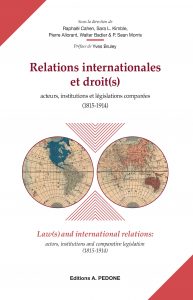
L’histoire du droit international et l’histoire des relations internationales connaissent un renouveau historiographique depuis une vingtaine d’années. Le bicentenaire du congrès de Vienne a notamment permis de reconsidérer la mise en place du concert européen, comme système international, au XIXe siècle. L’étude des rapports entre relations internationales et droit(s) permet ainsi de faire émerger un champ de recherche qui se révèle d’une grande richesse. Ce livre en apporte la preuve. Il s'articule autour de trois axes : les actrices et acteurs des relations internationales et du droit international (juristes, magistrats, avocats, activistes, éditeurs) ; les institutions du droit international et du droit comparé (ministère des affaires étrangères, tribunaux, Conseil d’État, universités, académies) ; les experts et les expertises en droit international. L’ouvrage réunit plus d’une vingtaine de contributions inédites, en anglais et en français, proposées par des auteurs venant de plusieurs continents. Chaque contribution explore des aspects novateurs du rapport entre droit(s) et relations internationales au XIXe siècle. Soit en s’intéressant à une ou des institutions, soit à un groupe d'actrices ou d’acteurs, conseillers juridiques, avocats, juges, activistes, publicistes, ou encore à travers la biographie d’un juriste. Plusieurs chapitres éclairent la naissance de la profession de « juriste internationaliste », de même que le lien entre les législations comparées et le droit international.
The history of international law and international relations has been revived in the last twenty years. In particular, the bicentenary of the Congress of Vienna has provided an opportunity to reconsider the establishment of the European concert as an international system in the 19th century. The study of the relationship between international relations and law(s) has given rise to a rich field of research. This book is proof of that. It focuses on three main areas: those involved in international relations and international law (jurists, magistrates, lawyers, activists, publishers); international and comparative law institutions (Ministry of Foreign Affairs, courts, Council of State, universities, academies); and experts and expert reports on international law. The book combines more than twenty original contributions, in English and French, by authors from several continents. Each contribution explores innovative aspects of the relationship between law and international relations in the nineteenth century. The focus is either on one or more institutions or on a group of actors - legal advisers, lawyers, judges, activists, publicists - or on the biography of a jurist. Several chapters shed light on the birth of the profession of 'internationalist lawyer', as well as the link between comparative legislation and international law.
Table of Contents:
INTRODUCTION
Chapter 1. Introduction : law(s) and international relations – actors,
institutions and comparative legislation (1815-1914)
Raphaël CAHEN and P. Sean MORRIS ............................................................. 17
PREMIÈRE PARTIE
ACTRICES ET ACTEURS DES RELATIONS INTERNATIONALES
ET DU DROIT INTERNATIONAL
Chapitre 2. Aux origines du droit international public contemporain :
la mission londonienne de Walewski, émissaire du Gouvernement national
de Varsovie, en 1831
Bruno MARTIN-GAY ....................................................................................... 31
Chapter 3. Women’s rights and the rights of man : women’s status under law
as the measure of « civilization » in French political and legal discourse,
1869-1914
Sara L. KIMBLE ............................................................................................... 59
Chapter 4. Women’s leagues of nations. Women formulating international
peace law in the long XIXth century
Marion RÖWEKAMP ......................................................................................... 89
Chapitre 5. Alphonse Rivier, Internationaliste fonctionnel et juriste
disponible ? Retour sur la génération de 1873
Philippe RYGIEL ............................................................................................ 115
Chapter 6. Gustaw Roszkowski on the changes in public international law,
1870–1910
Paweł FIKTUS ................................................................................................ 139
Chapter 7. Teaching the Law of Nations in King Leopold’s Foreign Office :
Léon Arendt’s Droit des gens Course (1903)
Frederik DHONDT .......................................................................................... 169
DEUXIÈME PARTIE
INSTITUTIONS DU DROIT INTERNATIONAL ET DU DROIT COMPARÉ
Chapter 8. Peace through law in early nineteenth century Switzerland.
Jean-Jacques de Sellon (1782-1839) and the Société de la paix de Genève
(1830-1839)
Wouter DE RYCKE ......................................................................................... 203
Chapitre 9. L’Académie des sciences morales et politiques
et le droit international (1832-1914)
Raphaël CAHEN ............................................................................................. 245
Chapitre 10. La note d’Alphonse Royer (1856). Une contribution méconnue
à la réflexion sur la codification du droit civil ottoman
Jean-Romain FERRAND-HUS ......................................................................... 269
Chapitre 11. Les relations internationales dans la jurisprudence
du Conseil d’Etat (1815-1914)
Maxime CHARITÉ .......................................................................................... 299
Chapitre 12. Ubi societas gentium ibi jus inter gentes.
L’émergence d’un ordre juridique international
Bilel HAMDI .................................................................................................. 315
Chapitre 13. Droit égyptien, legal transplants et législations comparées.
Aperçu historique, actualité et devenir des relations franco-égyptiennes
dans le domaine juridique
Yousra CHAABAN .......................................................................................... 333
Chapitre 14 Naissance et affirmation de la Societé de législation comparée
(1869-1900)
Pierre ALLORANT et Walter BADIER ............................................................. 353
TROISIÈME PARTIE
EXPERTS ET EXPERTISES DU DROIT INTERNATIONAL
Chapitre 15. Renseignement, diplomatie et relations internationales.
Le rôle de la connaissance dans les origines de l’Empire du capital
britannique en Amérique latine
Mariano SCHLEZ ........................................................................................... 373
Chapter 16. Mimicry of international law : Andres Bello’s Principios de
Derecho Internacional
Nina KELLER-KEMMERER ............................................................................. 399
Chapter 17. Prussia and international slavery laws
Saskia GEISLER ............................................................................................. 427
Chapitre 18. L’économie des droits compensateurs dans le droit international
du commerce avant-guerre : quel rôle pour la science économique dans la
doctrine juridique ?
Florenz VOLKAERT ....................................................................................... 439
Chapter 19. Inseparable pairs for modernising Japan? Japanese Ministry
of Foreign Affairs and academia, 1880-1914
Hirofumi OGURI ............................................................................................ 463
Chapitre 20. André Gros, Jurisconsulte du Ministère des affaires étrangères
Pierre-François LAVAL .................................................................................. 493
CONCLUSION
Chapter 21. Conclusion : toxic Optimism ?
Miloš VEC ..................................................................................................... 507
More info with the the publisher.