ESIL Interest Group History of International Law

ESIL Interest Group History of International Law

Friday, 16 September 2016

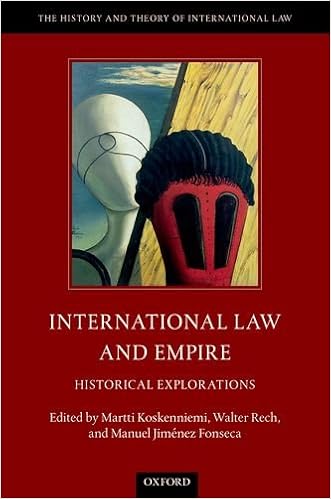
BOOK: Martti KOSKENNIEMI, Walter RECH & Manuel JIMÉNEZ FONSECA (eds.), International Law and Empire: Historical Explorations [The History and Theory of International Law]. Oxford: Oxford University Press, Dec 2016, 416p. ISBN 978-0198795575, £ 80.


(image source: amazon)


Oxford University Press will publish a volume on 1 December 2016 on the theme International Law and Empire: Historical Explorations. This is a product of the project "International Law, Religion and Empire" under the direction of Martti Koskenniemi at the Eric Castrén Institute (Helsinki).

Book description:
In times in which global governance in its various forms, such as human rights, international trade law, and development projects, is increasingly promoted by transnational economic actors and international institutions that seem to be detached from democratic processes of legitimation, the question of the relationship between international law and empire is as topical as ever. By examining this relationship in historical contexts from early modernity to the present, this volume aims to deepen current understandings of the way international legal institutions, practices, and narratives have shaped specifically imperial ideas about and structures of world governance. As it explores fundamental ways in which international legal discourses have operated in colonial as well as European contexts, the book enters a heated debate on the involvement of the modern law of nations in imperial projects. Each of the chapters contributes to this emerging body of scholarship by drawing out the complexity and ambivalence of the relationship between international law and empire. They expand on the critique of western imperialism while acknowledging the nuances and ambiguities of international legal discourse and, in some cases, the possibility of counter-hegemonic claims being articulated through the language of international law. Importantly, as the book suggests that international legal argument may sometimes be used to counter imperial enterprises, it maintains that international law can barely escape the Eurocentric framework within which the progressive aspirations of internationalism were conceived.

Table of contents:
Introduction, Martti Koskenniemi
Part I: Epistemologies of Empire and International Law 1: Provincializing Grotius: International Law and Empire in a Seventeenth-Century Malay Mirror, Arthur Weststeijn
2: Indirect Hegemonies in International Legal Relations: The Debate of Religious Tolerance in Early Republican China, Stefan Kroll
3: International Law, Empire, and the Relative Indeterminacy of Narrative, Walter Rech
Part II: Legal Discourses of Empire 4: The Concepts of Universal Monarchy and Balance of Power in the First Half of the Seventeenth Century-a Case Study, Peter Schröder
5: Between Faith and Empire: The Justification of the Spanish Intervention in the French Wars of Religion in the 1590s, Randall Lesaffer
6: Jus gentium and the Transformation of Latin American Nature: One More Reading of Vitoria?, Manuel Jiménez Fonseca
7: Cerberus: The State, the Empire, and the Company as Subjects of International Law in Grotius and the Peace of Westphalia, José-Manuel Barreto
8: Revolution, Empire, and Utopia: Tocqueville and the Intellectual Background of International Law, Julie Saada
Part III: Managing Empire: Imperial Administration and Diplomacy 9: Towards the Empire of a 'Civilizing Nation': The French Revolution and its Impact on Relations with the Ottoman Regencies in the Maghreb, Christian Windler
10: A Comporting Sovereign, Tribes, and the Ordering of Imperial Authority in Colonial Upper Canada of the 1830s, PG McHugh
11: Territory, Sovereignty, and the Construction of the Colonial Space, Luigi Nuzzo
Part IV: A Legal Critique of Empire? 12: An Anti-Imperialist Universalism? Jus Cogens and the Politics of International Law, Umut Özsu
13: Drift towards an Empire? The Trajectory of American Reformers in the Cold War, Hatsue Shinohara
14: Imperium sine fine: Carneades, the Splendid Vice of Glory, and the Justice of Empire, Benjamin Straumann
15: Scepticism of the Civilizing Mission in International Law, Andrew Fitzmaurice 

On the editors:
Martti Koskenniemi is Academy Professor and Director of the Erik Castrén Institute of International Law and Human Rights at the University of Helsinki, a Professorial Fellow at Melbourne Law School, and Centennial Professor at the London School of Economics and Political Science. He has held visiting professorships at New York University, the University of Cambridge, the University of Utrecht, Columbia University, the University of São Paulo, the University of Toronto, and the Universities of Paris I, II, X and XVI. He was a member of the Finnish diplomatic service from 1978 to 1994 and of the International Law Commission (UN) from 2002 to 2006. His publications include From Apology to Utopia: The Structure of International Legal Argument (1989), The GentleCivilizer of Nations: The Rise and Fall of International Law 1870-1960 (2001), The Politics of International Law (2011), and The Cambridge Companion to International Law (2012, co-edited with Professor James Crawford). 
Walter Rech is a postdoctoral researcher at the Erik Castrén Institute of International Law and Human Rights, University of Helsinki. His research interests are located in the history and theory of international law and international politics. His publications include Enemies of Mankind: Vattel's Theory of Collective Security ( 2013). 
Manuel Jiménez Fonseca is a doctoral researcher at the Erik Castrén Institute of International Law and Human Rights, University of Helsinki. His research interests include the historical relationship between international law and nature, development, and social movements. His publications include 'The Colonization of American Nature and the Early Developments of International Law' 12 Journal of the History of International Law (2010) 189. 

The book can be pre-ordered with amazon.

Sunday, 11 September 2016

ESIL IG History of International Law Workshop "Writing Crisis in the History of International Law" (Riga, 7 September 2016)

 (Prof. Peters starting her response to the papers presented)

The Interest Group invited its members (latest ESIL secretariat count: 377) for an engaging and stimulating workshop on the theme "Writing Crisis in the History of International Law" within the Annual ESIL conference, organised in Riga (Latvia). 

Four papers were presented by Monica García Salmones (Helsinki, "Universal Solutions for Exceptional Times: Vitoria and Grotius"), Eric Loefflad (Kent, "‘The Stunted ‘Science’ of Statehood as a Technology of Crisis Disavowal: Three ‘Gentle Civilizers’, The Blindspots of International Institutionalism, and Explanations of the Third Reich’"), Paolo Amarosa (Helsinki; "Diverging Reconstructions: the American international law of Alejandro Álvarez and James Brown Scott during World War I") and Ingo Venzke (Amsterdam; "The Economic Crisis in the 1970s: Possibilities for Change in the Past to Feed the Future"). Prof. Anne Peters (MPI Heidelberg) responded to the proposed texts.

The Interest Groups thanks all participants for a stimulating exchange on topics of doctrine, theory and the life of the law, ranging from 16th century theology to 21st century critical legal studies.


(view from the Latvian National Library, main site of the conference)

We point to the open call for abstracts for the workshop at the upcoming ESIL Research Forum in Granada (30-31 March 2017), which can be found here. We hope to welcome you again in Spain !

Thursday, 25 August 2016

CALL FOR ABSTRACTS: ESIL RESEARCH FORUM, Granada: Workshop "Neutrality in the History of International Law - Myths and Evolving Realities"; DEADLINE 15 DEC 2016


(image source: Wikimedia Commons)

No law is neutral. Law is always a mirror of the value-system and the power structure  underlying  any  given  society  at  any  point  in  time and international law has never been an exception to this rule. A different, and yet related matter, is the extent to which the law applies equally (or not) to all members of any given society, the extent to which these members participate as equals (or not) in the formation of international law and the extent to which the law is effectively (or not) applied in an objective and un-biased manner (what is, commonly known, as 'neutrally') by international bodies and adjudicators charged with applying it to international situations or with settling disputes between any given parties. The aspiration towards 'neutrality'  (as  such  conceived)  of  international  law  in  its  quest  for  an ever-greater  legitimacy,  has, undoubtedly, evolved  throughout  different historical  periods.  

Neutrality  in  the  history  of  international  law can,  on the other hand, also be understood as a legal institution. Neutrality as a legal  institution  was  born  as a  synonym  for  emancipation  from  a  rigorous moral  top-down  juridical-moral  framework  inherited  from  theology. Its theoretical  blossoming  went  in  parallel  with  the  consolidation  of  the principle  of  sovereign  equality  of  nations  and  the  principle  of  non-intervention in domestic affairs during the transition of the classical law of nations to modern international law. Since the establishment of the first international  institutions  with  universal  and  permanent  character, neutrality  as  a  legal  institution  has  continued  to  evolve  against  the background  provided  by  the  ever-shifting  chessboard  of  international relations  and  proliferating  international  institutions. 

Finally,  the relationship of neutrality and the history of international law can be also examined  through  the  lenses  of  the  neutrality  (or  lack  of)  of  history writing itself. If all history is, as B. Croce noted, contemporary history (by which it is generally meant that all history writing is, in one degree or other, done from the perspective of the present and also that all history writing  constitutes  an  intervention  in  the  present)  could  any  historical account  possibly  aspire  to  be  considered  a  'neutral'  history  of international law? And, if so, under what criteria?
   
The  Interest  Group  of  the  History  of  International  Law  welcomes  abstracts that  engage  critically  with  any  of  these  dimensions  of  neutrality  in  the history  of  international  law  or  a  combination  thereof  in  historical perspective  by  reference  to  relevant  episodes  in  the  history  of international law and/or different historiographical schools.   
 
Each submission should include:
– An abstract of no more than 400 words, the intended language of presentation,
– A short curriculum vitae containing the author’s  name,  institutional  affiliation,  contact  information  and  e-mail address.
Applications should be submitted to both Ignacio de la Rasilla del Moral (ignacio.delarasillaydelmoral@graduateinstitute.ch);  and Frederik  Dhondt (frederik.dhondt@vub.ac.be)   by  15th December  2016.  All  applicants  will  be notified of the outcome of the selection process by 15th January 2017
Selection will be based on scholarly merit and with regard to producing an engaging  workshop,  without  prejudice  to  gender,  seniority,  language  or geographical  location.  Please  note  that  the  ESIL  Interest  Group  on  the History  of  International  Law  is  unable  to  provide  funds  to  cover  the conference registration fee or related transport and accommodation costs.  

More information on the Research Forum (30-31 March 2017) can be found on the website of the European Society of International Law or on the Granada Law School website.

CHAPTER: Anne ORFORD, 'International Law and the Limits of History', in: Wouter WERNER, Alexis GALÁN & Marieke DE HOON (eds.), The Law of International Lawyers: Reading Martti Koskenniemi. Cambridge: CUP, Aug 2015

(image source: SSRN)

Prof. Anne Orford (Melbourne) posted 'International Law and the Limits of History', a forthcoming chapter in The Law of International Lawyers: Reading Martti Koskenniemi (eds. Wouter Werner, Alexis Galán and Marieke De Hoon, CUP).

Abstract:
This chapter explores the effect that the turn to history has had on the field of international law. The publication of Martti Koskenniemi’s history of the international legal profession, The Gentle Civilizer of Nations, is often presented as representing a moment at which the field of international law took a ‘turn to history’, or more precisely, a turn in its mode of writing history. Of course, international law has always had a deep engagement with the past. Past texts and concepts are constantly retrieved and taken up as a resource in international legal argumentation and scholarship. Thus the ‘turn to history’ trope marks a turn to history as a critical method, rather than a turn to history as a substantive engagement with the past. Koskenniemi himself introduced The Gentle Civilizer as a ‘move from structure to history in the analysis of international law’ and ‘a kind of experimentation in the writing about the disciplinary past’. In later work, however, he became much conventional in his exposition of history as method, arguing against the ‘sin of anachronism’ and urging critical scholars to focus on the meaning of texts for their authors’ ‘contemporaries’. A similar turn to history as method more broadly begin to shape new writing about international law over the decade following The Gentle Civilizer’s publication. This chapter suggests that the turn to history as method that followed in the wake of The Gentle Civilizer was an abandonment of the critical potential of that initial work. What marked out The Gentle Civilizer as a singular achievement was Koskenniemi’s attempt to hold together the history of international law, the sociology of international law, and the practice of international law. If the attempt to hold together those genres is abandoned, the critical potential of historical work in international law is lost. The chapter concludes by exploring what the historicizing of international law as a critical gesture might mean for the field going forward.
More information on SSRN.
(source: Legal History Blog)

Wednesday, 24 August 2016

BOOK: Robert MCQUORDALE & Jean-Pierre GAUCI (eds.), British Influences on International Law, 1915-2015. Leiden/Boston: Martinus Nijhoff/Brill, 2016, XVIII + 524 p. ISBN 9789004284166, €225

 (image source Brill)

Book abstract:
This book considers British influences on the development of international law over 100 years from 1915. This century has been marked by unprecedented developments in international law, not least the setting up of an array of international organisations, including the United Nations and the League of Nations, and international courts and tribunals (including the International Court of Justice and its predecessor the Permanent Court of International Justice, as well as the International Criminal Court). Two world wars, complex transboundary issues and increased globalisation have shown the importance of international law. This volume addresses these developments – domestic, regional and international - and looks at how Britain and British people (broadly defined) have influenced these changes.
The contributors to the book have examined an array of different issues. These include British influences on treaty-making, recognition and immunity, as well as on specific fields of international law, such as armed conflict, criminal law, environment and human rights. It has commentary on the British influence on the sources of international law, including by its courts and Foreign Office, in the development of the European Union and in the idea of a professional international lawyer. There are also reflections on many of the key people over the century.
The book provides a novel perspective, which surveys and appraises the contributions of British people and institutions in domestic and international legal forums and their key role in the development, interpretation and application of international law.
 Table of contents:

  • Robert McCorquodale & Jean-Pierre Gauci, From Grotius to Higgins: British Influences on International Law from 1915–2015
  • Antonios Tzanakapoulos, The Influence of English Courts on the Development of International Law
  • Kate Jones, Marking Foreign Policy by Justice: The Legal Advisers to the Foreign Office, 1876–1953
  • Philip Allott, Britain and Europe: Managing Revolution
  • Stephen Samuel, British Influences on the Ideals of International Lawyers
  • Kasey McCall-Smith, British influence on the law of treaties
  • Martin Clark, British Contributions to the concept of recognition during the inter-war period: Williams, Baty and Lauterpacht
  • Philippa Webb, British Contribution to the Law of State Immunity
  • David H. Anderson, British Influence on the Law of the Sea 1915–2015
  • Mario Prost & Yoriko Otomo, British influences on international environmental law: the case of wildlife conservation
  • Merris Amos, The Influence of British Courts on the Jurisprudence of the European Court of Human Rights
  • Nigel S. Rodley, The Contribution of British NGOs to the Development of International Law
  • Amina Higgins & Noelle Adanan, Britain’s Influence on the Regulation of the Slave Trade in the Twentieth Century
  • Nicholas Tsagourias, Contribution of British International Lawyers to the Law on the Use of Force
  • Matthew Garrod, The British Influence on the development of the laws of war and the punishment of war criminals: from the Grotius Society to the United Nations War Crimes Commission
  • Shavana Musa, The British and the Nuremburg Trials
  • James Upcher, Neutral and Beligerent Rights: the development of a British Position?
  • Anne Marie Brennan, Historical Reflections on the Criminalisation of Terrorism under International Law from the League of Nations to R v. Mohammed Gul: How Britain has Swollen the Tide of Obscurity
  • Richard Collins, The Progressive Conception of International Law: Brierly and Lauterpacht in the Interbellum Period
  • Robert Cryer, International Law and the Illusion of Novelty: Georg Schwarzenberger
  • Gerry Simpson, Juridical Intervention: Martin Wight as International Lawyer
  • Philippe Sands & Arman Sarvarian, The Contribution of the UK Bar to International Courts
More information on the Brill website.
Source: International Law Reporter.

Tuesday, 23 August 2016

BOOK: Emmanuelle TOURME JOUANNET, Horatia MUIR WATT, Olivier DE FROUVILLE & Jean MATRINGE (eds.), Droit international et reconnaissance (Paris: Pedone, 2016), 370 p. ISBN 978-2-233-00801-5, € 38

(image source: LGDJ)

Book abstract:
Cet ouvrage est le résultat d'une journée d'étude organisée le 26 janvier 2013 à la suite de la sortie du livre d'Emmanuelle Tourme Jouannet, Qu'est-ce qu'une société internationale juste ? Le droit international entre développement et reconnaissance (Paris, Pedone, 2013). Il s'agissait de soumettre à la discussion l'idée formulée par Emmanuelle Tourme Jouannet dans son dernier livre, selon laquelle une nouvelle branche du droit international serait en voie d'émergence : un droit de la « reconnaissance » qui viserait à répondre à un certain nombre de revendications formulées dans le cadre d'une « société post-coloniale et post-guerre froide ».

Un grand nombre de dimensions du droit de la reconnaissance sont abordées, qu'il s'agisse de la problématique des droits sociaux ou des droits culturels, de la réparation des crimes du passé, ou encore des demandes de reconnaissance des afro-descendants, des peuples autochtones et des « révoltes arabes ».

Toutes les contributions sont écrites par des juristes qui, tous, ont opté pour l'interdisciplinarité, mélangeant les perspectives du droit, de la philosophie, de l'histoire ou des relations internationales. 

Table of contents:


  • Emmanuelle Tourme Jouannet, Le droit international de la reconnaissance
  • Jean d’Aspremont, De la reconnaissance à l’anthropomorphisme en droit international
  • Robert Howse, “Kojevian” Recognition and Contemporary International Law
  • Charalambos Apostolidis, Le droit international de la reconnaissance comme champ de recherche. Réflexions autour de l’ouvrage d’Emmanuelle Tourme Jouannet « Qu’est-ce qu’une société internationale juste ? »
  • Olivier de Frouville, La lutte pour la reconnaissance : une nouvelle théorie explicative de l’évolution du droit international ? A propos de « Pour une société internationale juste. Entre droit du développement et reconnaissance », d’Emmanuelle Tourme Jouannet
  • Albane Geslin, De l’entre-soi à l’entre-autre(s). Enjeux et ambiguités de la reconnaissance internationale des droits des peuples autochtones
  • Carlos-Miguel Herrera, La reconnaissance par les droits (en partant des droits sociaux)
  • Emmanuel Decaux, La reconnaissance des droits culturels
  • Livia Kummer, Legal Recognition of Historic Crimes in the Present Day: Case Study of the Katyń Massacre
  • Jose Manuel Coelho, Réflexion(s) sur les crimes de l’histoire et le droit international de la reconnaissance
  • Cécile de Caunes & Juan Branco, Les reconnaissances juridiques des afro-descendants
  • Noura Kridis, Droit de la reconnaissance dans le cadre des révoltes arabes
  • Horatia Muir Watt, La reconnaissance entre philosophie politique et droit international privé : un rendez-vous manqué ?
  • Paul Lagarde, Introduction au thème de la reconnaissance des situations : rappel des points les plus discutés
  • Ivana Isailovic, La reconnaissance politique en droit transnational : les identités, les marginalisations et le droit international privé
  • Dominique Gaurier, La vision de l’autre, étranger ou non européen à travers le regard des auteurs classiques du droit international

Thursday, 18 August 2016

BOOK: Jakob ZOLLMANN, Naulila 1914. World War I in Angola and International Law: A Study in (Post-)Colonial Border Regimes and Interstate Arbitration [Studien zur Geschichte des Völkerrechts; 35]. Baden-Baden: Nomos Verlag, 2016, 516 p. ISBN 978-3-8487-2547-2, € 98.

(image source: blogger)

 Jakob Zollmann published Naulila 1914. World War I in Angola and International Law: A Study in (Post-)Colonial Border Regimes and Interstate Arbitration in Nomos' collection Studien zur Geschichte des Völkerrechts.

Abstract:
In 1885, Germany and Portugal became neighbours in Africa. The newly founded colony of German Southwest Africa prevented the southwards expansion of the ancient colony of Angola. The border along the Cunene and Kavango Rivers remained under dispute. After the outbreak of World War I in Europe, Portugal’s neutrality was questioned in German Southwest Africa, and when a group of German officials waiting near the border of Angola for food transports were shot in the Angolan fortress Naulila, a state of war between both colonies seemed inevitable. German troops launched several military reprisals against fortresses in southern Angola, most significantly against Naulila in December 1914. After their victory at Naulila, the Germans retreated to GSWA. However, African powers, most notably Kwanyama forces led by King Mandume, used the weakness of the defeated Portuguese army to expel the colonial troops from southern Angola. In 1915, a counter-offensive was launched with troops from Portugal that ended with the complete occupation of Kwanyama territories. After the war, a Luso-German arbitration procedure according to the Treaty of Versailles (1919) assessed the damages in Angola and Germany’s responsibility to pay reparations. The arbitration award of 1928 that established Germany’s responsibility for the violation of international law when attacking Naulila became a landmark case. It still holds relevance for modern international law. The final part of this book analyses the memorial culture that developed in Angola, Namibia, Germany and Portugal around the war in 1914/15.
More information here.
Source: International Law Reporter.