ESIL Interest Group History of International Law

ESIL Interest Group History of International Law
Showing posts with label legal theory. Show all posts

Thursday, 26 August 2021

BOOK: Daniel LEE, The Right of Sovereignty. Jean Bodin on the Sovereign State and the Law of Nations [The History and Theory of International Law] (Oxford: OUP, 2021), 320 p. ISBN 9780198755531, 80 GBP


(image source: OUP)

Abstract:
Sovereignty is the vital organizing principle of modern international law. This book examines the origins of that principle in the legal and political thought of its most influential theorist, Jean Bodin (1529/30-1596). As the author argues in this study, Bodin's most lasting theoretical contribution was his thesis that sovereignty must be conceptualized as an indivisible bundle of legal rights constitutive of statehood. While these uniform 'rights of sovereignty' licensed all states to exercise numerous exclusive powers, including the absolute power to 'absolve' and release its citizens from legal duties, they were ultimately derived from, and therefore limited by, the law of nations. The book explores Bodin's creative synthesis of classical sources in philosophy, history, and the medieval legal science of Roman and canon law in crafting the rules governing state-centric politics. The Right of Sovereignty is the first book in English on Bodin's legal and political theory to be published in nearly a half-century and surveys themes overlooked in modern Bodin scholarship: empire, war, conquest, slavery, citizenship, commerce, territory, refugees, and treaty obligations. It will interest specialists in political theory and the history of modern political thought, as well as legal history, the philosophy of law, and international law.

On the author:
Daniel Lee is Associate Professor of Political Science and Director of Graduate Studies in Political Science at the University of California, Berkeley. He specializes in political theory, the history of political thought, and jurisprudence. He is the author of Popular Sovereignty in Early Modern Constitutional Thought (OUP, 2016) and A Division of the Whole Law (forthcoming with OUP).

(source: OUP


Wednesday, 25 August 2021

BOOK: Edward JONES CORREDERA, The Diplomatic Enlightenment. Spain, Europe, and the Age of Speculation [History of European Political and Constitutional Thought; 5] (Leiden/Boston: Martinus Nijhoff/Brill, 2021), ISBN 978-90-04-46906-8


(image source: Brill)

Book abstract:

This book reconfigures the study of the origins of the Enlightenment in the Spanish Empire. Challenging dominant interpretations of the period, this book shows that early eighteenth-century Spanish authors turned to Enlightenment ideas to reinvent Spain’s role in the European balance of power. And while international law grew to provide a legal framework that could safeguard peace, Spanish officials, diplomats, and authors, hardened by the failure of Spanish diplomacy, sought instead to regulate international relations by drawing on investment, profit, and self-interest. The book shows, on the basis of new archival research, that the Diplomatic Enlightenment sought to turn the Spanish Empire into a space for closer political cooperation with other European and non-European states and empires.

Table of contents:

Preface 
Acknowledgements 

1 The Missing Century
 The Enlightenment, the Nation, and Modern Spain
 1 Introduction
 2 The Nineteenth-Century Spanish Enlightenment
 3 The Twentieth-Century View of the Absence of the Spanish Enlightenment
 4 Religion and the Spanish Political Elites
 5 The Diplomatic Enlightenment

2 Predicting War and Peace
 1 Introduction
 2 Spain, Europe, and Arbitrary Monarchy
 3 Crisis and Catharsis: The Dawn of the Early Spanish Enlightenment
 4 What News Do You Bring?
 5 Information Overload and Elite Political Debate

3 Investing in the Luces
 1 Introduction
 2 Shorting Diplomacy
 3 Representations of the Spanish Empire
 4 The Assembly of Public Trust
 5 Luces in the Mines
 6 The Seminary of Lawsuits: Law, Trade, and Corporations
 7 José Carvajal y Lancaster and the Arbitration of Europe
 8 Private Vices, Public Virtues, and Diplomatic Cooperation
 9 Coins, Corporations, China, and Europe
 10 The Naval Officer and the Aristocrat

4 Revolts and Returns
Free Trade and the Fear of Independence
 1 Introduction
 2 Investing in a New Timepiece
 3 Mapping Reform in Enlightenment Europe
 4 Free Trade: The Farce of Independence and the Growth of Spanish Political Economic Debate
 5 The Perils of Emulation: Corporations and the Meaning of the Spanish Empire
 6 The Criticism of Carvajal’s Joint-Stock Companies

5 The Lever of the Balance of Power
 1 Introduction
 2 Iberia’s Role in Europe
 3 Borders and Trade
 4 Investing in Peace
 5 A Monarchy without a King

6 Carthage’s Contractors
The Ends of the Spanish Empire
 1 Introduction
 2 The Grain Monopoly and the Voice of the People
 3 The Idea of the Nation: Outsourcing Propaganda and Colonisation
 4 Constitutionalism in the Spanish Empire and the International Order

7 Conclusion

Bibliography
Index

On the author:

Edward Jones Corredera is a Senior Research Fellow at the Max Planck Institute for Comparative Public Law and International Law and a Fellow of the Royal Society of Arts. He completed his doctoral studies at the University of Cambridge in 2020.

(see Brill's site: DOI 10.1163/9789004469099)

Monday, 16 August 2021

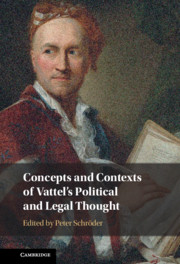
BOOK: Peter SCHRÖDER (ed.) Concepts and Contexts of Vattel's Political and Legal Thought (Cambridge: Cambridge University Press, 2021), ISBN 9781108784009


(image source: CUP)

Abstract:
Swiss-born Emer de Vattel (1714–1767) was one of the last eminent thinkers of natural law. He shaped the later part of early-modern natural jurisprudence. At the time, the subject had become a fashionable academic sub-discipline in both jurisprudence and philosophy. Vattel's considerable impact on statesmen, political thinkers, diplomats and lawyers during his lifetime and after rested primarily on the fact that his The Law of Nations (1758) transformed natural law into the basis of a more comprehensive and practicable theory of interstate relations. His ideas served to promote reform programmes whose comprehensive natures spanned the domains of economic reform, constitutionalism and international diplomacy and foreign trade policy. Vattel's conception centred round the principle that defined all sovereign states as nations composed of societies of free men and profoundly influenced legal and political debates in the eighteenth and nineteenth centuries.

See table of contents on Cambridge Core.


Friday, 2 July 2021

BOOK: Jean d'ASPREMONT, The Discourse on Customary International Law (Oxford: Oxford University Press, 2021), ISBN 9780192843906


(image source: OUP)

Book abstract:
This book argues that it does not suffice to simply invoke and demonstrate the two constitutive elements of customary international law, practice and opinion juris, to successfully and plausibly make a claim under the doctrine of customary international law. Behind what may look like a very crude dualist type of legal reasoning, a fine variety of discursive constructions are at work. By unpacking these discursive constructions, the book depicts the discursive splendour of customary international law. It reviews eight discursive performances at work in the discourse on customary international law and makes a number of original and provocative claims about this aspect of law. For example, the book claims that customary international law is not the surviving trace of an ancient law-making mechanism that used to be found in traditional societies. Indeed, as is shown throughout, the splendour of customary international law is everything but ancient. In fact, there is hardly any doctrine of international law that contains so many of the features of modern thinking. The book also puts forward the idea that all discursive performances of customary international law are shaped by texts, are articulated around texts, echo and continue pre-existing texts, unfold in a textual space, or, more simply, originate in a text-constituted environment.

Read more with OUP (DOI 10.1093/law/9780192843906.001.0001).


Monday, 21 June 2021

JOURNAL: Forum on "Historiography, Ideology, and Law" (History & Theory, LX (2021), Issue 2, 185-405


(image source: Wiley)

Historiography, Ideology and Law: an Introduction (Justin Desautels-Stein & Samuel Moyn) (DOI 10.1111/hith.12207)

Abstract:

This is an introduction to a forum on historiography, ideology, and law. The basic question weaving this forum together concerns the meaning of the term “critical” in the domain of critical legal history, a question that is deeply familiar to historians of all stripes. Ultimately, whether you are a lawyer doing historical work, a historian interested in law, or a historian of a different sort altogether, there is no hiding from the question of context and, critically, the ideological stakes in choosing an answer to that question.

 On the domestication of Critical Legal History (Justin Desautels-Stein & Samuel Moyn) (DOI 10.1111/hith.12208)

Abstract:

Among many of today's legal historians, there is a relatively new and generally unreflective understanding of the relationship between history and method. The landscape is everywhere marked by a tendency to eschew big thinking, grand theory, and programmatic approaches to historical explanation and social transformation. In the place of the grand theory approach to law and history, there is a preference for the minimalist, the pragmatic, the particularistic, and the quotidian. What this normal science of today's legal historiography makes obvious is a kind of attachment to particular kinds of problems with particular sorts of built-in solutions. The result for today is intellectual stagnation, a routinized and thoroughly domesticated mode of revealing contingency. Oddly, the fascination with contingency, and its deadening affair with a minimalist pragmatism, is itself a result of the triumph of what continues to be called “critical legal history.” Ostensibly due to an interface between critical legal studies and the historical discipline, the rise and triumph of critical legal history hides a secret: the whole idea of a reigning critical appreciation for contingency seems to be a misnomer. Sure, some may say that “things might have been otherwise.” But what this intellectual settlement demands is obedience to its qualification: “things might have been otherwise, but they weren't, and so let's get on with doing what works.” Although so-called critical legal history seduces adherents with promises of edgy progressivism, the actual malaise of our minimalism seems in fact to suggest just the opposite. It is a quiescent and even quietistic method in practice, counseling in its conservatism against higher-order proposals that might ever make good on the discovery that nothing is natural. In the end, either we must accept that critical legal history in the United States is a lot less politically explosive than we once thought—given its deradicalization and domestication today—or that people have been mistaken about what critical legal history was, is, and ought to be.

Law and the Time of Angels: International Law's Method Wars and the Affective Lives of Disciplines (Natasha Wheatley) (DOI 10.1111/hith.12209)

Abstract:

Recent method wars in international legal scholarship turn on the problem of law in time. Rejecting historians' focus on context and their “policing of anachronism,” prominent legal scholars like Anne Orford and Martti Koskenniemi have argued that the workings of modern law are not governed by the narrow strictures of sequential chronology and that legal scholars require alternate methods that reflect law's transfer of meaning through time. Contextualism, in this reckoning, represents a misguided methodological straightjacket that stifles critique by quarantining meaning and power in discrete historical silos; the embrace of anachronism, conversely, would foster a revitalized history of international law intimately connected with the political imperatives of the present. This essay uses the debate as an opening into a fuller exploration of law in history and in time. In considering the idiosyncratic way law frames time, sequence, and duration, it explores the connection between law's transtemporal transfers and its very mode of reproduction. To speak of law's capacity to escape context and travel through time is another way of describing its normativity: the laws of the past that survive to exert a normative force in the present are not, in their law-ness, past—they are simply present law. The essay suggests some ways to make that temporality itself the object of analysis (rather than naturalizing and affirming it, as Orford has, or, conversely, dismissing it as bad history, as some historians have). It draws on the history of science to generate an account of law's temporal habitus as a disciplinary knowledge tool, a kind of epistemic virtue that is intimately involved in law's internal criteria for truth and falsity.

Theorizing Constitutional History (Maeve Glass) (DOI 10.1111/hith.12210)

Abstract:

The historical study of American constitutional law has long rested on a conceptual framework that divides the past into linear units of analysis. Constitutional time unfolds according to discrete eras defined by changes in political leadership and governance, whereas constitutional space typically appears divided into bordered jurisdictions and regional sections. Despite the prominence of this conceptual framework, scholars have yet to ask how, why, and to what effect it became the paradigmatic mode of study. In the absence of close study, the framework instead appears as a neutral embodiment of the constitutional order. This essay offers a preliminary sketch of how theories of knowledge production, and particularly Louis Althusser's theory of law as an ideological apparatus, can help to move beyond this facile assumption. By returning to a selection of landmark judicial opinions and legal treatises from the long nineteenth century and analyzing their discursive practices in relation to the dominant modes of production, this exploratory essay suggests a striking possibility: that the paradigm that we have assumed to be a primordial part of the constitutional order only emerged in its current iteration in the late nineteenth-century shift from a plantation mode of production rooted in enslaved labor to an industrial mode of production rooted in wage labor. As these sources indicate, leading jurists in America's age of conquest and enslavement regularly analyzed questions of state power and rights by organizing time according to chains of title rooted in dispossession based on race and space according to the geographic circuits of capital. Effective in naturalizing the strict racialized hierarchy integral to the production and circulation of export commodities, this discourse of tethering institutions to the history of property acquisition and the movement of commodities began to shift with the formal abolition of slavery and rise of intensive industrialization, as a new generation of legal academics created a paradigm of institutional time and space that, by erasing material histories of structural inequality, made it possible to reconstitute an old social order predicated on racial classifications of whiteness.

Family Law Matters (Judith Surkis) (DOI 10.1111/hith.12211)

Abstract:

This essay analyzes how new histories of family law help to dismantle developmentalist accounts of legal, economic, and political modernity. Far from being backwaters, they have recently emerged as sites of theoretical and practical innovation. Recombining methodologies from genealogy to social reproduction theory and psychoanalysis, they do more than denaturalize categories, destabilize familiar narratives, and demonstrate ideological contradictions (although they do that too). Motivated by a sense of what is lost theoretically and politically by the family's historical and juridical marginalization, they reinvigorate legal history by locating the problem of the family at the center of broader critical projects.

 Proximate Causation in Legal Historiography (Simon Stern) (DOI 10.1111/hith.12212)

Abstract:

The variety of legal history published in general-interest law journals tends to differ from the variety published in history journals. This study compares the two varieties by examining footnote references in five general-interest law journals and footnote references in two journals of legal history. In the law journals, cases and statutes accounted for the single largest group of footnotes (approximately 35%), followed by references to other law journal articles (nearly 25%). In the legal history journals, these two categories accounted for less than 20% of all references; primary and secondary historical materials predominated in the footnotes. To be sure, legal decisions and law journal articles can also be historical sources: rather than being used as evidence of what the law is, they might be studied for what they reveal about legal reasoning or rhetoric in an earlier age. However, in most legal historical research that attends primarily to cases and statutes, these materials figure as evidence of the state of the law at that time. When the analysis relies on legal sources to trace the development of a certain doctrine and treats them as sufficient to account for that development, the result is the distinctive style of research that I seek to contrast against approaches that cast the net of historical inquiry more widely. To account for these different approaches, I suggest that law professors rely on a notion of proximate causation as a historiographic method. According to this approach, legal developments are proximately caused by other developments in the legal sphere, and other social and cultural developments play more attenuated roles, such that their influence is less significant. By proposing this explanation, I hope to draw more attention to assumptions about causation in legal historiography and to question their persuasive force.

(read further: Wiley

(source: ESCLH Blog)

Wednesday, 2 June 2021

WEBINAR: Grotian Theory Talks with Nehal BHUTA (Heidelberg: MPIL, 11 JUN 2021)


(image source: Twitter)

The MPIL in Heidelberg hosts the 'Grotian' Theory Talks. Prof. Nehal Bhuta (Edinburgh) is announced for the 11 June at 15:00 CET.

More information by clicking on the image.

Tuesday, 25 May 2021

CALL FOR ENGAGED LISTENERS: The Individual in International Law. History and Theory (MPIL Heidelberg, Zoom, 17-18 JUN 2021)


(image source: Wikimedia Commons)

Prof. Anne Peters and dr. Tom Sparks convene an online workshop on the individual in itnernational law, with a copious programme.

Abstract:

The interrelationship between international law and the individual has been the subject of a great and growing interest by scholars in recent years. In many or most of international law’s subfields and specialisms, the appropriate relationship between the interests of individuals and those of other actors is the subject of important debates. On the other hand, we are currently witnessing a return to statist principles in the debate and practice of international law, with an emphasis on sovereignty, territory, and boundaries. Human rights and the idea of rights more generally are under attack. The individual’s position in international law, pushed and pulled by these factors, is in flux. However, analyses conducted of the individual’s position remain, in the main, examinations of the positive law. A number of questions thus remain to be answered which go beyond the individual’s treatment by various fields of international law in the present moment, in particular from the perspectives of history and theory.

Participation:

 If you are interested in participating in the workshop as an engaged listener and thus in contributing to our discussions, please sign up via the links below. We particularly welcome the participation of early-career scholars, including pre- and post-graduate students, and from scholars working in institutions in the global south. Note that each link applies to only one day, and that those intending to attend the entirety of the workshop will need to register under both links. For further inquiries, or in case of technical difficulties, please contact Ms. Anette Kreutzfeld, via apeters-office@mpil.de.

 Program and more information here.


Thursday, 1 April 2021

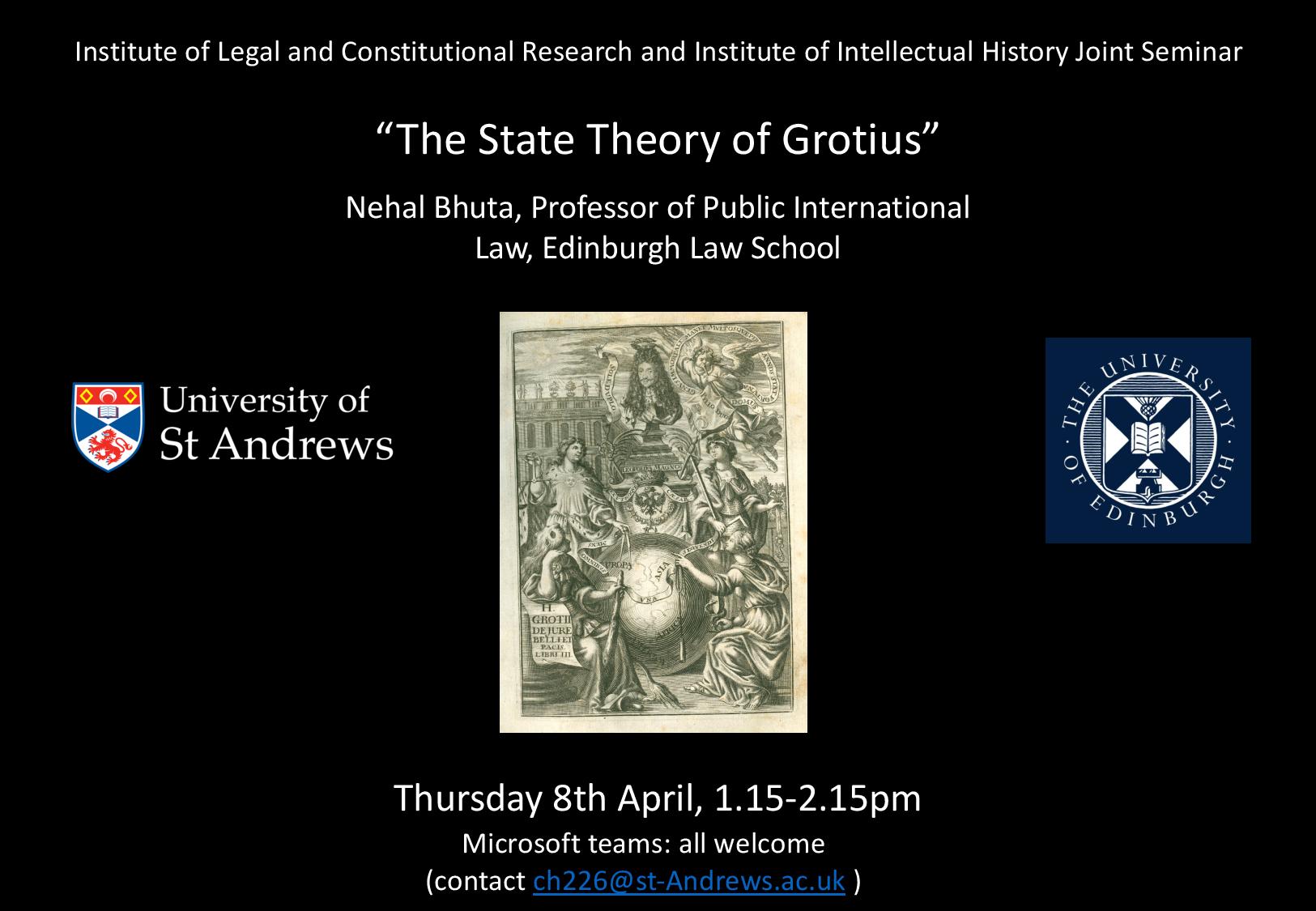
ZOOM SEMINAR: Nehal BHUTA, The State Theory of Grotius (St Andrews, ILCR - IIH, 8 APR 2021)


(source: Twitter; click on image to enlarge for full details)

Nehal Bhuta (Edinburgh Law School) will hold a talk on "The State Theory of Grotius", organized by the University of St Andrews (ILCR and IIH) on Zoom. Click on the image above to enlarge the image and obtain details.

(source: Twitter)

Monday, 15 March 2021

BOOK: Torben SPAAK & Patricia MINDUS (eds.), The Cambridge Companion to Legal Positivism [Cambridge Companions to Law] (Cambridge: CUP, 2021), ISBN 9781108447010


(source: Cambridge Core)

Book abstract:

Legal positivism is one of the fundamental theories of jurisprudence studied in law and related fields around the world. This volume addresses how legal positivism is perceived and makes the case for why it is relevant for contemporary legal theory. The Cambridge Companion to Legal Positivism offers thirty-three chapters from leading scholars that provide a comprehensive commentary on the fundamental ideas of legal positivism, its history and major theorists, its connection to normativity and values, its current development and influence, as well as on the criticisms moved against it.

(more information on Cambridge Core

Thursday, 25 February 2021

ARTICLE: Jochen VON BERNSTORFF, "Autorité oblige: The Rise and Fall of Hans Kelsen’s Legal Concept of International Institutions" (EJIL XXXI (2020), No. 2 (Sep) 497-523


(image source: OUP)

Abstract:
Hans Kelsen and his Vienna School in International Law developed a highly original legal concept of international institutions. It originated in the Interbellum and aimed at bolstering the new institutional structures created in the League era by promoting egalitarian legal structures and strong judicial controls of both member states and the organs of the institution. Against the background of this new approach to international organization, Kelsen, after World War II, developed a first and particularly harsh critique of the UN Charter.

Read further with OUP: DOI  10.1093/ejil/chaa045

Wednesday, 24 February 2021

BOOK: Randall LESAFFER and Janne NIJMAN (ed.), The Cambridge Companion to Hugo Grotius (Cambridge: CUP, 2021)

(image Hugo Grotius; source: Wikimedia Commons)


Abstract:

The Cambridge Companion to Grotius offers a comprehensive overview of Hugo Grotius (1583–1645) for students, teachers, and general readers, while its chapters also draw upon and contribute to recent specialised discussions of Grotius' oeuvre and its later reception. Contributors to this volume cover the width and breadth of Grotius' work and thought, ranging from his literary work, including his historical, theological and political writing, to his seminal legal interventions. While giving these various fields a separate treatment, the book also delves into the underlying conceptions and outlooks that formed Grotius' intellectual map of the world as he understood it, and as he wanted it to become, giving a new political and religious context to his forays into international and domestic law.

Table of contents:

1. Introduction Randall Lesaffer and Janne E. Nijman
Part I: Grotius in Context:
2. Life and Intellectual Development. An Introductory Biographical Sketch Henk Nellen
3. Grotius as Legal, Political and Diplomatic Official in the Dutch Republic Edwin Rabbie
4. Grotius and the East Indies Peter Borschberg
Part II: Concepts:
5. Virtue Mark Somos
6. Trust (fides) Peter Schröder
7. Natural Law as True Law Meirav Jones
8. Sociability Benjamin Straumann
9. Sovereignty Guus Van Nifterik
10. Church and State Harm-Jan Van Dam
11. Predestination Camilla Boisen
12. Rights Francesca Iurlaro
13. Rights Laurens Winkel
14. Property, Trade and Empire Andrew Fitzmaurice
Part III: Grotius as Man of Letters, Theologian and Political Writer:
15. Literary Writings Arthur Eyffinger
16. Historical Writings Jan Waszink
17. Theological Writings Oliver O'Donovan
18. Political Writings Hans Blom
Part IV: Grotius as a Legal Scholar:
19. Legal Scholastic and Humanist Influences on Grotius Alain Wijffels
20.Grotius' Introduction to Hollandic Jurisprudence Wouter Druwé
21. The Laws of War- and Peace-Making Randall Lesaffer
22. The Law of Armed Conflict Stephen C. Neff
23. The Freedom of the Seas William E. Butler
24. Property Bart Wauters
25. The Law of Contract and Treaties Paolo Astorri
26. Punishment and Crime Dennis Klimchuk
Part V: The Reception of Grotius:
27. Grotius and the Enlightenment Marco Barducci
28. Grotian Revivals in the Theory and History of International Law Ignacio de la Rasilla
29. Grotius in International Relations Theory William Bain.

On the editors:

Randall Lesaffer, Universiteit van Tilburg, The Netherlands Randall Lesaffer is Professor of Legal History at KU Leuven in Belgium and at Tilburg University in The Netherlands. His research focuses on the history of the early-modern law of nations in Europe, as well as the history of modern international law. He is the general editor of The Cambridge History of International Law, Oxford Historical Treaties and an editor of The Journal of the History of International Law. He is president of the Grotiana Foundation (https://grotiana.eu/); Janne E. Nijman, Universiteit van Amsterdam Janne E. Nijman is Professor of History and Theory of International Law at the University of Amsterdam in The Netherlands, and academic director of the T.M.C. Asser Institute in The Hague. She is also Professor of Public International Law at the Graduate Institute of International and Development Studies in Geneva. She has published on Hugo Grotius, and she is an editor on the board of Grotiana and a board member of the Grotiana Foundation (https://grotiana.eu/).

(source: CUP

Friday, 22 January 2021

VACANCY: Professor in Methods of Legal Research and Legal Theory (Ghent University, Deadline 22 FEB 2021)

(Aula Academica, Ghent University; image source: Wikimedia Commons)

 Assignment:

The Faculty of Law and Criminology is recruiting a tenure track assistant professor for a full time position starting on 1 September 2021 in the discipline of Methods of Legal Research and Legal Theory. 

With this position, the faculty wishes to increase its expertise with a view to providing a sound methodological foundation for legal research in the faculty. This also requires the candidate to possess a solid knowledge of legal theory.

You will be appointed in the department of Interdisciplinary Study of Law, Private Law and Business Law (RE21). 

During the 5 year tenure track, you will have the possibility to devote most of your time to academic research activities in the field of Methods of Legal Research and Legal Theory, with a teaching load limited to no more than 8 ECTS credits per semester on average over a period of 3 years.

For the further development of the academic career, please see ‘Appointment information’ below.


Academic Research
You conduct research in the discipline of Methods of Legal Research and Legal Theory


Academic education


You will gradually be tasked with teaching assignments in the field of Methods of Legal Research and Legal Theory.


Academic services

You take part in the internal and external service provision of the department of Interdisciplinary Study of Law, Private Law and Business Law (RE21).
You advise colleagues on methodogical aspects of their academic research.

Profile

Experience
-    You have already conducted excellent academic research in the fields of methods of legal research and legal theory, which is clearly reflected in outstanding publications in national and international peer-reviewed books and/or journals;
-    You are didactically skilled to teach university students to develop academic competences; 
-    You are familiar with research methods in other social sciences.
-    Recommended are: 
          o    Experience in supervising research and/or coaching Ph.D. students;
          o    International mobility, among other things thanks to research stays at institutions external to the  one where you acquired your highest academic degree;
          o    Positively evaluated experience in provided or organised academic lecturing;
          o    Professionalisation of education.


Skills / Attitude 
-    You are quality-oriented; 
-    You take initiative;
-    You are a proactive person and possess strong interpersonal skills;
-    You are able to coach and adequately supervise young researchers.


Admission requirements
-    You hold a thesis-based doctorate or a diploma or certificate that is recognised as equivalent (article V.20 Codex Higher Education). 


Upon evaluation of a foreign (non-EU) diploma, a certificate of equivalence may still have to be requested at NARIC. If this is the case, we advise you to initiate this recognition procedure as soon as possible. You are required to have the recognition no later than on the date of your appointment. 


-    You have at least two years of postdoctoral experience 1 september 2021. This term of two years is determined by the date written on the above-mentioned required diploma.

 Appointment information

We offer you a temporary appointment as an assistant professor in a tenure track system for a term of five years with a focus on research. If positively evaluated by the University Board, the term of office will be transferred into a permanent appointment as an associate professor. At that moment the time devoted to research, education and academic services may be altered. The recruitment is possible no sooner than 1 september 2021.

More information here

Thursday, 10 December 2020

ONLINE SERIES: Method, methodology and critique in international law (Asser Institute, 2020-2021)


(image source: Asser)

Description:

In recent decades, the field of international law has seen a multiplication of methodological approaches, a growing variation in methods and a critical reflection on central epistemological and stylistic registers. Changes in the course of the discipline have thereby often been fueled not by new substantive claims in existing (doctrinal, analytical or political) controversies, but through the emergence of different modes of seeing, thinking and writing. The aim of the new Asser lecture and workshop series is to explore various new ways of ‘doing’ international legal scholarship. This includes a focus on the opportunities, pitfall and politics of varying methodological approaches, their embedded epistemological, sociological or philosophical commitments as well as the particular technical crafts they demand. Researchers participating in the workshops will not only gain a better grasp of how to position themselves in an increasingly complex methodological landscape. They will also enhance their understanding of what is at stake in the various ‘turns’ that are continuously performed in international law (such as the ‘turn’ to practice, history, discourse, political economy, critical sociology, materiality, geography or aesthetics to name but a few).

Program:

Programme: 'Method, methodology and critique in international law' 16 December 2020 – 14.00. Introducing the Asser workshop series on method, methodology and critique in international law – Dimitri Van Den Meerssche and Wouter Werner 20 January 2021 – 11.00. Political economy – John Haskell and Ntina Tzouvala 17 February 2021 – 14.00. Historiography – Rose Parfitt and Nehal Bhuta 17 March 2021 – 14.00. Postcolonialism and critical race theory – Luis Eslava and Ayça Çubukçu 21 April 2021 – 14.00. Critical sociology and discourse analysis – Sara Dezalay and Antoine Vauchez 19 May 2021 – 14.00 STS and ANT – Marieke de Goede and Gavin Sullivan 9 June 2021 – 14.00. Legal anthropology and ethnography – Emma Nyhan and Matt Canfield 22 September 2021 – 14.00. Posthumanism and new materialism – Matilda Arvidsson and Sara Kendall 20 October 2021 – 14.00. Critical geography – Nik Rajkovic and Sofia Stolk 17 November 2021 – 14.00. Architecture, space & design – Renske Vos and Amin Parsa 15 December 2021 – 14.00. Aesthetics, affect & emotion – Emily Kidd White and Rebecca Sutton December 2021 (dates tbc) Concluding two-day workshop with keynote speaker Gerry Simpson 

Full program here

(source: Asser Institute)

Monday, 7 December 2020

ONLINE SYMPOSIUM: JHIL Special Issue "Politics and the Histories of International Law" (Friday 18 DEC, 09:00-10:45, CET); DEADLINE 14 DEC 2020

(image: La lecture de Molière by François de Troy (1728); source: Wikimedia Commons)

On the occasion of the recent publication of the JHIL's special issue 'Politics and the Histories of International Law' the ESIL IGHIL will be organizing an online seminar on 18 December (09-10:45, CET) providing an appraisal of the individual articles and an overall discussion of the special issue's impact on the field. 

We are offering the opportunity to give a short presentation on one of the articles and its merits or potential issues to young researchers interested in the relationship between international law, legal history and modern politics. 

Scholars of any gender, nationality or disciplinary background are warmly invited to apply with an outline of their views on their chosen article and a short CV at esilighil@gmail.com by Monday 14 December 13:00 CET. The event itself will be streamed anline and open to all.

Monday, 30 November 2020

BOOK: Ekaterina YAHYAOUI KRIVENKO, Space and Fates of International Law - Between Leibniz and Hobbes (Cambridge: Cambridge University Press, 2020). ISBN 9781108488754, 85.00 GBP

(Source: CUP)

CUP is publishing a new book on the influence exercised by the concept of space on the emergence and continuing operation of international law.

ABOUT THE BOOK

The book offers the first analysis of the influence exercised by the concept of space on the emergence and continuing operation of international law. By adopting a historical perspective and analysing work of two central early modern thinkers – Leibniz and Hobbes – it offers a significant addition to a limited range of resources on early modern history of international law. The book traces links between concepts of space, universality, human cognition, law, and international law in these two early modern thinkers in a comparative fashion. Through this analysis, the book demonstrates the dependency of the contemporary international law on the Hobbesian concept of space. Although some Leibnizian elements continue to operate, they are distorted. This continuing operation of Leibnizian elements is explained by the inability of international law, which is based on the Hobbesian concept of space, to ensure universality of its normative foundation.

ABOUT THE AUTHOR

Ekaterina Yahyaoui KrivenkoNational University of Ireland, Galway


Ekaterina Yahyaoui Krivenko is the current Chair of the Interest Group on International Legal Theory and Philosophy of the European Society of International Law. In 2016 she received NUI Galway President's award for research excellence. Her work critically examines theoretical underpinnings of international law and human rights.

TABLE OF CONTENTS

1. Introduction

2. Science and Law in the Seventeenth Century

3. Space

4. The Idea of Universals and Human Cognition

4. Law

5. Intermezzo

6. Space(s) of International Law

7. Conclusions and Way Forward


More info here

(source: ESCLH Blog)

Friday, 27 November 2020

BOOK: François BRUNET, La pensée juridique de...Hans Kelsen (Paris: Mare & Martin, 2019). ISBN: 978-2-84934-440-8, pp. 160, € 9


(Source: Mare & Martin)

ABOUT THE BOOK

Ce livre concis et accessible présente les principales facettes de la pensée de Hans Kelsen, reconnu comme l’un des plus grands juristes du xxe siècle. Figure de proue du positivisme juridique, ce théoricien prône une science pure du droit, dédiée à la description objective du système juridique existant. Cet ouvrage restitue pas à pas le sens précis des concepts fondamentaux de Kelsen, dont la célèbre « hiérarchie des normes ». Ce faisant, il s’agit de montrer la profonde cohérence du projet intellectuel de Kelsen, marqué par l’idéal de la science.

ABOUT THE AUTHOR

François Brunet est professeur de droit public à l’université de Tours. Il a publié notamment La normativité en droit (Mare & Martin, 2012) et Introduction générale au droit avec Muriel Fabre-Magnan (Puf, 2017).


More information with the publisher.

(source: ESCLH Blog)

Friday, 20 November 2020

ADVANCE ARTICLE: Hans BLOM & Mark SOMOS, 'Public-Private Concord through Divided Sovereignty: Reframing societas for International Law' (Journal of the History of International Law/Revue d'histoire du droit international) (OPEN ACCESS)

(image source: Brill)

 Abstract:

Grotius is the father of modern international law. The indivisibility of sovereignty was the sine qua non of early-modern conceptual innovation in law. Both statements are axiomatic in the mainstream literature of the last two centuries. Both are profoundly and interestingly wrong. This paper shows that Grotius’ systematisation of public and international law involved defining corporations as potentially (and the VOC actually) integral to reason of state, and able to bear and exercise marks of sovereignty under certain conditions. For Grotius, some corporations were not subsumed under the state’s legal authority, nor were they hybrid ‘company-states’. Instead, states and such corporations, able and forced to cooperate, fell under dovetailing natural, international, and municipal systems of law. The paper reexamines Grotius’ notion of international trade, public debt, private corporation, and public and private war through the reassembled prism of these dovetailing laws and the category of societas that underpins Grotian associations. It is argued that although formulated around the new East India trade, the actual reality of legal pluralism was available to Grotius in the Dutch trade experience of the sixteenth century.

(read more with Brill: DOI 10.1163/15718050-12340170)

Wednesday, 18 November 2020

ARTICLE: Kostiantyn GOROBETS, 'The International Rule of Law and the Idea of Normative Authority' (Hague Journal on the Rule of Law XII (2020), nr. 12, 227-249)


(image source: Wikimedia Commons)

Abstract:

Domestic and international jurisprudence exist and develop as two ‘pocket universes’ in a sense that they belong to the same fabric of reality, but at the same time many concepts shift their meaning when moved from one pocket to another. This is of a paramount importance for the idea of the rule of law, which in domestic setting was forged in the flame of civil wars and struggles against the rulers. This history and such struggles are something international law has never known, and thus any direct transplantation of the domestic images of the rule of law to international realm are doomed to fail. This entails a need in deconstructing the rule of law. Its core meaning (‘laws must be obeyed’), brings a normative claim relevant to any legal order. The idea of the (international) rule of law appears to be linked to the idea of authority of (international) law. There are differences of the structures of authority in domestic and international law as authority can be mediated or unmediated. Mediation of authority, typical for domestic law, presupposes the existence of officials that are functionally and institutionally differentiated from the subjects of law. Authority of international law is by and large unmediated because of its horizontal nature. Such reconstruction allows to reframe the central concern of the international rule of law enquiries. Instead of trying to fit it to the procrustean bed of domestic theories, international legal scholarship must focus on defining conditions under which international law’s claim to authority is realisable.

(read the article: DOI https://dx.doi.org/10.1007/s40803-020-00141-3

Tuesday, 17 November 2020

ADVANCE ARTICLE: Wouter DE RYCKE, "Legislating Utopia. Louis Bara (1821–1857) and the Liberal-Scientific Restatement of International Law in the Nineteenth Century Peace Movement" (Journal of the History of International Law/Revue d'histoire du droit international)


(image source: Brill)

Abstract:

This article deals with the contribution of one exponent of the first generation of institutional pacifist internationalism to the rise of ius contra bellum. Traditionally associated with events from the late nineteenth century onwards, this significant paradigm shift knew an extensive prehistory. Legal scholarship has long dismissed the ‘peace friends’ of the mid-century as either not legalistic or solely focussed on arbitration. The article will argue that this longstanding bias has precluded a profound engagement with legal discourse within the early international peace movement. It will do so through a contextual legal analysis of the works of Louis Bara, a young Belgian lawyer who won first prize for his lengthy and controversial peace essay at the famous Paris peace conference of 1849. This neglected jurist articulated an enduring popular desire to develop a liberal international legal project, which both the peace movement and international law as a discipline increasingly internalized.

(read more with Brill; DOI 10.1163/15718050-12340146 

Thursday, 5 November 2020

ADVANCE ARTICLE: Felix WALDMANN, 'Natural Law and the Chair of Ethics in the University of Naples, 1703–1769' (Modern Intellectual History)

(image source: CUP)

Abstract:

This articles focuses on a significant change to the curriculum in “ethics” (moral philosophy) in the University of Naples, superintended by Celestino Galiani, the rector of the university (1732–53), and Antonio Genovesi, Galiani's protégé and the university's professor of ethics (1746–54). The article contends that Galiani's and Genovesi's sympathies lay with the form of “modern natural law” pioneered by Hugo Grotius and his followers in Northern Europe. The transformation of curricular ethics in Protestant contexts had stemmed from an anxiety about its relevance in the face of moral skepticism. The article shows how this anxiety affected a Catholic context, and it responds to John Robertson's contention that Giambattista Vico's use of “sacred history” in his Scienza nuova (1725, revised 1730, 1744) typified a search among Catholics for an alternative to “scholastic natural law,” when the latter was found insufficiently to explain the sources of human sociability. 

(read the article here: DOI 10.1017/S1479244320000360)