ESIL Interest Group History of International Law

ESIL Interest Group History of International Law
Showing posts with label history of international law. Show all posts

Monday, 25 October 2021

ARTICLE: Andreas VON ARNAULD, "How to Illegalize Past Injustice: Reinterpreting the Rules of Intertemporality", EJIL XXXII (2021), Nr. 2, 401-432


(image source: OUP)

Abstract:

Attempts to legally tackle cases of historical injustice are often confronted with the problem that the events in question were not considered illegal at their time and that, in general, legal rules should not be applied retroactively. The present article suggests a conceptual framework to carefully stretch the dogmas of intertemporal law by introducing, via ethical principles as part of positive law of the time, contemporary contestation of inhumane actions and practices. Even though such contestation might not yet be enough to overturn a widely shared apologetic view among lawyers and states, it is argued that the violation of ethical-legal principles as such should give rise to a duty to give satisfaction under the law of state responsibility. In most cases of historical injustice brought to court, members of victimized groups aim at acknowledgment of their plight and at a reappraisal of the past that includes their experiences. In line with this objective, the present article makes a special case for a state obligation to negotiate with the victims of historical injustice or their descendants.

(read more here: DOI 10.1093/ejil/chab037) 

Thursday, 21 October 2021

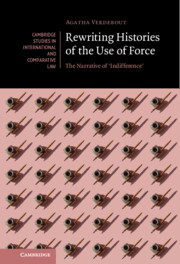
BOOK: Agatha VERDEBOUT, Rewriting Histories of the Use of Force The Narrative of ‘Indifference' [Cambridge Studies in International and Comparative Law; 160] (Cambridge: CUP, 2021), ISBN 9781108937375


(image source: CUP)

On the book:

It is commonly taught that the prohibition of the use of force is an achievement of the twentieth century and that beforehand States were free to resort to the arms as they pleased. International law, the story goes, was 'indifferent' to the use of force. 'Reality' as it stems from historical sources, however, appears much more complex. Using tools of history, sociology, anthropology and social psychology, this monograph offers new insights into the history of the prohibition of the use of force in international law. Conducting in-depth analysis of nineteenth century doctrine and State practice, it paves the way for an alternative narrative on the prohibition of force, and seeks to understand the origins of international law's traditional account. In so doing, it also provides a more general reflection on how the discipline writes, rewrites and chooses to remember its own history.

On the author:

Agatha Verdebout holds a PhD in Public International Law from the Université Libre de Bruxelles (ULB). Her main research interests lie in critical histories of international law and the use of force. She is the recipient of several prizes, awards and research grants, notably the 2017 Henri Rolin Prize.

(read more here)

Friday, 15 October 2021

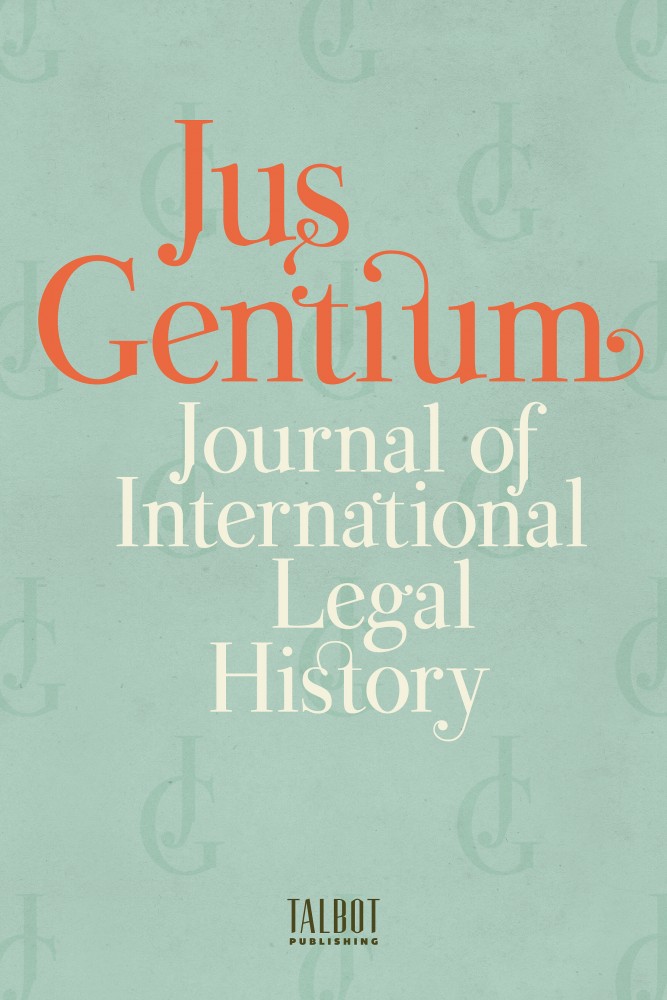
JOURNAL: Jus Gentium. Journal of International Legal History VI (2021), No. 2 (Jul)


(image source: Lawbookexchange)

Vol. 6, No. 2 | July 2021

ARTICLES
Theory of the History of International Law: Methodology, Grounds, and Developments
Olga Butkevych

The English Translators and Publishers of Grotius on War and Peace: 1654–1928
W. E. Butler

China and the Unequal Treaties: Localization, Variation, and Response
Zenghua Zhuo

NOTES AND COMMENTS
Ruminations on DNA and the History of International Law
W. E. Butler

Georg von Gretschaninow (1892–1973): Émigré Jurist Stateless at Berlin and Heidelberg. A Concise Bio-Bibliography
P. Macalister-Smith

DOCUMENTS AND OTHER EVIDENCE OF STATE PRACTICE
Royal Naval Instructions Implementing the 1817 Anglo-Spanish Treaty on Illicit Trafficking of Slaves
W. E. Butler

A Brief Calendar of State Practice for Shandong: 1897–1914. Part Four (1914): Into World War
P. Macalister-Smith
J. Schweitzke

FROM THE LITERATURE

(source: lawbookexchange)

Tuesday, 12 October 2021

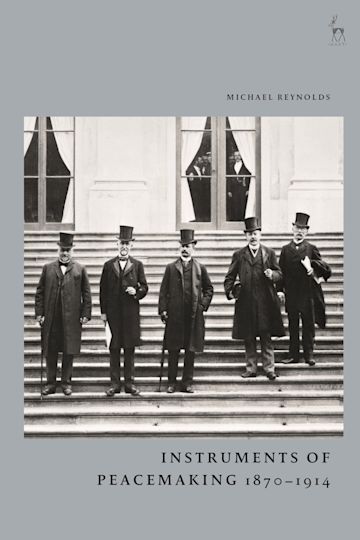
BOOK: Michael REYNOLDS, Instruments of Peacemaking 1870-1914 (London: Bloomsbury, 2021), 360 p. ISBN 9781509938308, 72 GBP


(image source: Bloomsbury)

Book abstract:
This book focuses on Anglo-American disputes arising out of the civil war in the United States and British interests in the American continent: the Geneva Arbitration, the Venezuela-Guiana Arbitration and the Bhering Sea Arbitration. It draws on those cases as model proceedings which laid the foundations and inspiration for a promotion of international law through the Hague Conferences and by the work of English and American jurists. It considers the encouragement these cases gave to the promotion of public international law and how that contributed to the resolution of inter-state disputes.

On the author:

Michael Reynolds is Visiting Senior Research Fellow in the Department of International History at the London School of Economics and Political Science, UK. 

(more information with the publisher) 

(source: ESCLH Blog)

Tuesday, 5 October 2021

ROUNDTABLE: The Historical Turn in International Economic Law - Ghent/Brussels, 12.10.2021 – 12h30-14h (on Zoom)


(Source: Rolin-Jaequemyns International Law Institute Ghent)


The historical turn in international has been followed by various subdisciplinary turns to, for example, the history of human rights law, international humanitarian law and international criminal law. Nevertheless, the origins and history of international economic law has received less attention from both international economic lawyers and international legal historians. This roundtable will reflect on the current state of the art, its gaps and potential avenues for future research, in particular with respect to interdisciplinarity, periodization, method, the role of non-state actors and eurocentrism.


Convenors:

Drs. Filip Batselé (Ghent University – Université Libre de Bruxelles, Ghent Legal History Institute – Centre de droit international)

Dr. Gustavo Prieto (Ghent University, Human Rights Center - Human Rights in Context)

Drs. Florenz Volkaert (Ghent University, Ghent Legal History Institute)


Introduction by:

Prof. Dr. Em. Ernst-Ulrich Petersmann (European University Institute): ‘Reflections on the history of international economic law’


Panelists:

Dr. Mona Pinchis-Paulsen (London School of Economics)

Dr. Sabine Pitteloud (Université de Genève)

Dr. Raphaël Lima Sakr (University of Sheffield)

Moderated by Dr. Gustavo Prieto


Jointly hosted by the Ghent Legal History Institute, the Ghent Rolin-Jacquemyns Institute and Contextual Research in Law (Free University of Brussels), in collaboration with the ESIL Interest Groups International Economic Law and History of International Law.

12.10.2021 – 12h30-14h (Zoom-link to register).


Monday, 27 September 2021

RESEARCH GUIDE: History of International Law (Peace Palace Library, The Hague)

(image source: PPL)

Presentation
The History of International Law examines the evolution and development of public international law in both state practice and conceptual understanding. Modern international law developed out of Renaissance Europe and is strongly entwined with the development of Western political organisation at that time. The development of European notions of sovereignty and nation states would necessitate the development of methods for interstate relations and standards of behaviour, and these would lay the foundations of what would become international law.

(read further on the PPL website) 


Monday, 6 September 2021

VACANCY: Professorship in Legal History (Tilburg: Tilburg University, DEADLINE 24 SEP 2021)


(image: "Hoofdwacht te Tilburg" (1830); source: Europeana/Rijksmuseum)

Tilburg University advertises a vacancy for a professorship in legal history (80%).

More information can be found here.

Wednesday, 1 September 2021

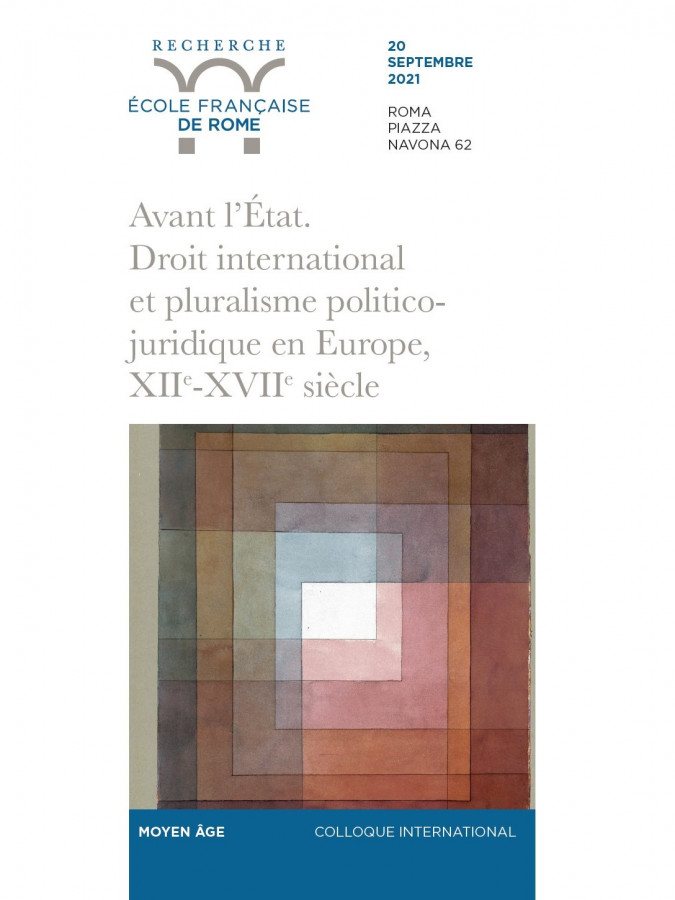
CONFERENCE PROGRAM: Avant l'État. Droit international et pluralisme politico-juridique en Europe, XIIe-XVIIe siècle (Rome, Ecole Française de Rome, 20 SEP 2021 - HYBRID)


(image source: univ-droit)

Conference presentation

Alors que l’État national souverain a longtemps été considéré comme l’acteur exclusif des relations internationales, ce projet a l’ambition de nouer un dialogue entre historiens et historiens du droit pour s’interroger sur le droit international conçu comme le cadre multi-normatif qui régit les relations entre une grande variété d’acteurs. Cette notion nous paraît mieux s’adapter aux traits spécifiques de la constellation politique médiévale et pré-moderne, qui était caractérisée par l’entrelacement de différentes juridictions, fondées sur des liens de dépendance personnelle et sur des relations de sujétion territoriale, par la coexistence d’une pluralité de centres de pouvoir au statut variable et par la répartition de l’autorité politique à différents niveaux.

Les thèmes abordés dans les deux rencontres (la première à Rome le 20 septembre 2021 et la deuxième à Lille et Courtrai les 18-19 mai 2022) incluent la guerre, les représailles, la diplomatie, les relations féodales, le droit de la mer, le commerce ou encore les relations avec les juifs et les « infidèles », notre ambition générale étant de faire porter la réflexion sur trois questions transversales : celle des acteurs du droit international ; celle des sources du droit international, qui ne constituait pas à l’époque prémoderne une branche autonome de la science juridique ; celle enfin de la résolution des conflits, en particulier à travers la médiation et l’arbitrage.

Programme:

9h30 : Accueil des participants
Brigitte Marin - Directrice de l’EFR

9h50 : Introduction
Dante Fedele - CNRS Lille
Randall Lesaffer - KU Leuven
Pierre Savy - EFR


Droit, politique et diplomatie

Présidence : Luca Loschiavo - Università degli Studi di Teramo

10h10 : Tra attività pubblica e privata : il ruolo diplomatico dei banchieri della Corona d’Aragona nella Curia durante il tardo Medioevo
Esther Tello Hernández - Universitat de València

10h30 : Videtur maxima inequalitas. Le aderenze nella diplomazia dei Gonzaga (XIV-XV secolo)
Francesco Bozzi - Università degli Studi di Milano Statale

10h50 : Uno stato pluricittadino : analisi del cosiddetto “bilancio” delle entrate e spese del ducato di Milano, 1463
Nadia Covini - Università degli Studi di Milano Statale

11h10 : Serenissimus Rex Romanorum et Rex Francorum, uter alterum praecedat : una rilettura dei rapporti tra impero e regno di Francia in un consilium (1545) di Antonio Quetta
Giovanni Rossi - Università di Verona

11h30 : Il jus gentium e il diritto di legazione nella prima età Moderna : gli Stati terzi e il riconoscimento delle prerogative diplomatiche
Giuseppina De Giudici - Università degli Studi di Cagliari


Après-midi


Frontières et conflits

Présidence : Sara Menzinger - Università degli Studi Roma Tre

14h30 : Aquinas on infidel dominium
Bart Wauters - IE University

14h50 : Allying with Infidels : Hugo Grotius’s Letters to East-Indian Rulers
Marc de Wilde - University of Amsterdam

15h10 : Reprisal in theory and practice : the 17th century case of Robert Powlett
Philippine Van den Brande - KU Leuven

15h30 : Justice at the Borders and International Law : Extradition Agreements in Renaissance Italy
Andrew Vidali - Università Ca’ Foscari Venezia

15h50 : Conclusions
Alain Wijffels - CNRS Lille, KU Leuven

(see earlier on this blog)

(source: univ-droit)

Tuesday, 31 August 2021

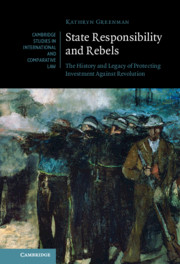
BOOK: Kathryn GREENMAN, State Responsibility and Rebels. The History and Legacy of Protecting Investment Against Revolution [Cambridge Studies in International and Comparative Law; 161] (Cambridge: Cambridge University Press, 2021), ISBN 9781009043779, 85 GBP


(image source: CUP)

Book abstract:
This book traces the emergence and contestation of State responsibility for rebels during the nineteenth and early-twentieth centuries. In the context of decolonisation and capitalist expansion in Latin America, it argues that the mixed claims commissions-and the practices of intervention associated with them-served to insulate economic order against revolution, by taking the question of who assumed the risk of harm by rebels out of the scope of national authority. The jurisprudence of the commissions was contradictory and ambiguous. It took a lot of interpretive work by later scholars and codifiers to rationalise rules of responsibility out of these shaky foundations, as they battled for the meaning and authority of the arbitral practice. The legal debates were structured around whether the standard of protection against rebels owed to aliens was nationally or internationally determined and whether it was domestic or international authority that adjudicated such standard-a struggle over the internationalisation of protection against rebels.
On the author:
Kathryn Greenman is Lecturer in Law at the University of Technology Sydney. She is a co-editor of Revolutions in International Law: The Legacies of 1917 (Cambridge University Press, 2021) with Anne Orford, Ntina Tzouvala and Anna Saunders.

(source: CUP) 


Monday, 30 August 2021

BOOK: Dominique BAUER & Randall C.H. LESAFFER (eds.), History, Casuistry and Custom in the Legal Thought of Francisco Suárez (1548-1617). Collected Studies [Legal History Library, 51; Studies in the History of International Law, 19] (Leiden/Boston: Martinus Nijhoff/Brill, 2021), viii + 160 p. ISBN 9789004464803, € 93


(image source: Brill)

Book abstract:
The thought and work of the Jesuit Francisco Suárez (1548-1617) is widely acknowledged as the culmination point of the contribution of the theologians and jurists of the so-called School of Salamanca to the development of modern Western law. This collection of studies on the legal work of Suárez explores some of his major forays into the law. Both his theoretical system-building as well as his interventions in practical questions are covered. Next to discussions on the nature of law and its different categorisations, they extend to various subbranches of the law including family law, property law, the law of obligations, criminal law and international law.

Contributors:

Dominique Bauer, Daniel Schwartz, João Manuel Azevedo Alexandrino Fernandes, Lisa Brunori, Wim Decock, Bart Wauters, Gaëlle Demelemestre, Jean-Paul Coujou, and Cintia Faraco.  

Read more with Brill (DOI 10.1163/9789004464810) 


Wednesday, 18 August 2021

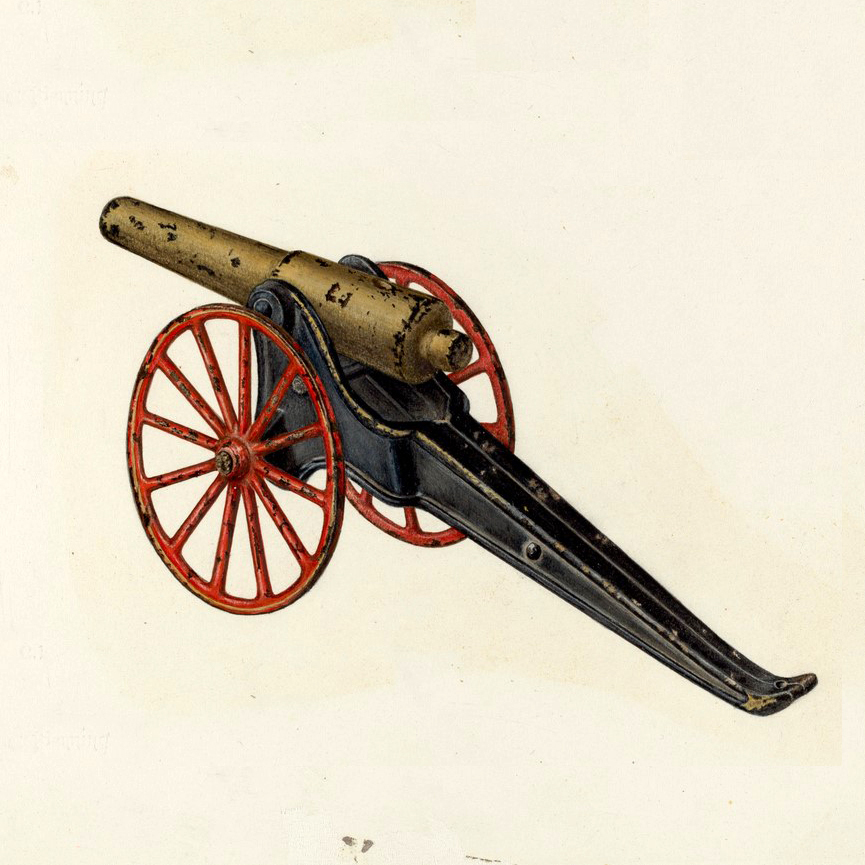
BLOG: Christian POGIES, The Cannon. A Tool for Delimiting Maritime Space (Legal History Insights, MPILHLT)


(image source: MPILHLT)

 First paragraph:

This is the story of the cannon as a tool to delimit maritime space in the history of the law of the sea. It is a story that spans from the 17th to the 20th century – it is a story about a state practice that became legal theory, technological progress and Western dominance in international law.

Read more here.

Friday, 9 July 2021

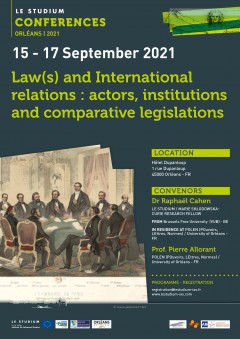
CONFERENCE: Law(s) and International relations : actors, institutions and comparative legislations (Orléans, 15-17 SEP 2021)

(image source: Le Studium)

Conference description:

In the last twenty years, the study of the history of international law and of international relations has witnessed something of a renaissance. The bicentenary of the Congress of Vienna (1814-1815) also led to several new publications on the Congress System and on the “security culture” that was established in the aftermath of Napoleon. Nevertheless, many lacunae remain, especially regarding the relationship between law(s) and international relations during the long nineteenth century and in the sociocultural history of international law as a discipline with its own actors, networks, venues, institutions and power circles. The aim of the present conference is to deepen our study of the interconnections  between law(s) and international relations through the eyes of a plurality of actors (e.g., legal advisers, lawyers, judges, activists, publicists, journalists, editors), institutions (e.g., foreign offices, courts, universities, academies of science, associations, libraries) and works on comparative law. Three focuses will be especially addressed by this conference. The first is the plurality of actors. We welcome proposals on legal advisers within governments, foreign offices and national or colonial administrations; on civil and administrative judges, admiralty courts and prize laws; and on lawyers, academics, peace activists, international thinkers, journalists and editors, including women as well as men. A prosopography of a group of actors is invited as well as individual biographies. The theme of the birth and professionalization of “international lawyers” will be studied as well as the various editors and the book market for international law. Our second focus will be on institutions. We especially invite papers studying the treatment of law(s) in foreign offices in a comparative perspective. For example, in Great Britain, legal issues were dealt by the Queens Lawyers until 1872 and afterwards by the Legal Adviser of the Foreign Office. In France after 1835, it was the Comité consultatif du contentieux that dealt with legal issues. But what about the foreign offices of other countries? Other institutions (similar to the Conseil d’état in France) may have also had their own “Foreign Office Committee.” How were these organized? Did they cooperate with the foreign office?  What role was played by scientific academies in the diffusion of international law? By the universities? By popular libraries? Our third and final focus is on the study of comparative law and its link to the development of international law. The Société de législation comparée, founded in 1869, was full of members of the first generation of the Institut de Droit International, while many comparativists were, vice versa, members of the Institut de Droit International. Scientific journals such as the Revue historique de droit français et étranger and the Revue de droit international et de législation comparée dealt with both comparative and international law. Papers on the progressive autonomy of the discipline and on the networks of the founding members are especially welcome.

Convenors:

Dr Raphaël Cahen, LE STUDIUM / Marie Skłodowska-Curie Research Fellow FROM: Brussels Free University  (VUB) - BE IN RESIDENCE AT: POuvoirs, LEttres, Normes (POLEN) / CNRS, University of Orléans - FR, Prof. Pierre Allorant, POuvoirs, LEttres, Normes (POLEN) / CNRS, University of Orléans - FR, Prof. Walter Badier, POuvoirs, LEttres, Normes (POLEN) / CNRS, University of Orléans - FR 

See full program here. 

(see call earlier on this blog)

Tuesday, 6 July 2021

ADVANCE ARTICLE: Miloš VEC, "A Luminous Trace. Commemorating the Frankfurt Lawyer and Historian of International Law Michael Stolleis (20 July 1941–18 March 2021)" (Journal of the History of International Law/Revue d'histoire du droit international) (OPEN ACCESS)

(image source: Brill)

First paragraph:

Perhaps it is not an inappropriate idea to have a profile of the late pioneer of global international legal history and emeritus editor of this journal, Michael Stolleis, begin in a Munich attic room. So let’s travel back a few decades, to Munich in the late 1960s, where Stolleis, a doctoral student and later post-doctoral lecturer, received crucial inspiration for his style of thinking.

Read further on the journal's website: DOI 10.1163/15718050-12340188. 

A German version is available here: DOI 10.1163/15718050-12340190

Thursday, 1 July 2021

SSRN PAPER: Alexandra KEMMERER, "Exile and Access: Lilly Melchior Roberts and the Infrastructures of International Law" (forthcoming in: Immi TALLGREN (ed.), Portraits of Women in International Law)


(image source: Wikimedia Commons)

Abstract:

In her two consecutive and yet closely interwoven legal careers, as a corporate lawyer in Berlin’s premier transnational law firm in the years of the decline of the Weimar Republic and as a law librarian and bibliographer in one of the world’s leading law libraries at the height of the Cold War, Lilly Melchior Roberts (1903 – 1966) was part of an intellectual project that encompassed the disciplinary fields of international law, comparative law, and the emerging field of European legal integration, inspired by conceptual frameworks and perspectives of transnational law. In this chapter, on a biographical journey from Hamburg and Berlin to Ann Arbor, challenging well-worn distinctions between content and infrastructures, scholarship and practice, faculty and library, the German-Jewish émigré lawyer Lilly Melchior Roberts will be portrayed as a transformative actor in the emerging field of transnational (and, in particular: European) legal studies as well as in the disciplines of comparative and international law.

Read the paper on SSRN. 

Monday, 28 June 2021

FOCUS SECTION: The European Tradition in International Law: Camilo Barcia Trelles (European Journal of International Law XXXI (2021), No. 4 (Nov)

(image source: OUP)


Camilo Barcia Trelles in and beyond Vitoria's Shadow (1888–1977) (Ignacio de la Rasilla) (DOI 10.1093/ejil/chab001)

Abstract:

Credited with having fostered the renaissance of Francisco de Vitoria and the School of Salamanca in international law circles in the interwar period, Camilo Barcia Trelles has largely fallen into oblivion along with most Spanish international law professors of the Spanish Civil War generation. The first part of this article provides an outline of the long career of Barcia Trelles against the background of the radically transformed domestic and international context of the interwar years and the aftermath of World War II in both Spain and Europe. The second part surveys three key themes of Barcia Trelles’ 60-year long contribution to the study of international law and international politics. First, it analyses his early interest in the process of regionalism in Latin America and the role of North American foreign policy in the region. This is followed by an analysis of Barcia Trelles’s attention to the study of the Spanish classics of international law during the interwar period, and, finally, by an overview of his approach to the study of international law in the light of international politics during the Cold War. The conclusion briefly engages with the legacy of Barcia Trelles’ life and works in the European tradition of international law.

 The Cradle of International Law: Camilo Barcia Trelles on Francisco de Vitoria at The Hague (1927) (Randall Lesaffer) (DOI 10.1093/ejil/chab002)

Abstract:

In 1926, James Brown Scott invited the Spanish international lawyer Camilo Barcia Trelles to lecture at the 1927 Hague Academy of International Law on the contribution of the Spanish internationalists of the 16th century to the development of international law. With his lecture series on Francisco de Vitoria, Barcia Trelles fulfilled the hopes Scott had of enlisting an ally in his crusade to the Spanish origins of international law. Through their respective writings, the two international lawyers from both sides of the Atlantic co-produced the myth which situates the oldest roots of the ‘science of international law’ with Vitoria and the School of Salamanca and which has to this day largely obscured the contribution of late-medieval jurisprudence. This article analyses the methodological and intellectual moves Barcia Trelles made to construe Vitoria as the original founder of international law and detach him from his medieval sources.

Camilo Barcia Trelles on the Meaning of the Monroe Doctrine and the Legacy of Vitoria in the Americas (Juan Pablo Scarfi) (DOI 10.1093/ejil/chab003)

Abstract:

This article explores three important dimensions of the work and trajectory of Camilo Barcia Trelles: his understanding of the Monroe Doctrine; his vision and contribution to the debates in Latin America and the United States over intervention and the codification of American international law; and how his own understanding of the intellectual legacy of Francisco de Vitoria shaped his views and approaches to these topics. The article argues that Barcia Trelles provided a Spanish Americanist version of international law in the Americas, according to which, following the Spanish conquest of America and Vitoria’s important contribution to international law, a irreversible division began to emerge between the two Americas, that is, the Latin American and US traditions of international law, especially since the US Declaration of Independence, the collapse of the Spanish Monarchy and the independence of the Spanish American republics.

 Skip Nav Destination Article Navigation Camilo Barcia Trelles on Francisco de Vitoria: At the Crossroads of Carl Schmitt’s Grossraum and James Brown Scott’s ‘Modern International Law’ (José María Beneyto) (DOI 10.1093/ejil/chab005)

Abstract:

Carl Schmitt’s The Nomos of the Earth in the International Law of the Jus Publicum Europaeum (1950) undertook a re-interpretation of the modern origins of the discipline of international law, placing Vitoria at its pivot, as the Spanish international law professor Camilo Barcia Trelles (1888–1977) had done before. Barcia’s work had a strong influence on some of the seminal pieces on international law and geopolitics that Schmitt wrote in the period from 1941 to 1950. This was the case for Schmitt’s historical mythology of the opposition between sea and earth and its juridical consequence, his doctrine of the Grossraum, which had as its basis Barcia’s account of the Monroe Doctrine, and also of Schmitt’s critique of the ‘discrimination of war’ formalized in the Kellogg–Briand Pact. According to Barcia, the exclusion of European powers from the American continent by the United States as a rising hegemon was transformed – thanks to its domination of the sea – into the global reach of a world police power. Barcia did not agree with Brown Scott’s transformation of international law through American liberal internationalism into ‘modern international law’. While Brown Scott and Schmitt were competing for two opposing vernaculars of the discipline in search for a new definition and to shape it, Barcia was instrumental in the opposed efforts of these two apparently very dissimilar representatives of international law by ushering Vitoria into their service.

Friday, 25 June 2021

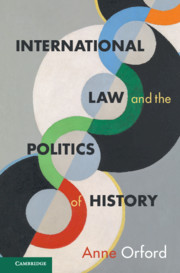
BOOK: Anne ORFORD, International Law and the Politics of History (Cambridge: CUP, 2021), ISBN 9781108691765, GB 22,99

(image source: Cambridge)

Book abstract:
As the future of international law has become a growing site of struggle within and between powerful states, debates over the history of international law have become increasingly heated. International Law and the Politics of History explores the ideological, political, and material stakes of apparently technical disputes over how the legal past should be studied and understood. Drawing on a deep knowledge of the history, theory, and practice of international law, Anne Orford argues that there can be no impartial accounts of international law's past and its relation to empire and capitalism. Rather than looking to history in a doomed attempt to find a new ground for formalist interpretations of what past legal texts really mean or what international regimes are really for, she urges lawyers and historians to embrace the creative role they play in making rather than finding the meaning of international law.

Table of contents: 

1 - Neoformalism and the Turn to History in International Law 
2 - Situating the Turn to History in International Law
3 - History and the Turn to the International 3 - History and the Turn to the International
4 - History’s Lawyers
5 - The Past in the Practice of International Law
6 - The History of What?
7 - Why Study the Past of International Law? History as Politics
Read more on Cambridge Core (DOI 10.1017/9781108691765).

Wednesday, 23 June 2021

BOOK: Raphael SCHÄFER & Anne PETERS, Politics and the Histories of International Law - The Quest for Knowledge and Justice (Leiden/New York: Brill, 2021). ISBN 978-90-04-46179-6, 109.00 EUR


(Source: Brill)

Brill is publishing the edited collection ‘Politics and the Histories of International Law’

ABOUT THE BOOK

What are the implications of writing the history of legal issues? Eighteen authors from different legal systems and backgrounds offer different answers, by examining the history writing on issues ranging from slavery over the use of force to extraterritorial jurisdiction. Contributions show how historiography has often distorted or neglected regional cultures and suggest alternative methods and approaches to history writing. These studies are highly relevant for current international relations in which the fight over master narratives is especially fierce among governments, in different academic fields, and also between governments and academics.

 
Contributors are: Jean d'Aspremont, Julia Bühner, Emiliano J.Buis, Maria Adele Carrai, Jacob Katz Cogan, Ríán Derrig, Angelo Dube, Michel Erpelding, Etienne Henry, Madeleine Herren, Randall Lesaffer, Anne-Charlotte Martineau, Parvathi Menon, Momchil Milanov, Hirofumi Oguri, Gustavo Prieto, Hendrik Simon, Sebastian Spitra, and Deborah Whitehall.

ABOUT THE AUTHOR

TABLE OF CONTENTS

Politics and the Histories of International Law: An Introduction

  Anne Peters, Raphael Schäfer and Randall Lesaffer

Part 1: International Law and Vulnerable Groups

1 Strength through Diversity? The Paradox of Extraterritoriality and the History of the Odd Ones Out

  Madeleine Herren-Oesch

2 The Politics of Writing on the History of Slavery in International Law

  Anne-Charlotte Martineau

3 Edmund Burke and the Ambivalence of Protection for Slaves: Between Humanity and Control

  Parvathi Menon

4 One Hundred Years of Soli(dari)tude: The Creation of the Refugee Regime and the Politics of Humanitarianism

  Momchil Milanov

Part 2: The Use of Force Discourse in a Historical Perspective

5 Theorising Order in the Shadow of War: The Politics of International Legal Knowledge and the Justification of Force in Modernity

  Hendrik Simon

6 The Road to Collective Security: Soviet Russia, the League of Nations, and the Emergence of the ius contra bellum in the Aftermath of the Russian Revolution (1917–1934)

  Etienne Henry

7 Three Wartime Textbooks of International Law

  Deborah Whitehall

Part 3: Regional and Cultural Variations of International Law

8 The Politics of History in the Late Qing Era: William A. P. Martin and a History of International Law for China

  Maria Adele Carrai

9 Mixed Claims Commissions in Latin America during the 19th and 20th Centuries: The Development of International Law in between Caudillos and Revolutions

  Gustavo Prieto

10 The Forgotten Continent? A South African Perspective on the Development of African International Legal Thought

  Angelo Dube and Lindelwa Mhlongo

11 International Law and the European Court of Justice: The Politics of Avoiding History

  Michel Erpelding

Part 4: The Looming of the Past over the 20th Century

12 Civilisation, Protection, Restitution: A Critical History of International Cultural Heritage Law in the 19th and 20th Century

  Sebastian M. Spitra

13 International Law, Science and Psychology in the New Haven School

  Ríán Derrig

14 Histories Hidden in the Shadow: Vitoria and the International Ostracism of Francoist Spain

  Julia Bühner

Part 5: New Methods and Approaches

15 Turntablism in the History of International Law

  Jean d’Aspremont

16 The Politics of Anti-Politics: Historiographies of International Law and the Paradox of Antiquity

  Emiliano J. Buis

17 Combatting Naïve Positivism by Quellenkritik: Lassa Oppenheim and His Ascertainment of Customary International Law

  Hirofumi Oguri


18 A History of International Law in the Vernacular

  Jacob Katz Cogan

Index


More info here


(source: ESCLH Blog)

Thursday, 10 June 2021

BOOK SYMPOSIUM: Ntina TZOUVALA, Capitalism as Civilisation (with Rohini SEN, Daniel R. QUIROGA-VILLAMARIN, Jullie WETTERSLEY, Kanad BAGCHI)

(image source: EUI)

Ntina Tzouvala's Capitalism as Civilisation (see earlier on this blog) is at the heart of an open access book symposium with the European Journal of Legal Studies, including a response by the author herself.

Kanad Bagchi, ‘Materialism, Culture and the Standard of Civilization’ (61-79) 

Julie Wetterslev, ‘The Standard of Civilisation in International Law’ (81-99) 

Daniel R. Quiroga-Villamarín, ‘Victorian Antics: The Persistence of the “Law as Craft” Mindset in the Critical Legal Imagination’ (101-116) 

Rohini Sen, ‘Reading and Readings of Capitalism as Civilisation‘ (117-136) 

Ntina Tzouvala, ‘Capitalism as Civilisation, or How to Respond to your Book Reviews when the Author is Dead’ (137-153) 

Read everything on the journal's website. 

Wednesday, 9 June 2021

OPEN ACCESS: OUP History of International Law Collection


(image source: OUP)

Description:

Explore our collection of free content on the history and development of international law, sourced from across our academic books and online reference works. Covering classical antiquity to the twenty-first century, this selection covers both useful introductions and in-depth commentary on a variety of topics in the field. All articles and chapters featured are free to access until 31 July 2021.

 Read all here.

Tuesday, 25 May 2021

CALL FOR ENGAGED LISTENERS: The Individual in International Law. History and Theory (MPIL Heidelberg, Zoom, 17-18 JUN 2021)


(image source: Wikimedia Commons)

Prof. Anne Peters and dr. Tom Sparks convene an online workshop on the individual in itnernational law, with a copious programme.

Abstract:

The interrelationship between international law and the individual has been the subject of a great and growing interest by scholars in recent years. In many or most of international law’s subfields and specialisms, the appropriate relationship between the interests of individuals and those of other actors is the subject of important debates. On the other hand, we are currently witnessing a return to statist principles in the debate and practice of international law, with an emphasis on sovereignty, territory, and boundaries. Human rights and the idea of rights more generally are under attack. The individual’s position in international law, pushed and pulled by these factors, is in flux. However, analyses conducted of the individual’s position remain, in the main, examinations of the positive law. A number of questions thus remain to be answered which go beyond the individual’s treatment by various fields of international law in the present moment, in particular from the perspectives of history and theory.

Participation:

 If you are interested in participating in the workshop as an engaged listener and thus in contributing to our discussions, please sign up via the links below. We particularly welcome the participation of early-career scholars, including pre- and post-graduate students, and from scholars working in institutions in the global south. Note that each link applies to only one day, and that those intending to attend the entirety of the workshop will need to register under both links. For further inquiries, or in case of technical difficulties, please contact Ms. Anette Kreutzfeld, via apeters-office@mpil.de.

 Program and more information here.