ESIL Interest Group History of International Law

ESIL Interest Group History of International Law
Showing posts with label colonial history. Show all posts

Thursday, 15 July 2021

RESEARCH PROJECT: NYU-Yale American Indian Sovereignty Project

(image: Prof. Maggie Blackhawk; source: NYU)

Description: 

On July 2, NYU Law announced the establishment of the NYU-Yale American Indian Sovereignty Project, whose goals include supporting the sovereignty of Native nations and addressing the impact of American colonialism on Native peoples. Professor of Law Maggie Blackhawk (Fond du Lac Band of Lake Superior Ojibwe) and Ned Blackhawk (Te-Moak Tribe of Western Shoshone Indians of Nevada), professor of history and American Studies at Yale University, will jointly run the multi-year project.

Read more here. 

Tuesday, 13 July 2021

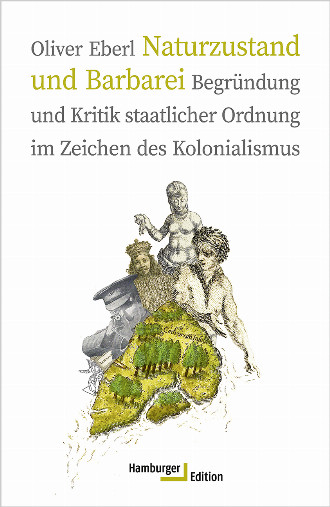
BOOK: Oliver EBERL. Naturzustand und Barbarei. Begründung und Kritik staatlicher Ordnung im Zeichen des Kolonialismus (Hamburg: Hamburger Edition, 2021), 552 p. ISBN 978-3-86854-349-0; € 40


(image source: Hamburger Edition)

Book description:

Im Zuge des Denkmalsturzes ehemaliger Sklavenhalter werden auch westliche Konzepte auf ihren Beitrag zu Rassismus und Unterdrückung hin untersucht. Ein solches Konzept ist der fest im europäischen Denken verankerte Begriff »Barbarei«. »Barbarei« ist der zentrale Begriff für die Beschreibung anderer Völker, die seit der Antike die Abwertung anderer Kulturen markiert und immer wieder neu bestimmt wird. In der europäischen Geschichte ist »Barbarei« auf das Engste mit dem Kolonialismus verbunden und muss somit als dessen Komplize und Erbe verstanden werden. »Barbarei« steht für das »Andere« westlicher Ordnung und zivilisierter Werte. Man beklagt damit furchtbare Verbrechen und verurteilt sie als moralisch besonders verwerflich. Zurückgreifen können diese politischen Verwendungsweisen auf eine lange Geschichte theoretischer Konzepte der »Barbarei«. Obwohl ein enger Zusammenhang zwischen »Barbarei« und Kolonialismus besteht, ist es bemerkenswert, dass der Begriff im Alltag und in der Theorie weiter verwendet wird – wenn auch in kritischer Absicht. Im Topos der »Barbarei« vereinen sich über die Zeiten die Gegenbilder verschiedener Wertesysteme: der Vernunft, des Christentums, der Humanität, der Zivilisation, der Kultur oder der Menschenrechte. Wie fand diese theoretische und begriffsgeschichtliche Entwicklung statt? Oliver Eberl hat mit dieser Studie die Dekolonisierung der Politischen Theorie zum Ziel, die ihr Denken mit Blick auf den Staat und seine Kritik vielfach von dem Begriffspaar »Naturzustand und Barbarei« anleiten lässt. Dazu zeichnet er die Theoriegeschichte des Begriffs »Barbarei« nach. Im Zuge der neuzeitlichen Staatsbegründung wurde »Barbarei« als Vergangenheit der europäischen Staaten verstanden und Staatlichkeit vor dem Hintergrund der Gefahr des Rückfalls in den »Naturzustand« theoretisiert. Zentral ist dabei die Verknüpfung mit dem europäischen Kolonialismus, dem »Barbarei« von der Antike bis zum 20. Jahrhundert zur Abwertung der Kolonisierten diente und der das »Barbarische« als das Nichtstaatliche mit dem zu Kolonisierenden gleichsetzte. Die seit der Aufklärung vollzogene Wende vom kolonialen zum kritischen Gebrauch sichert den theoretischen Stellenwert des Begriffs bis heute. Diese Wende hat dem Begriff »Barbarei« einen festen Platz in unserem Denken gesichert, so die These des Autors. In der Auseinandersetzung mit den Nationalsozialisten wurde der Begriff dann zum Platzhalter für die Kritik von Menschheitsverbrechen. Dabei wurde verdrängt, dass auch der Kolonialismus ein Menschheitsverbrechen ist und als solches kritisiert werden muss. Eindrücklich verdeutlicht Oliver Eberl, wie fatal es für politische Theoriebildung ist, in kritischer Absicht die Wirkungsgeschichte des Kolonialismus zu verlängern.

On the author:

 Oliver Eberl, PD Dr. phil. ist wissenschaftlicher Mitarbeiter für Politische Theorie und Ideengeschichte an der Leibniz-Universität Hannover und Privatdozent an der Technischen Universität Darmstadt; vier Semester Vertretung der Professur »Politische Theorie und Ideengeschichte« an der Goethe-Universität Frankfurt am Main. Forschungsschwerpunkte: Politische Theorie, Demokratietheorie, Gesellschaftstheorie, Ideengeschichte. Ko-Leiter des Projekts »Der Blick nach unten. Soziale Konflikte in der Ideengeschichte der Demokratie«.

See publisher's website for more information.

This book has been reviewed by Prof. Miloš Vec (Vienna) in the Frankfurter Allgemeine Zeitung of 23 June 2021.

Thursday, 8 July 2021

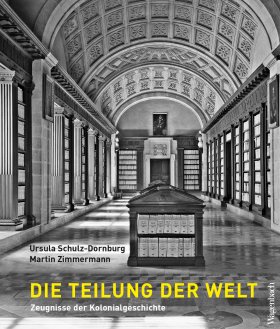
BOOK: Ursula SCHULZ-DORNBURG & Martin ZIMMERMANN, Die Teilung der Welt. Zeugnisse der Kolonialgeschichte (Berlin: Verlag Klaus Wagenbach, 2021), 160 p. ISBN 978-3-8031-3697-8, € 28


(image source: Verlag Klaus Wagenbach)

Book abstract:

In einer eindrucksvollen Serie hat Ursula Schulz-Dornburg das monumentale Archiv der spanischen Kolonialmacht in Sevilla dokumentiert – Bilder, die ahnen lassen, was die Regale beherbergen: Geschichten von Entdeckungsreisen, von der Hybris der Herrschenden und folgenreiche Schriftstücke. Die Papiere scheinen sich zu rühren. Die Pappen sind schief, leicht geknickt, als habe sie jemand mit kindlicher Neugier hochgebogen, um ihnen ihre Geheimnisse zu entlocken. Sie bergen zahllose Schicksale, wissen von verschwundenen Sprachen, von Gier nach Gold und den Träumen von einer »Neuen Welt«: ein papiernes Monument der Macht in Schränken aus kubanischem Zedernholz, lichtdurchfluteten Marmorsälen, atemberaubender Architektur. Ursula Schulz-Dornburgs bisher unveröffentlichte, historisch einmalige Fotografien zeigen das Archivo General de Indias in Sevilla vor seiner Sanierung. Seit 1785 sind hier 300 Jahre spanische Kolonialgeschichte in Amerika archiviert, 8.000 Karten, rund 90 Millionen Dokumente – darunter beispielsweise das Bordbuch des Kolumbus sowie der berühmte »Vertrag von Tordesillas«: 1494 zeichneten die Könige von Portugal und Spanien, vermittelt vom Papst, eine Linie durch den Atlantik und teilten die neu entdeckten und noch zu entdeckenden Länder der Welt unter sich auf. Der Historiker Martin Zimmermann unternimmt eine Reise ins Zeitalter der »Entdecker« und erzählt von gefährlichen Überfahrten, der Begegnung mit dem Fremden, kolonialer Gewalt, der Macht der Kartografie – und vom unstillbaren Wunsch, sich die ganze Welt zu erschließen.
On the authors:

Ursula Schulz-Dornburg gehört zu den international renommiertesten deutschen Fotografinnen. In ihren Arbeiten erkundet sie Orte am Rande der westlichen Wahrnehmung und menschengemachte Grenzregionen, zuletzt in ihrer Ausstellung »The Land in Between« im Frankfurter Städel. Sie lebt in Düsseldorf.
Martin Zimmermann ist Professor für Alte Geschichte an der LMU München. Zuletzt erschienen von ihm »Gewalt. Die dunkle Seite der Antike« sowie »Die seltsamsten Orte der Antike«.

This book has been reviewed by Prof. Miloš Vec (Vienna) in the Frankfurter Allgemeine Zeitung of 21 June 2021. 

Read more on the publisher's website.

Tuesday, 16 March 2021

JOB OFFER: 3 PhD Students (m/f/d) (Dr. Inge VAN HULLE, Legal Connectivities and Colonial Cultures in Africa; Frankfurt: MPILHLT, DEADLINE 1 MAY 2021)

(image source: MPI for Legal History and Legal Theory)
 

Project description:

The legal history of colonialism has for a long time been embedded in the paradigm of the nation state, where the focus lies on investigating the history of individual colonies within a single colonial or national legal tradition. State-centrism in colonial legal history means that the colonies and metropole are often separated from developments that took place on a regional or international level. However, insights from global history, histoire croisée and entangled history, have illustrated the impact on historical developments of the movement and the spatial interconnectedness of people, goods and ideas. This project starts from the premise that the same may be said for the movement of legal concepts and ideas in and about Africa during the colonial period of the late nineteenth- and twentieth centuries. The project maps the connectivities of legal developments in colonial Africa across the local, regional and international level by identifying normative exchanges, for example, between international treaty- and diplomatic negotiations, lobby groups, colonial governments and local actors. Here, the actions of and networks between historical actors who often held plural and conflicting allegiances take centre-stage.

Duties and responsibilities:

 Your key responsibility is to develop and complete a doctoral dissertation within the confines of the research group in one of the three themes described above. Doctoral students are expected to publish and disseminate their research findings in close co-operation with the other members of the research group.

Your profile:

A university degree in law, humanities or social sciences that has been completed with above-average success is required. You have an excellent command of English, both spoken and written and are proficient in either French or German. Knowledge of African languages is not a requirement but will be considered as an asset. Your curriculum vitae shows the potential to conduct research at an internationally high level. You work meticulously and are able to handle deadlines. You work independently and have a strong interest in interdisciplinary, archival and comparative work. You have the ability to play an active collaborative role in the research group.

Job: 

The PhD positions (39 hours per week) are paid the equivalent of 65% of the German Civil Service Collective Agreement (TVöD Bund), level E13, and are primarily intended to enable the preparation of a doctoral thesis. The positions are fixed-term appointments for three years; in exceptional cases, a position can be extended for one additional year. The Max Planck Society is committed to increasing the number of individuals with disabilities in its workforce and therefore encourages applications from such individuals. Furthermore, the Max Planck Society seeks to increase the number of women in those areas where they are underrepresented and therefore explicitly encourages women to apply. The Max Planck Society strives for gender equality and diversity. We welcome applications from all backgrounds.

 Application process:

 Your application must be submitted online via the link below by the closing date of May 1, 2021. Please forward your application documents to your indicated reviewers. If you are shortlisted, we will request a review. If your application is convincing, we will invite you to a selection interview.

The application should be in English or German and should contain the following documents:

  • Names and addresses (by post and electronically) of three researchers who have agreed to issue you with a letter of reference
  • Detailed CV containing a list of any publications you might have
  • Copies of your school leaver’s certificate and degree certificate
  • Preliminary research project (up to five pages) fitting within one of the three themes; Cover letter naming your research project and explaining to what extent your profile meets the selection criteria
  • Written sample of approx. 20 printed pages (e.g. master thesis sample, journal articles, book chapters, etc.)

Contact:

Informal enquiries may be directed to Dr. I. Van Hulle (vanhulle@rg.mpg.de). For questions as to the terms and conditions of employment please contact Ms. Anna Heym (jobs@rg.mpg.de).

Link to application here. 

Friday, 26 February 2021

ZOOM TALK: Berengère PIRET & Marie VAN EECKENRODE, Les dossiers de la colonie. Les archives de la colonisation belge, entre enjeux historiques et interrogations citoyennes (Bruxelles: Académie Royale de Belgique, 2 MAR 2021)


(Postcard from Léopoldville; image source: geanet)

Abstract:

Ces derniers mois, les statues coloniales ont été au cœur de nombreux et vifs débats ; les uns souhaitent les déboulonner jugeant qu’elles n’ont plus leur place dans la Belgique contemporaine quand d’autres réclament leur conservation sous peine « d’effacer l’histoire ». Les discussions concernant le patrimoine colonial sont plus complexes qu’il n’y parait et ne peuvent en aucun cas se limiter aux statues. Celui-ci comprend aussi les archives et les objets culturels produits à cette période ainsi que, de manière générale, le paysage urbain notamment. Les archives sont produites par les acteurs de la colonisation pour documenter leurs activités administratives, économiques ou missionnaires comme leur vie quotidienne. La plupart de ces documents ont été transférés à Bruxelles au moment de l’indépendance. Les biens culturels sont façonnés dans différentes régions du Congo avant d’être (mal) acquis par des ethnologues ou fonctionnaires coloniaux principalement pour les envoyer aux musées métropolitains. Le paysage urbain, et bruxellois en particulier, a été largement redessiné durant la période coloniale. Léopold II a veillé à inscrire le Congo dans l’espace public. À son instar, de nombreux édiles communaux et des entreprises ont érigé des monuments ou nommé des rues en référence à l’action coloniale. Après avoir envisagé ces trois éléments, ce cycle abordera le thème de leur devenir articulé en questionnant les notions de restitution et de réappropriation.

More information here. 

Thursday, 11 February 2021

ONLINE LECTURE: Thomas SPIJKERBOER, Confronting the colonial structure of international migration law (Gent: UGent, Human Rights Centre, 20 JAN 2021)

(image source: UGent, HRC)
 

Lecture abstract:

Legal doctrine in the global North asserts that it is well-established in international law that states have the right to control migration, as a consequence of which individuals have an international law-based claim to admission or non-removal only in exceptional cases. This legal doctrine has been shaped by colonialism and continues to have a colonial deep structure. Legal doctrine in formerly colonized parts of the world does not necessarily share Northern doctrine. How can legal academics confront this pluralist and contested character of the field they are working in?

Lecturer bio:

Thomas Spijkerboer is professor of Migration Law at the Vrije Universiteit Amsterdam as well as the Raoul Wallenberg Visiting Professor of Human Rights and Humanitarian Law at Lund University. He is a member of the Royal Holland Society of Sciences and Humanities and of the Royal Netherlands Academy of Arts and Sciences. Having studied law at the University of Amsterdam, Thomas first worked in practice before writing his PhD at the Catholic University Nijmegen and becoming a Lecturer in Migration Law there in 1993. He founded the Amsterdam Centre for Migration and Refugee Law on his moving in 2000 to the Vrije Universiteit Amsterdam. His research and teaching focuses on border deaths and human rights; gender and sexuality in asylum law; and the externalisation of European migration policy. 

Watch the recorded lecture on Ghent University's website. 

(source: HRC, UGent) 

Monday, 25 January 2021

CONFERENCE: Imperial Artefacts: History, Law and the Looting of Cultural Property (Leiden/Online, 28-29 JAN 2021)

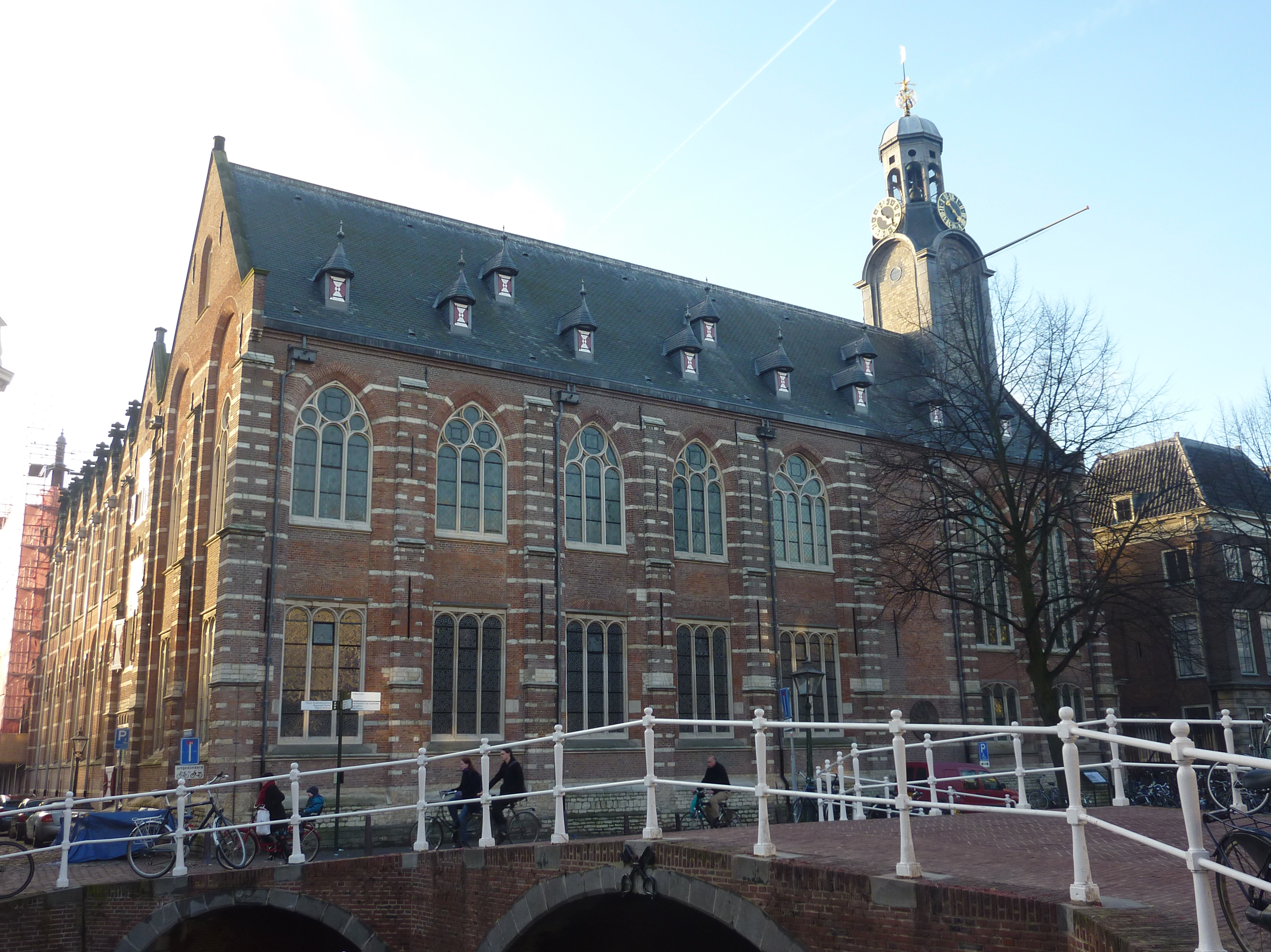
(image: Universiteit Leiden, Rapenburg; source: Wikimedia Commons)


The conference 'Imperial Artefacts: History, Law and the Looting of Cultural Property' (organized by Diana M. Natermann (Leiden) and Inge Van Hulle (Tilburg)), advertised earlier on this blog, will take place online on Thursday and Friday.

Programme


All keynotes and panels are held via MS Teams and it is generally recommended to use either Google Chrome or Chromium Edge as browsers.

DAY 1

09:15 – 09:30 Welcome words: Inge Van Hulle & Diana M. Natermann
09:30 – 10:30 Keynote: Prof. Dr. Jürgen Zimmerer – Looting, restitution, reconciliation (09:30 Germany)

10:30 – 10:45 Coffee break


1. Diplomacy, Identity and Restitution – Panel Chair: Diana Natermann

10:45 – 11:15 Lucas Lixinski (20.45 Sydney, Australia), ‘Beyond UNESCO: Regional International Legal Approaches to Post-Colonial Restitution’
11:15 – 11:45 Sahra Rausch (11:15 Germany), ‘An Affective De-Memorization? Debates over Colonial Amnesia regarding the Repatriation of Human Remains from Colonial Contexts in France and Germany’
11:45 – 12:15 Lars Müller (11:45 Germany), ‘Delaying, Evading, Rejecting. Western Reactions to Sri Lankan Demands for Restitution around 1980’

12:15 – 13:00 Lunch Break


2. Multi-disciplinary Perspectives on Colonial Violence and Restitution – Panel Chair: Raphael Shafer

13:00 – 13:30 Rotem Giladi (13:15 Israel), ‘Reading Between Categories: Corpora, Culture, Property and the Laws of War’
13:30 – 14:00 Jan Huesgen (13:45 Germany), ‘The Enemy on Display – Suits of Armour in Military Museums’
14:00 – 14:30 Ivan Obadić, Robert Mrljic & Miran Marelja (14:15 Croatia, Belgium), ‘War, spoils and return of cultural property: framing of restitution law at the Congress of Vienna in 1815’

14:30 – 14:45 Coffee Break


3. Law and Restitution: Past & Present – Panel Chair: Ana Delic

14:45 – 15:15 Afolasade A. Adewumi (15:15 Nigeria), ‘Does Utilitarianism Merge the Dichotomy Between the Nationalist and Internationalist Conception of Cultural Property in the Quest for Restitution?
15:15 – 15:45 Arianna Visconti (15:45 Italy), ‘A Paradox in Law: Italy’s Ambivalent Approach to Restitution Claims’
16:45 – 16:15 Marie-Sophie de Clippele & Bert Demarsin (16:15 Belgium), ‘Rights, wrongs and remedies - Working towards colonial heritage repatriation legislation for Belgium’

16:15 – 16:30 Coffee Break


4. Heritage, Discourse and the Representation of Cultural Artefacts – Panel Chair: Walter Nkwi Gam

16:30 – 17:00 Annalisa Bolin (16:30 Sweden), ‘Power and Possibility: The Return of Rwanda’s Stolen Bones’
17:00 – 17:30 Kokou Amazede (16:00 Togo), Acquisition methods of colonial objects and the traditional perception of the museum in German Togo
17:30 – 18:00 Janne Lahti (18:30 Finland), ‘Mesa Verde and Finland: Stolen Artefacts, Contested Discourses, and Nordic Colonial Legacies’
18:00 – 18:30 Donna Yates (18:00 The Netherlands) and Brieanah Gouveia (07:00 Hawaii), ‘Provenance narratives of colonial exploitation as value enhancers on the Oceanic art market’
18:
30 – 19:00 Kaitlyn DeLong (12:30 Washington DC), ‘Confronting the Past: The Provenance of Indigenous Objects on Display’


DAY 2

09:15 – 10:15 Keynote: Junior Prof. Dr. Matthias Goldmann, (09:15 Germany) ‘The Role of Law in the Restitution Debate’

10:15 – 10:30 Coffee break


1. Enduring Coloniality and Cultural Heritage – Panel Chair: Alexandra Ortolja-Baird

10:30 – 11:00 Iain Sandford and Ada Siqueira (20:30 Sydney, Australia), ‘The Destruction of the Juukan Gorge Caves: A Study on the Role of International Law in Protecting Cultural Heritage in Times of Peace’
11:00 – 11:30 Norman Aselmeyer (11:00 Germany), Intangible Heritage: The Man-Eaters of Tsavo and their Global (After)Lives
11:30 – 12:00 Marcelo Marques Miranda & Jully Acuña Suárez (11:30 The Netherlands), ‘Repatriation as a means, not as an end’

12:00 – 13:00 Lunch Break


2. International Legal History and Restitution Debates – Panel Chair: Inge Van Hulle

13:00 – 13:30 Tomás Irish (12:00 UK), ‘“The Danger of Arbitrary Decisions”: The Paris Peace Conference and Cultural Reparations after the First World War’
13:30 – 14:00 Sebastian Willert (13:30 Germany), ‘A German Excavation for the Ottoman Imperial Museum? The Scramble for Objects between Berlin and Istanbul at Tell Halaf, 1911–1914’
14:00 – 14:30 Florian Wagner (14:00 Germany): ‘Colonialist Notions of Property: How European Lawyers Legitimized Dispossession (1880s-1950s)’

14:30 – 15:00 Coffee Break


3. Restitution, Heritage, and Human Rights – Panel Chair: Anne-Isabelle Richards

15:00 – 15:30 Evelien Campfens (15:00 The Netherlands), ‘Whose cultural objects? Introducing ‘heritage title’ in a human rights law approach’
15:30 – 16:00 Jihane Chedouki (15:30 Morocco): ‘From a moral function to a utilitarian function: the transformation of ancient objects and monuments in the Arab world in the 19-20th centuries’
16:00 – 16:30 Gretchen Allen (15:00 Ireland), ‘A Way for the Giant’s Cause: an examination of Irish indigenous rights in the case of Charles Byrne’
16:30 – 17:00 Caroline Drieënhuizen & Fenneke Sysling (16:30 The Netherlands), ‘Java Man: restitution claims at the natural history museum’

17:00 Closing remarks: Inge Van Hulle & Diana M. Natermann

(source: Universiteit Leiden) 

Friday, 18 December 2020

PODCAST: House of Wisdom with Dr. Inge van Hulle


(Source: House of Wisdom)


The House of Wisdom Podcast has recently talked to Dr. Inge van Hulle about her new book “Britain and International Law in West Africa: The Practice of Empire”.

"Anthea Roberts asked the question how international is international law? When we look back at the development of international law within West Africa during the 19th century we realise there were many voices involved, not just Britain.  

In this episode, we talk to Dr. Inge Van Hulle about her new book - Britain and International Law in West Africa: The Practice of Empire. We discuss the influence ex colonial powers have had on the development of the international legal system, changing narratives about our perceptions of West Africa, and whether we need to rethink how we teach and research international law.   

Dr. Inge Van Hulle is Assistant Professor of Legal History at Tilburg University, The Netherlands. Prior to joining Tilburg University she worked as a PhD research assistant at the department of Roman law and legal history at KU Leuven where she obtained her PhD in 2016. Her area of expertise is International Legal Theory and International Legal History, in particular colonialism and West Africa."

(Source: Houseofwisdompodcast.co.uk)

(source: ESCLH Blog)

Wednesday, 23 September 2020

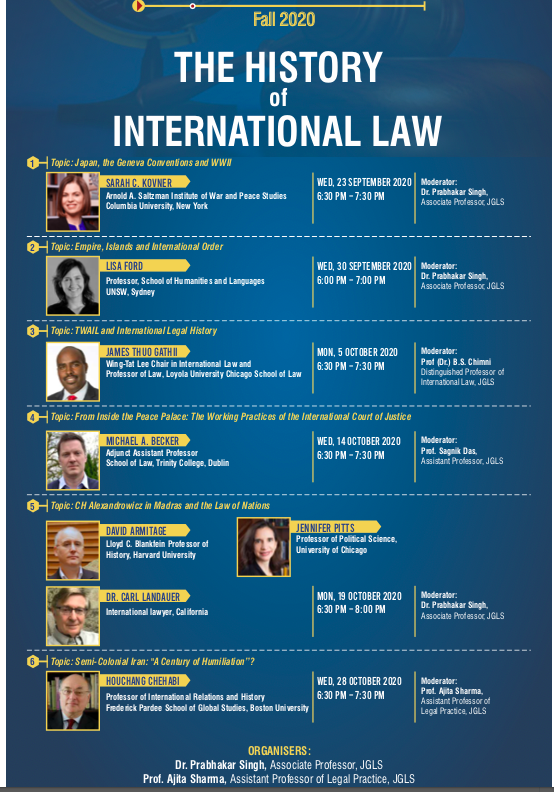
ONLINE SEMINAR: The History of International Law (Jindal Global University) (23 SEP-28 OCT 2020))

(image source: Twitter)

The Jindal Global University announces a thrilling series of online lectures on the History of International Law, featuring Sarah C. Kovner (Columbia), Lisa Ford (UNSW), James Thuo Gath II (Chicago), Michael A. Becker (Trinity College Dublin), David Armitage (Harvard), Carl Landauer and Jennifer Pitts (Chicago) and Houchang Chehabi (Boston).

The series is organised by dr. Prabhakar Singh and Prof. Ajita Sharma.

More information on dr. Singh's twitter.

Thursday, 20 August 2020

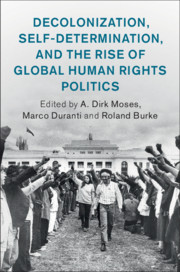
BOOK: A. Dirk MOSES, Marco DURANTI, and Roland BURKE, Decolonization, Self-Determination, and the Rise of Global Human Rights Politics (Cambridge: Cambridge University Press, 2020). ISBN 9781108479356, 90.00 GBP

(Source: CUP)

Cambridge University Press is publishing an edited collection on the global history of human rights politics in the age of decolonization.

ABOUT THE BOOK

This volume presents the first global history of human rights politics in the age of decolonization. The conflict between independence movements and colonial powers shaped the global human rights order that emerged after the Second World War. It was also critical to the genesis of contemporary human rights organizations and humanitarian movements. Anti-colonial forces mobilized human rights and other rights language in their campaigns for self-determination. In response, European empires harnessed the new international politics of human rights for their own ends, claiming that their rule, with its promise of 'development,' was the authentic vehicle for realizing them. Ranging from the postwar partitions and the wars of independence to Indigenous rights activism and post-colonial memory, this volume offers new insights into the history and legacies of human rights, self-determination, and empire to the present day.

ABOUT THE EDITORS

A. Dirk Moses, University of Sydney

A. Dirk Moses is Professor of Modern History at the University of Sydney. He is Senior Editor of the Journal of Genocide Research.

Marco Duranti, University of Sydney

Marco Duranti is Senior Lecturer in Modern European and International History at the University of Sydney. He is the author of The Conservative Human Rights Revolution (2017).

Roland Burke, La Trobe University, Victoria

Roland Burke is Senior Lecturer in World History at La Trobe University. He is the author of Decolonization and the Evolution of International Human Rights (2010).

TABLE OF CONTENTS
Introduction. Human rights, empire, and after Roland Burke, Marco Duranti and A. Dirk Moses
Part I. Anti-colonial struggles and the right to self-determination:
1. Seeking the political kingdom: universal human rights and the anti-colonial movement in Africa Bonny Ibhawoh
2. Decolonizing the United Nations: Anti-colonialism and human rights in the French Empire Marco Duranti
3. The French Red Cross, decolonization, and humanitarianism during the Algerian War Jennifer Johnson
4. Connecting indigenous rights to human rights in the Anglo settler states: Another 1970s story Miranda Johnson
5. Privileging the Cold War over decolonization: The US emphasis on political rights Mary Ann Heiss
Part II. Post-colonial statehood and global human rights norms:
6. Cutting out the ulcer and washing away the incubus of the past: genocide prevention through population transfer A. Dirk Moses
7. Codifying minority rights: postcolonial constitutionalism in Burma, Ceylon, and India Cindy Ewing
8. Between ambitions and caution: India, human rights, and self-determination at the United Nations Raphaëlle Khan
9. 'From this era of passionate self-discovery': Norman Manley, human rights, and the end of colonial rule in Jamaica Steven L. B. Jensen
10. Re-entering histories of past imperial violence: Kenya, Indonesia, and the reach of transitional justice Michael Humphrey
Part III. Colonial and neo-colonial responses
11. The inventors of human rights in Africa: Portugal, late colonialism, and the UN human rights regime Miguel Bandeira Jerónimo and José Pedro Monteiro
12. 'A world made safe for diversity': Apartheid and the language of human rights, progress, and pluralism Roland Burke
13. Between humanitarian rights and human rights: René Cassin, architect of universality, diplomat of French Empire Jay Winter
14. The end of the Vietnam War and the rise of human rights Barbara Keys
15. Decolonizing the Geneva Conventions: national liberation and the development of humanitarian law Eleanor Davey
16. Liberté sans frontières, French humanitarianism, and the neoliberal critique of Third Worldism Jessica Whyte.


More info here
(source: ESCLH Blog)

Wednesday, 29 July 2020

BOOK: Luigi NUZZO, Lawyers, Space and Subjects: Historical Perspectives Historical Perspectives on the Western Legal Tradition (Lecce: Pensa Multimedia, 2020). ISBN: 9788867607129, pp. 283, 28,00€

(Source: Pensa Multimedia)


ABOUT THE  BOOK

How it is possible to appropriate the European legal legacy for writing a decolonized history of international law? Is this task possible also for a European legal historian ? Or is he is stucked in his past with his ‘dead white heroes’? Assuming an historical perspective, the book intends to answer these questions and tells the history of the paradoxical beginnings of a Western law. It was a new law that was considered the measuring unit of the civilized world and the instrument to reassemble the distinctions between ‘Us and the Others’ that it did not cease to produce.

ABOUT THE AUTHOR

Luigi Nuzzo is full professor of Legal History and History of International Law at the Law Faculty of the University of Salento (Lecce). He has been research fellow at the Max-Planck-Institut für europäische Rechtsgeschichte (Frankfurt am Main) and at the Freie Universität Berlin; Senior Robbins Research Fellow at the University of California at Berkeley; Hauser Global Research Fellow at the New York University and Fernand Braudel Fellow at European University Institute. He published extensively in Italian, English, German and Spanish about the history of international law, the Spanish Indies and the German and Italian legal culture between the XIXth and XXth centuries.


More information with the publisher.

(source: ESCLH Blog)

Wednesday, 8 July 2020

JOURNAL: Special Issue "Le concept de civilisation en droit colonial belge" (Revue interdisciplinaire d'études juridiques LXXXIII (2019), no. 2

(image source: CAIRN)

De l’épistémologie de la théorie du droit (Pierre Moor)
Abstract:
We cannot approach legal theory without first answering two questions : First, what do we mean by « law ». And second, what, in light of this understanding, are the appropriate theoretical instruments for its analysis ? As regards the first question, the legal phenomenon should be understood as it operates in reality : that is to say, as a system constituted by a set of texts, the most important being normative, which are produced by a set of actors – those being lawyers and people who work with them. It is the functioning of this complex system that legal theory must explain. The answer to the second question - the appropriate theoretical instruments-derives from this analysis. The instruments will be drawn, on the one hand, from semiology, insofar as the law is unthinkable without considering its textual and therefore linguistic dimension : defining the semiotic status of the signs that form the normative texts is therefore necessary to understand the relationship between the norms and their object. On the other hand, the contemporary theory of systems allows us to grasp the texture of internal relations between the legal actors, a differentiated texture that gives law its autoreferential character, while also bringing to light the modalities of its relation with its social environment. In sum, the point of view could be said to be external, since it does not use legal concepts, but, to the contrary, treats such concepts as the object of analysis ; and legal theory, not being a legal discipline, is an element of the sociology of law.
 Introduction. Nations civilisées, mission civilisatrice, droit de civilisation (Pierre-Olivier de Broux)
First paragraph:
Le concept de civilisation est au cœur du présent dossier, consacré au concept de civilisation en droit colonial belge. Ce concept est à la fois particulièrement ancien mais aussi très déprécié aujourd’hui, précisément à cause des usages qui en ont été faits aux XIXe et XXe siècles. Sa présence dans le droit colonial belge ne doit rien au hasard : la mission civilisatrice dont s’est prévalu Léopold II s’inscrit dans un contexte historique et juridique qui balise pour une bonne part la référence au concept de civilisation. C’est ce contexte – surtout issu de la sphère internationale – qui est brièvement brossé dans la présente introduction, synthétisant la littérature critique abondante récemment parue à ce sujet.
 « Le Congo était fondé dans l’intérêt de la civilisation et de la Belgique ». La notion de civilisation dans la Charte coloniale (Pierre-Olivier de Broux & Bérengère Piret)
Abstract:
Belgium’s “civilizing mission” in its African colonial territories is at the heart of colonial rhetoric. The leitmotif of overseas action since the foundation of the Congo Free State in 1885 and a prelude to most European colonization efforts in Africa in the 19th century. The Belgian colonial vocabulary did not hesitate to use it. However, its legal and administrative translation still seems to be poorly studied. The main ambition of this contribution is therefore to question this “civilizing mission” on the basis of the colonial charter. More precisely, this article aims to identify the meaning of the notion of civilization as used by the colonial authorities when the Congo was taken over by Belgium and to identify the legal instruments by which the “civilizing mission” must be implemented there.
 Civiliser les « indigènes » par le droit. Antoine Sohier et les revues juridiques coloniales (1925-1960) (Romain Landmeters & Nathalie Tousignant)
Abstract:
The idea of civilizing the population of Congo is concomitant with the Belgian colonial enterprise from the very beginning. This conception has been inherent in the imperial imagination since the end of the 19th century. With the takeover of Congo by Belgium in 1908, the civilization effort of the Congo Free State (CFS) became the common denominator of the Belgian government, of the world of industry and commerce as well as missionaries. At the crossroads of these three pillars of Belgian-style colonialism, the colonial judiciary also contributes to the civilizing mission. Through the analysis of textual data of three colonial legal journals, this contribution explores the uses of the terms civilize/civilization/civilized by contributors, including the main one, magistrate Antoine Sohier. This analysis highlights the construction of a consensus around a single Civilization, an objective to be achieved by the Congolese populations adhering to the values promoted by the civilizing mission/action claimed by the Belgian colonial project.
 La notion de civilisation en droit colonial belge postérieur à la Seconde Guerre mondiale et en droit congolais postérieur à l’indépendance (Wenceslas Busane Ruhana Mirindi)
Abstract:
Belgian colonial law has organised institutions and forged rules for the implementation of the civilizing mission, the main objective of the colonial enterprise. This contribution focuses on the evolution of the notion of civilization in the post-World War II period, during which the end of colonization took place. During this period, colonial law was characterised by a conception of civilization that was clearly European-centred and inherited from the 19th century. Nevertheless, there is a decrease in the intensity of the affirmation of the civilizing mission. Congolese post-independence law, on the other hand, shows the quest for an authentic civilization. It reflects a tension between the instrumentalization of autocratic power and the opening towards the values of universal civilization.
Lancement du nouveau thème du SIEJ (Jérémie Van Meerbeeck)

L’homme augmenté : quelle dignité humaine pour encadrer les progrès de la génétique ? (Jean-Aymeric Marot)
Abstract:
The notion of « human dignity » is ambivalent, susceptible to be brought up both to uphold the highest principles of protection of our species as a whole or to support the growing affirmation of the power of individuals’ self-determination over their own bodies. Today, at a time when the mysteries of the human genome are slowly unveiled, the use of human enhancement technologies comes in the wake of this autonomist trend but raises new fears as to the preservation of genetic heritage, the determination of the best interests of the child or the right to privacy. In these respects, involvement of public authorities will be required to ensure the safeguarding of the most fundamental values on which our society is built.
Book reviews:

  • J. Gaakeer, Judging from experience. Law, praxis, humanities, Edinburgh, Edinburgh University Press, 2019, 307 p. (François Ost)
  • A. Somek, The Legal Relation : Legal Theory after Legal Positivism, Cambridge, Cambridge University Press, 2017, 220 p. (Aristel Skrbic)
  • Th. Berns et J. Lafosse (dir.), Guerre juste et droit des gens moderne, Bruxelles, Éditions de l’Université de Bruxelles, 2017, 208 p. (Louis Triaille)
  • F. Ost, Si le droit m’était conté…, Paris, Dalloz, 2019, 214 p. (Xavier Dijon)
  • A. Flückiger, (Re)faire la loi. Traité de légistique à l’ère du droit souple, Berne, Stämpfli, 2019, 761 p. (Norman Vander Putten)
Read more on Cairn.

(source: ESCLH Blog)


Thursday, 14 May 2020

SSRN PAPER: Jean d'ASPREMONT, Comparativism and Colonizing Thinking in International Law

(image source: Wikimedia Commons)

Paper abstract:
Comparison is a very common tool for international lawyers. In fact, international law is built around, and draws upon constructions necessitating an exercise of comparison. In recent years, however, calls have been made to turn the familiar tool of comparison into a central way to engage with international law. This is the idea of those spearheading the rise of a new field called Comparative International Law (‘the comparativist project’). The comparativist project has attracted enormous attention and enthusiasm in the international legal literature. This article critically examines the promotion of comparison as a central mode of engagement with international law and scrutinizes some of the main features of the comparativist project. It particularly shows that the comparativist project, far from laying bare the plurality of international legal thought and practice, enables a dangerous thought-colonizing enterprise. The article ends with some observations on the need to promote counter-comparability thinking as a guarantee against colonizing thinking in international legal studies.
Download the paper here.

Thursday, 30 April 2020

OPEN ACCESS RESOURCE: Bulletin officiel du Congo belge


(Source: Kaowarsom.be)

We learned that the Royal Academy for Overseas Sciences has digitized the Official Bulletin of the Belgian Congo (1885-1959). The collection can be found, free of charge, here


(source: ESCLH Blog)

Wednesday, 4 March 2020

VACANCY: Historian for the Research Project DIGICOLJUST: Colonial Violence, Subaltern Agency and Shared Archival Heritage: A Digital Platform of Colonial Judiciary Sources, 2 Years (Brussels: State Archives/VUB-ULB, DEADLINE 1 APR 2020)

(image: Leopold II, King of the Belgians; souce: Wikimedia Commons)

Project abstract:
DIGICOLJUST – Colonial Violence, Subaltern Agency and Shared Archival Heritage: A Digital Platform of Colonial Judiciary Sources Funded by the BELSPO program BRAIN-be2.0 and based on a partnership between AGR/ARA, ULB and VUB, DIGICOLJUST is a two-year digitizing and scientific project starting from a poorly-known archival collection of strategic importance for the history of Belgian colonialism in Central Africa and for the Belgian State Archives collections: the archives of the trial records of the court martials of the Congo Free State (1885-1908) and of the Belgian Congo (1908-1960). This project aims to make these records accessible and to explore new research agendas related to controversial issues of colonial violence and repression as well as to African agency and its modes of expression in colonial courtrooms. DIGICOLJUST will work on three levels: (1) identification and inventory of sources; (2) digitization and preservation; (3) digital dissemination and scientific valorization.

(more information here)

Friday, 10 January 2020

BOOK: Albane GESLIN & Emmanuelle TOURME JOUANNET (dir). Le droit international de la reconnaissance, un instrument de décolonisation et de refondation du droit international ? (Nice: DICE, 2019), 204 p. ISBN 979-10-97578-07-7, OPEN ACCESS

(image source: DICE)

Book abstract:
Lorsqu’en 2011 est publié Qu’est-ce qu’une société internationale juste ? Le droit international entre développement et reconnaissance, d’Emmanuelle Tourme Jouannet, puis que paraît, l’année suivante son article « Le droit international de la reconnaissance », surgit dans le champ de la recherche française – et plus largement francophone – en droit international un nouveau paradigme, celui de la « reconnaissance ». Les réactions suscitées par ces publications furent vives. Il y eu quelques mécompréhensions du concept même de reconnaissance, et diverses critiques se firent entendre. C’est à l’occasion du premier workshop international du groupe de recherche Justice/Injustice Globale, les 8 et 9 septembre 2016, que fut abordée la question de savoir si le droit international de la reconnaissance pouvait être un instrument de décolonisation et de refondation du droit international.
On the editors:
Albane Geslin, Professeure de droit public. Sciences Po Aix - Aix Marseille Univ, Université de Toulon, Univ Pau & Pays Adour, CNRS, DICE, CERIC, Aix-en-Provence, France Emmanuelle Tourme Jouannet, Professeure de droit public, École de Droit, Sciences Po, Paris

Table of contents here.

Thursday, 26 September 2019

ADVANCE ARTICLE: Zak LEONARD, "Law of Nations Theory and the Native Sovereignty Debates in Colonial India" (Law & History Review)

(image source: Cambridge Core)

First paragraph:
Perhaps few topics are more invidious in colonial legal history than the definition of “paramountcy” in British India. Alternatively cast as a feudal compact with subordinate native princely states, a noninterventionist policy supportive of semi-sovereignty, and a doctrine invented to justify colonial “earth hunger,”1 the concept elicited significant debate in the mid-Victorian era. But epistemological and practical issues bedeviled any comprehensive understanding of the term.
Read more on Cambridge Core.

Monday, 2 September 2019

BOOK: Alexandra HARMON, Reclaiming the Reservation: Histories of Indian Sovereignty Suppressed and Renewed [Emil and Kathleen Sick Book Series in Western History and Biography] (Washington: University of Washington Press, 2019), 424 p. ISBN 9780295745855, 35 USD


Book description:
In the 1970s the Quinault and Suquamish, like dozens of Indigenous nations across the United States, asserted their sovereignty by applying their laws to everyone on their reservations. This included arresting non-Indians for minor offenses, and two of those arrests triggered federal litigation that had big implications for Indian tribes’ place in the American political system. Tribal governments had long sought to manage affairs in their territories, and their bid for all-inclusive reservation jurisdiction was an important, bold move, driven by deeply rooted local histories as well as pan-Indian activism. They believed federal law supported their case. In a 1978 decision that reverberated across Indian country and beyond, the Supreme Court struck a blow to their efforts by ruling in Oliphant v. Suquamish Indian Tribe that non-Indians were not subject to tribal prosecution for criminal offenses. The court cited two centuries of US legal history to justify their decision but relied solely on the interpretations of non-Indians. In Reclaiming the Reservation, Alexandra Harmon delves into Quinault, Suquamish, and pan-tribal histories to illuminate the roots of Indians’ claim of regulatory power in their reserved homelands. She considers the promises and perils of relying on the US legal system to address the damage caused by colonial dispossession. She also shows how tribes have responded since 1978, seeking and often finding new ways to protect their interests and assert their sovereignty.
On the author:
Alexandra Harmon is professor of American Indian studies at the University of Washington. She is the author of Rich Indians: Native People and the Problem of Wealth in American History and editor of The Power of Promises: Perspectives on Pacific Northwest Indian Treaties.
(source: International Law Reporter)

Friday, 30 August 2019

CALL FOR PAPERS: "The Past is Prologue: The Impact of Law’s History" (DEADLINE 30 SEP 2019)

The Past is Prologue: The Impact of Law’s History : A New Edited Collection of Essays on Legal History 

The Book. 

Legal rules, decisions, institutions, and individual actors have had an enormous impact on our cultures and societies today. The leaders that govern us, the crimes that are committed, and the freedoms that we cherish are part and parcel of the enduring legacy of legal history. Despite its diminishing presence in legal education in recent decades, the study of legal history is on an upswing as its importance gains renewed recognition. The availability of new techniques and resources allow scholars to develop new insights and supplement, contextualise, or challenge our previous understandings of the causes and consequences of developments in law and society. 
We are assembling a special collection of essays that consider how legal history in Aboriginal, British, Australian, American or wider contexts have shaped our shared present. The essays in this collection will be more than just discussions of particular aspects of legal history in the abstract; instead, each will draw a clear and significant connection to a meaningful feature of our lives today. With this Call for Papers, we are now soliciting contributions from the academy and members of the public more generally. 
Advice for contributors.  

This edited collection will be initially offered to an Australian academic press.  Please submit an abstract of up to 250 words explaining the focus and approach your proposed essay would take to ensure appropriate academic rigour. The proposed volume is intended to be scholarly but accessible in tone and approach. Each contribution should be in the area of 6000 to 10000 words. Please email abstracts to marcus.harmes@usq.edu.au by 30 September 2019. 
About the editors. 
Associate Professor Marcus Harmes is Associate Director (Academic Development) in the University of Southern Queensland’s Open Access College and teaches legal history in the law degree.  Dr. Jeremy Patrick is Acting Associate Head of School (Research) in the University of Southern Queensland School of Law and Justice. He has published on the historical aspects of various subjects in the area of law and religion.  Ms Sarah McKibbin is Lecturer (Law) in the University of Southern Queensland’s School of Law and Justice. She was instrumental in developing the legal history course in the law degree.

(source: Legal History Blog)