ESIL Interest Group History of International Law

ESIL Interest Group History of International Law
Showing posts with label law of nature. Show all posts

Friday, 7 June 2019

BOOK: Heikki HAARA, Pufendorf's Theory of Sociability: Passions, Habits and Social Order [The New Synthese Historical Library] (Heidelberg: Springer, 2019), XII + 188 p. ISBN 978-3-319-99324-9, € 63,03

(image source: Springer)

Book abstract:
This book centres on Samuel Pufendorf’s (1632–1694) moral and political philosophy, a subject of recently renewed interest among intellectual historians, philosophers and legal scholars in the English-speaking world. Pufendorf’s significance in conceptualizing sociability in a way that ties moral philosophy, the theory of the state, political economy, and moral psychology together has already been acknowledged, but this book is the first systematic investigation of the moral psychological underpinnings of Pufendorf’s theory of sociability in their own right. Readers will discover how Pufendorf’s psychological and social explanation of sociability plays a crucial role in his natural law theory. By drawing attention to Pufendorf’s scattered remarks and observations on human psychology, a new interpretation of the importance of moral psychology is presented. The author maintains that Pufendorf’s reflection on the psychological and physical capacities of human nature also matters for his description of how people adopt sociability as their moral standard in practice. We see how, since Pufendorf’s interest in human nature is mainly political, moral psychological formulations are important for Pufendorf’s theorizing of social and political order. This work is particularly useful for scholars investigating the multifaceted role of passions and emotions in the history of moral and political philosophy. It also affords a better understanding of what later philosophers, such as Smith, Hume or Rousseau, might have find appealing in Pufendorf’s writings. As such, this book will also interest researchers of the Enlightenment, natural law and early modern philosophy.
On the author:
Heikki Haara is a postdoctoral researcher at the University of Helsinki. He has been a visiting researcher at the Universities of California, Berkeley and Oxford. Currently, he works in the Academy of Finland’s centre for excellence, Reason and Religious Recognition. 

Friday, 24 April 2015

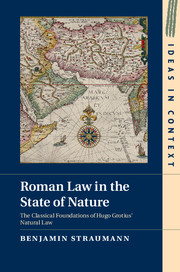
BOOK: Benjamin STRAUMANN, Roman Law in the State of Nature. The Classical Foundations of Hugo Grotius' Natural Law [Ideas in Context] (Cambridge: CUP, 2015), 283 p. ISBN 9781107092907, £ 65

(image source: cambridge.org)


Benjamin Straumann (NYU) published a new work on roman law and the early modern law of nations at Cambridge University Press.

Abstract:
Roman Law in the State of Nature offers a new interpretation of the foundations of Hugo Grotius' natural law theory. Surveying the significance of texts from classical antiquity, Benjamin Straumann argues that certain classical texts, namely Roman law and a specifically Ciceronian brand of Stoicism, were particularly influential for Grotius in the construction of his theory of natural law. The book asserts that Grotius, a humanist steeped in Roman law, had many reasons to employ Roman tradition and explains how Cicero's ethics and Roman law – secular and offering a doctrine of the freedom of the high seas – were ideally suited to provide the rules for Grotius' state of nature. This fascinating new study offers historians, classicists and political theorists a fresh account of the historical background of the development of natural rights, natural law and of international legal norms as they emerged in seventeenth-century early modern Europe.
Table of Contents:
Introduction
1. Natural law in historical context
2. A novel doctrine of the sources of law: nature and the classics
3. Proving natural law: the influence of classical rhetoric on Grotius' method
4. Social instinct or self-preservation?
5. Justice for the state of nature: from Aristotle to the Corpus Iuris
6. Grotius' concept of the state of nature
7. Natural rights: Roman remedies in the state of nature
8. Natural rights and just wars
9. Enforcing natural law: the right to punish
Epilogue
Bibliography
Index.
 Free marketing excerpt here.