ESIL Interest Group History of International Law

ESIL Interest Group History of International Law

Thursday, 11 March 2021

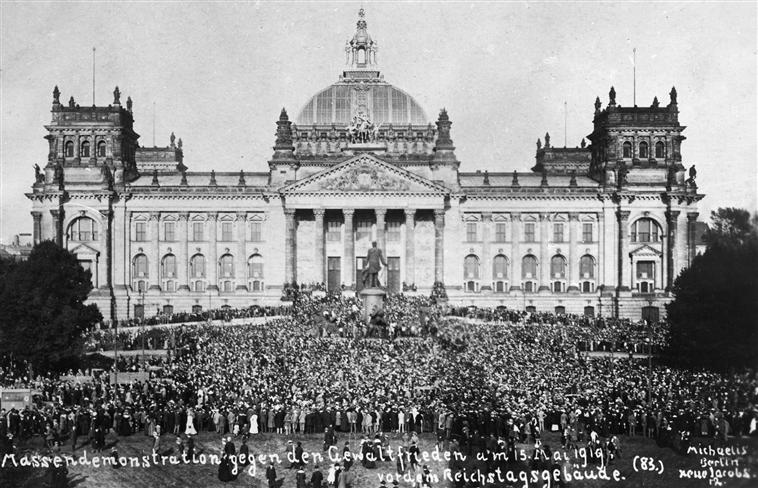
YEARBOOK: German Yearbook of International Law 62 (2019): Symposium on the Treaty of Versailles at 100


(demonstrations in Berlin against the Treaty of Versailles; source: Wikimedia Commons)


The German Yearbook of International Law devoted a focus section to the hundreth anniversary of the Peace of Versailles.

Table of contents:

Contents

Forum – Comparative Disciplinary Perspectives on the Challenges Facing the Human Rights Council

Rosa Freedman & Samuel Gordon

An International Law Perspective on the Challenges Confronting the Human Rights Council

11

Wolfgang S. Heinz

An International Relations Perspective on the Reform Needs of the Human Rights Council

43

Focus – The Treaty of Versailles at 100

Andreas von Arnauld

The Treaty of Versailles at 100: By Way of Introduction

83

Christian J. Tams

Experiments Great and Small: Centenary Reflections on the League of Nations

93

Thomas Kleinlein

The Versailles Peace Treaty Before the Permanent Court of International Justice: Tracing the Legalism of the Paris Settlement

129

Claus Kreß

The Peacemaking Process After the Great War and the Origins of International Criminal Law Stricto Sensu

163

Lauri Mälksoo

The Treaties of Brest-Litovsk, Versailles and Moscow: Contesting Sovereignty and Hegemony in Eastern Europe in 1918–1939

189

Jochen von Bernstorff

From Versailles to the Kellog-Briand Pact: Prohibiting and Justifying Aggression in the Interbellum

211

Markus P. Beham

A Forgotten Lighthouse of International Law: Heinrich Lammasch and the League of Nations

245

Magnan Johannes Mohr

Between Pacifism and Patriotism: Walther Schücking (1875–1935)

275

Walther Schücking Lecture

Alan Boyle

Progressive Development of International Environmental Law: Legislate or Litigate?

305

General Articles

James Gerard Devaney

Reapprasing the Role of Experts in Recent Cases Before the International Court of Justice

337

Nikolay Marin & Bilyana Manova

The Constraints of International Courts as a Tool for Resolving the Ukrainian-Russian Conflicts

371

Ulf Linderfalk

The Exercise of Discretion in International Law – Why Constraining Criteria Have a Proper Place in the Analysis of Legal Decision-Making

407

Bjørn Kunoy

Sharing is Caring: Transboundary Hydrocarbon Deposits on the Continental Shelf

431

Julian Scheu & Petyo Nikolov

The Incompatibility of Intra-EU Investment Treaty Arbitration With European Union Law – Assessing the Scope of the ECJ’s Achmea Judgment

475

Ilya Berlin

Western Sahara, Morocco, and the EU: Did the CJEU Get it Wrong? A Commentary of Advocate-General Wathelet’s Opinion and the CJEU Decision in the Western Sahara Campaign UK Case

505

German Practice

Alexander Grimmig

The German Constitutional Court’s Pronouncement on Self-Defence Against Non-State Actors in Syria

539

Leander Beinlich

Drones, Discretion, and the Duty to Protect the Right to Life: Germany and its Role in the United State’s Drone Programme Before the Higher Administrative Court of Münster

557

Liv Christiansen & Lilo Rösch

German Practice Concerning the Implementation of the 2015 Paris Agreement

581

Alexandra Lily Kather & Britta Redwood

Universal Jurisdiction in Germany: Framework and Practice Insights

599

Outstanding Theses

Andreas von Arnauld, Kerstin von der Decken & Nele Matz Lück

Editor’s Note

615

Laura Hering

The Consequences of Errors in the European Union’s Direct Administrative Proceedings: A Comparative Analysis of ‘Rectification’ and ‘Irrelevance’

617

Isabella Risini

The Inter-State Application Under the European Convention on Human Rights

621

Cornelia Kirchbach

The Right to Health Regulation in Investment Arbitration as Illustrated by the Example of Philip Morris v. Uruguay

625

Martin Jarret

Contributory Fault and Investor Misconduct in Investment Arbitration

629

José Guilherme Moreno Caiado

Commitments and Flexibilities in the WTO Agreement on Subsidies and Countervailing Measures: An Economically Informed Analysis

633

Sebastián Mantilla Blanco

Full Protection and Security in International Investment Law

635

Kevin Grimmeiß

Sezession und Reaktion. Zur völkerrechtlichen Regelung des Sezessionsvorgangs

639

Moritz von Rochow

Transnational Nomads in International Law – Borders and the Migration of Peoples

643

Book Reviews

W. A. Schabas: The Trial of the Kaiser (REIJNTJES)649
Harold Hongju Koh: The Trump Administration and International Law (SLOSS)651
Gina Heathcote: Feminist Dialogues on International Law: Success, Tensions, Futures
(O’DONOGHUE)
656
Steven Wheatley: The Idea of International Human Rights Law (CHINEN)658
Marco Longobardo: The Use of Force in Occupied Territory (BOTHE)660
Shavana Musa: Victim Reparation Under the Ius Post Bellum: An Historical and
Normative Perspective (IVERSON)
663
Russell Buchan: Cyber Espionage and International Law (DELERUE)664
Alejandro Rodiles: Coalitions of the Willing and International Law: The Interplay
Between Formality and Informality (TONDINI)
667
Cindy Wittke: Law in the Twilight: International Courts and Tribunals, the Security
Council and the Internationalisation of Peace Agreements Between State and Non-
State Parties (ZULUETA-FÜLSCHER)
669
P. Chandrasekhara Rao and Philippe Gautier: The International Tribunal for the Law of
the Sea: Law, Practice and Procedure (SCHATZ)
672
Lloyd Freeburn: Regulating International Sport. Power, Authority and Legitimacy
(TAMS)

Wednesday, 10 March 2021

JOURNAL: Journal of the History of International Law/Revue d'histoire du droit international XXIII (2021), no. 1 (Feb)

(image source: Blogger)

Towards a History of the Decolonization of International Law. An Introduction to the Special Issue (Natasha Wheatly & Samuel Moyn)

The High Tide of Anticolonial Legalism (Samuel Moyn)

Abstract:

For a time in the 1960s it seemed as if one domain in which the global south’s enthusiastic struggle to arrogate the mantle of universalism as an exercise in “worldmaking” was the transformation of international law. Though this struggle was ultimately circumvented by great power politics and newer forms of international law and organization, it was a crucial moment. The introductory prosopographical survey that follows seeks to recapture the consensus of a set of northern and southern international lawyers in the 1960s who saw potential in the project of transforming their field to register the aims of a new epoch – the aims of postcolonial states.

The Ricardian State: Carlos Calvo and Latin America’s Ambivalent Origin Story for the Age of Decolonization (Teresa Davis)

Abstract:

This article explores Latin America’s place in discussions about decolonization through the work of the Argentine international lawyer Carlos Calvo. It argues that while Calvo was an early proponent of Latin American sovereignty and a subtle critic of European empires, he worked within a framework that differed remarkably from that of post-World War II decolonization struggles. Most notably, Calvo’s defense of Latin American sovereignty was rooted in a liberal anti-imperialism which emphasized the important role of Latin American states as the bulwarks of free markets rather than the role of the state in curtailing markets in favor of national development. In the final section of this article I suggest some ways in which highlighting the history of liberal anti-imperialism might help reframe some of the conundrums present in recent histories of the more renowned era of Asian and African decolonization.

Building the Nation: Sovereignty and International Law in the Decolonisation of South Asia (Priyasha Saksena)

Abstract:

The position of the territorially sovereign nation-state as the fundamental building block of the contemporary world order has come under increasing challenge. Historians have long focused on social, cultural, economic, and technological factors to examine the constructed nature of the nation-state. In this article, I explore the role of law, and specifically the concept of sovereignty, in the creation of the unified spatial entity constituting the nation-state. I focus in particular on the decolonisation of South Asia and analyse legal arguments made in two international disputes (over Hyderabad and the river Indus) to understand the process through which the Indian nation-state came into being. 

Afro-Asian Jurists and the Quest to Modernise the International Protection of Foreign-Owned Property, 1955–1975 (Idriss Paul-Armand Fofana)

Abstract:

In the two decades following the 1955 Asian African Conference in Bandung, Asian and African jurists sought to reshape international law to better incorporate the aspirations of formerly colonised peoples. The Asian-African Legal Consultative Committee (AALCC), founded one year after the Bandung Conference, helped formulate a common Afro-Asian and Third World international legal agenda by bringing together jurists and ideologically diverse Asian and African governments while collaborating with UN institutions working to codify and develop international law. The AALCC’s work and the contemporaneous writings of African and Asian jurists reveal a shared ambition to weaken the international protection of foreign-owned property by pursuing a legal agenda anchored in the structure and principles of the post-World War II international legal system. The Afro-Asian international legal agenda combined efforts to eliminate pre-war rules incompatible with the foundational principles of the UN Charter while elaborating the content of these principles through UN institutions.

Erasing the Marks of Domination: Economic Sovereignty, Decolonization, and International Lawmaking in the 1950s and 1960s (Christopher Dietrich)

Abstract:

This article tells a legal and intellectual history of oil and decolonization in the 1950s and 1960s through the projects of international institutions including the UN Permanent Sovereignty Commission and the Organization of Petroleum Exporting Countries and the work of anti-colonial lawyers Hasan Zakariya and Nicolas Sarkis. It examines the ideas and infrastructure of decolonization as they related to the question of how international law could be used to win economic sovereignty.

Hydrocarbon Humanitarianism: Ibrahim Shihata, ‘Oil Aid’, and Resource Sovereignty (Umut Öszu)

Abstract:

This article revisits Ibrahim Shihata’s role in developing the financial aid policies of the Organization of Petroleum Exporting Countries (OPEC) after the formal inauguration of the New International Economic Order project (NIEO) in 1974. As director of the OPEC Special Fund, subsequently the OPEC Fund for International Development, after its establishment in 1976, Shihata spearheaded the development of the organization’s aid policies. He also defended the NIEO as a set of sensible reform measures for redistributing wealth, resources, and technology. This article contends that Shihata’s vigorous defence of OPEC’s aid record aimed to demonstrate that the NIEO – an enterprise OPEC supported – involved not simply structural reform of the inter-state system but direct engagement with questions of intra-state distribution, and that OPEC aid was designed partly to keep the ‘Third World bloc’ from disintegrating due to the growing distance between oil-producing and non-oil-producing countries. 

Decolonization and International Law: Putting the Ocean on the Map (Surabhi Ranganathan) (OPEN ACCESS)

Abstract:

From the middle of the twentieth century onwards, the order of the ocean has changed as remarkably as that of land. Yet, developments in the law of the sea usually receive less prominent consideration in international or global histories of this period. In this short essay, I examine firstly the ways in which literatures in history and international law engage, or not, with the ordering of the ocean during, and due to, decolonization. Secondly, I suggest that the making of the law of the sea offers rich insights into the contingencies, currents, and counter-currents of the decolonization moment. Among other things it reveals fluid political geographies, epistemic churn, and alternative models for the extraction and distribution of natural resources. The flickerings and foreclosures of the various possibilities of the decolonization moment are well worth further study, especially as unsettling our understandings of oceanic lines becomes necessary in the present times.

'What, Then, of the Land’?: Territoriality, International Law, and the Republic of New Afrika (Sam Klug)

Abstract:

This article charts how African American appeals to international law shifted away from a politics of petition to a politics of sovereignty with the growing influence of postcolonial states in international society and the UN’s recognition of a right to self-determination. Whereas earlier efforts by African-descended peoples in the Americas to gain a hearing before international bodies often required pushing the boundaries of international legal personality to include entities other than states, in the late 1960s and early 1970s a black nationalist group called the Republic of New Afrika (RNA) pursued international subjectivity in its traditional and fullest form: as a sovereign state. Examining the writings of RNA leaders, especially Imari Obadele, this article explores how the group’s claims for territory, reparations, and international subjectivity relied on international legal discourse about plebiscites, self-determination, and national development

Indigenizing Self-Determination at the United Nations: Reparative Progress in the Declaration on the Rights of Indigenous Peoples (Miranda Johnson)

Abstract:

When the United Nations General Assembly passed the Declaration on the Rights of Indigenous Peoples in 2007, it introduced into the international legal lexicon a new dimension to the concept of self-determination. The declaration emphasizes indigenous peoples’ distinctive rights to land, culture, language, and collective identity. It does not propose political independence or sovereign statehood, instead insisting on indigenous peoples’ equal rights of citizenship within existing nation-states. The distinct dimension of self-determination that the declaration introduces is one that speaks of indigenous peoples’ particular colonial histories of dispossession and the restoration of their rights and identities in the present, but without disrupting the political continuity of the states that surround them. It is reparative rather than revolutionary. In this article, I examine the construction and contestation of an indigenous right to self-determination both in relation to earlier definitions, and among and between the peoples and states who drafted the declaration. 

Book reviews:

  • Islamic Law of the Sea: Freedom of Navigation and Passage Rights in Islamic Thought, written by Hassan S. Khalilieh (Fahad Ahmad Bishara)
  •  Human Shields: A History of People in the Line of Fire , written by Neve Gordon and Nicola Perugini (Emily Crawford)
  •  A History of International Law in Italy, edited by Giulio Bartolini (Elisabetta Fiocchi Malaspina)
Read more with Brill.

Tuesday, 9 March 2021

WEBINAR: Janne NIJMAN (Asser Institute/UvA), "Locating Gender and Race in the History of International Law" (Geneva: IHEID, 10 MAR 2021)


(image source: IHEID Law/Twitter)

The IHEID's Law Faculty announced a webinar with Prof. Janne Nijman (Asser/UvA) entitled "Locating Gender and Race in the History of International Law".

The link for the seminar is here. See earlier on this blog for the EJIL article.

Monday, 8 March 2021

ESIL RESEARCH FORUM CATANIA: Pre-Event Meeting, Research Forum “Solidarity: the Quest for Founding Utopias of International Law" (15 APR 2021, Online)

(image: Catania Port; source: Wikimedia Commons)
 

Welcome (09:00 CET)

Presentations (09:05 CET)

09:05

‘Louis Bara (1821-1857) and the Liberal-scientific Restatement of International Law in the Nineteenth Century Peace Movement’, Wouter De Rycke (Brussels) (30 minutes)

Discussion (15 minutes)

09:50

‘The Role of the Brazilian Academic Elite in the “Civilization Project” during the XIX Century: An Analysis from the Example of the Whitening of the Population’, Luisa Cortat Simonetti Goncalves-Renato Coutinho (Maastricht)

Discussion (15 minutes)

Break (5 minutes)

10:40

‘Views in the Literature on Interdisciplinarity Research Between History and Law’ Jaanika Erne (Tartu, ESIL IGHIL Steering Committee)

Discussion (15 minutes)

Interest Group Meeting (11:25 CET)

The Zoom-link or registration procedure will be shared as soon as possible.

Wednesday, 3 March 2021

BOOK: Omer ALONI, The League of Nations and the Protection of the Environment [Cambridge Studies in International and Comparative Law] (Cambridge: CUP, JULY 2021), ISBN 9781108937399, 85 GBP


(image source: CUP)

Abstract:
In the history of how the law has dealt with environmental issues over the last century or so, the 1920s and 30s and the key role of the League of Nations in particular remain underexplored by scholars. By delving into the League's archives, Omer Aloni uncovers the story of how the interwar world expressed similar concerns to those of our own time in relation to nature, environmental challenges and human development, and reveals a missing link in understanding the roots of our ecological crisis. Charting the environmental regime of the League, he sheds new light on its role as a centre of surprising environmental dilemmas, initiatives, and solutions. Through a number of fascinating case studies, the hidden interests, perceptions, motivations, hopes, agendas and concerns of the League are revealed for the first time. Combining legal thought, historical archival research and environmental studies, a fascinating period in legal-environmental history is brought to life.

On the author:

Omer Aloni is Research and Postdoctoral Fellow in the Faculty of Social Sciences, University of Bar-Ilan, Ramat-Gan, Israel. He received his Ph.D. from Tel-Aviv University (Faculty of Law). He holds research affiliations with the University of Potsdam, the Rachel Carson Center for Environment and Society (LMU Munich) and the Max Planck Institute. He was awarded the Tallinn Prize by the European Society for Environmental History for the best research in 2018 and 2019. 

(source: CUP


Tuesday, 2 March 2021

BOOK: Andrew C. RATH, The Crimean War in Imperial Context, 1854-1856 (New York: Palgrave, 2015), ISBN 9781137544513.


(image source: Palgrave)

Abstract:

The Crimean War was fought far from its namesake peninsula in Ukraine. Until now, accounts of Britain's and France's naval campaigns against Czarist Russia in the Baltic, White Sea, and Pacific have remained fragmented, minimized, or thinly-referenced. This book considers each campaign from an imperial perspective extending from South America to Finland. Ultimately, this regionally-focused approach reveals that even the smallest Anglo-French naval campaigns in the remote White Sea had significant consequences in fields ranging from medical advances to international maritime law. Considering the perspectives of neutral powers including China, Japan, and Sweden-Norway, allows Rath to examine the Crimean conflict's impact on major historical events ranging from the 'opening' of Tokugawa Japan to Russia's annexation of large swaths of Chinese territory. Complete with customized maps and an extensive reference section, this will become essential reading for a varied audience.

 On the author:

Andrew Rath received his Ph.D. in History from McGill University, Canada. He and his wife Sarah live in Bethesda, Maryland.

See more here: DOI 10.1057/9781137544537

Monday, 1 March 2021

BOOK: Maartje ABBENHUIS & Gordon MORRELL, The First Age of Industrial Globalization. An international History 1815-1918 [New Approaches to International History] (London: Bloomsbury, 2019), 264 p. ISBN 9781474267090


(image source: Bloomsbury)

Abstract:
This book offers an accessible and lively survey of the global history of the age of industrialization and globalization that arose in the wake of the Napoleonic Wars and collapsed in the maelstrom of the First World War. Through a combination of industrialization, technological innovation and imperial expansion, the industrializing powers of the world helped to create inter-connected global space that left few regions untouched. In ten concise chapters, this book relays the major shifts in global power, economics and society, outlining the interconnections of global industrial, imperial and economic change for local and regional experiences, identities and politics. It finishes with an exposé on the catastrophic impact of the First World War on this global system. The First Age of Industrial Globalization weaves together the histories of industrialization, world economy, imperialism, international law, diplomacy and war, which historians usually treat as separate developments, and integrates them to offer a new analysis of an era of fundamental historical change. It shows that the revolutionary changes in politics, society and international affairs experienced in the 19th century were inter-connected developments. It is essential reading for any student of modern global history.

Table of contents:

List of illustrations and tables
Acknowledgements
A note on sources
Chapter 1: Contours of the first age of industrial globalization, 1815-1918
Chapter 2: Of concerts and restraints: the international diplomatic system, 1815-1856
Chapter 3: Industrializing empires and global capitalism after 1815
Chapter 4: Building globalization's infrastructure after 1856
Chapter 5: Migration and the spread of formal and informal empires
Chapter 6: Global commodities and the environmental costs of industrial capitalism
Chapter 7: A world of war after 1856
Chapter 8: Where local meets global: ideas and politics on a global scale
Chapter 9: Industrial globalization and the origins of the First World War
Chapter 10: Industrial globalization at total war, 1914-1918
Index

(source: Bloomsbury)