ESIL Interest Group History of International Law

ESIL Interest Group History of International Law
Showing posts with label book review. Show all posts

Wednesday, 13 October 2021

BOOK REVIEW: Romain BERTRAND, Dipesh CHAKRABARTY, Provincialiser l'Europe. La pensée postcoloniale et la différence historique (transl. O. RUCHET & N. VIEILLESCAZES (Paris: ED. Amsterdam, 2009 [2000], 381 p.) (Annales. Histoire, Sciences Sociales LXXV (2021), N° 3-4, 821-826


(image source: Cambridge Core)

First paragraph:
Aussi bien à l’occasion de sa parution en anglais que lors de sa traduction en français, Provincialiser l’Europe a souvent été considéré comme un manifeste anti-européocentriste, sinon même comme un brûlot relativiste. Son titre claquait comme une injonction – à mi-chemin de la nécessité théorique et de l’impératif moral. Au sein de l’espace de réception qui se dessina autour d’une certaine idée du livre, réduit à son intitulé, le propos de l’auteur fut tenu pour l’expression d’un programme fort des études postcoloniales – ce qu’il était, mais selon des voies qui déjouaient ses appropriations les plus radicales. Il convient ainsi, pour rendre pleinement justice au propos de Dipesh Chakrabarty, non seulement de suivre pas à pas son argument, mais aussi de rattacher chaque temps fort théorique de son texte aux éléments les plus déterminants de sa trajectoire intellectuelle.

(read more on Cambridge Core: DOI  10.1017/ahss.2021.21)


Monday, 7 June 2021

BOOK REVIEW: Wolfgang REINHARD (Freiburg im Breisgau) on Irene DINGEL et al. (eds.), Handbook of Peace in Early Modern Europe (Berlin: DeGruyter Oldenbourg, 2021) (Sehepunkte, MAY 2021)


(image source: Sehepunkte)

First paragraph:

Ein Werk wie dieses war längst überfällig. Zwar wurde der Friede schon immer gepriesen und hat im 20. Jahrhundert moralisch sogar die Oberhand gewonnen. Der Krieg wurde verboten. Es gibt heute keine Kriegsminister mehr, sondern nur noch Verteidigungsminister und auch so gut wie keine ordnungsgemäß mit Kriegserklärung begonnenen und mit Friedensschluss beendeten Kämpfe alten Stils. Die Wirklichkeit ist freilich nichtsdestoweniger kriegerischer denn je. Auch die Wissenschaft interessiert sich demgemäß lieber für Krieg als für Frieden. Faktisch gilt eben immer noch die Feststellung von Nietzsches Zarathustra "der gute Krieg ist es, der jede Sache heiligt" (97). Sogar die Menschenrechte müssen heute den Krieg "heiligen". Anthropologisch gesehen ist es ja viel einfacher, einen Konflikt auszulösen und durchzufechten als ihn beizulegen und zu beenden. Entsprechend schwer tut sich die Friedensforschung mit der Gewalt und entsprechend verdienstvoll ist der Versuch dieses Buches, hier mit historischer Friedensforschung massiv wissenschaftlich gegenzusteuern.

Read the full review here.

See earlier on this blog for the book

Thursday, 23 April 2020

BOOK REVIEW: Prof. dr. Miloš VEC reviews Fabian KLOSE, "In the Cause of Humanity". Eine Geschichte der humanitären Intervention im langen 19. Jahrhundert (Frankfurt Allgemeine Zeitung, 17 APR 2020)

(image source: V&R)

Prof. dr. Miloš Vec (Vienna) reviewed Fabian Klose's open access book In The Cause of Humanity: Eine Geschichte der humanitären Intervention im langen 19. Jahrhundert (see earlier on this blog).

First paragraph:
Bis heute ist die Idee einer humanitären Schutzverantwortung der internationalen Gemeinschaft eine der umstrittensten Fragen des Völkerrechts und beschäftigt die internationale Politik nicht erst seit der Intervention im Kosovo. Denn das prinzipielle Spannungsverhältnis ist seit ihrem Erscheinen im neunzehnten Jahrhundert gleich geblieben: hier die internationale Gemeinschaft, dort der einzelne Staat mit seinen Rechten auf Souveränität und territoriale Unverletzlichkeit. In welchen Fällen Krieg im Namen der Humanität geführt werden darf, wann die internationale Gemeinschaft intervenieren darf, bleibt deswegen heikel, weil Völkerrecht auch ein Machtspiel ist. Unter dem Vorwand der Hilfe und des Schutzes können auch imperiale Ziele verfolgt werden.

(read more on the FAZ Website)

Wednesday, 22 April 2020

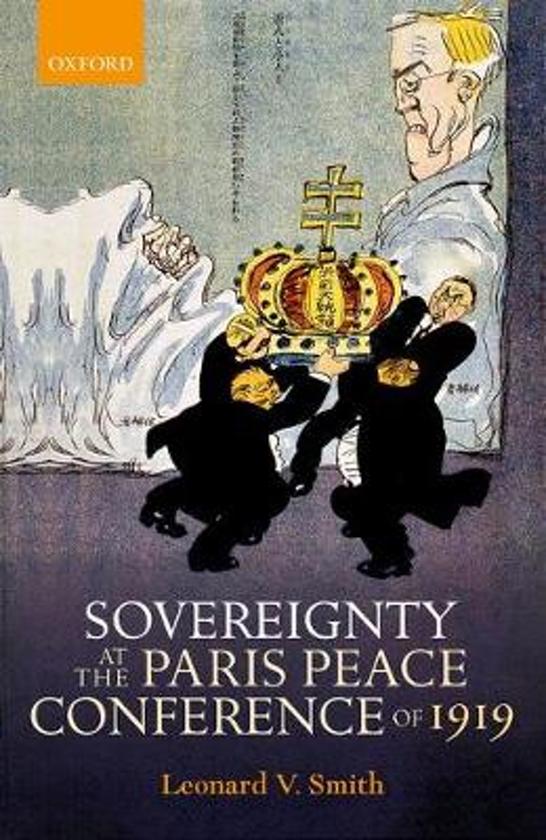
BOOK REVIEW: Isabel V. HULL reviews Leonard V. SMITH, Sovereignty at the Paris Peace Conference of 1919. (The Greater War, 1912–1923.) New York: Oxford University Press, 2018 (American Historical Review CXXV (2020), No. 2 (Apr), 713-714

(image source: bol.com)

First paragraph:
Leonard V. Smith, an accomplished social historian of World War I, has produced a thoughtful reassessment of the Paris Peace Conference that ended the Great War. It is well researched in both primary and secondary sources, and it pays close attention to recent trends in historiography. It aims to recapture the openness (“then-ness”) of this striking moment in human affairs. Smith is himself open to international relations (IR) theory to shake up the standard historian’s view. Sovereignty at the Paris Peace Conference of 1919 provides an accurate overview of the myriad issues facing contemporary statesmen: the collapse of empires, fluid borders, population disorder, colonial redistribution, war debts, reparations, establishing an entirely new international institution (the League of Nations), etc. Among its accomplishments, the book offers a sharp assessment of the role of experts, especially political geographers in postwar boundary drawing, a spirited defense of Fridtjof Nansen and the league, who are too often blamed for severe population transfers, and a shrewd analysis of how racial categorization functioned to compromise between greedy Allied imperial states and the requirement that they administer mandates rather than simply annex former German colonies.
Read more here.

Monday, 20 April 2020

BOOK REVIEW: Lucien FRARY reviews Will SMILEY, From Slaves to Prisoners of War: The Ottoman Empire, Russia, and International Law. (The History and Theory of International Law.) New York: Oxford University Press, 2018 (American Historical Review CXXV (2020), No. 2 (Apr), 616-618

(image source: OUP)

First paragraph:
Frederick the Great’s famous quip about the Russian-Ottoman wars as “the one-eyed fighting the blind” diminishes the significance of these titanic clashes, which unleashed mayhem upon huge populations, spread epidemic diseases, forced human migrations, and shredded territory throughout Eastern Europe and Transcaucasia. These wars determined the boundaries of modern nation-states and forged a sense of identity among millions of people. According to Will Smiley’s new book From Slaves to Prisoners of War: The Ottoman Empire, Russia, and International Law, the wars shaped the development of international law, including regulations for ransoming military captives and the trafficking of slaves, and defined subjecthood. What makes the book particularly intriguing (and its subject so difficult to research) is how the borderlands interacted with the international legal system during the eighteenth and nineteenth centuries, thus helping us understand the context in which these new international rules emerged.
Read more here and earlier on this blog.

Friday, 17 April 2020

BOOK REVIEW: Maartje ABBENHUIS reviews James CROSSLAND, War, Law and Humanity: The Campaign to Control Warfare, 1853–1914. New York: Bloomsbury Academic, 2018 (American Historical Review CXXV (2020), No. 2 (Apr)

(image source: Bloomsbury)

First paragaph:
James Crossland’s rather ambitiously titled book War, Law and Humanity: The Campaign to Control Warfare, 1853–1914 narrates the activism and agency of two dozen or so men and women in mitigating, restricting, and avoiding the violence and spread of war in the second half of the nineteenth century. Its author does so by explaining not only the agency of these individuals in developing key humanitarian causes—like the Red Cross and the United States Sanitary Commission—but also the interconnection between their agency and the development of a range of legal codes and treaties aimed at regulating warfare, like the Lieber Code (1863), the Geneva Conventions of 1864 and 1906, the Saint Petersburg Declaration of 1868, the Brussels Convention of 1874, and the Hague Conventions of 1899 and 1907. It is a highly readable book, replete with engaging anecdotes, contemporary reflections, and lively stylistic touches.
Read more here.

Tuesday, 11 February 2020

BOOK REVIEW: Saliha BELMESSOUS on JENNIFER PITTS. Boundaries of the International: Law and Empire (American Historical Review 2020)

(image source: OUP)

First paragraph:
Jennifer Pitts’s Boundaries of the International: Law and Empire examines the role of international law in shaping relations between Western European imperial powers and non-European societies in the eighteenth and nineteenth centuries. The book is presentist in the sense that it seeks to show how international law and order came to be dominated by Western powers up to today. Pitts criticizes the view that the law of nations was a European discourse produced to regulate relations between free and equal European states. The context in which the law of nations was produced—imperial expansion and other overseas activities—permeated the legal principles set up to regulate international relations. The law of nations was therefore a discourse produced to regulate relations between Europeans...
(more information with OUP)

Friday, 25 October 2019

BOOK REVIEW: Christophe LOSFELD reviews Stephan MEDER, Der unbekannte Leibniz. Die Entdeckung von Recht und Politik durch Philosophie (Francia Recensio 2019/3)

(image source: Perspectivia)

First paragraph:
Si, ces dernières années, Leibniz a beaucoup retenu l’attention, ce qui s’est traduit tant par la poursuite de l’édition de sa correspondance, la publication de textes consacrés à certains pans de son œuvre – qu’il s’agisse, par exemple, de ses textes consacrés à l’histoire ou à la diplomatie – ou de recueils ou de monographies étudiant telle ou telle facette de son activité polyvalente, la pensée juridique de cet auteur, Stephan Meder le constate avec raison, est un peu demeurée dans l’ombre. C’est en particulier chez les juristes que Meder note un manque d’intérêt pour le polygraphe des Lumières, ce qu’il explique par plusieurs facteurs: outre le caractère interdisciplinaire de Leibniz et les liens qu’il n’a cessé de tisser entre le droit et de la philosophie, Meder voit l’une des raisons de ce manque d’intérêt dans la difficulté d’accéder aux textes originaux, que ce soit parce que tous n’ont pas été édités ou parce que maints d’entre eux sont rédigés en latin, une langue que seule une minorité maîtrise aujourd’hui.
Read the full review on Francia Recensio's website.
More information on the book here.

Wednesday, 16 October 2019

BOOK REVIEW: Holger HEHRING reviews Jörn LEONHARD, Der überforderte Frieden. Versailles und die Welt 1918-1923 (München: Beck 2018) (Francia Recensio 2019/3

(image source: Deutschlandfunk)

First paragraph:
In January 1918 – the war had not ended yet – the Vienna paper »Der Morgen« published a cartoon that showed the »Babylonian peace tower«: on it and around it a plethora of political leaders, citizens, slogans, and banners compete for attention. They demand, for example, »democracy«, »freedom of the seas«, and in the background, we can spot a campaigner calling for »Africa to the Africans«. Readers can find this cartoon and an interpretation of it in Jörn Leonhard’s awe-inspiring monumental history of peace making after the First World War (p. 133).
Read more on Francia Recensio's website.
 

Monday, 26 August 2019

BOOK REVIEW: Joshua SMELTZER, Carl Schmitt In and Out of History (LSE Review of Books)

(image source: LSE Review of Books)

Review presentation:
In this long read, Joshua Smeltzer reviews two recent books that return to the works of infamous political and legal theorist Carl Schmitt, Perilous Futures: On Carl Schmitt’s Late Writings by Peter Uwe Hohendahl and Carl Schmitt’s State and Constitutional Theory: A Critical Analysis by Benjamin Schupmann. In the piece, Smeltzer reflects on some of the methodological challenges of studying Schmitt’s work in historical context, questions scholarly attempts to rehabilitate Schmitt as a liberal state theorist given his close involvement with Nazism and calls for greater attention on other protagonists in the intellectual history of German democracy.
Read further on the LSE Review of Books.

Thursday, 6 June 2019

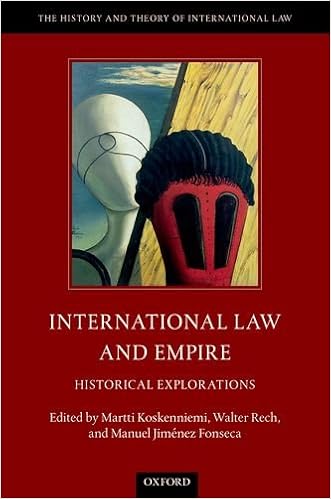
REVIEW: Alberto RINALDI reviews Martti KOSKENNIEMI, Walter RECH & Manuel JIMÉNEZ FONSECA (eds.), International Law and Empire: Historical Explorations (Oxford: OUP, 2017) (American Journal of Legal History Advance Articles)

(image source: Blogger)

First paragraph:
In recent years there has been a real flourishing of historical studies with a focus on international law’s past. The so called ‘turn to history’ is precisely the kind of terrain in which the present volume - in the form of a collection of essays - is situated, as the book explores the various, ambivalent ways in which international law has dealt with and is related to ‘Empire’, understood as a set of manifold practices, discourses, social manifestations, struggles, spaces and people.The authors - coming from a wide range of backgrounds from postcolonial studies to political philosophy - are in fact interested in looking at those episodes, events, theories, and texts...
Read more with Oxford Journals.
See earlier for on this blog for the book description.

Monday, 13 May 2019

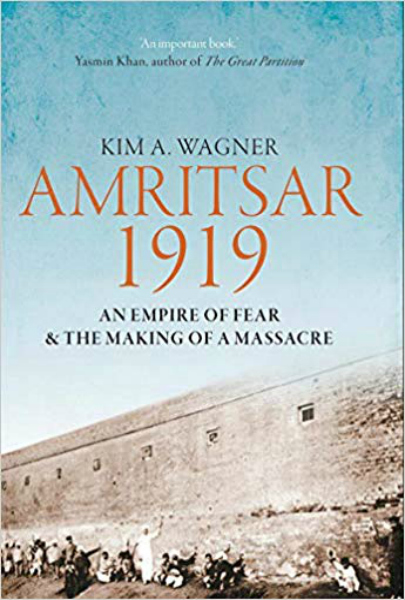
BOOK REVIEW: Thomas GIDNEY reviews Kim A. WAGNER, Amritsar 1919, An Empire of Fear and the Making of a Massacre (New Haven: Yale UP, 2019) (LSE Review of Books)

(image source: LSE Review of Books)

Review summary:
13 April 2019 marks 100 years since the Amritsar (or Jallianwala Bagh) massacre, which remains one of the most controversial acts of colonial violence in the history of the British Empire. In his new book Amritsar 1919: An Empire or Fear and the Making of a Massacre, Kim A. Wagner offers a meticulously researched account of the events leading up to the massacre as well as its aftermath. The book vividly and emotively captures post-war Amritsar, the horrors of the massacre and the violent humiliation inflicted through British colonial retribution, writes Thomas Gidney.
Read more with the LSE Review of Books.

Friday, 29 March 2019

BOOK REVIEW: Martin HECKEL, Martin Luthers Reformation und das Recht (Tübingen: Mohr Siebeck, 2017), 2016, XIV + 988 S., ISBN 978-3-16-154211-4, EUR 69,00 by Isabelle DEFLERS (Freibourg/Breisgau) Sehepunkte 18 (2018), 11

(image source: Sehepunkte)

First paragraph:
Das Reformationsjubiläum im Jahr 2017 wurde von einer unüberschaubaren Anzahl an Neuerscheinungen in den unterschiedlichsten Gattungen begleitet. Unter ihnen ragt die monumentale Studie Martin Heckels über das Verhältnis von Luthers reformatorischer Lehre zu seinem Verständnis vom Recht heraus. Das Buch enthält nicht nur eine gründliche und umfangreiche Untersuchung der Auswirkungen der lutherisch ausgeprägten Theologie auf die Art und Weise, wie Recht zu definieren sei, sondern darüber hinaus auch die persönliche Reflexion eines 89-jährigen Gelehrten über den Stellenwert des Kirchenrechts heutzutage. Somit zieht das 988 Seiten umfassende Buch ein Fazit über das eigene Œuvre und die eigene Disziplin, stellt aber kein Vermächtnis dar, denn Heckel erwähnt im Vorwort zwei geplante Fortsetzungen: zunächst einen Band über die Rechtsentwicklung im Reich und in den Territorien bis zum Westfälischen Frieden und einen dritten Band über die Wandlungen des evangelischen Kirchenrechts und Staatskirchenrechts bis in die Gegenwart.
Read further on Sehepunkte.
(source: ESCLH Blog)

Friday, 11 January 2019

REVIEW ARTICLE: John A. THOMPSON, "American Power and Interwar Internationalism" (The Historical Journal LXI (2018), No. 4, 1137-1148)

(image source: Cambridge Core)

Extract:
Two central features of global history over the past century have been the pre-eminent power of the United States in world politics and the growth of international organizations. The relationship between these phenomena has been variously interpreted, in ways that reflect theoretical and methodological commitments as well as political perspectives. The Realist school, for whom power relationships are always determinative, have followed Carl Schmitt and E. H. Carr in seeing international institutions, and the norms and laws they uphold, as instruments through which dominant powers seek legitimacy as well as influence. By contrast, liberal theorists have viewed the pursuit of a rule-governed world order, and the development of the idea of a ‘world community’, as a more autonomous and broadly based enterprise, one spurred by increased interdependence and greater concern with matters of common interest to all nations – not least that of avoiding the devastating effects of great power warfare in the modern era. As is usually the case with such analytically sharp distinctions, neither of these positions conveys the whole truth

Read more here.

Thursday, 13 December 2018

BOOK REVIEW: Jorge Díaz CEBALLOS reviews Jorge CAÑIZARES-EGUERA, Entangled Empires: The Anglo-Iberian Atlantic, 1500-1830 (Philadelphia: University of Philadelphia Press, 2018), 344 p. ISBN 9780812249835, 55 USD [H-DIPLO]

(image source: HNet)

First paragraph:

In his influential book, which appeared in 1970, The Old World and the New, John H. Elliott traced the origins and development of European’s perception of the New World since 1492. Elliott emphasized how nineteenth-century historiography set the standards of interpretation for this event, creating a “Europocentric conception of history” that celebrated, in a somewhat optimistic fashion, the pursuits and the impact of European nations in faraway lands.[1] That conception of history was based on a liberal interpretation of history as a linear and uninterrupted path of progress. According to Elliott, twentieth-century historiography maintained the interpretation of European’s conquest of the New World. The difference was that twentieth-century scholars wrote about “European superiority” “burdened with the consciousness of European guilt.”[2] Although Elliott’s historiographic analysis only covered books published until 1970, his conclusions remained valid until recent times. This book has had a long-lasting influence on scholars working on the relationship between the New World and Old; two congresses, later published in books, even sprang from that influence.[3] Elliott’s own chapter in one of these books qualified as “blunted” the impact between Renaissance Europe and America, and declared that, in the moment of the first contact a linear advance did not start; instead “we find ourselves at the beginning of a winding road which twists back on itself, and involves retreats, advances, and more than one false start.”[4] That very spirit moved Elliott’s own research on a comparative history of Spanish and British Empires in the New World to a very well-built monographic study of the conquest and colonization of America by the two nations. Elliott’s Empires of the Atlantic World: Britain and Spain in America 1492-1830 (2006), although deepened by his analysis, was constructed with a parallel structure that compared two empires chronologically and thematically.


Read further here.

(source: H-Diplo)

Tuesday, 30 October 2018

BOOK REVIEW: Michael GEYER (Chicago) reviews Jennifer PITTS, Boundaries of the International (H-Net)


Michael Geyer (Chicago) reviewed Jennifer Pitt's Boundaries of the International, announced earlier on this blog.

First paragraph:
It is a categorical error to conceive of the global society of nations as a European system of states writ large. The world is not Europe; it never has been and never will be. Neither does the world follow Europe’s model; not even Europe follows its own purported model. Jennifer Pitts’s remarkable study, The Boundaries of the International, calls this categorical fallacy “parochial universalism” and demonstrates that it has deep roots in European thought.[1]
Read further here.

Friday, 5 October 2018

BOOK REVIEW: Charles-Edouard LEVILLAIN reviews Nicolas DROCOURT & Eric SCHNAKENBOURG (dir.), Thémis en diplomatie. Droit et arguments juridiques dans les relations internationales [Histoire] (Rennes: Presses universitaires de Rennes, 2016)

(image source: JMH)

First paragraph:
International law law was long in the making. By exploring the rich dialectical relationship between law and diplomacy, this volume invites readers to rethink the art of negotiation as an empirical process that only very gradually assumed a formal coherence and a theoretical substance. The editors have assembled a team of scholars working on different periods -from the late Roman antiquity to the Enlightenment- and different territories. While the volume's primary focus is on European history, some chapters discuss Ottoman or early American history. The volume alternates between global and local history.
Read the rest of the review here.

Sunday, 25 February 2018

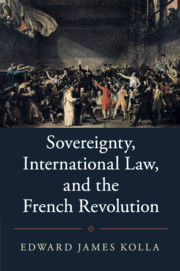
BOOK REVIEW: Joshua MEEKS reviews Edward James KOLLA, Sovereignty, International Law, and the French Revolution [Studies in Legal History Series] (Cambridge: Cambridge University Press, 2017) [H-Diplo]

(image source: CUP)
 
Joshua Meeks (Northwest University) reviewed Edward James Kolla's recent book on the French Revolution, Sovereignty and International Law (CUP 2017, see announcement on the ESCLH blog).

First paragraph:


One of the more common conceptions of diplomacy during the French Revolution is that the revolutionaries attacked tradition in the name of liberty and disregarded international law and conventions as they attempted to export radical revolution throughout Europe. In Sovereignty, International Law, and the French Revolution, Edward James Kolla pushes back against this idea, arguing that though the revolutionaries were willing to adapt and in some cases ignore established legal traditions, they did so not in a conscious attempt to replace international law with a revolutionary variant. Instead, he explains in both breadth and detail how the principles of popular sovereignty espoused by the revolutionaries shaped the principle of self-determination in international law through a contingent, contradictory, and often haphazard process. Through case studies ranging from Corsica to the Netherlands, Kolla elucidates a thoughtful argument that combines a rigorous approach to international law with a well-crafted historical narrative.
Read the full review here.
(source: H-Diplo mailing)

Tuesday, 17 May 2016

OPEN ACCESS BOOK REVIEWS (Zeitschrift für Historische Forschung 2015 (3))


(image source: recensio.net)

 Recensio.net published two open access book reviews of potential interest to our members:

Guido Braun / Arno Strohmeyer (Hg.): Frieden und Friedenssicherung in der Frühen Neuzeit. Das Heilige Römische Reich und Europa, 2013 (Anuschka Tischer, in: Zeitschrift für Historische Forschung (ZHF), 42 (2015), 3), click here.

Markus Kremer (Hg.): Francisco Suárez: De pace – De bello / Über den Frieden – Über den Krieg, 2013 (Nils Jansen, in: Zeitschrift für Historische Forschung (ZHF), 42 (2015), 3), click here.

Monday, 28 September 2015

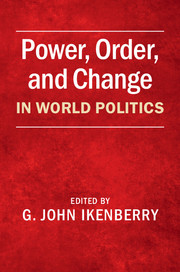
BOOK REVIEW: Nuno Monteiro (Yale) reviews John IKENBERRY (ed.), Power, Order, and Change in World Politics. Cambridge: Cambridge University Press, 2014. 308 pp. $32.99, ISBN 978-1-107-42106-6 (H-Diplo)


(image source: H-Diplo)

The discussion forum H-Diplo (HNet) features a review by Nuno Monteiro (Yale) of John Ikenberry's collective work Power, Order and Change in World Politics (CUP, 2014).

(image source: Cambridge UP)


First paragraph:
The ninth of Walter Benjamin’s 1940 theses “On the Concept of History” consists of the following controversial observation about Paul Klee’s drawing Angelus Novus (1920): “A Klee painting named Angelus Novus shows an angel looking as though he is about to move away from something he is fixedly contemplating. His eyes are staring, his mouth is open, his wings are spread. This is how one pictures the angel of history. His face is turned toward the past. Where we perceive a chain of events, he sees one single catastrophe which keeps piling wreckage upon wreckage and hurls it in front of his feet. The angel would like to stay, awaken the dead, and make whole what has been smashed. But a storm is blowing from Paradise; it has got caught in his wings with such violence that the angel can no longer close them. The storm irresistibly propels him into the future to which his back is turned, while the pile of debris before him grows skyward. This storm is what we call progress.”
 Read the fulltext here.