ESIL Interest Group History of International Law

ESIL Interest Group History of International Law
Showing posts with label humanitarian intervention. Show all posts

Thursday, 23 April 2020

BOOK REVIEW: Prof. dr. Miloš VEC reviews Fabian KLOSE, "In the Cause of Humanity". Eine Geschichte der humanitären Intervention im langen 19. Jahrhundert (Frankfurt Allgemeine Zeitung, 17 APR 2020)

(image source: V&R)

Prof. dr. Miloš Vec (Vienna) reviewed Fabian Klose's open access book In The Cause of Humanity: Eine Geschichte der humanitären Intervention im langen 19. Jahrhundert (see earlier on this blog).

First paragraph:
Bis heute ist die Idee einer humanitären Schutzverantwortung der internationalen Gemeinschaft eine der umstrittensten Fragen des Völkerrechts und beschäftigt die internationale Politik nicht erst seit der Intervention im Kosovo. Denn das prinzipielle Spannungsverhältnis ist seit ihrem Erscheinen im neunzehnten Jahrhundert gleich geblieben: hier die internationale Gemeinschaft, dort der einzelne Staat mit seinen Rechten auf Souveränität und territoriale Unverletzlichkeit. In welchen Fällen Krieg im Namen der Humanität geführt werden darf, wann die internationale Gemeinschaft intervenieren darf, bleibt deswegen heikel, weil Völkerrecht auch ein Machtspiel ist. Unter dem Vorwand der Hilfe und des Schutzes können auch imperiale Ziele verfolgt werden.

(read more on the FAZ Website)

Thursday, 5 March 2020

BOOK: Mark SWATEK-EVENSTEIN, A History of Humanitarian Intervention (Cambridge: Cambridge UP, 2020), 286 p. ISBN 9781107061927, 85 GBP

(image source: CUP)

Abstract:
The question of 'humanitarian intervention' has been a staple of international law for around 200 years, with a renewed interest in the history of the subject emerging in the last twenty years. This book provides a chronological account of the evolution of the discussion and uncovers the fictional narrative provided by international lawyers to support their conclusions on the subject, from justifications and arguments for 'humanitarian intervention', the misrepresentation of great power involvement in the Greek War of Independence in 1827, to the 'humanitarian intervention that never was', India's war with Pakistan in 1971. Relying on a variety of sources, some of them made available in English for the first time, the book provides an undogmatic, alternative history of the fight for the protection of human rights in international law.
On the author:
Mark Swatek-Evenstein is a scholar and lawyer specializing in criminal law, immigration and refugee law. He is a member of the International Network of Genocide Scholars and has taught courses on The Holocaust and The Law. His current research focuses on the minority experience in international law. 
(source: CUP)

Thursday, 18 July 2019

BOOK: Fabian KLOSE, "In the Cause of Humanity". Eine Geschichte der humanitären Intervention im langen 19. Jahrhundert [Veröffentlichungen des Instituts für Europäische Geschichte Mainz; 256] (Göttingen: Vandenhoeck & Ruprecht, 2019), 516 p. 978-3-525-37084-1, OPEN ACCESS

(image source: Vandenhoeck & Ruprecht)

Introduction:
Im Jahr 2000 veröffentlichte der damalige UN-Generalsekretär Kofi Annan anlässlich der Jahrtausendwende einen Bericht, in dem er die Rolle der Vereinten Nationen und die Herausforderungen für die Weltorganisation im beginnenden 21. Jahrhundert eingehend thematisierte. Seine umfangreichen Ausführungen, die sich von Fragen der Globalisierung, der weltweiten Armutsbekämpfung, der Friedenssicherung, des nachhaltigen Umweltund Klimaschutzes bis hin zu Strukturreformen der UN-Organisation selbst erstreckten, waren als Anregungen und Empfehlungen an die UN-Mitgliedsstaaten für den anstehenden Millenniumsgipfel gedacht, um dort gemeinsam Antworten auf drängende Probleme der Gegenwart und Zukunft zu finden. Die Durchsetzung universaler Menschenrechte war für Annan in diesem Zusammenhang von zentraler Bedeutung, und entsprechend plädierte er nachdrücklich für eine Verbesserung der dafür vorgesehenen internationalen Schutzmechanismen. Die dabei vorgeschlagenen neuen Strategien implizierten neben der Errichtung des Internationalen Strafgerichtshofs und der allgemeinen Stärkung des humanitären Völkerrechts auch das Konzept der humanitären Intervention, also die direkte, in letzter Konsequenz auch gewaltsame Einmischung von außen in die inneren Angelegenheiten eines souveränen Staates zum Schutz humanitärer Normen
Read the whole book for free here.

Wednesday, 30 January 2019

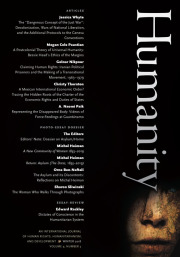
OPEN ACCESS ARTICLE: Jessica WHYTE, "The Dangeous Concept of the Just War": Decolonization, Wars of National Liberation, and the Additional Protocols to the Geneva Conventions", Humanity IX (2018), nr. 3

(image source: Humanity)

First paragraph:
In 2002, the North American political theorist Michael Walzer announced the “triumph of just war theory,” which he saw as evidence of moral progress. This paper challenges Walzer’s progressive narrative by turning to the often-acrimonious debates about just and unjust wars during the drafting of the Additional Protocols to the Geneva Conventions. I show that during the International Committee of the Red Cross’s “Diplomatic Conference on the Laws of War” (1974-77) it was the Third World and Soviet states that used the language of the “just war” to distinguish wars of national liberation from wars of “imperialist aggression”—particularly the US War in Vietnam. In stark contrast, the Western states, including the US, attacked the language of just war as a medieval licence to cruelty.
Read the article for free here.

Thursday, 16 August 2018

ARTICLE: Catherine S ARNOLD, "Affairs of Humanity: Arguments for Humanitarian Intervention in England and Europe, 1698–1715" (English Historical Review CXXXIII (2018), Issue 563), 835-865

(image source: Oxford Academic)

Abstract:
Why and how did a new type of intervention, intended to prevent rulers from punishing individuals for their religious beliefs and justified using natural law, emerge in England during the first decade of the eighteenth century? This article traces its origins to the War of the Spanish Succession, when Huguenot publicists and diplomats petitioned English politicians to negotiate freedom for Huguenot prisoners in France. In campaigning for prisoners’ freedom rather than for the restoration of Huguenot corporate rights in France, Huguenot publicists and diplomats had to justify intervention in universalising, non-confessional terms. Because those prisoners were not protected by treaty law, the laws of war, or the laws of France, they cited Protestant and humanist traditions of natural law and theories of natural sociability to justify negotiating their release. In so doing, they invited European readers, politicians and monarchs to sympathise with distant strangers—and even to take political action on their behalf—not only because they shared a common faith, but also because they belonged to human society and shared a common humanity. These arguments circulated both in print and among European diplomats, altering the conduct of international affairs. In England, this article shows, Huguenot campaigns influenced debates about intervention and English foreign policy-making. Thus, this article suggests a new narrative for the diffusion of humanitarian argument in eighteenth-century western European political culture.
Source: Oxford Academic.