ESIL Interest Group History of International Law

ESIL Interest Group History of International Law
Showing posts with label just war. Show all posts

Wednesday, 30 January 2019

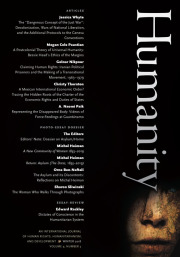
OPEN ACCESS ARTICLE: Jessica WHYTE, "The Dangeous Concept of the Just War": Decolonization, Wars of National Liberation, and the Additional Protocols to the Geneva Conventions", Humanity IX (2018), nr. 3

(image source: Humanity)

First paragraph:
In 2002, the North American political theorist Michael Walzer announced the “triumph of just war theory,” which he saw as evidence of moral progress. This paper challenges Walzer’s progressive narrative by turning to the often-acrimonious debates about just and unjust wars during the drafting of the Additional Protocols to the Geneva Conventions. I show that during the International Committee of the Red Cross’s “Diplomatic Conference on the Laws of War” (1974-77) it was the Third World and Soviet states that used the language of the “just war” to distinguish wars of national liberation from wars of “imperialist aggression”—particularly the US War in Vietnam. In stark contrast, the Western states, including the US, attacked the language of just war as a medieval licence to cruelty.
Read the article for free here.

Thursday, 16 August 2018

ARTICLE: Catherine S ARNOLD, "Affairs of Humanity: Arguments for Humanitarian Intervention in England and Europe, 1698–1715" (English Historical Review CXXXIII (2018), Issue 563), 835-865

(image source: Oxford Academic)

Abstract:
Why and how did a new type of intervention, intended to prevent rulers from punishing individuals for their religious beliefs and justified using natural law, emerge in England during the first decade of the eighteenth century? This article traces its origins to the War of the Spanish Succession, when Huguenot publicists and diplomats petitioned English politicians to negotiate freedom for Huguenot prisoners in France. In campaigning for prisoners’ freedom rather than for the restoration of Huguenot corporate rights in France, Huguenot publicists and diplomats had to justify intervention in universalising, non-confessional terms. Because those prisoners were not protected by treaty law, the laws of war, or the laws of France, they cited Protestant and humanist traditions of natural law and theories of natural sociability to justify negotiating their release. In so doing, they invited European readers, politicians and monarchs to sympathise with distant strangers—and even to take political action on their behalf—not only because they shared a common faith, but also because they belonged to human society and shared a common humanity. These arguments circulated both in print and among European diplomats, altering the conduct of international affairs. In England, this article shows, Huguenot campaigns influenced debates about intervention and English foreign policy-making. Thus, this article suggests a new narrative for the diffusion of humanitarian argument in eighteenth-century western European political culture.
Source: Oxford Academic.

Monday, 17 November 2014

PODCAST: Just war in canon law (Concordance des Temps, France Culture, 14 November 2014)

(Pope Urbanus II calls for the First Crusade at the Council of Clermont, 1095)

The French radio station France Culture broadcasted an episode of Jean-Noël Jeanneney's Concordance des Temps around the just war doctrine in medieval canon law and theology. Since the roots of present-day jus ad bellum lie in christian doctrine, the ESILHIL-blog thought this of sufficient interest to our members and readers. Jeanneney, former president of the Bibliothèque nationale de France, professor at Sciences Po Paris and former Secretary of State under François Mitterrand, invited medievist André Vauchez, member of the Institut de France and the Académie des inscriptions et des belles lettres, to discuss the Church's role as an actor in international relations and as a lawmaker. An erudite conversation on the (im)possible morality of the use of force, proportionality,  auctoritas, recta intentio, causa justa and sovereignty.

Podcast here.