ESIL Interest Group History of International Law

ESIL Interest Group History of International Law
Showing posts with label journal. Show all posts

Saturday, 9 November 2024

NEW ISSUE: Journal of the History of International Law (Volume 26, Issue 3)

Source: Brill

Articles


British Utilitarianism after Bentham: Nineteenth-Century Foundations of International Law Part II

Author:
Robert Schütze
Pages: 243–284

Unequal Treaty in Practice: A Story about Article 23 of the Treaty of Tientsin
Author:
Shiu Chung Chan
Pages: 285–311

Gender, Human Rights Networks, and the State of Emergency During the Arab Revolt (1936–1939)

Author:
Paola Zichi
Pages: 312–344

Book Review

State Responsibility and Rebels: The History and Legacy of Protecting Investment against Revolution, written by Kathryn Greenman

Author:
Filip Batselé
Pages: 345–349

Visit Brill's website for more info.

Monday, 14 October 2024

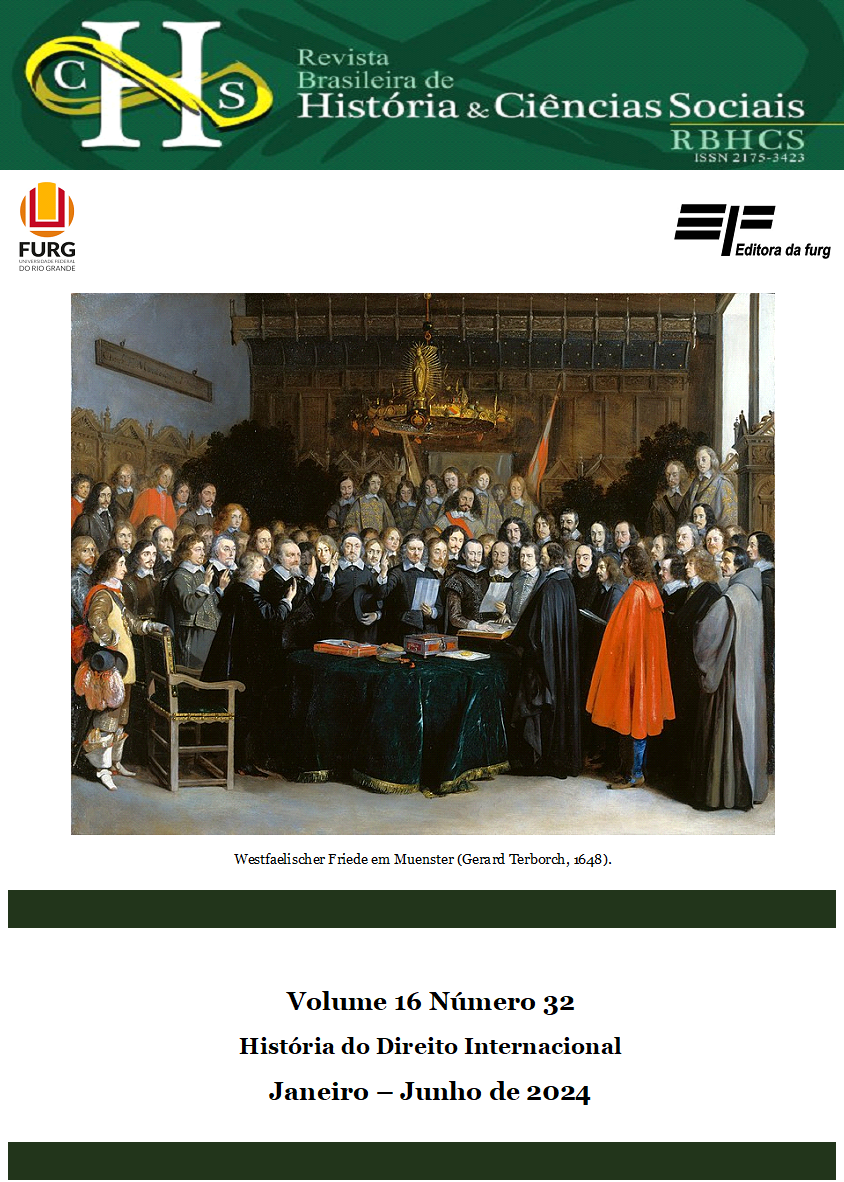
SPECIAL ISSUE: Revista Brasileira de História & Ciências Sociais, "História do Direito Internacional" (Volume 16, Issue 32, 2024)


Source: Revista Brasileira de Historia & Ciencias Sociais


Description:

Apresentação do Volume 16 Número 32 da Revista Brasileira de História & Ciências Sociais

Denize Terezinha Leal Freitas, Fabiano Quadros Rückert, José Carlos da Silva Cardozo, Jonathan Fachini da Silva, Tiago da Silva Cesar, Wagner Silveira Feloniuk

4-5

História do Direito Internacional

Augusto Jaeger Junior, Arno Dal Ri Jr., Lucas Carlos Lima

6-10

Dossiê

Percursos do Princípio das Nacionalidades nas doutrinas belgas de Direito Internacional: do Círculo de Gante à Escola de Lovânia (1863-1953)

DOI: https://doi.org/10.14295/rbhcs.v16i32.16513

Arno Dal Ri Jr

11-53


A cláusula da nação mais favorecida em tratados comerciais: percepções ocidentais sobre a prática latino-americana de tratados comerciais no final do século XIX e início do século XX

DOI: https://doi.org/10.14295/rbhcs.v16i32.16576

Florenz Volkaert, Fernando Muniz Shecaira

54-87


A participação brasileira na elaboração do Estatuto da CPJI: o papel de Clovis Bevilaqua a Raul Fernandes

DOI: https://doi.org/10.14295/rbhcs.v16i32.16509

Lucas Carlos Lima

88-107


A história da construção do modelo de produção tradicional do direito internacional

DOI: https://doi.org/10.14295/rbhcs.v16i32.16665

Amina Welten Guerra

108-138


A prática dos estados asiáticos na implementação do princípio de proteção de monumentos e obras de arte antes da Primeira Guerra Mundial

DOI: https://doi.org/10.14295/rbhcs.v16i32.16429

Alice Lopes Fabris

139-158


A obra literária de Carl Schmitt durante seus anos como protagonista jurídico do nacional-socialismo (1933-1936): uma sobreposição entre os escritos e os fatos

DOI: https://doi.org/10.14295/rbhcs.v16i32.16602

Marcelo Markus Teixeira

159-181


Decolonizing International Law: between demystifications and resignifications

DOI: https://doi.org/10.14295/rbhcs.v16i32.16555

Tatiana de A. F. R. Cardoso Squeff, Gabriel Pedro Dassoler Damasceno

182-205


O peticionamento das vítimas de violações de direitos humanos no sistema convencional das nações unida

DOI: https://doi.org/10.14295/rbhcs.v16i32.16529

Cristina Figueiredo Terezo Ribeiro, Thaís Magno

206-245


De objetivos universais a resultados locais: apontamentos para uma história da proteção regional aos direitos humanos

DOI: https://doi.org/10.14295/rbhcs.v16i32.16586

Alexander de Castro

246-269


Direitos africanos dos Direitos Humanos – análise desde a perspectiva jurídico-histórica

DOI: https://doi.org/10.14295/rbhcs.v16i32.16565

João Francisco

270-298


A talidomida no banco dos réus: o julgamento de Alsdorf (Alemanha, 1968) a partir da imprensa brasileira

DOI: https://doi.org/10.14295/rbhcs.v16i32.16582

Francieli Lunelli Santos

299-323


A Resiliência da Identidade: Indigenato e a Virada Histórica no Direito Internacional

DOI: https://doi.org/10.14295/rbhcs.v16i32.16369

Lucas Lixinski

324-354


O Supremo Acordo: usos jurídicos do passado da Anistia no julgamento da Arguição de Descumprimento de Preceito Fundamental n. 153

DOI: https://doi.org/10.14295/rbhcs.v16i32.16715

Ilanil Coelho, Pedro Odainai

355-390


Interesses políticos na evolução histórica do Direito Internacional dos Refugiados e no caso ucraniano: entre humanitarismo e seletividade na prática europeia

DOI: https://doi.org/10.14295/rbhcs.v16i32.16537

Augusto Jaeger Junior, Ricardo Strauch Aveline

391-420


Das contribuições de Francisco de Vitória ao necessário giro epistemológico para as Américas: o Direito Internacional redimensionado a partir do Sul Global

DOI: https://doi.org/10.14295/rbhcs.v16i32.16568

Thiago Giovani Romero, Wanda Helena Mendes Muniz Falcão, Vinicius Villani Abrantes

421-438


O solidarismo de Hugo Grócio como princípio normativo de um constitucionalismo transnacional no século XXI

DOI: https://doi.org/10.14295/rbhcs.v16i32.16724

Anderson Vichinkeski Teixeira


More info with the publisher.

Monday, 25 September 2023

JOURNAL: American Journal of International Law Unbound, "Special Issue: 150 Years of the Institut de Droit International and the International Law Association" (Volume 117, 2023)


The latest issue of AJIL Unbound comprises a dedicated section on the history of international law, in particular the Institut de droit international and the International Law Association. Consult AJIL's website for more information.

Table of Contents:

Introduction to the Symposium on 150 Years of the Institut de Droit International and the International Law Association: Cause for Celebration or Concern?

Introduction to the Symposium on 150 Years of the Institut de Droit International and the International Law Association: Cause for Celebration or Concern?
Part of 150 Years of the Institut de Droit International and the International Law Association
Jeffrey L. Dunoff


The Institutionalization of International Law at a Crossroads: Pacifists, Jurists, and the Creation of the ILA and the IDI
Part of 150 Years of the Institut de Droit International and the International Law Association
Xiaohang Chen

Legal Knowledge as Social and Political Capital
Part of 150 Years of the Institut de Droit International and the International Law Association
Sara Dezalay


The Institute of International Law and the Colonial Phenomenon
Part of 150 Years of the Institut de Droit International and the International Law Association
Georges Abi-Saab


Unveiling the “Legal Conscience of the Civilized World:” a Critical Look at the Institut de Droit International
Part of 150 Years of the Institut de Droit International and the International Law Association
Julia Emtseva


The IDI, The ILA, and their Impact on the Institutionalization of International Law in the Americas: Resonances and Dissonances
Part of 150 Years of the Institut de Droit International and the International Law Association
Juan Pablo Scarfi

The International Law Commission, the Institut, and States
Part of 150 Years of the Institut de Droit International and the International Law Association
Dire Tladi

Friday, 15 October 2021

JOURNAL: Jus Gentium. Journal of International Legal History VI (2021), No. 2 (Jul)


(image source: Lawbookexchange)

Vol. 6, No. 2 | July 2021

ARTICLES
Theory of the History of International Law: Methodology, Grounds, and Developments
Olga Butkevych

The English Translators and Publishers of Grotius on War and Peace: 1654–1928
W. E. Butler

China and the Unequal Treaties: Localization, Variation, and Response
Zenghua Zhuo

NOTES AND COMMENTS
Ruminations on DNA and the History of International Law
W. E. Butler

Georg von Gretschaninow (1892–1973): Émigré Jurist Stateless at Berlin and Heidelberg. A Concise Bio-Bibliography
P. Macalister-Smith

DOCUMENTS AND OTHER EVIDENCE OF STATE PRACTICE
Royal Naval Instructions Implementing the 1817 Anglo-Spanish Treaty on Illicit Trafficking of Slaves
W. E. Butler

A Brief Calendar of State Practice for Shandong: 1897–1914. Part Four (1914): Into World War
P. Macalister-Smith
J. Schweitzke

FROM THE LITERATURE

(source: lawbookexchange)

Tuesday, 17 August 2021

JOURNAL: Monde(s) 19 [La Société des nations. Une expérience de l'internationalisme, eds. Jean-Michel GUIEU & Stanislas JEANNESSON] (JUL 2021) (ISBN 9782753582682)


(image source: CAIRN)

Articles
« L’expérience de Genève » (1920-1946) (Jean-Michel Guieu & Stanislas Jeannesson)

The League of Nations Secretariat: An Experiment in Liberal Internationalism? (Karen Gram-Skjoldager & Haakon Andreas Ikonomou)

Employées à la Société des nations : carrières et conditions de travail, 1920-1932 (Myriam Piguet)

Usages du droit et espaces de pouvoir transnationaux. La pratique pétitionnaire de la section des minorités de la SDN face aux rescapés d’un crime de masse, 1920-1939 (Dzovinar Kévonian)

Beware of Pity: The League of Nations’ Treatment of Prostitution (Magaly Rodríguez García)

Breaking Even for the Future: The Financial History of the League of Nations Between 1919 and 1933 (Hannah Tyler)

Joseph Paul-Boncour à Genève : une pratique de l’internationalisme (Matthieu Boisdron)

Un Uruguayen à Genève : Julián Nogueira et l’internationalisme latino-américain à la Société des nations (Yannick Wehrli)

Missed Opportunities to be Global Conversion and Diversion of the Scientific Field of Knowledge of International Relations of the International Studies Conference and the Institute of Pacific Relations (Tomoko Akami)

Débat autour d'un livre
Les États-Unis et la Société des nations (1914-1946) Le système international face à l’émergence d’une superpuissance, Berne, Peter Lang, 2016 (Andrew Barros, Nicolas Vaicbourdt, Ludovic Tournès)

Varia
En quête de légitimité. Le Comité international de la Croix-Rouge et l’Afrique durant les années 1960 (Marie-Luce Desgrandchamps)

Les maoïstes suisses et « l’or de Pékin » au cœur de la Guerre froide (Cyril Cordoba)

Read all articles on Cairn. Or buy the special issue in book form with the PUR.

Monday, 12 July 2021

JOURNAL: Grotiana XLII (2021), No. 1 (Jul)


(image source: Brill)

Historical, Philosophical, and Legal Foundations of Strict Liability in Hugo Grotius—Some Introductory Remarks to the Special Dossier (Bart Wauters) (OPEN ACCESS)

Culpa Levissima and the Eclipse of Strict Liability (James Gordley) (DOI 10.1163/18760759-42010002)

Abstract:

In Roman law, as interpreted by the medieval jurists, in a gratuitous loan (commodatum), the borrower was liable for culpa levissima, failure to use be as diligent as “most diligent” (diligentissimus). It would seem, then, that a person could be liable for conduct that he could not help. That consequence troubled the medieval canonists a person would then be liable who had not sinned. It troubled the late scholastics because a person would then be liable for an accident, which was not a violation of commutative justice. Some concluded that liability for culpa levissima was a creature of positive law, based on pragmatic considerations but with no grounding in principle. There was another explanation glimpsed by the late scholastics and by Hugo Grotius: commutative justice requires that one who borrows gratuitously indemnify the lender against any loss. Unfortunately, in the following centuries, that explanation was lost from sight.

Qualitative Liability in the Early Modern Low Countries (ca. 1425–1650) (Wouter Druwé)

Abstract:

In his ‘Inleidinge tot de Hollantsche Rechtsgeleertheyt’, Hugo Grotius introduced the concept of wrong-by-construction-of-law (‘misdaed door wetsduidinge’), the idea that civil law could assign liability to someone who had not committed any fault, i.e. merely because of his or her ‘capacity’ or ‘quality’ as a parent, as an owner of an animal, as an inhabitant of a building, or as an employer or shipowner. This contribution situates Grotius’s views on qualitative liability within the wider Netherlandish learned juridical context of his time, and especially studies the role of fault (‘culpa’) and presumptions of fault in the learned theories on qualitative liability. Apart from printed treatises and volumes of consilia, this contribution also takes into account hitherto unstudied handwritten lecture notes of the late medieval and early modern university of Leuven.

The Place of Fault in Grotius’s Conception of Liability for Wrongdoing (Joe Sampson) (OPEN ACCESS)

Abstract:

This article compares Grotius’s treatments of liability for wrongdoing in natural law and the law of Holland to emphasise the conceptual centrality of fault in both, and places Grotius’s analyses in their historical context by tracing the treatment of strict liability in those intellectual traditions upon which he drew. It focuses in particular on the formulation of obligations quasi ex maleficio to show how the absence of fault rendered the obligation something other than delictual.

Strict Liability and Necessity in Grotius, Pufendorf, Smith, Kant, and Beyond (Bart Wauters) (DOI 10.1163/18760759-42010005)

Abstract:

This article compares the views of Grotius and subsequent authors on the doctrines of necessity and strict liability. This comparison takes place at two levels. On the one hand, there is a comparison of the views of Grotius with those of Pufendorf, Smith, Kant and recent Kantian authors. On the other hand, there is a comparison between the doctrines of necessity and strict liability. This exercise leads to the conclusion that strict liability does not have to be a mere matter of choice opted for by positive law, but in some instances can also be thought of as a requirement of a private law framework expressing the fundamental moral equal freedom of man.

Grotius’s Position on Implied Servitudes by Means of Destinatione Patris Familias (Vincent Van Hoof) (OPEN ACCESS) (DOI 10.1163/18760759-42010006)

Abstract:

According to Grotius in his Inleiding (2.36.6), the actual use of two houses by the same owner could lead to the implied grant of a servitude if he transferred one of the houses to someone else, ‘without any mention either the one way or the other’. Various interpretations of this text exist, but the consensus is lacking. In this article, the author investigates the meaning and influence of Grotius’s position on implied servitudes in both his time and the following centuries. This research shows how Grotius’s opinion progressed from Bartolus’s approach to implied servitudes and sheds new light on the creation of servitudes by means of destinatione patris familias in the Netherlands.

Religion and Government in Hugo Grotius’s Annales: Orthodoxy, William the Silent and Reason of State (Jan Waszink) (DOI 10.1163/18760759-42010007)

Abstract:

In Grotius’s Annales, religion appears almost exclusively as a social and political problem. References (implied or explicit) to religion as a good thing or its positive effects are lacking. This aspect of Grotius’s text arises from its equation of ‘religion’ with ‘combative orthodox religion in the post-reformation era’. However, it is not credible that this view represents Hugo Grotius’s actual opinion of the Christian faith as such. The solution seems rather that the above equation must be a conscious rhetorical strategy designed to strengthen the argument of the Annales. Continuing from that conclusion, however, the texts allow us to deduce some views on reason of state and religious policy, which do seem to have been actually held by Grotius in this period, or at least to have enjoyed his active interest.

The History of Fair Trade: Hugo Grotius, Corporations, and the Spanish Enlightenment (Edward Jones Corredera) (DOI 10.1163/18760759-42010008)

Abstract:

The early Spanish Enlightenment was shaped by debates over corporations, sovereignty, and the balance of power in Europe. Spanish officials, in this context, turned to the ideas of Hugo Grotius to establish joint-stock companies that could allow the Crown to regain control over its imperial domains and establish perpetual peace in Europe. This article recovers the writings of Félix Fernando de Sotomayor, Duke of Sotomayor (1684–1767), who drew on the works of Grotius, Samuel Pufendorf, and Charles Dutot in order to show that the history of these corporations chronicled the contestation and erosion of Spanish power and the diversion of European states from their true interests. Sovereigns, not merchants, argued Sotomayor, could guarantee fair trade and the equitable distribution of wealth. The study of Sotomayor’s views on trade, natural law, and alienation challenges traditional interpretations about the Iberian engagement with Grotius, the rise of capitalist hopes in Southern and Northern Europe, and Spain’s investment in the Enlightenment.

Book reviews:

  • The Law of Nations and Natural Law 1625–1800, ed. by Simone Zurbuchen (Gabriella Silvestrini)
  • Michael P. Scharf, Milena Sterio and Paul R. Williams, The Syrian Conflict’s Impact on International Law (Robert Volterra)
  • Martha Nussbaum, The Cosmopolitan Tradition: A Noble But Flawed Ideal (Tarik Kochi)
(read further here)

Monday, 21 June 2021

JOURNAL: Forum on "Historiography, Ideology, and Law" (History & Theory, LX (2021), Issue 2, 185-405


(image source: Wiley)

Historiography, Ideology and Law: an Introduction (Justin Desautels-Stein & Samuel Moyn) (DOI 10.1111/hith.12207)

Abstract:

This is an introduction to a forum on historiography, ideology, and law. The basic question weaving this forum together concerns the meaning of the term “critical” in the domain of critical legal history, a question that is deeply familiar to historians of all stripes. Ultimately, whether you are a lawyer doing historical work, a historian interested in law, or a historian of a different sort altogether, there is no hiding from the question of context and, critically, the ideological stakes in choosing an answer to that question.

 On the domestication of Critical Legal History (Justin Desautels-Stein & Samuel Moyn) (DOI 10.1111/hith.12208)

Abstract:

Among many of today's legal historians, there is a relatively new and generally unreflective understanding of the relationship between history and method. The landscape is everywhere marked by a tendency to eschew big thinking, grand theory, and programmatic approaches to historical explanation and social transformation. In the place of the grand theory approach to law and history, there is a preference for the minimalist, the pragmatic, the particularistic, and the quotidian. What this normal science of today's legal historiography makes obvious is a kind of attachment to particular kinds of problems with particular sorts of built-in solutions. The result for today is intellectual stagnation, a routinized and thoroughly domesticated mode of revealing contingency. Oddly, the fascination with contingency, and its deadening affair with a minimalist pragmatism, is itself a result of the triumph of what continues to be called “critical legal history.” Ostensibly due to an interface between critical legal studies and the historical discipline, the rise and triumph of critical legal history hides a secret: the whole idea of a reigning critical appreciation for contingency seems to be a misnomer. Sure, some may say that “things might have been otherwise.” But what this intellectual settlement demands is obedience to its qualification: “things might have been otherwise, but they weren't, and so let's get on with doing what works.” Although so-called critical legal history seduces adherents with promises of edgy progressivism, the actual malaise of our minimalism seems in fact to suggest just the opposite. It is a quiescent and even quietistic method in practice, counseling in its conservatism against higher-order proposals that might ever make good on the discovery that nothing is natural. In the end, either we must accept that critical legal history in the United States is a lot less politically explosive than we once thought—given its deradicalization and domestication today—or that people have been mistaken about what critical legal history was, is, and ought to be.

Law and the Time of Angels: International Law's Method Wars and the Affective Lives of Disciplines (Natasha Wheatley) (DOI 10.1111/hith.12209)

Abstract:

Recent method wars in international legal scholarship turn on the problem of law in time. Rejecting historians' focus on context and their “policing of anachronism,” prominent legal scholars like Anne Orford and Martti Koskenniemi have argued that the workings of modern law are not governed by the narrow strictures of sequential chronology and that legal scholars require alternate methods that reflect law's transfer of meaning through time. Contextualism, in this reckoning, represents a misguided methodological straightjacket that stifles critique by quarantining meaning and power in discrete historical silos; the embrace of anachronism, conversely, would foster a revitalized history of international law intimately connected with the political imperatives of the present. This essay uses the debate as an opening into a fuller exploration of law in history and in time. In considering the idiosyncratic way law frames time, sequence, and duration, it explores the connection between law's transtemporal transfers and its very mode of reproduction. To speak of law's capacity to escape context and travel through time is another way of describing its normativity: the laws of the past that survive to exert a normative force in the present are not, in their law-ness, past—they are simply present law. The essay suggests some ways to make that temporality itself the object of analysis (rather than naturalizing and affirming it, as Orford has, or, conversely, dismissing it as bad history, as some historians have). It draws on the history of science to generate an account of law's temporal habitus as a disciplinary knowledge tool, a kind of epistemic virtue that is intimately involved in law's internal criteria for truth and falsity.

Theorizing Constitutional History (Maeve Glass) (DOI 10.1111/hith.12210)

Abstract:

The historical study of American constitutional law has long rested on a conceptual framework that divides the past into linear units of analysis. Constitutional time unfolds according to discrete eras defined by changes in political leadership and governance, whereas constitutional space typically appears divided into bordered jurisdictions and regional sections. Despite the prominence of this conceptual framework, scholars have yet to ask how, why, and to what effect it became the paradigmatic mode of study. In the absence of close study, the framework instead appears as a neutral embodiment of the constitutional order. This essay offers a preliminary sketch of how theories of knowledge production, and particularly Louis Althusser's theory of law as an ideological apparatus, can help to move beyond this facile assumption. By returning to a selection of landmark judicial opinions and legal treatises from the long nineteenth century and analyzing their discursive practices in relation to the dominant modes of production, this exploratory essay suggests a striking possibility: that the paradigm that we have assumed to be a primordial part of the constitutional order only emerged in its current iteration in the late nineteenth-century shift from a plantation mode of production rooted in enslaved labor to an industrial mode of production rooted in wage labor. As these sources indicate, leading jurists in America's age of conquest and enslavement regularly analyzed questions of state power and rights by organizing time according to chains of title rooted in dispossession based on race and space according to the geographic circuits of capital. Effective in naturalizing the strict racialized hierarchy integral to the production and circulation of export commodities, this discourse of tethering institutions to the history of property acquisition and the movement of commodities began to shift with the formal abolition of slavery and rise of intensive industrialization, as a new generation of legal academics created a paradigm of institutional time and space that, by erasing material histories of structural inequality, made it possible to reconstitute an old social order predicated on racial classifications of whiteness.

Family Law Matters (Judith Surkis) (DOI 10.1111/hith.12211)

Abstract:

This essay analyzes how new histories of family law help to dismantle developmentalist accounts of legal, economic, and political modernity. Far from being backwaters, they have recently emerged as sites of theoretical and practical innovation. Recombining methodologies from genealogy to social reproduction theory and psychoanalysis, they do more than denaturalize categories, destabilize familiar narratives, and demonstrate ideological contradictions (although they do that too). Motivated by a sense of what is lost theoretically and politically by the family's historical and juridical marginalization, they reinvigorate legal history by locating the problem of the family at the center of broader critical projects.

 Proximate Causation in Legal Historiography (Simon Stern) (DOI 10.1111/hith.12212)

Abstract:

The variety of legal history published in general-interest law journals tends to differ from the variety published in history journals. This study compares the two varieties by examining footnote references in five general-interest law journals and footnote references in two journals of legal history. In the law journals, cases and statutes accounted for the single largest group of footnotes (approximately 35%), followed by references to other law journal articles (nearly 25%). In the legal history journals, these two categories accounted for less than 20% of all references; primary and secondary historical materials predominated in the footnotes. To be sure, legal decisions and law journal articles can also be historical sources: rather than being used as evidence of what the law is, they might be studied for what they reveal about legal reasoning or rhetoric in an earlier age. However, in most legal historical research that attends primarily to cases and statutes, these materials figure as evidence of the state of the law at that time. When the analysis relies on legal sources to trace the development of a certain doctrine and treats them as sufficient to account for that development, the result is the distinctive style of research that I seek to contrast against approaches that cast the net of historical inquiry more widely. To account for these different approaches, I suggest that law professors rely on a notion of proximate causation as a historiographic method. According to this approach, legal developments are proximately caused by other developments in the legal sphere, and other social and cultural developments play more attenuated roles, such that their influence is less significant. By proposing this explanation, I hope to draw more attention to assumptions about causation in legal historiography and to question their persuasive force.

(read further: Wiley

(source: ESCLH Blog)

Thursday, 10 June 2021

BOOK SYMPOSIUM: Ntina TZOUVALA, Capitalism as Civilisation (with Rohini SEN, Daniel R. QUIROGA-VILLAMARIN, Jullie WETTERSLEY, Kanad BAGCHI)

(image source: EUI)

Ntina Tzouvala's Capitalism as Civilisation (see earlier on this blog) is at the heart of an open access book symposium with the European Journal of Legal Studies, including a response by the author herself.

Kanad Bagchi, ‘Materialism, Culture and the Standard of Civilization’ (61-79) 

Julie Wetterslev, ‘The Standard of Civilisation in International Law’ (81-99) 

Daniel R. Quiroga-Villamarín, ‘Victorian Antics: The Persistence of the “Law as Craft” Mindset in the Critical Legal Imagination’ (101-116) 

Rohini Sen, ‘Reading and Readings of Capitalism as Civilisation‘ (117-136) 

Ntina Tzouvala, ‘Capitalism as Civilisation, or How to Respond to your Book Reviews when the Author is Dead’ (137-153) 

Read everything on the journal's website

Monday, 29 March 2021

ARTICLE: Ntina TZOUVALA, "The Specter of Eurocentrism in International Legal History" (Yale Journal of Law & The Humanities XXXI (2021), No. 2, 413-434 (OPEN ACCES)

(image source: Yale)


First lines:

The honeymoon period of the “turn to history” in international law did not last long. On the surface everyone agreed that the past of the discipline remained under-examined and under-theorized. Additionally, few (if any) international legal scholars still believed in the most extreme versions of linear, progressivist narratives that imagined (international) law to be part and parcel of “the long march of mankind from the cave to the computer.”2 Nevertheless, important methodological differences persisted.

Read the full article here

Wednesday, 10 March 2021

JOURNAL: Journal of the History of International Law/Revue d'histoire du droit international XXIII (2021), no. 1 (Feb)

(image source: Blogger)

Towards a History of the Decolonization of International Law. An Introduction to the Special Issue (Natasha Wheatly & Samuel Moyn)

The High Tide of Anticolonial Legalism (Samuel Moyn)

Abstract:

For a time in the 1960s it seemed as if one domain in which the global south’s enthusiastic struggle to arrogate the mantle of universalism as an exercise in “worldmaking” was the transformation of international law. Though this struggle was ultimately circumvented by great power politics and newer forms of international law and organization, it was a crucial moment. The introductory prosopographical survey that follows seeks to recapture the consensus of a set of northern and southern international lawyers in the 1960s who saw potential in the project of transforming their field to register the aims of a new epoch – the aims of postcolonial states.

The Ricardian State: Carlos Calvo and Latin America’s Ambivalent Origin Story for the Age of Decolonization (Teresa Davis)

Abstract:

This article explores Latin America’s place in discussions about decolonization through the work of the Argentine international lawyer Carlos Calvo. It argues that while Calvo was an early proponent of Latin American sovereignty and a subtle critic of European empires, he worked within a framework that differed remarkably from that of post-World War II decolonization struggles. Most notably, Calvo’s defense of Latin American sovereignty was rooted in a liberal anti-imperialism which emphasized the important role of Latin American states as the bulwarks of free markets rather than the role of the state in curtailing markets in favor of national development. In the final section of this article I suggest some ways in which highlighting the history of liberal anti-imperialism might help reframe some of the conundrums present in recent histories of the more renowned era of Asian and African decolonization.

Building the Nation: Sovereignty and International Law in the Decolonisation of South Asia (Priyasha Saksena)

Abstract:

The position of the territorially sovereign nation-state as the fundamental building block of the contemporary world order has come under increasing challenge. Historians have long focused on social, cultural, economic, and technological factors to examine the constructed nature of the nation-state. In this article, I explore the role of law, and specifically the concept of sovereignty, in the creation of the unified spatial entity constituting the nation-state. I focus in particular on the decolonisation of South Asia and analyse legal arguments made in two international disputes (over Hyderabad and the river Indus) to understand the process through which the Indian nation-state came into being. 

Afro-Asian Jurists and the Quest to Modernise the International Protection of Foreign-Owned Property, 1955–1975 (Idriss Paul-Armand Fofana)

Abstract:

In the two decades following the 1955 Asian African Conference in Bandung, Asian and African jurists sought to reshape international law to better incorporate the aspirations of formerly colonised peoples. The Asian-African Legal Consultative Committee (AALCC), founded one year after the Bandung Conference, helped formulate a common Afro-Asian and Third World international legal agenda by bringing together jurists and ideologically diverse Asian and African governments while collaborating with UN institutions working to codify and develop international law. The AALCC’s work and the contemporaneous writings of African and Asian jurists reveal a shared ambition to weaken the international protection of foreign-owned property by pursuing a legal agenda anchored in the structure and principles of the post-World War II international legal system. The Afro-Asian international legal agenda combined efforts to eliminate pre-war rules incompatible with the foundational principles of the UN Charter while elaborating the content of these principles through UN institutions.

Erasing the Marks of Domination: Economic Sovereignty, Decolonization, and International Lawmaking in the 1950s and 1960s (Christopher Dietrich)

Abstract:

This article tells a legal and intellectual history of oil and decolonization in the 1950s and 1960s through the projects of international institutions including the UN Permanent Sovereignty Commission and the Organization of Petroleum Exporting Countries and the work of anti-colonial lawyers Hasan Zakariya and Nicolas Sarkis. It examines the ideas and infrastructure of decolonization as they related to the question of how international law could be used to win economic sovereignty.

Hydrocarbon Humanitarianism: Ibrahim Shihata, ‘Oil Aid’, and Resource Sovereignty (Umut Öszu)

Abstract:

This article revisits Ibrahim Shihata’s role in developing the financial aid policies of the Organization of Petroleum Exporting Countries (OPEC) after the formal inauguration of the New International Economic Order project (NIEO) in 1974. As director of the OPEC Special Fund, subsequently the OPEC Fund for International Development, after its establishment in 1976, Shihata spearheaded the development of the organization’s aid policies. He also defended the NIEO as a set of sensible reform measures for redistributing wealth, resources, and technology. This article contends that Shihata’s vigorous defence of OPEC’s aid record aimed to demonstrate that the NIEO – an enterprise OPEC supported – involved not simply structural reform of the inter-state system but direct engagement with questions of intra-state distribution, and that OPEC aid was designed partly to keep the ‘Third World bloc’ from disintegrating due to the growing distance between oil-producing and non-oil-producing countries. 

Decolonization and International Law: Putting the Ocean on the Map (Surabhi Ranganathan) (OPEN ACCESS)

Abstract:

From the middle of the twentieth century onwards, the order of the ocean has changed as remarkably as that of land. Yet, developments in the law of the sea usually receive less prominent consideration in international or global histories of this period. In this short essay, I examine firstly the ways in which literatures in history and international law engage, or not, with the ordering of the ocean during, and due to, decolonization. Secondly, I suggest that the making of the law of the sea offers rich insights into the contingencies, currents, and counter-currents of the decolonization moment. Among other things it reveals fluid political geographies, epistemic churn, and alternative models for the extraction and distribution of natural resources. The flickerings and foreclosures of the various possibilities of the decolonization moment are well worth further study, especially as unsettling our understandings of oceanic lines becomes necessary in the present times.

'What, Then, of the Land’?: Territoriality, International Law, and the Republic of New Afrika (Sam Klug)

Abstract:

This article charts how African American appeals to international law shifted away from a politics of petition to a politics of sovereignty with the growing influence of postcolonial states in international society and the UN’s recognition of a right to self-determination. Whereas earlier efforts by African-descended peoples in the Americas to gain a hearing before international bodies often required pushing the boundaries of international legal personality to include entities other than states, in the late 1960s and early 1970s a black nationalist group called the Republic of New Afrika (RNA) pursued international subjectivity in its traditional and fullest form: as a sovereign state. Examining the writings of RNA leaders, especially Imari Obadele, this article explores how the group’s claims for territory, reparations, and international subjectivity relied on international legal discourse about plebiscites, self-determination, and national development

Indigenizing Self-Determination at the United Nations: Reparative Progress in the Declaration on the Rights of Indigenous Peoples (Miranda Johnson)

Abstract:

When the United Nations General Assembly passed the Declaration on the Rights of Indigenous Peoples in 2007, it introduced into the international legal lexicon a new dimension to the concept of self-determination. The declaration emphasizes indigenous peoples’ distinctive rights to land, culture, language, and collective identity. It does not propose political independence or sovereign statehood, instead insisting on indigenous peoples’ equal rights of citizenship within existing nation-states. The distinct dimension of self-determination that the declaration introduces is one that speaks of indigenous peoples’ particular colonial histories of dispossession and the restoration of their rights and identities in the present, but without disrupting the political continuity of the states that surround them. It is reparative rather than revolutionary. In this article, I examine the construction and contestation of an indigenous right to self-determination both in relation to earlier definitions, and among and between the peoples and states who drafted the declaration. 

Book reviews:

  • Islamic Law of the Sea: Freedom of Navigation and Passage Rights in Islamic Thought, written by Hassan S. Khalilieh (Fahad Ahmad Bishara)
  •  Human Shields: A History of People in the Line of Fire , written by Neve Gordon and Nicola Perugini (Emily Crawford)
  •  A History of International Law in Italy, edited by Giulio Bartolini (Elisabetta Fiocchi Malaspina)
Read more with Brill.

Wednesday, 6 January 2021

JOURNAL: Journal of the History of International Law/Revue d'histoire du droit international XXII (2020), nr. 4

(image source: Brill)
 

‘A Retrograde Tendency’: The Expropriation of German Property in the Versailles Treaty (Nicholas Mulder)

Abstract:

This article explores how the Versailles Treaty was shaped by the effects of economic warfare 1914–1919. The First World War was in part an Allied economic war waged against the Central Powers in conditions of advanced economic and financial globalization. This was reflected in the treaty’s expropriation mechanisms, which were used to take control of German property, rights, and interests around the world. Whereas Articles 297 and 298 of the treaty legalized wartime seizures, the Reparations Section of the treaty also contained a provision, paragraph 18, that gave the Allies far-reaching confiscatory powers in the future. The article places these mechanisms in a wider political, legal and economic context, and traces how they became a bone of contention among the former belligerents in the interwar period.

The Economic World of the populus Romanus (Amy Russell)

Abstract:

Rome’s transformation from city-state to territorial empire involved a massive increase in wealth; it also both created and responded to fundamental political changes, in a moment often positioned as the creation myth of republicanism. James Tan has modelled the Republican economy as a three-way relationship between aristocrats, the state, and the people. Aristocrats competed with the state for access to the riches of conquest; simultaneously the state’s dependence on citizen taxation declined. This article examines the relationship between state and people as both practical and ideological. The People were sovereign, yet it was the People who increasingly lost their status as economic and political stakeholders even as their empire grew. The complex relationship between the people and the populus (‘the People’ as an institution) had economic as well as political elements, and is central to how we should apply notions of economic sovereignty to Republican Rome 

 Public-Private Concord through Divided Sovereignty: Reframing societas for International Law (Hans Blom & Mark Somos)

Abstract:

Grotius is the father of modern international law. The indivisibility of sovereignty was the sine qua non of early-modern conceptual innovation in law. Both statements are axiomatic in the mainstream literature of the last two centuries. Both are profoundly and interestingly wrong. This article shows that Grotius’ systematisation of public and international law involved defining corporations as potentially (and the VOC actually) integral to reason of state, and able to bear and exercise marks of sovereignty under certain conditions. For Grotius, some corporations were not subsumed under the state’s legal authority, nor were they hybrid ‘company-states’. Instead, states and such corporations, able and forced to cooperate, fell under dovetailing natural, international, and municipal systems of law. The article reexamines Grotius’ notion of international trade, public debt, private corporation, and public and private war through the reassembled prism of these dovetailing laws and the category of societas that underpins Grotian associations. It is argued that although formulated around the new East India trade, the actual reality of legal pluralism was available to Grotius in the Dutch trade experience of the sixteenth century.

Book reviews:

  • From Slaves to Prisoners of War: The Ottoman Empire, Russia, and International Law , written by Will Smiley (Joshua M. White)
  • Origins of the Right of Self-defence in International Law: From the Caroline Incident to the United Nations Charter , written by Tadashi Mori (Federica Paddeu)
  • The Trial of the Kaiser , written by William A. Schabas (David Cohen)

 (source: Brill)

Tuesday, 29 December 2020

JOURNAL: Grotiana XLI (2020), No. 2

(image souce: Grotiana)


Grotius on the Use of Force: Perfect, Imperfect and Civil Wars. An Introduction (Randall Lesaffer) (OPEN ACCESS)

First paragraph:

In both of Hugo Grotius’s major forays into the law of nations, the just war doctrine provided the backbone of the argument. Between 1604 and 1606, Grotius prepared a treatise in defence of the capture of the Portuguese ship Santa Catarina in the Strait of Singapore by a fleet of the Dutch East India Company. In the text, which became known as De iure praedae commentarius upon its publication in 1868, Grotius refashioned the just war doctrine in order to argue that the captured ship and cargo were good prize in a just war. According to Grotius, this was the case regardless of whether one considered the Company an agent of the Dutch Republic in a war between states, or a private actor.

Perfect War: Alberico Gentili on the Use of Force and the Early Modern Law of Nations (Valentina Vadi)

Abstract:

Gentili’s conceptualization of war as a conflict between states attempted to limit the legitimacy of war to external wars only, thus precluding the legitimacy of civil wars. It reflected both the emergence of sovereign states and the vision of international law as a law among polities rather than individuals. The conceptualization of war as a dispute settlement mechanism among polities rather than a punishment for breach of the law of nations and the idea of the bilateral justice of war humanized the conduct of warfare and the content of peace treaties. The idea of perfect war excluded brigandage, piracy, and civil wars from its purview. Some scholars have suggested that perfect war had a dark side, legitimizing imperial expansion. Others have cautioned that Gentili explicitly opposed imperial expansion rather adopting anti-imperialist stances. This article suggests that these ambivalent readings of the Gentilian oeuvre reflect the ambivalence of the early modern law of nations. Under the early modern law of nations, aggression for the sake of empire was clearly unjust; nonetheless, imperial expansion took place. Whereas ‘a law which many transgress[ed] [wa]s nonetheless a law’, there was a wide divide between theory and practice

Hugo Grotius, Declaration of War, and the International Moral Order (Camilla Boisen)

Abstract:

This article investigates the formal purpose of declaring wars for Hugo Grotius. Grotius was adamant that states always use justification in a duplicitous way to conceal their real motivation to go to war. As such, the purpose of declaration is not to assert the just cause of war. Rather, what any public declaration does, is provide recognition that confers legal validation to the disputing parties. The legal rules of war were described by the law of nations and occasionally permitted states to commit certain ‘war crimes’ with impunity. For Grotius, this was not a moral sanctioning of such crimes but rather a means to prevent the occurrence of wars, which such endless repudiations risked causing or exacerbating. Grotius’s concern for the effects of war is conspicuous; and recounting his maxim that war should always be a last resort, this article argues that declaration of war has a distinct moral purpose for Grotius. In fact, public declaration of war is, together with constraints on the conduct of war, a ‘principle of moderation’ Grotius insists should be upheld in times of war. Declaration of war gives the parties avenues to seek peace and reconciliation, and, therefore has a humanitarian purpose for Grotius by ultimately seeking to prevent the disparaging effects of war. Even in wars that do not demand a public declaration, such as those regulated by natural law such as punitive wars or defensive wars, Grotius cautions that declarations of war are advisable. The remaining lingering issue is how to engage with unlawful enemy combatants, such as pirates - a distinct problem that the international community still faces with increasing regularity. Grotius was certainly aware of the legal (and moral) consequences of recognising belligerency we cannot possible hope to build moral relations with, and, this article claims, ‘unlawful’ enemies ultimately demarcates the boundary of international society.

'Remedium repraesaliarum’: The Medieval and Early Modern Practice and Theory of Reprisal within the Just War Doctrine (Philippine Christina Van den Brande)

Abstract:

Centuries before being included in Hugo Grotius’s De iure belli ac pacis and De iure praedae, the subject of reprisal was already being discussed in medieval literature. The aim of this paper is to examine the medieval and early modern practice and theory of reprisal as it developed before and during Grotius’s lifetime. Its first part investigates a number of important foundational elements, such as the issues of definition and terminology, and the common characteristics of a reprisal case. In the second half, the author explores why reprisals were deemed to be a ‘perversus mos’ or ‘bad custom’ and how continued reliance on this practice was nonetheless justified by inserting it into the medieval just war doctrine. The paper does not provide a systematic study of Grotius’s own engagement with medieval reprisal sources. Rather, it should be read in conjunction with another publication in this same volume, ‘Grotius on Reprisal’ by Randall Lesaffer.

Grotius on Reprisal (Randall Lesaffer) (OPEN ACCESS)

Abstract:

In neither of his two major forays into the laws of war and peace – De iure praedae or De iure belli ac pacis – did Hugo Grotius discuss the legal institutions of reprisal – whether special or general – or privateering in their own right. His profoundly novel reading of the just war doctrine in the context of his theory of natural rights, however, gave powerful legitimisation to the practices of special reprisals, as well as of privateering in times of war and of peace.

Corporate Belligerency and the Delegation Theory from Grotius to Westlake (Rotem Giladi)

Abstract:

This article starts with a critical reflection on John Westlake’s reading of the history of empire and the English/British East India Company – for him, essentially, the proper concern of ‘constitutional history’ rather than international law. For Westlake, approaching this history through the prism of nineteenth-century positivist doctrine, the Company’s exercise of war powers could only result from state delegation. Against his warnings to international lawyers not to stray from the proper boundaries of international legal inquiry, the article proceeds to recover Hugo Grotius’s theory of corporate belligerency in his early treatise De iure praedae. For Grotius, corporations could wage public war on behalf of the state yet, at the same time, were in law capable of waging private war in their own right. The article proceeds to reflect on the practice of corporate belligerency in the centuries separating Westlake and Grotius; it concludes with observations on the implications of Grotius’s theory of corporate belligerency today

Grotius and Late Medieval Ius Commune on Rebellion and Civil War (Dante Fedele)

Abstract:

This paper explores the presence of late medieval ius commune in Grotius’s thought on the use of force in internal strife and war, based on De iure belli ac pacis (1625). To this end, it examines Grotius’s use of ius commune sources, and considers some similar sources, which he does not actually cite, but which relate to his discussion. By clarifying Grotius’s selection and use of ius commune sources, the paper intends to contribute to the achievement of a double aim: firstly, to determine the place of rebellion and civil war in De iure belli ac pacis, especially in relation to (external) war; and, secondly, to assess Grotius’s approach to the two former issues, particularly with regard to the criteria by which a distinction between rebellion and civil war can be drawn, and to the effects of this distinction.

A Prodigy Child of the Dutch Revolt: Immediate ‘Precursors’ to Grotius on Just Revolt (Raymond Kubben)

Abstract:

One of the odd things about Grotius’s thought is that he – advocate of a rebellious regime – was not very supportive of the right of resistance. Justifying the revolt at the time not only meant legitimizing the new regime he was serving; it also meant ruling out opposition against it. That posed an intricate puzzle; a puzzle Grotius solved by drawing on the theorizing on just revolt of the previous decades. This paper purports to show the connection between Grotius’s thought on just revolt and the intellectual and political environment in which Grotius came of age. It also sets out to show that the solution to the puzzle lies in the element of authority and the particular view taken on the constitutional position of the States in the Low Countries.

Hugo Grotius and the Classical Law of Civil War (Ville Kari)

Abstract:

This article explores the writings of Hugo Grotius on the law of civil war. First, the article takes a look at what Grotius wrote about the Dutch revolt, the civil war during which he himself lived and which he helped to legitimise. Second, the article notes how in legal practice the Dutch revolt also provided a valuable early precedent for the later scholars of the law of civil war, who were more concerned with questions of revolutionary prize jurisdiction and the problem of recognition. Third, the article explores the elements relating to these questions of civil war in Grotius’s volitional law of nations as presented in De iure belli ac pacis. These provided Grotius’s most enduring legacy for the later scholars on the law of civil war.

(read more with Brill)

Monday, 2 November 2020

JOURNAL: Special Issue Politics and the Histories of International Law (eds. Anne PETERS, Raphaël SCHÄFER & Randall LESAFFER) Journal of the History of International Law/Revue d'histoire du droit international XXII (2020), No. 2-3

(image source: Brill)

 Articles:

  • Politics and the Histories of International Law: An Introduction to the Special Issue (Anne Peters, Raphael Schäfer, and Randall Lesaffer) (open access)
  • A History of International Law in the Vernacular (Jacob Katz Cogan)
  • Theorising Order in the Shadow of War. The Politics of International Legal Knowledge and the Justification of Force in Modernity (Hendrik Simon)
  • Edmund Burke and the Ambivalence of Protection for Slaves: Between Humanity and Control (Parvathi Menon)
  • The Politics of History in the Late Qing Era: William A. P. Martin and a History of International Law for China (Maria Adèle Carrai)
  • Strength through Diversity? The Paradox of Extraterritoriality and the History of the Odd Ones Out (Madeleine Herren)
  • Civilisation, Protection, Restitution: A Critical History of International Cultural Heritage Law in the 19th and 20th Century (Sebastian M. Spitra) (open access)
  • Full Access The Road to Collective Security: Soviet Russia, the League of Nations, and the Emergence of the ius contra bellum in the Aftermath of the Russian Revolution (1917–1934) (Etienne Henry)
  • Three Wartime Textbooks of International Law (Deborah Whitehall)
  • Full Access Histories Hidden in the Shadow: Vitoria and the International Ostracism of Francoist Spain (Julia Bühner)
  • International Law and the European Court of Justice: The Politics of Avoiding History (Michel Elperding)
  • Turntablism in the History of International Law (Jean d'Aspremont) (open access)

Book reviews:

  • Rewriting the History of the Law of Nations. How James Brown Scott Made Francisco de Vitoria the Founder of International Law, written by Paolo Amorosa (Ignacio de la Rasilla del Moral)
  • Islamic International Law. Historical Foundations and Al-Shaybani’s Siyar, written by Khaled Ramadan Bashir (Dominique Gaurier)
(read more here)

Thursday, 15 October 2020

JOURNAL: Jus Gentium - Journal of International Legal History (vol. V, issues 1 and 2) [incl. Symposium: Archives of International Law: Histories of International Lawyers between Trajectories, Practices, and Discourses, ed. Dvozinar KEVONIAN & Philippe RYGIEL]


(image source: Lawbookexchange)
Issue 1

Ancient China: Degeneration of the Institution of Zhou from Constitution to International Law and on to Anarchy (David K. C. Huang & Nigel N. T. Li)

The Private Foundations of International Law: Intellectual Property Rights and Pashukanis (Sean P. Morris)

Ukrainian Statehood in the Mid-Seventeenth to Early Eighteenth Centuries in Treaties with Foreign States: Principal Legal Models (Part One) (O.V. Kresin)

Aleksandr Pilenko: International Law and Invention Law in Russia (Vitalii S. Ivanenko)

Notes and comments: On the Origins of the Earliest Lecture on International Law in Persia (Moshen Nikbin)

Documents and Other Evidence of State Practice: Thomas Baty: Legal Adviser to the Government of Japan (William E. Butler) - Enemy Allegiance, Domicile, and 'House of Trade' (Thomas Baty) 

Idem: A Brief Calendar of State Practice for Shandong: 1897-1924: Part One (1897-1904): Open Door to China (Peter Macalister-Smith & Joachim Schwietzke)

Reviews:

The Last Waltz of the Law of Nations (W.E. Butler)
Encyclopedia of International Law (W.E. Butler)

Issue 2

When Law Failed: The Admiralty Sessions at the Old Bailey, 7-8 June 1792 (John D. III Gordan)

Ukrainian Statehood in the Mid-Seventeenth to Early Eighteenth Centuries in Treaties with Foreign States: Principal Legal Models (Part Two) (O.V. Kresin)

Arbitrating Capitulations: Small versus Barbarous in the 1901 Greco-Ottoman Consular Convention (N. Fujinami)

Symposium: Archives of International Law: Histories of International Lawyers between Trajectories, Practices, and Discourses

Archives of International Lawyers: Towards a Social History of International Legal Practice (Dzovinar Kevonian & Philippe Rygiel)

Very Discreet Experts: The "International Association of Penal Law" and the Nuremberg Moment (Guillaume Mouralis)

Private Files and Personal Contacts: Tobias Asser: Just Another Case Study (Arthur Eyffinger)

Estanislao Zeballos and the Argentine Doctrine of Human Private Law: A Micro-Social Approach to the History of Private International Law (Pilar Gonzalez & Bernaldo de Quiros)

Cross-Referencing Written Archives and Oral Sources: Transcript of a Filmed Interview of Jean Salmon (Dzovinar Kevonian & Philippe Rygiel)

Notes and Comments:

Boris Nolde: International Lawyer of Imperial Russia and the Russia (V.S. Ivanenko)

Chains of Law: Postwar Justice in the Andaman Islands, Singapore, and Tokyo, 1945-1948 (Alexander Williams)

Documents and Other Evidence of State Practice

The First Published Treaty Collection in Persia: An Introduction (Mohsen Nikbin)

Fragments from the 1844 Stepanov Manuscript on the "Law of Nations and Diplomacy" from the Legacy of the Kharkiv School of International Law (Oleg Tarasov)

Manuscript of T. F. Stepanov "Law of Nations and Diplomacy" (T.F. Stepanov)

A Brief Calendar of State Practice for Shandong: 1897-1924: Part Two (1905-1914): Open Door to China (Peter Macalister-Smith & Joachim Schwietzke)

Van Vechten (Johnny) Veeder (1948-2020) In Memoriam (W.E. Butler)

(source: HeinOnline)

Tuesday, 11 August 2020

JOURNAL: Revista de Direito Internacional - Brazilian Journal of International Law [Focus Section History of International Law] XV (2018), nr. 3

(image source: uniCEUB)

Editorial - What does it mean to apply history in international law studies? (Arthur Capella Giannattasio)

Brazilian literature on international law during the empire regime. Or the diffusion of international law in the peripheries through appropriation and adaptation (Airton Ribeiro da Silva Júnior)
Abstract:
This essay attempts to understand the profile of Brazilian textbooks on international law published during the Brazilian Empire (1822-1889), in order to comprehend which doctrines and influences can be traceable in the Brazilian legal literature. In this sense, the article focused on the entanglements between Western and Brazilian knowledge, privileging the conception of moderation between cultures rather than unilateral imposition or reproduction - interpretations that eventually prevails on the study of diffusion of knowledge in legal history. The research revealed that all of the three textbooks that had been published during the Imperial political regime (1851, 1867, 1889) shared, in general, the same characteristics: all of them had been written by professors of the Faculty of Recife, they were all prepared to serve as textbooks to the discipline of international law, and the three books followed the Droit des Gens Moderne de l’Europe written by the German jurist Johann Ludwig Klüber. In fact, the very first book of international law published in Brazil, written by Pedro Autran da Matta Albuquerque, is an abridged translation of Klüber’s book. The history of the discipline and the bibliography of international law in nineteenth-century Brazil had been neglected; the present essay modestly attempts to fulfil this gap narrating the diffusion of international law from an extra-European standpoint.

Natural, positivo, romano e universal? Investigação sobre o direito das gentes em Tomás de Aquino (Rafael Zelesco Barretto)
Abstract:
O artigo busca sintetizar o pensamento de Tomás de Aquino sobre o direito das gentes, a partir de uma leitura contextualizada das passagens em que tal autor o menciona. Trata-se de uma instância intermediária entre os direitos natural e positivo, determinada pelos institutos repetidos entre os diversos povos. A hipótese de trabalho, que se pensa haver comprovado no texto, é que o direito das gentes tomista não é mera herança do direito romano, inserindo-se coerentemente no pensamento jurídico do autor da Suma, com sua marca típica de universalidade. O trabalho foi desenvolvido em quatro partes: a primeira resume a teoria jurídica do Aquinate. A segunda mapeia o direito das gentes no texto da Suma Teológica. A terceira parte faz a análise textual e contextual, reservando-se apartados para o Tratado da Lei, o Tratado da Justiça e as fontes, sobretudo de juristas romanos, empregadas pelo Aquinate. Tal análise será comparada com as conclusões de outros historiadores do pensamento jusinternacionalista a respeito, o que permitirá ressaltar certas nuances da postura do teólogo medieval.

The (Un)practical Secularization Process: International Law and Religion as Social Realities (Douglas De Castro)
Abstract:
The long debate about separation of International law and religion might be traced since the Peace of Westphalia. However, empirical evidence shows that not only both have been closely connected ontologically but instrumental to each other to realize their objectives. This article applies the tenets of the social theory propagation approach: phenomenology and rhetoric to identify the links between international law and religion in history to identify the dialectic existence between them, and how unpractical is secularization as “preached” by mainstream academic considering the social realities experienced in both fields.

Sur la nature du droit islamique (Hocine Benkheira)
Abstract:
L’expression « droit musulmans » ou « droit islamique » pourrait laisser croire à l’existence d’un modèle juridique universel. Dans notre contribution nous cherchons à souligner certaines spécificités du système institutionnel de l’islam, comme par exemple le fait que le rôle central est joué non par le juge, mais par le juriste ou mufti. C’est ce fait qui empêche la subordination du système juridique au système politique. Il en est autrement de nos jours alors que la plupart des pays musulmans ont adopté un modèle d’inspiration occidental.

Islamic Shariʿa Law, History and Modernity: Some Reflections (Suleiman A Mourad)
Abstract:
In the last two centuries, Muslim modernists have introduced major legal reforms that led to the restriction of the range and scope of Islamic Shariʿa Law and the overhaul of legal thought and practice in the Muslim World. Nevertheless, every time a new legal reform is proposed, it is met with outcries from Islamists who label it un-Islamic and blasphemy against God. This paper examines some major premodern scholars of Islamic jurisprudence whose thought and practice about Shariʿa Law featured tremendous flexibility in the way they understood their role as legislators and accepted a diversity of rules. The paper shows how important Islamic history is for a proper understanding of Islamic Shariʿa Law, which accommodates change and constant interpretation
(this issue results from the call for papers, which was distributed earlier on this blog)

Read all articles in open access here.

Wednesday, 5 August 2020

JOURNAL: Grotiana, Volume 41 (2020): Issue 1 (Jun 2020)

Cover Grotiana
(Source: Brill)

We learned of the publication of the latest issue of Grotiana. Here the table of contents:

Hugo Grotius’s Views on Consent, Contract and the Christian Commonwealth – Introductory Remarks
By: Wim Decock, pp. 1-12

Grotius’s Doctrine of Alliances with Infidels and the Idea of Respublica Christiana
By: Orazio Condorelli, pp. 13-39

The Binding Force of Unilateral Promises in the Ius Commune before Grotius
By: Giovanni Chiodi
Pages: 40–58

Grotius’s Impact on the Scandinavian Theory of Contract Law
By: Sören Koch, pp. 59-87

Grotius’s Contract Theory in the Works of His German Commentators: First Explorations
By: Paolo Astorri, pp. 88-107

Making Use of the Testimonies: Suárez and Grotius on Natural Law
By: Sydney Penner, pp. 108-136

Vitoria, Suárez, and Grotius: James Brown Scott’s Enduring Revival
By: Mark Somos and Joshua Smeltzer, pp. 137-162

Consent and the Ethics of International Law Revisiting Grotius’s System of States in a Secular Setting
By: Christoph Stumpf, pp. 163-176

Nicolaus Ignaz Königsmann: Natural Law in Prague Before 1752
By: Ivo Cerman, pp. 177-197

Admired Adversary: Wrestling with Grotius the Exegete in Cotton Mather’s Biblia Americana (1693–1728)
By: Jan Stievermann, pp. 198-235

Territorial Sovereignty: A Philosophical Exploration, written by Anna Stilz
By: Tom Sparks, pp. 237-245

Hugo Grotius’ Remonstrantie of 1615. Facsimile, Transliteration, Modern Translations and Analysis, written by David Kromhout and Adri Offenberg
By: Joke Spaans, pp. 246-250

Die politischen Gesetze des Mose: Entstehung und Einflüsse der politia-judaica-Literatur in der Frühen Neuzeit, written by Markus M. Totzeck
By: Sina Rauschenbach, pp. 251-254


More information with Brill.

(source: ESCLH Blog)

Tuesday, 28 July 2020

CALL FOR PAPERS: Guerra a pace tra pubblico e privato (Italian Review of Legal History); DEADLINE 30 SEP 2020

(image source: IRLH)

Description:
Il Comitato di Direzione dell’Italian Review of Legal History invita tutti gli studiosi interessati a partecipare, con un contributo in prospettiva storica o con riguardo all’attualità, al dibattito sul tema proposto. La guerra, la forma più organizzata e strutturata di violenza, rappresenta infatti una plurisecolare sfida per il Diritto, che non ha rinunciato allo sforzo di attribuirle una dimensione giuridica, costituita da principii, istituzioni, istituti, prassi, esplicitamente o implicitamente tendenti al passaggio dal "silent leges inter arma" al "cedant arma togae". Molteplici sono le prospettive attraverso le quali fissare lo sguardo sul tema: oltre, naturalmente, alla storia militare e a quella della diplomazia e delle relazioni internazionali, pressochè tutti gli indirizzi della storiografia impattano sulla (purtroppo) indefettibile presenza del conflitto e sui meccanismi elaborati per evitarlo o ricomporlo. La tensione tra guerra e pace riguarda non solo “soggetti” pubblici ma anche privati (basti pensare ai conflitti familiari e interpersonali o alle guerre e alle paci private dell'età comunale e della prima età moderna), lungo l’arco cronologico dall’età medievale alla contemporanea, e interroga tuttora storici e giuristi, con riferimento sia al contesto europeo che a quello extraeuropeo. In effetti se, da un lato, l'ampiezza della tematica ha stimolato consolidati filoni di indagine, essa richiede tuttora nuove prospettive di ricerca e ulteriori contributi scientifici.
Practical:
Il termine per l’invio del contributo è fissato al 30 settembre 2020. I contributi saranno pubblicati, a scelta dell’autore, in italiano (o nella lingua madre) e in inglese oppure soltanto in lingua italiana (o nella lingua madre), con un abstract in inglese di quattromila caratteri. Per ogni ulteriore informazione, anche relativa a come redigere i contributi, vi invitiamo a visitare il sito della Rivista https://riviste.unimi.it/index.php/irlh Si prega di compilare entro il 30 giugno 2020 il seguente modulo (file pdf compilabile con Acrobat Reader) e di inviarlo a segreteria.irlh@unimi.it e a claudia.storti@unimi.it

Read more on the journal's website.

Wednesday, 8 July 2020

JOURNAL: Special Issue "Le concept de civilisation en droit colonial belge" (Revue interdisciplinaire d'études juridiques LXXXIII (2019), no. 2

(image source: CAIRN)

De l’épistémologie de la théorie du droit (Pierre Moor)
Abstract:
We cannot approach legal theory without first answering two questions : First, what do we mean by « law ». And second, what, in light of this understanding, are the appropriate theoretical instruments for its analysis ? As regards the first question, the legal phenomenon should be understood as it operates in reality : that is to say, as a system constituted by a set of texts, the most important being normative, which are produced by a set of actors – those being lawyers and people who work with them. It is the functioning of this complex system that legal theory must explain. The answer to the second question - the appropriate theoretical instruments-derives from this analysis. The instruments will be drawn, on the one hand, from semiology, insofar as the law is unthinkable without considering its textual and therefore linguistic dimension : defining the semiotic status of the signs that form the normative texts is therefore necessary to understand the relationship between the norms and their object. On the other hand, the contemporary theory of systems allows us to grasp the texture of internal relations between the legal actors, a differentiated texture that gives law its autoreferential character, while also bringing to light the modalities of its relation with its social environment. In sum, the point of view could be said to be external, since it does not use legal concepts, but, to the contrary, treats such concepts as the object of analysis ; and legal theory, not being a legal discipline, is an element of the sociology of law.
 Introduction. Nations civilisées, mission civilisatrice, droit de civilisation (Pierre-Olivier de Broux)
First paragraph:
Le concept de civilisation est au cœur du présent dossier, consacré au concept de civilisation en droit colonial belge. Ce concept est à la fois particulièrement ancien mais aussi très déprécié aujourd’hui, précisément à cause des usages qui en ont été faits aux XIXe et XXe siècles. Sa présence dans le droit colonial belge ne doit rien au hasard : la mission civilisatrice dont s’est prévalu Léopold II s’inscrit dans un contexte historique et juridique qui balise pour une bonne part la référence au concept de civilisation. C’est ce contexte – surtout issu de la sphère internationale – qui est brièvement brossé dans la présente introduction, synthétisant la littérature critique abondante récemment parue à ce sujet.
 « Le Congo était fondé dans l’intérêt de la civilisation et de la Belgique ». La notion de civilisation dans la Charte coloniale (Pierre-Olivier de Broux & Bérengère Piret)
Abstract:
Belgium’s “civilizing mission” in its African colonial territories is at the heart of colonial rhetoric. The leitmotif of overseas action since the foundation of the Congo Free State in 1885 and a prelude to most European colonization efforts in Africa in the 19th century. The Belgian colonial vocabulary did not hesitate to use it. However, its legal and administrative translation still seems to be poorly studied. The main ambition of this contribution is therefore to question this “civilizing mission” on the basis of the colonial charter. More precisely, this article aims to identify the meaning of the notion of civilization as used by the colonial authorities when the Congo was taken over by Belgium and to identify the legal instruments by which the “civilizing mission” must be implemented there.
 Civiliser les « indigènes » par le droit. Antoine Sohier et les revues juridiques coloniales (1925-1960) (Romain Landmeters & Nathalie Tousignant)
Abstract:
The idea of civilizing the population of Congo is concomitant with the Belgian colonial enterprise from the very beginning. This conception has been inherent in the imperial imagination since the end of the 19th century. With the takeover of Congo by Belgium in 1908, the civilization effort of the Congo Free State (CFS) became the common denominator of the Belgian government, of the world of industry and commerce as well as missionaries. At the crossroads of these three pillars of Belgian-style colonialism, the colonial judiciary also contributes to the civilizing mission. Through the analysis of textual data of three colonial legal journals, this contribution explores the uses of the terms civilize/civilization/civilized by contributors, including the main one, magistrate Antoine Sohier. This analysis highlights the construction of a consensus around a single Civilization, an objective to be achieved by the Congolese populations adhering to the values promoted by the civilizing mission/action claimed by the Belgian colonial project.
 La notion de civilisation en droit colonial belge postérieur à la Seconde Guerre mondiale et en droit congolais postérieur à l’indépendance (Wenceslas Busane Ruhana Mirindi)
Abstract:
Belgian colonial law has organised institutions and forged rules for the implementation of the civilizing mission, the main objective of the colonial enterprise. This contribution focuses on the evolution of the notion of civilization in the post-World War II period, during which the end of colonization took place. During this period, colonial law was characterised by a conception of civilization that was clearly European-centred and inherited from the 19th century. Nevertheless, there is a decrease in the intensity of the affirmation of the civilizing mission. Congolese post-independence law, on the other hand, shows the quest for an authentic civilization. It reflects a tension between the instrumentalization of autocratic power and the opening towards the values of universal civilization.
Lancement du nouveau thème du SIEJ (Jérémie Van Meerbeeck)

L’homme augmenté : quelle dignité humaine pour encadrer les progrès de la génétique ? (Jean-Aymeric Marot)
Abstract:
The notion of « human dignity » is ambivalent, susceptible to be brought up both to uphold the highest principles of protection of our species as a whole or to support the growing affirmation of the power of individuals’ self-determination over their own bodies. Today, at a time when the mysteries of the human genome are slowly unveiled, the use of human enhancement technologies comes in the wake of this autonomist trend but raises new fears as to the preservation of genetic heritage, the determination of the best interests of the child or the right to privacy. In these respects, involvement of public authorities will be required to ensure the safeguarding of the most fundamental values on which our society is built.
Book reviews:

  • J. Gaakeer, Judging from experience. Law, praxis, humanities, Edinburgh, Edinburgh University Press, 2019, 307 p. (François Ost)
  • A. Somek, The Legal Relation : Legal Theory after Legal Positivism, Cambridge, Cambridge University Press, 2017, 220 p. (Aristel Skrbic)
  • Th. Berns et J. Lafosse (dir.), Guerre juste et droit des gens moderne, Bruxelles, Éditions de l’Université de Bruxelles, 2017, 208 p. (Louis Triaille)
  • F. Ost, Si le droit m’était conté…, Paris, Dalloz, 2019, 214 p. (Xavier Dijon)
  • A. Flückiger, (Re)faire la loi. Traité de légistique à l’ère du droit souple, Berne, Stämpfli, 2019, 761 p. (Norman Vander Putten)
Read more on Cairn.

(source: ESCLH Blog)


Tuesday, 23 June 2020

JOURNAL: Special Issue Histoire du droit international, ed. R. CAHEN, F. DHONDT & E. FIOCCHI MALASPINA] (Clio@Thémis: revue européenne électronique d'histoire du droit/European Electronic journal in Legal History n° 18 (2020)

(image source: Clio@Thémis)


L’essor récent de l’histoire du droit international (Raphaël Cahen, Elisabetta Fiocchi Malaspina & Frederik Dhondt)
First paragraph:
Ce dossier spécial est consacré à l’histoire du droit international. Il regroupe sept contributions portant sur divers aspects de cette sous-discipline de l’histoire du droit qui connaît un essor historiographique majeur dans le monde, mais plus relatif en France [1]. En effet, aucune section ne portait sur l’histoire du droit international dans l’ouvrage collectif récent qui présentait les tendances actuelles et les nouveaux champs de l’histoire du droit en France [2]. Néanmoins, on ne peut omettre de mentionner les travaux d’Emmanuelle Tourme-Jouannet, de Dominique Gaurier ou encore ceux de Dzovinar Kévonian et Philippe Rygiel qui font exception dans un champ académique français relativement peu fréquenté ni institutionnalisé [3].
Between private and public law : The contribution of late medieval ius commune to the conceptualisation of diplomatic representation (Dante Fedele)
Abstract:
This paper examines the development, by late medieval ius commune jurists, of a notion of diplomatic representation which is rooted in the doctrine of private law agency. In particular, it endeavours to study the basis and limits of ambassadors’ negotiating powers, by analysing some issues relating to procuration and the ratification of treaties. The conclusion illustrates the persistence of the central role of this notion of diplomatic representation in the discussion of the matter right up until the late eighteenth century, thus allowing us to appreciate the importance of the contribution made by late medieval ius commune to the early modern discussion of the status of the ambassador.
Renonciations et possession tranquille : l’abbé de Saint-Pierre, la paix d’Utrecht et la diplomatie de la Régence (Frederik Dhondt)
Abstract:
Abbot Saint-Pierre (1658-1743) is one of the most studied early 18th century political thinkers. His “utopian” project of perpetual peace was published during the Utrecht Peace Congress (1712-1713), where plenipotentiaries from various European powers ended the War of the Spanish Succession (1701-1714). As Merle Perkins demonstrated, Saint-Pierre’s conceptions on the state of nature and man’s violent instinct were similar to Hobbes’. Saint-Pierre, by contrast, believed in the possibility to overcome the violent state of nature. The key element here was the freezing of reciprocal legal claims by monarchs, which were always a source of conflict. Leaving quarrels behind, the “European Union” would be able to ensure the “tranquil possession” of sovereigns. The diplomatic context after the Peace of Utrecht was more compatible with his position than his first version (1712), wherein he castigated balance of power-politics. The peace was based on the mutual renunciations by the most prominent pretenders to the Spanish Succession. Saint-Pierre redacted the 1717 edition of his Projet to convince the Regent’s diplomats. Their efforts focused on finding a solution for the duchies of Parma and Piacenza, and the Grand-Duchy of Tuscany. The context of Regency diplomacy explains the attempts of Saint-Pierre to deliver a credible message, able to convince the actors of French foreign policy. 
Hauterive et l’école des diplomates (1800-1830) (Raphaël Cahen)
Abstract:
Alexandre d’Hauterive (1754-1830) was one of the most important members of the French foreign Office, from the time of the Directoire until the July Monarchy. Although one of the founders of a school of diplomats, which lasted until his death, d’Hauterive remains remarkably understudied in historiography. His diplomatic academy maintained an ambiguous relation with the law of nations. Despite numerous efforts and proposed projects, the diplomatic profession never fully professionalized during the thirty years of the academy’s existence. A biographical case-study of three former students of this school, all of whom eventually rose to the presidency of the Litigation committee of the French Foreign Office, will be used to analyse the Juridification of international relations.
 « Toil of the noble world » : Pasquale Stanislao Mancini, Augusto Pierantoni and the international legal discourse of 19th century Italy (Elisabetta Fiocchi Malaspina)
Abstract:
The aim of this article is to reconstruct, from a legal historical point of view, the complexity and the meaning of international law in the Italian peninsula during the 19th century. The paper will analyse different entanglements that constituted the core of nineteenth-century Italian international legal discourse. It is structured in four sections, dealing respectively with : 1) the principle of nationality elaborated by Pasquale Stanislao Mancini and its repercussion both on private and public international law ; 2) the return to the historical origins of Italian international law and the role played by comparative constitutional law ; 3) the implementation and translation of particular legal genres, such as the attempts to codify international law ; 4) colonial education, including legal education, through the creation of the Scuola diplomatico-coloniale (colonial and diplomatic school).
After the Great War : International Law in Austria’s First Republic, 1918–mid 1920 (Sebastian M Spitra)
Abstract:
This article studies the role of international law in the Austrian republic after the First World War – a time of hope and concerns for the international legal order. Although the war was perceived as backlash for international law, its scholarship expanded in Austria until the mid-1920 s. The Austrian international lawyers strived to integrate themselves in the broader transnational academic community. Their contribution to this field developed out of the constitutional debates of the Habsburg Empire. However, the Austrian jurists also omitted to treat certain international issues in their scholarship, such as the relief program by the League of Nations for Austria’s economy in crisis
Historiographies of International Law from a Chinese Perspective (Maria Adèle Carrai)
Abstract:
One objective of the emerging global history of international law is to broaden its scope in an attempt to overcome Eurocentrism. In this context, China, not only as an emerging global power that can influence the creation of the normative principles grounding the future world order, but also with its history of international law, offers a counter-teleology to the classic progress narrative of international law understood as a science. This article presents a critical summary and analysis of the approaches of a selection of Chinese scholars to the history of international law. The current debates seem to be closely linked to a new conception of modernity that does not correspond with the Western conception. The Chinese perspective, in this sense, can help broaden the history of international law, especially when that history claims to be global. 
Comment et pourquoi écrire l’histoire du droit international ? Le cas de l’abolition de l’esclavage (Anne-Charlotte Martineau)
Abstract:
Over the last decade, there have been debates opposing international lawyers on the one hand, and historians and legal historians on the other, on how and why to write the history of international law. The objective of this article is to participate in these debates through a case study : that of the abolition of slavery and its inclusion in the historiography of international law. The history of slavery and in particular that of its abolition has aroused renewed interest within the discipline of international law. Some international lawyers have turned to history in order to draw lessons from the successful ways in which international law ought to have abolished the transatlantic slave trade in the nineteenth century. Others have examined the history of the codification of slavery in international law in the light of European colonial imperialism. It will emerge from our analysis that international lawyers’ renewed interest in the history of slavery is rooted in the present, in the sense that they want to better understand the past in order to better act in the present. This presentism is not a problem in itself ; it becomes a problem only when the recourse to history ceases to be critical and serves merely to justify – and thus to perpetuate – existing professional projects and international legal institutions. 
 Read all articles in open access here.