ESIL Interest Group History of International Law

ESIL Interest Group History of International Law
Showing posts with label special issue. Show all posts

Monday, 14 October 2024

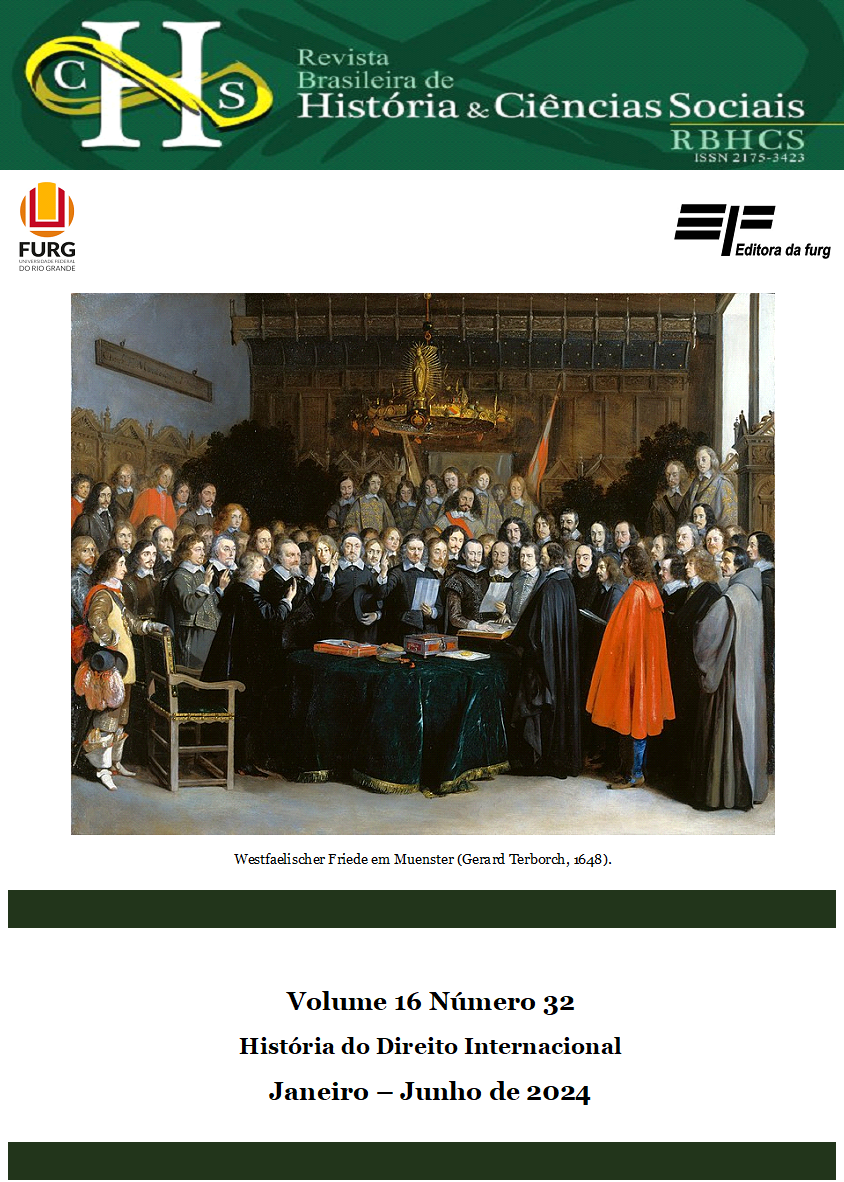
SPECIAL ISSUE: Revista Brasileira de História & Ciências Sociais, "História do Direito Internacional" (Volume 16, Issue 32, 2024)


Source: Revista Brasileira de Historia & Ciencias Sociais


Description:

Apresentação do Volume 16 Número 32 da Revista Brasileira de História & Ciências Sociais

Denize Terezinha Leal Freitas, Fabiano Quadros Rückert, José Carlos da Silva Cardozo, Jonathan Fachini da Silva, Tiago da Silva Cesar, Wagner Silveira Feloniuk

4-5

História do Direito Internacional

Augusto Jaeger Junior, Arno Dal Ri Jr., Lucas Carlos Lima

6-10

Dossiê

Percursos do Princípio das Nacionalidades nas doutrinas belgas de Direito Internacional: do Círculo de Gante à Escola de Lovânia (1863-1953)

DOI: https://doi.org/10.14295/rbhcs.v16i32.16513

Arno Dal Ri Jr

11-53


A cláusula da nação mais favorecida em tratados comerciais: percepções ocidentais sobre a prática latino-americana de tratados comerciais no final do século XIX e início do século XX

DOI: https://doi.org/10.14295/rbhcs.v16i32.16576

Florenz Volkaert, Fernando Muniz Shecaira

54-87


A participação brasileira na elaboração do Estatuto da CPJI: o papel de Clovis Bevilaqua a Raul Fernandes

DOI: https://doi.org/10.14295/rbhcs.v16i32.16509

Lucas Carlos Lima

88-107


A história da construção do modelo de produção tradicional do direito internacional

DOI: https://doi.org/10.14295/rbhcs.v16i32.16665

Amina Welten Guerra

108-138


A prática dos estados asiáticos na implementação do princípio de proteção de monumentos e obras de arte antes da Primeira Guerra Mundial

DOI: https://doi.org/10.14295/rbhcs.v16i32.16429

Alice Lopes Fabris

139-158


A obra literária de Carl Schmitt durante seus anos como protagonista jurídico do nacional-socialismo (1933-1936): uma sobreposição entre os escritos e os fatos

DOI: https://doi.org/10.14295/rbhcs.v16i32.16602

Marcelo Markus Teixeira

159-181


Decolonizing International Law: between demystifications and resignifications

DOI: https://doi.org/10.14295/rbhcs.v16i32.16555

Tatiana de A. F. R. Cardoso Squeff, Gabriel Pedro Dassoler Damasceno

182-205


O peticionamento das vítimas de violações de direitos humanos no sistema convencional das nações unida

DOI: https://doi.org/10.14295/rbhcs.v16i32.16529

Cristina Figueiredo Terezo Ribeiro, Thaís Magno

206-245


De objetivos universais a resultados locais: apontamentos para uma história da proteção regional aos direitos humanos

DOI: https://doi.org/10.14295/rbhcs.v16i32.16586

Alexander de Castro

246-269


Direitos africanos dos Direitos Humanos – análise desde a perspectiva jurídico-histórica

DOI: https://doi.org/10.14295/rbhcs.v16i32.16565

João Francisco

270-298


A talidomida no banco dos réus: o julgamento de Alsdorf (Alemanha, 1968) a partir da imprensa brasileira

DOI: https://doi.org/10.14295/rbhcs.v16i32.16582

Francieli Lunelli Santos

299-323


A Resiliência da Identidade: Indigenato e a Virada Histórica no Direito Internacional

DOI: https://doi.org/10.14295/rbhcs.v16i32.16369

Lucas Lixinski

324-354


O Supremo Acordo: usos jurídicos do passado da Anistia no julgamento da Arguição de Descumprimento de Preceito Fundamental n. 153

DOI: https://doi.org/10.14295/rbhcs.v16i32.16715

Ilanil Coelho, Pedro Odainai

355-390


Interesses políticos na evolução histórica do Direito Internacional dos Refugiados e no caso ucraniano: entre humanitarismo e seletividade na prática europeia

DOI: https://doi.org/10.14295/rbhcs.v16i32.16537

Augusto Jaeger Junior, Ricardo Strauch Aveline

391-420


Das contribuições de Francisco de Vitória ao necessário giro epistemológico para as Américas: o Direito Internacional redimensionado a partir do Sul Global

DOI: https://doi.org/10.14295/rbhcs.v16i32.16568

Thiago Giovani Romero, Wanda Helena Mendes Muniz Falcão, Vinicius Villani Abrantes

421-438


O solidarismo de Hugo Grócio como princípio normativo de um constitucionalismo transnacional no século XXI

DOI: https://doi.org/10.14295/rbhcs.v16i32.16724

Anderson Vichinkeski Teixeira


More info with the publisher.

Wednesday, 18 August 2021

JOURNAL: Outre-Mers. Revue d'histoire 410-411 [Numéro Spécial: L'impérialisme informel de la France et de l'Espagne au XIXe siècle] (JUN 2021)


(image source: SFHOM)

Description:

"La Société Française d’Histoire des Outre-mers publie dans ce numéro de sa revue un travail novateur d’Arnaud Bartolomei, de Xavier Huetz De Lemps et de Martín Rodrigo Y Alharilla sur l’impérialisme informel de la France et de l’Espagne au XIXe siècle. Si la notion d’impérialisme informel a été mobilisée par les historiens britanniques pour comprendre la puissance coloniale hégémonique d’outre-manche, cette notion a été plus rarement sollicitée pour analyser les trajectoires impériales d’autres puissances européennes. Les auteurs pallient cette carence pour les empires français et espagnol dont l’historiographie s’est trop longtemps attachée à la seule conquête territoriale afin d’évaluer leur puissance impériale. Toute proportion gardée avec le modèle britannique, les auteurs interrogent la puissance heuristique d’une telle perspective et les modalités de domination informelle envisagées par la France et l’Espagne au XIXe siècle. David Todd focalise son attention sur les agents français et les collaborateurs autochtones des outre-mers, sur les promoteurs et les bénéficiaires de ces nouvelles formes d’influence en France métropolitaine. Ce cadre établi, Arnaud Bartolomei, Manuel Talamante et Xavier Daumalin ouvrent respectivement des perspectives sur l’expansion commerciale de la France au Mexique, à Montevideo mais aussi en Afrique. Pour l’Espagne, les contributions d’Eloy Martín Corrales et de Juan Inarejos Muñoz portent sur l’analyse des motivations des politiques d’expansion espagnole qui vont à l’encontre de la seule lecture de la « matrice » du désastre de 1898. D’autres acteurs et d’autres intentions ont pu générer de nouvelles formes d’impérialisme. Martín Rodrigo y Alharilla et Lizbeth Chaviano Pérez montrent ainsi que la question de l’esclavage et de la traite a constitué le principal moteur de l’implantation de l’Espagne en Afrique sub-saharienne. De même, L. Chaviano Pérez met clairement en évidence des formes de sous-impérialisme informel en montrant que le sort des établissements espagnols en Guinée a été intimement lié aux intérêts cubains et aux pressions de ses planteurs. En focalisant leur attention sur la fin de l’époque moderne et le début de la reprise de l’expansion européenne dans le dernier tiers du XIXe siècle, l’ensemble de ces contributions invite le lecteur à appréhender les « conditions d’une domination économique » qui se voulait « si possible exclusive ou privilégiée, sur le reste du monde »."

(source: SFHOM

Tuesday, 17 August 2021

JOURNAL: Monde(s) 19 [La Société des nations. Une expérience de l'internationalisme, eds. Jean-Michel GUIEU & Stanislas JEANNESSON] (JUL 2021) (ISBN 9782753582682)


(image source: CAIRN)

Articles
« L’expérience de Genève » (1920-1946) (Jean-Michel Guieu & Stanislas Jeannesson)

The League of Nations Secretariat: An Experiment in Liberal Internationalism? (Karen Gram-Skjoldager & Haakon Andreas Ikonomou)

Employées à la Société des nations : carrières et conditions de travail, 1920-1932 (Myriam Piguet)

Usages du droit et espaces de pouvoir transnationaux. La pratique pétitionnaire de la section des minorités de la SDN face aux rescapés d’un crime de masse, 1920-1939 (Dzovinar Kévonian)

Beware of Pity: The League of Nations’ Treatment of Prostitution (Magaly Rodríguez García)

Breaking Even for the Future: The Financial History of the League of Nations Between 1919 and 1933 (Hannah Tyler)

Joseph Paul-Boncour à Genève : une pratique de l’internationalisme (Matthieu Boisdron)

Un Uruguayen à Genève : Julián Nogueira et l’internationalisme latino-américain à la Société des nations (Yannick Wehrli)

Missed Opportunities to be Global Conversion and Diversion of the Scientific Field of Knowledge of International Relations of the International Studies Conference and the Institute of Pacific Relations (Tomoko Akami)

Débat autour d'un livre
Les États-Unis et la Société des nations (1914-1946) Le système international face à l’émergence d’une superpuissance, Berne, Peter Lang, 2016 (Andrew Barros, Nicolas Vaicbourdt, Ludovic Tournès)

Varia
En quête de légitimité. Le Comité international de la Croix-Rouge et l’Afrique durant les années 1960 (Marie-Luce Desgrandchamps)

Les maoïstes suisses et « l’or de Pékin » au cœur de la Guerre froide (Cyril Cordoba)

Read all articles on Cairn. Or buy the special issue in book form with the PUR.

Monday, 28 June 2021

FOCUS SECTION: The European Tradition in International Law: Camilo Barcia Trelles (European Journal of International Law XXXI (2021), No. 4 (Nov)

(image source: OUP)


Camilo Barcia Trelles in and beyond Vitoria's Shadow (1888–1977) (Ignacio de la Rasilla) (DOI 10.1093/ejil/chab001)

Abstract:

Credited with having fostered the renaissance of Francisco de Vitoria and the School of Salamanca in international law circles in the interwar period, Camilo Barcia Trelles has largely fallen into oblivion along with most Spanish international law professors of the Spanish Civil War generation. The first part of this article provides an outline of the long career of Barcia Trelles against the background of the radically transformed domestic and international context of the interwar years and the aftermath of World War II in both Spain and Europe. The second part surveys three key themes of Barcia Trelles’ 60-year long contribution to the study of international law and international politics. First, it analyses his early interest in the process of regionalism in Latin America and the role of North American foreign policy in the region. This is followed by an analysis of Barcia Trelles’s attention to the study of the Spanish classics of international law during the interwar period, and, finally, by an overview of his approach to the study of international law in the light of international politics during the Cold War. The conclusion briefly engages with the legacy of Barcia Trelles’ life and works in the European tradition of international law.

 The Cradle of International Law: Camilo Barcia Trelles on Francisco de Vitoria at The Hague (1927) (Randall Lesaffer) (DOI 10.1093/ejil/chab002)

Abstract:

In 1926, James Brown Scott invited the Spanish international lawyer Camilo Barcia Trelles to lecture at the 1927 Hague Academy of International Law on the contribution of the Spanish internationalists of the 16th century to the development of international law. With his lecture series on Francisco de Vitoria, Barcia Trelles fulfilled the hopes Scott had of enlisting an ally in his crusade to the Spanish origins of international law. Through their respective writings, the two international lawyers from both sides of the Atlantic co-produced the myth which situates the oldest roots of the ‘science of international law’ with Vitoria and the School of Salamanca and which has to this day largely obscured the contribution of late-medieval jurisprudence. This article analyses the methodological and intellectual moves Barcia Trelles made to construe Vitoria as the original founder of international law and detach him from his medieval sources.

Camilo Barcia Trelles on the Meaning of the Monroe Doctrine and the Legacy of Vitoria in the Americas (Juan Pablo Scarfi) (DOI 10.1093/ejil/chab003)

Abstract:

This article explores three important dimensions of the work and trajectory of Camilo Barcia Trelles: his understanding of the Monroe Doctrine; his vision and contribution to the debates in Latin America and the United States over intervention and the codification of American international law; and how his own understanding of the intellectual legacy of Francisco de Vitoria shaped his views and approaches to these topics. The article argues that Barcia Trelles provided a Spanish Americanist version of international law in the Americas, according to which, following the Spanish conquest of America and Vitoria’s important contribution to international law, a irreversible division began to emerge between the two Americas, that is, the Latin American and US traditions of international law, especially since the US Declaration of Independence, the collapse of the Spanish Monarchy and the independence of the Spanish American republics.

 Skip Nav Destination Article Navigation Camilo Barcia Trelles on Francisco de Vitoria: At the Crossroads of Carl Schmitt’s Grossraum and James Brown Scott’s ‘Modern International Law’ (José María Beneyto) (DOI 10.1093/ejil/chab005)

Abstract:

Carl Schmitt’s The Nomos of the Earth in the International Law of the Jus Publicum Europaeum (1950) undertook a re-interpretation of the modern origins of the discipline of international law, placing Vitoria at its pivot, as the Spanish international law professor Camilo Barcia Trelles (1888–1977) had done before. Barcia’s work had a strong influence on some of the seminal pieces on international law and geopolitics that Schmitt wrote in the period from 1941 to 1950. This was the case for Schmitt’s historical mythology of the opposition between sea and earth and its juridical consequence, his doctrine of the Grossraum, which had as its basis Barcia’s account of the Monroe Doctrine, and also of Schmitt’s critique of the ‘discrimination of war’ formalized in the Kellogg–Briand Pact. According to Barcia, the exclusion of European powers from the American continent by the United States as a rising hegemon was transformed – thanks to its domination of the sea – into the global reach of a world police power. Barcia did not agree with Brown Scott’s transformation of international law through American liberal internationalism into ‘modern international law’. While Brown Scott and Schmitt were competing for two opposing vernaculars of the discipline in search for a new definition and to shape it, Barcia was instrumental in the opposed efforts of these two apparently very dissimilar representatives of international law by ushering Vitoria into their service.

Monday, 21 June 2021

JOURNAL: Forum on "Historiography, Ideology, and Law" (History & Theory, LX (2021), Issue 2, 185-405


(image source: Wiley)

Historiography, Ideology and Law: an Introduction (Justin Desautels-Stein & Samuel Moyn) (DOI 10.1111/hith.12207)

Abstract:

This is an introduction to a forum on historiography, ideology, and law. The basic question weaving this forum together concerns the meaning of the term “critical” in the domain of critical legal history, a question that is deeply familiar to historians of all stripes. Ultimately, whether you are a lawyer doing historical work, a historian interested in law, or a historian of a different sort altogether, there is no hiding from the question of context and, critically, the ideological stakes in choosing an answer to that question.

 On the domestication of Critical Legal History (Justin Desautels-Stein & Samuel Moyn) (DOI 10.1111/hith.12208)

Abstract:

Among many of today's legal historians, there is a relatively new and generally unreflective understanding of the relationship between history and method. The landscape is everywhere marked by a tendency to eschew big thinking, grand theory, and programmatic approaches to historical explanation and social transformation. In the place of the grand theory approach to law and history, there is a preference for the minimalist, the pragmatic, the particularistic, and the quotidian. What this normal science of today's legal historiography makes obvious is a kind of attachment to particular kinds of problems with particular sorts of built-in solutions. The result for today is intellectual stagnation, a routinized and thoroughly domesticated mode of revealing contingency. Oddly, the fascination with contingency, and its deadening affair with a minimalist pragmatism, is itself a result of the triumph of what continues to be called “critical legal history.” Ostensibly due to an interface between critical legal studies and the historical discipline, the rise and triumph of critical legal history hides a secret: the whole idea of a reigning critical appreciation for contingency seems to be a misnomer. Sure, some may say that “things might have been otherwise.” But what this intellectual settlement demands is obedience to its qualification: “things might have been otherwise, but they weren't, and so let's get on with doing what works.” Although so-called critical legal history seduces adherents with promises of edgy progressivism, the actual malaise of our minimalism seems in fact to suggest just the opposite. It is a quiescent and even quietistic method in practice, counseling in its conservatism against higher-order proposals that might ever make good on the discovery that nothing is natural. In the end, either we must accept that critical legal history in the United States is a lot less politically explosive than we once thought—given its deradicalization and domestication today—or that people have been mistaken about what critical legal history was, is, and ought to be.

Law and the Time of Angels: International Law's Method Wars and the Affective Lives of Disciplines (Natasha Wheatley) (DOI 10.1111/hith.12209)

Abstract:

Recent method wars in international legal scholarship turn on the problem of law in time. Rejecting historians' focus on context and their “policing of anachronism,” prominent legal scholars like Anne Orford and Martti Koskenniemi have argued that the workings of modern law are not governed by the narrow strictures of sequential chronology and that legal scholars require alternate methods that reflect law's transfer of meaning through time. Contextualism, in this reckoning, represents a misguided methodological straightjacket that stifles critique by quarantining meaning and power in discrete historical silos; the embrace of anachronism, conversely, would foster a revitalized history of international law intimately connected with the political imperatives of the present. This essay uses the debate as an opening into a fuller exploration of law in history and in time. In considering the idiosyncratic way law frames time, sequence, and duration, it explores the connection between law's transtemporal transfers and its very mode of reproduction. To speak of law's capacity to escape context and travel through time is another way of describing its normativity: the laws of the past that survive to exert a normative force in the present are not, in their law-ness, past—they are simply present law. The essay suggests some ways to make that temporality itself the object of analysis (rather than naturalizing and affirming it, as Orford has, or, conversely, dismissing it as bad history, as some historians have). It draws on the history of science to generate an account of law's temporal habitus as a disciplinary knowledge tool, a kind of epistemic virtue that is intimately involved in law's internal criteria for truth and falsity.

Theorizing Constitutional History (Maeve Glass) (DOI 10.1111/hith.12210)

Abstract:

The historical study of American constitutional law has long rested on a conceptual framework that divides the past into linear units of analysis. Constitutional time unfolds according to discrete eras defined by changes in political leadership and governance, whereas constitutional space typically appears divided into bordered jurisdictions and regional sections. Despite the prominence of this conceptual framework, scholars have yet to ask how, why, and to what effect it became the paradigmatic mode of study. In the absence of close study, the framework instead appears as a neutral embodiment of the constitutional order. This essay offers a preliminary sketch of how theories of knowledge production, and particularly Louis Althusser's theory of law as an ideological apparatus, can help to move beyond this facile assumption. By returning to a selection of landmark judicial opinions and legal treatises from the long nineteenth century and analyzing their discursive practices in relation to the dominant modes of production, this exploratory essay suggests a striking possibility: that the paradigm that we have assumed to be a primordial part of the constitutional order only emerged in its current iteration in the late nineteenth-century shift from a plantation mode of production rooted in enslaved labor to an industrial mode of production rooted in wage labor. As these sources indicate, leading jurists in America's age of conquest and enslavement regularly analyzed questions of state power and rights by organizing time according to chains of title rooted in dispossession based on race and space according to the geographic circuits of capital. Effective in naturalizing the strict racialized hierarchy integral to the production and circulation of export commodities, this discourse of tethering institutions to the history of property acquisition and the movement of commodities began to shift with the formal abolition of slavery and rise of intensive industrialization, as a new generation of legal academics created a paradigm of institutional time and space that, by erasing material histories of structural inequality, made it possible to reconstitute an old social order predicated on racial classifications of whiteness.

Family Law Matters (Judith Surkis) (DOI 10.1111/hith.12211)

Abstract:

This essay analyzes how new histories of family law help to dismantle developmentalist accounts of legal, economic, and political modernity. Far from being backwaters, they have recently emerged as sites of theoretical and practical innovation. Recombining methodologies from genealogy to social reproduction theory and psychoanalysis, they do more than denaturalize categories, destabilize familiar narratives, and demonstrate ideological contradictions (although they do that too). Motivated by a sense of what is lost theoretically and politically by the family's historical and juridical marginalization, they reinvigorate legal history by locating the problem of the family at the center of broader critical projects.

 Proximate Causation in Legal Historiography (Simon Stern) (DOI 10.1111/hith.12212)

Abstract:

The variety of legal history published in general-interest law journals tends to differ from the variety published in history journals. This study compares the two varieties by examining footnote references in five general-interest law journals and footnote references in two journals of legal history. In the law journals, cases and statutes accounted for the single largest group of footnotes (approximately 35%), followed by references to other law journal articles (nearly 25%). In the legal history journals, these two categories accounted for less than 20% of all references; primary and secondary historical materials predominated in the footnotes. To be sure, legal decisions and law journal articles can also be historical sources: rather than being used as evidence of what the law is, they might be studied for what they reveal about legal reasoning or rhetoric in an earlier age. However, in most legal historical research that attends primarily to cases and statutes, these materials figure as evidence of the state of the law at that time. When the analysis relies on legal sources to trace the development of a certain doctrine and treats them as sufficient to account for that development, the result is the distinctive style of research that I seek to contrast against approaches that cast the net of historical inquiry more widely. To account for these different approaches, I suggest that law professors rely on a notion of proximate causation as a historiographic method. According to this approach, legal developments are proximately caused by other developments in the legal sphere, and other social and cultural developments play more attenuated roles, such that their influence is less significant. By proposing this explanation, I hope to draw more attention to assumptions about causation in legal historiography and to question their persuasive force.

(read further: Wiley

(source: ESCLH Blog)

Monday, 6 January 2020

SPECIAL ISSUE: American Historical Review Reflections on "One Hundred Years of Mandates" (American Historical Review CXXIV (2019), Issue 5)

(image source: OUP)

Introduction: The League of Nations Mandates and the Temporality of Deferral (Alex Lichtenstein & Michelle Moyd)

An International Regime in an Age of Empire (Susan Pedersen)
Abstract:
A century after the victorious Allied powers distributed their spoils of victory in 1919, the world still lives with the geopolitical consequences of the mandates system established by the League of Nations. The Covenant article authorizing the new imperial dispensation came cloaked in the old civilizationist discourse, entrusting sovereignty over “peoples not yet able to stand by themselves under the strenuous conditions of the modern world” to the “advanced nations” of Belgium, England, France, Japan, and South Africa. In this series of “reflections” on the mandates, ten scholars of Europe, Africa, the Middle East, Asia, and the international order consider the consequences of the new geopolitical order birthed by World War I. How did the reshuffling of imperial power in the immediate postwar period configure long-term struggles over minority rights, decolonization, and the shape of nation-states when the colonial era finally came to a close? How did the alleged beneficiaries—more often the victims—of this “sacred trust” grasp their own fates in a world that simultaneously promised and denied them the possibility of self-determination? From Palestine, to Namibia, to Kurdistan, and beyond, the legacies of the mandatory moment remain pressing questions today.
The Matter of Time (Sherene Seikaly)
Abstract:
A century after the victorious Allied powers distributed their spoils of victory in 1919, the world still lives with the geopolitical consequences of the mandates system established by the League of Nations. The Covenant article authorizing the new imperial dispensation came cloaked in the old civilizationist discourse, entrusting sovereignty over “peoples not yet able to stand by themselves under the strenuous conditions of the modern world” to the “advanced nations” of Belgium, England, France, Japan, and South Africa. In this series of “reflections” on the mandates, ten scholars of Europe, Africa, the Middle East, Asia, and the international order consider the consequences of the new geopolitical order birthed by World War I. How did the reshuffling of imperial power in the immediate postwar period configure long-term struggles over minority rights, decolonization, and the shape of nation-states when the colonial era finally came to a close? How did the alleged beneficiaries—more often the victims—of this “sacred trust” grasp their own fates in a world that simultaneously promised and denied them the possibility of self-determination? From Palestine, to Namibia, to Kurdistan, and beyond, the legacies of the mandatory moment remain pressing questions today.
The French Mandate in Lebanon (Carol Hakim)
Abstract:
A century after the victorious Allied powers distributed their spoils of victory in 1919, the world still lives with the geopolitical consequences of the mandates system established by the League of Nations. The Covenant article authorizing the new imperial dispensation came cloaked in the old civilizationist discourse, entrusting sovereignty over “peoples not yet able to stand by themselves under the strenuous conditions of the modern world” to the “advanced nations” of Belgium, England, France, Japan, and South Africa. In this series of “reflections” on the mandates, ten scholars of Europe, Africa, the Middle East, Asia, and the international order consider the consequences of the new geopolitical order birthed by World War I. How did the reshuffling of imperial power in the immediate postwar period configure long-term struggles over minority rights, decolonization, and the shape of nation-states when the colonial era finally came to a close? How did the alleged beneficiaries—more often the victims—of this “sacred trust” grasp their own fates in a world that simultaneously promised and denied them the possibility of self-determination? From Palestine, to Namibia, to Kurdistan, and beyond, the legacies of the mandatory moment remain pressing questions today.
The Ottoman Empire: The Mandate That Never Was (Yigit Akin)
Abstract:
A century after the victorious Allied powers distributed their spoils of victory in 1919, the world still lives with the geopolitical consequences of the mandates system established by the League of Nations. The Covenant article authorizing the new imperial dispensation came cloaked in the old civilizationist discourse, entrusting sovereignty over “peoples not yet able to stand by themselves under the strenuous conditions of the modern world” to the “advanced nations” of Belgium, England, France, Japan, and South Africa. In this series of “reflections” on the mandates, ten scholars of Europe, Africa, the Middle East, Asia, and the international order consider the consequences of the new geopolitical order birthed by World War I. How did the reshuffling of imperial power in the immediate postwar period configure long-term struggles over minority rights, decolonization, and the shape of nation-states when the colonial era finally came to a close? How did the alleged beneficiaries—more often the victims—of this “sacred trust” grasp their own fates in a world that simultaneously promised and denied them the possibility of self-determination? From Palestine, to Namibia, to Kurdistan, and beyond, the legacies of the mandatory moment remain pressing questions today.
Islands for an Anxious Empire: Japan’s Pacific Island Mandate  (Tze M. Loo)
Abstract:
 A century after the victorious Allied powers distributed their spoils of victory in 1919, the world still lives with the geopolitical consequences of the mandates system established by the League of Nations. The Covenant article authorizing the new imperial dispensation came cloaked in the old civilizationist discourse, entrusting sovereignty over “peoples not yet able to stand by themselves under the strenuous conditions of the modern world” to the “advanced nations” of Belgium, England, France, Japan, and South Africa. In this series of AHR “reflections” on the mandates, ten scholars of Europe, Africa, the Middle East, Asia, and the international order consider the consequences of the new geopolitical order birthed by World War I. How did the reshuffling of imperial power in the immediate postwar period configure long-term struggles over minority rights, decolonization, and the shape of nation-states when the colonial era finally came to a close? How did the alleged beneficiaries—more often the victims—of this “sacred trust” grasp their own fates in a world that simultaneously promised and denied them the possibility of self-determination? From Palestine, to Namibia, to Kurdistan, and beyond, the legacies of the mandatory moment remain pressing questions today.
Betwixt and Between Colony and Nation-State: Liminality, Decolonization, and the South West Africa Mandate (Molly McCullers)
Abstract:
 A century after the victorious Allied powers distributed their spoils of victory in 1919, the world still lives with the geopolitical consequences of the mandates system established by the League of Nations. The Covenant article authorizing the new imperial dispensation came cloaked in the old civilizationist discourse, entrusting sovereignty over “peoples not yet able to stand by themselves under the strenuous conditions of the modern world” to the “advanced nations” of Belgium, England, France, Japan, and South Africa. In this series of “reflections” on the mandates, ten scholars of Europe, Africa, the Middle East, Asia, and the international order consider the consequences of the new geopolitical order birthed by World War I. How did the reshuffling of imperial power in the immediate postwar period configure long-term struggles over minority rights, decolonization, and the shape of nation-states when the colonial era finally came to a close? How did the alleged beneficiaries—more often the victims—of this “sacred trust” grasp their own fates in a world that simultaneously promised and denied them the possibility of self-determination? From Palestine, to Namibia, to Kurdistan, and beyond, the legacies of the mandatory moment remain pressing questions today.
“Sons of the Soil”: Cause Lawyers, the Togo-Cameroun Mandates, and the Origins of Decolonization  (Meredit Terretta & Benjamin N. Lawrance)
Abstract:
A century after the victorious Allied powers distributed their spoils of victory in 1919, the world still lives with the geopolitical consequences of the mandates system established by the League of Nations. The Covenant article authorizing the new imperial dispensation came cloaked in the old civilizationist discourse, entrusting sovereignty over “peoples not yet able to stand by themselves under the strenuous conditions of the modern world” to the “advanced nations” of Belgium, England, France, Japan, and South Africa. In this series of “reflections” on the mandates, ten scholars of Europe, Africa, the Middle East, Asia, and the international order consider the consequences of the new geopolitical order birthed by World War I. How did the reshuffling of imperial power in the immediate postwar period configure long-term struggles over minority rights, decolonization, and the shape of nation-states when the colonial era finally came to a close? How did the alleged beneficiaries—more often the victims—of this “sacred trust” grasp their own fates in a world that simultaneously promised and denied them the possibility of self-determination? From Palestine, to Namibia, to Kurdistan, and beyond, the legacies of the mandatory moment remain pressing questions today.
The British Cameroons Mandate Regime: The Roots of the Twenty-First-Century Political Crisis in Cameroon 
Abstract:
A century after the victorious Allied powers distributed their spoils of victory in 1919, the world still lives with the geopolitical consequences of the mandates system established by the League of Nations. The Covenant article authorizing the new imperial dispensation came cloaked in the old civilizationist discourse, entrusting sovereignty over “peoples not yet able to stand by themselves under the strenuous conditions of the modern world” to the “advanced nations” of Belgium, England, France, Japan, and South Africa. In this series of “reflections” on the mandates, ten scholars of Europe, Africa, the Middle East, Asia, and the international order consider the consequences of the new geopolitical order birthed by World War I. How did the reshuffling of imperial power in the immediate postwar period configure long-term struggles over minority rights, decolonization, and the shape of nation-states when the colonial era finally came to a close? How did the alleged beneficiaries—more often the victims—of this “sacred trust” grasp their own fates in a world that simultaneously promised and denied them the possibility of self-determination? From Palestine, to Namibia, to Kurdistan, and beyond, the legacies of the mandatory moment remain pressing questions today.
A League to Preserve Empires: Understanding the Mandates System and Avenues for Further Scholarly Inquiry (Sean Andrew Wempe)
Abstract:
 A century after the victorious Allied powers distributed their spoils of victory in 1919, the world still lives with the geopolitical consequences of the mandates system established by the League of Nations. The Covenant article authorizing the new imperial dispensation came cloaked in the old civilizationist discourse, entrusting sovereignty over “peoples not yet able to stand by themselves under the strenuous conditions of the modern world” to the “advanced nations” of Belgium, England, France, Japan, and South Africa. In this series of “reflections” on the mandates, ten scholars of Europe, Africa, the Middle East, Asia, and the international order consider the consequences of the new geopolitical order birthed by World War I. How did the reshuffling of imperial power in the immediate postwar period configure long-term struggles over minority rights, decolonization, and the shape of nation-states when the colonial era finally came to a close? How did the alleged beneficiaries—more often the victims—of this “sacred trust” grasp their own fates in a world that simultaneously promised and denied them the possibility of self-determination? From Palestine, to Namibia, to Kurdistan, and beyond, the legacies of the mandatory moment remain pressing questions today.
Read more on the journal's website.