ESIL Interest Group History of International Law

ESIL Interest Group History of International Law
Showing posts with label grotius. Show all posts

Monday, 12 July 2021

JOURNAL: Grotiana XLII (2021), No. 1 (Jul)


(image source: Brill)

Historical, Philosophical, and Legal Foundations of Strict Liability in Hugo Grotius—Some Introductory Remarks to the Special Dossier (Bart Wauters) (OPEN ACCESS)

Culpa Levissima and the Eclipse of Strict Liability (James Gordley) (DOI 10.1163/18760759-42010002)

Abstract:

In Roman law, as interpreted by the medieval jurists, in a gratuitous loan (commodatum), the borrower was liable for culpa levissima, failure to use be as diligent as “most diligent” (diligentissimus). It would seem, then, that a person could be liable for conduct that he could not help. That consequence troubled the medieval canonists a person would then be liable who had not sinned. It troubled the late scholastics because a person would then be liable for an accident, which was not a violation of commutative justice. Some concluded that liability for culpa levissima was a creature of positive law, based on pragmatic considerations but with no grounding in principle. There was another explanation glimpsed by the late scholastics and by Hugo Grotius: commutative justice requires that one who borrows gratuitously indemnify the lender against any loss. Unfortunately, in the following centuries, that explanation was lost from sight.

Qualitative Liability in the Early Modern Low Countries (ca. 1425–1650) (Wouter Druwé)

Abstract:

In his ‘Inleidinge tot de Hollantsche Rechtsgeleertheyt’, Hugo Grotius introduced the concept of wrong-by-construction-of-law (‘misdaed door wetsduidinge’), the idea that civil law could assign liability to someone who had not committed any fault, i.e. merely because of his or her ‘capacity’ or ‘quality’ as a parent, as an owner of an animal, as an inhabitant of a building, or as an employer or shipowner. This contribution situates Grotius’s views on qualitative liability within the wider Netherlandish learned juridical context of his time, and especially studies the role of fault (‘culpa’) and presumptions of fault in the learned theories on qualitative liability. Apart from printed treatises and volumes of consilia, this contribution also takes into account hitherto unstudied handwritten lecture notes of the late medieval and early modern university of Leuven.

The Place of Fault in Grotius’s Conception of Liability for Wrongdoing (Joe Sampson) (OPEN ACCESS)

Abstract:

This article compares Grotius’s treatments of liability for wrongdoing in natural law and the law of Holland to emphasise the conceptual centrality of fault in both, and places Grotius’s analyses in their historical context by tracing the treatment of strict liability in those intellectual traditions upon which he drew. It focuses in particular on the formulation of obligations quasi ex maleficio to show how the absence of fault rendered the obligation something other than delictual.

Strict Liability and Necessity in Grotius, Pufendorf, Smith, Kant, and Beyond (Bart Wauters) (DOI 10.1163/18760759-42010005)

Abstract:

This article compares the views of Grotius and subsequent authors on the doctrines of necessity and strict liability. This comparison takes place at two levels. On the one hand, there is a comparison of the views of Grotius with those of Pufendorf, Smith, Kant and recent Kantian authors. On the other hand, there is a comparison between the doctrines of necessity and strict liability. This exercise leads to the conclusion that strict liability does not have to be a mere matter of choice opted for by positive law, but in some instances can also be thought of as a requirement of a private law framework expressing the fundamental moral equal freedom of man.

Grotius’s Position on Implied Servitudes by Means of Destinatione Patris Familias (Vincent Van Hoof) (OPEN ACCESS) (DOI 10.1163/18760759-42010006)

Abstract:

According to Grotius in his Inleiding (2.36.6), the actual use of two houses by the same owner could lead to the implied grant of a servitude if he transferred one of the houses to someone else, ‘without any mention either the one way or the other’. Various interpretations of this text exist, but the consensus is lacking. In this article, the author investigates the meaning and influence of Grotius’s position on implied servitudes in both his time and the following centuries. This research shows how Grotius’s opinion progressed from Bartolus’s approach to implied servitudes and sheds new light on the creation of servitudes by means of destinatione patris familias in the Netherlands.

Religion and Government in Hugo Grotius’s Annales: Orthodoxy, William the Silent and Reason of State (Jan Waszink) (DOI 10.1163/18760759-42010007)

Abstract:

In Grotius’s Annales, religion appears almost exclusively as a social and political problem. References (implied or explicit) to religion as a good thing or its positive effects are lacking. This aspect of Grotius’s text arises from its equation of ‘religion’ with ‘combative orthodox religion in the post-reformation era’. However, it is not credible that this view represents Hugo Grotius’s actual opinion of the Christian faith as such. The solution seems rather that the above equation must be a conscious rhetorical strategy designed to strengthen the argument of the Annales. Continuing from that conclusion, however, the texts allow us to deduce some views on reason of state and religious policy, which do seem to have been actually held by Grotius in this period, or at least to have enjoyed his active interest.

The History of Fair Trade: Hugo Grotius, Corporations, and the Spanish Enlightenment (Edward Jones Corredera) (DOI 10.1163/18760759-42010008)

Abstract:

The early Spanish Enlightenment was shaped by debates over corporations, sovereignty, and the balance of power in Europe. Spanish officials, in this context, turned to the ideas of Hugo Grotius to establish joint-stock companies that could allow the Crown to regain control over its imperial domains and establish perpetual peace in Europe. This article recovers the writings of Félix Fernando de Sotomayor, Duke of Sotomayor (1684–1767), who drew on the works of Grotius, Samuel Pufendorf, and Charles Dutot in order to show that the history of these corporations chronicled the contestation and erosion of Spanish power and the diversion of European states from their true interests. Sovereigns, not merchants, argued Sotomayor, could guarantee fair trade and the equitable distribution of wealth. The study of Sotomayor’s views on trade, natural law, and alienation challenges traditional interpretations about the Iberian engagement with Grotius, the rise of capitalist hopes in Southern and Northern Europe, and Spain’s investment in the Enlightenment.

Book reviews:

  • The Law of Nations and Natural Law 1625–1800, ed. by Simone Zurbuchen (Gabriella Silvestrini)
  • Michael P. Scharf, Milena Sterio and Paul R. Williams, The Syrian Conflict’s Impact on International Law (Robert Volterra)
  • Martha Nussbaum, The Cosmopolitan Tradition: A Noble But Flawed Ideal (Tarik Kochi)
(read further here)

Wednesday, 2 June 2021

WEBINAR: Grotian Theory Talks with Nehal BHUTA (Heidelberg: MPIL, 11 JUN 2021)


(image source: Twitter)

The MPIL in Heidelberg hosts the 'Grotian' Theory Talks. Prof. Nehal Bhuta (Edinburgh) is announced for the 11 June at 15:00 CET.

More information by clicking on the image.

Thursday, 1 April 2021

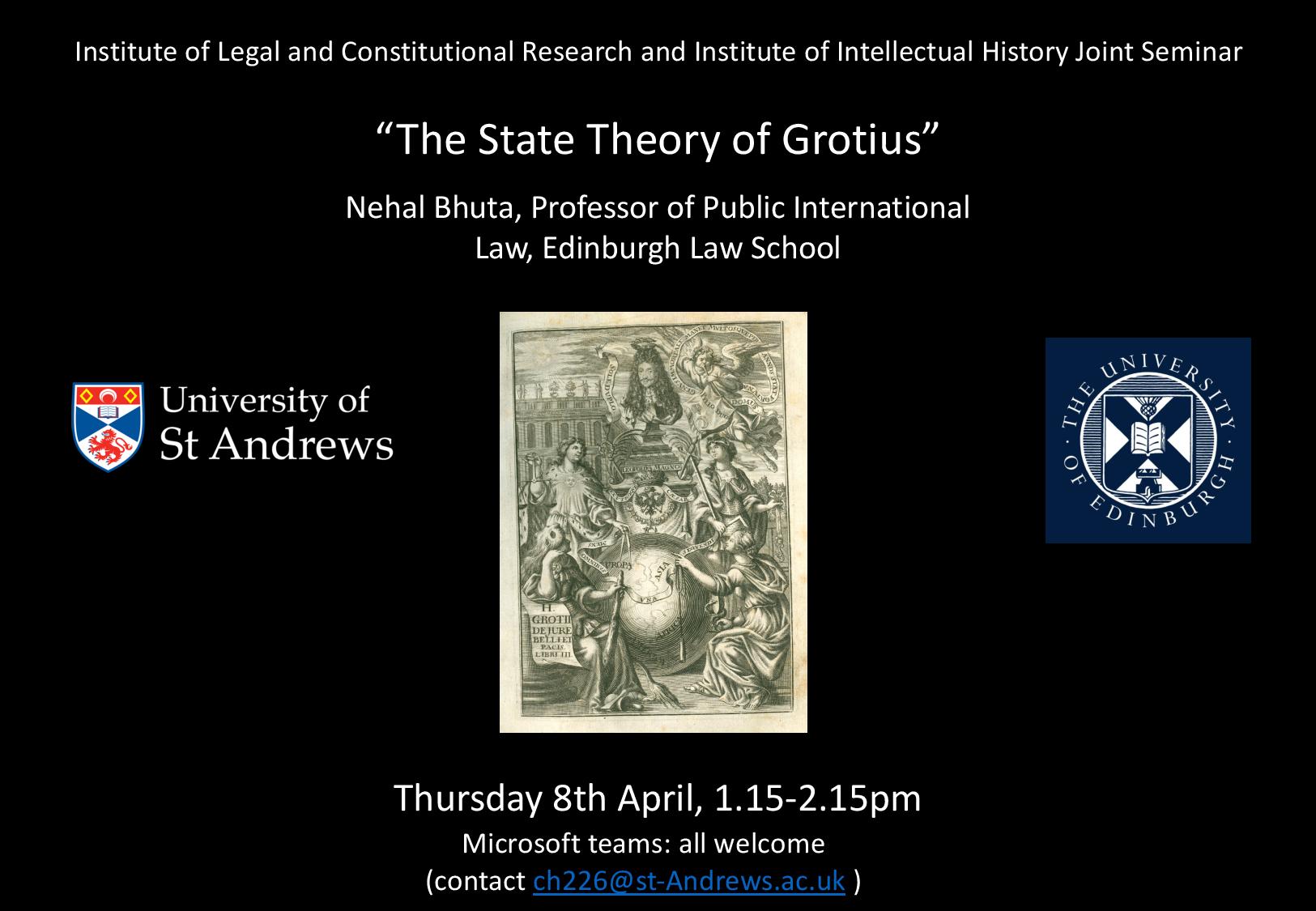
ZOOM SEMINAR: Nehal BHUTA, The State Theory of Grotius (St Andrews, ILCR - IIH, 8 APR 2021)


(source: Twitter; click on image to enlarge for full details)

Nehal Bhuta (Edinburgh Law School) will hold a talk on "The State Theory of Grotius", organized by the University of St Andrews (ILCR and IIH) on Zoom. Click on the image above to enlarge the image and obtain details.

(source: Twitter)

Wednesday, 24 February 2021

BOOK: Randall LESAFFER and Janne NIJMAN (ed.), The Cambridge Companion to Hugo Grotius (Cambridge: CUP, 2021)

(image Hugo Grotius; source: Wikimedia Commons)


Abstract:

The Cambridge Companion to Grotius offers a comprehensive overview of Hugo Grotius (1583–1645) for students, teachers, and general readers, while its chapters also draw upon and contribute to recent specialised discussions of Grotius' oeuvre and its later reception. Contributors to this volume cover the width and breadth of Grotius' work and thought, ranging from his literary work, including his historical, theological and political writing, to his seminal legal interventions. While giving these various fields a separate treatment, the book also delves into the underlying conceptions and outlooks that formed Grotius' intellectual map of the world as he understood it, and as he wanted it to become, giving a new political and religious context to his forays into international and domestic law.

Table of contents:

1. Introduction Randall Lesaffer and Janne E. Nijman
Part I: Grotius in Context:
2. Life and Intellectual Development. An Introductory Biographical Sketch Henk Nellen
3. Grotius as Legal, Political and Diplomatic Official in the Dutch Republic Edwin Rabbie
4. Grotius and the East Indies Peter Borschberg
Part II: Concepts:
5. Virtue Mark Somos
6. Trust (fides) Peter Schröder
7. Natural Law as True Law Meirav Jones
8. Sociability Benjamin Straumann
9. Sovereignty Guus Van Nifterik
10. Church and State Harm-Jan Van Dam
11. Predestination Camilla Boisen
12. Rights Francesca Iurlaro
13. Rights Laurens Winkel
14. Property, Trade and Empire Andrew Fitzmaurice
Part III: Grotius as Man of Letters, Theologian and Political Writer:
15. Literary Writings Arthur Eyffinger
16. Historical Writings Jan Waszink
17. Theological Writings Oliver O'Donovan
18. Political Writings Hans Blom
Part IV: Grotius as a Legal Scholar:
19. Legal Scholastic and Humanist Influences on Grotius Alain Wijffels
20.Grotius' Introduction to Hollandic Jurisprudence Wouter Druwé
21. The Laws of War- and Peace-Making Randall Lesaffer
22. The Law of Armed Conflict Stephen C. Neff
23. The Freedom of the Seas William E. Butler
24. Property Bart Wauters
25. The Law of Contract and Treaties Paolo Astorri
26. Punishment and Crime Dennis Klimchuk
Part V: The Reception of Grotius:
27. Grotius and the Enlightenment Marco Barducci
28. Grotian Revivals in the Theory and History of International Law Ignacio de la Rasilla
29. Grotius in International Relations Theory William Bain.

On the editors:

Randall Lesaffer, Universiteit van Tilburg, The Netherlands Randall Lesaffer is Professor of Legal History at KU Leuven in Belgium and at Tilburg University in The Netherlands. His research focuses on the history of the early-modern law of nations in Europe, as well as the history of modern international law. He is the general editor of The Cambridge History of International Law, Oxford Historical Treaties and an editor of The Journal of the History of International Law. He is president of the Grotiana Foundation (https://grotiana.eu/); Janne E. Nijman, Universiteit van Amsterdam Janne E. Nijman is Professor of History and Theory of International Law at the University of Amsterdam in The Netherlands, and academic director of the T.M.C. Asser Institute in The Hague. She is also Professor of Public International Law at the Graduate Institute of International and Development Studies in Geneva. She has published on Hugo Grotius, and she is an editor on the board of Grotiana and a board member of the Grotiana Foundation (https://grotiana.eu/).

(source: CUP

Tuesday, 29 December 2020

JOURNAL: Grotiana XLI (2020), No. 2

(image souce: Grotiana)


Grotius on the Use of Force: Perfect, Imperfect and Civil Wars. An Introduction (Randall Lesaffer) (OPEN ACCESS)

First paragraph:

In both of Hugo Grotius’s major forays into the law of nations, the just war doctrine provided the backbone of the argument. Between 1604 and 1606, Grotius prepared a treatise in defence of the capture of the Portuguese ship Santa Catarina in the Strait of Singapore by a fleet of the Dutch East India Company. In the text, which became known as De iure praedae commentarius upon its publication in 1868, Grotius refashioned the just war doctrine in order to argue that the captured ship and cargo were good prize in a just war. According to Grotius, this was the case regardless of whether one considered the Company an agent of the Dutch Republic in a war between states, or a private actor.

Perfect War: Alberico Gentili on the Use of Force and the Early Modern Law of Nations (Valentina Vadi)

Abstract:

Gentili’s conceptualization of war as a conflict between states attempted to limit the legitimacy of war to external wars only, thus precluding the legitimacy of civil wars. It reflected both the emergence of sovereign states and the vision of international law as a law among polities rather than individuals. The conceptualization of war as a dispute settlement mechanism among polities rather than a punishment for breach of the law of nations and the idea of the bilateral justice of war humanized the conduct of warfare and the content of peace treaties. The idea of perfect war excluded brigandage, piracy, and civil wars from its purview. Some scholars have suggested that perfect war had a dark side, legitimizing imperial expansion. Others have cautioned that Gentili explicitly opposed imperial expansion rather adopting anti-imperialist stances. This article suggests that these ambivalent readings of the Gentilian oeuvre reflect the ambivalence of the early modern law of nations. Under the early modern law of nations, aggression for the sake of empire was clearly unjust; nonetheless, imperial expansion took place. Whereas ‘a law which many transgress[ed] [wa]s nonetheless a law’, there was a wide divide between theory and practice

Hugo Grotius, Declaration of War, and the International Moral Order (Camilla Boisen)

Abstract:

This article investigates the formal purpose of declaring wars for Hugo Grotius. Grotius was adamant that states always use justification in a duplicitous way to conceal their real motivation to go to war. As such, the purpose of declaration is not to assert the just cause of war. Rather, what any public declaration does, is provide recognition that confers legal validation to the disputing parties. The legal rules of war were described by the law of nations and occasionally permitted states to commit certain ‘war crimes’ with impunity. For Grotius, this was not a moral sanctioning of such crimes but rather a means to prevent the occurrence of wars, which such endless repudiations risked causing or exacerbating. Grotius’s concern for the effects of war is conspicuous; and recounting his maxim that war should always be a last resort, this article argues that declaration of war has a distinct moral purpose for Grotius. In fact, public declaration of war is, together with constraints on the conduct of war, a ‘principle of moderation’ Grotius insists should be upheld in times of war. Declaration of war gives the parties avenues to seek peace and reconciliation, and, therefore has a humanitarian purpose for Grotius by ultimately seeking to prevent the disparaging effects of war. Even in wars that do not demand a public declaration, such as those regulated by natural law such as punitive wars or defensive wars, Grotius cautions that declarations of war are advisable. The remaining lingering issue is how to engage with unlawful enemy combatants, such as pirates - a distinct problem that the international community still faces with increasing regularity. Grotius was certainly aware of the legal (and moral) consequences of recognising belligerency we cannot possible hope to build moral relations with, and, this article claims, ‘unlawful’ enemies ultimately demarcates the boundary of international society.

'Remedium repraesaliarum’: The Medieval and Early Modern Practice and Theory of Reprisal within the Just War Doctrine (Philippine Christina Van den Brande)

Abstract:

Centuries before being included in Hugo Grotius’s De iure belli ac pacis and De iure praedae, the subject of reprisal was already being discussed in medieval literature. The aim of this paper is to examine the medieval and early modern practice and theory of reprisal as it developed before and during Grotius’s lifetime. Its first part investigates a number of important foundational elements, such as the issues of definition and terminology, and the common characteristics of a reprisal case. In the second half, the author explores why reprisals were deemed to be a ‘perversus mos’ or ‘bad custom’ and how continued reliance on this practice was nonetheless justified by inserting it into the medieval just war doctrine. The paper does not provide a systematic study of Grotius’s own engagement with medieval reprisal sources. Rather, it should be read in conjunction with another publication in this same volume, ‘Grotius on Reprisal’ by Randall Lesaffer.

Grotius on Reprisal (Randall Lesaffer) (OPEN ACCESS)

Abstract:

In neither of his two major forays into the laws of war and peace – De iure praedae or De iure belli ac pacis – did Hugo Grotius discuss the legal institutions of reprisal – whether special or general – or privateering in their own right. His profoundly novel reading of the just war doctrine in the context of his theory of natural rights, however, gave powerful legitimisation to the practices of special reprisals, as well as of privateering in times of war and of peace.

Corporate Belligerency and the Delegation Theory from Grotius to Westlake (Rotem Giladi)

Abstract:

This article starts with a critical reflection on John Westlake’s reading of the history of empire and the English/British East India Company – for him, essentially, the proper concern of ‘constitutional history’ rather than international law. For Westlake, approaching this history through the prism of nineteenth-century positivist doctrine, the Company’s exercise of war powers could only result from state delegation. Against his warnings to international lawyers not to stray from the proper boundaries of international legal inquiry, the article proceeds to recover Hugo Grotius’s theory of corporate belligerency in his early treatise De iure praedae. For Grotius, corporations could wage public war on behalf of the state yet, at the same time, were in law capable of waging private war in their own right. The article proceeds to reflect on the practice of corporate belligerency in the centuries separating Westlake and Grotius; it concludes with observations on the implications of Grotius’s theory of corporate belligerency today

Grotius and Late Medieval Ius Commune on Rebellion and Civil War (Dante Fedele)

Abstract:

This paper explores the presence of late medieval ius commune in Grotius’s thought on the use of force in internal strife and war, based on De iure belli ac pacis (1625). To this end, it examines Grotius’s use of ius commune sources, and considers some similar sources, which he does not actually cite, but which relate to his discussion. By clarifying Grotius’s selection and use of ius commune sources, the paper intends to contribute to the achievement of a double aim: firstly, to determine the place of rebellion and civil war in De iure belli ac pacis, especially in relation to (external) war; and, secondly, to assess Grotius’s approach to the two former issues, particularly with regard to the criteria by which a distinction between rebellion and civil war can be drawn, and to the effects of this distinction.

A Prodigy Child of the Dutch Revolt: Immediate ‘Precursors’ to Grotius on Just Revolt (Raymond Kubben)

Abstract:

One of the odd things about Grotius’s thought is that he – advocate of a rebellious regime – was not very supportive of the right of resistance. Justifying the revolt at the time not only meant legitimizing the new regime he was serving; it also meant ruling out opposition against it. That posed an intricate puzzle; a puzzle Grotius solved by drawing on the theorizing on just revolt of the previous decades. This paper purports to show the connection between Grotius’s thought on just revolt and the intellectual and political environment in which Grotius came of age. It also sets out to show that the solution to the puzzle lies in the element of authority and the particular view taken on the constitutional position of the States in the Low Countries.

Hugo Grotius and the Classical Law of Civil War (Ville Kari)

Abstract:

This article explores the writings of Hugo Grotius on the law of civil war. First, the article takes a look at what Grotius wrote about the Dutch revolt, the civil war during which he himself lived and which he helped to legitimise. Second, the article notes how in legal practice the Dutch revolt also provided a valuable early precedent for the later scholars of the law of civil war, who were more concerned with questions of revolutionary prize jurisdiction and the problem of recognition. Third, the article explores the elements relating to these questions of civil war in Grotius’s volitional law of nations as presented in De iure belli ac pacis. These provided Grotius’s most enduring legacy for the later scholars on the law of civil war.

(read more with Brill)

Wednesday, 9 October 2019

PROJECT: "De Iure Belli Ac Pacis" and its dissemination (Mark SOMOS, MPIL Heidelberg)

(image source: Wikimedia Commons)

News from the Max Planck Institute for Comparative Public Law and International Law:

Mark Somos won a Heisenberg position. The MPIL will host a five-year Heisenberg project starting on 1st October. The project seeks to uncover an unknown aspect of the history of international law by examining all surviving copies of the first ten editions of Hugo Grotius’ seminal De iure belli ac pacis. The project will map their dissemination around the world, and will analyse all hand-written annotations left by four centuries of readers, including major figures in the history of international law.
(source: MPIL)

Monday, 29 April 2019

CHAPTER: Ignacio DE LA RASILLA DEL MORAL, "Grotian Revivals in the Theory and History of International Law", in: Randall LESAFFER & Janne NIJMAN (eds.), The Cambridge Companion to Hugo Grotius (Cambridge: CUP, forthcoming)

(image source: Wikimedia Commons)

Abstract:
This chapter examines how the title of founder of the law of nations was bestowed upon Grotius and how the liberal internationalist interpretation of the existence of a Grotian tradition in international law came into being. It also reviews the extent to which both historical constructs have been challenged by new historical research and contemporary re-interpretations of Grotius’ works and figure. The chapter is divided into three parts. The first part accompanies the reception of Grotius by international lawyers from the time of the discovery of his De Jure Praedae in 1864 to the establishment of the Grotius Society in England during the First World War. The second part examines the revivals of Grotius among international lawyers in the aftermaths of both world wars and considers a number of Grotius-related historiographical developments during the Cold War period. The third part examines how, in recent decades, on the one hand Grotius has become more mainstreamed and further institutionalised as a global symbol of international law while on the other hand his reputation has suffered from him being labelled a handmaiden of European colonialism and exploitation. The concluding section reflects on the lasting fame of the ‘miracle of Holland’ among international lawyers and suggests that the history of international law as a research field should now take a break from Hugo Grotius.
Read the fulltext on SSRN.
(source: International Law Reporter)