ESIL Interest Group History of International Law

ESIL Interest Group History of International Law
Showing posts with label international relations. Show all posts

Monday, 8 June 2020

BOOK: Kyle M. LASCURETTES, Orders of Exclusion. Great Powers and the Strategic Sources of Foundational Rules in International Relations (Oxford: OUP, 2020), 336 p. ISBN 9780190068554, 20,99 GBP

(image source: OUP)

Abstract:
When and why do powerful countries seek to enact major changes to international order, the broad set of rules that guide behavior in world politics? This question is particularly important today given the Trump administration's clear disregard for the reigning liberal international order in the United States. Across the globe, there is also uncertainty over what China might seek to replace that order with as it continues to amass power and influence. Together, these developments mean that what motivates great powers to shape and change order will remain at the forefront of debates over the future of world politics. Prior studies have focused on how the origins of international orders have been consensus-driven and inclusive. By contrast, Kyle Lascurettes argues in Orders of Exclusion that the propelling motivation for great power order building has typically been exclusionary. Dominant powers pursue fundamental changes to order when they perceive a major new threat on the horizon. Moreover, they do so for the purpose of targeting this perceived threat, be it another powerful state or a foreboding ideological movement. The goal of order building, then, is blocking that threatening entity from amassing further influence, a motive Lascurettes illustrates at work across more than three hundred years of international history. Far from falling outside of the bounds of traditional statecraft, order building is the continuation of power politics by other means.
On the author:
Kyle M. Lascurettes is Assistant Professor of International Affairs at Lewis & Clark College in Portland, Oregon, where he specializes in global order, international institutions, and international relations theory. 
(read more here)

Monday, 14 October 2019

CONFERENCE: Peace and Security in Times of Transition: Socialist and Post-Socialist States and the Development of International Peacekeeping Since 1945 (29-31 October 2020, Moscow) (DEADLINE: 1 DECEMBER 2019)


(Source: HSozKult)

Via HSozKult, we learned of a conference at the Deutsches Historisches Institut in Moscow on the role of socialist and post-socialist states in the development of peacekeeping operations since 1945.

The interconnected histories of international organizations and the normative conceptions of international relations with their discussions about range and universality constitute one of the most promising and challenging topics of International History since 1945. Debates about the balance between state sovereignty and territorial integrity, international security, human rights, and dimensions of peace were reflected and still are reflected by international approaches to international challenges, new- and old-type crises, and problems of Cold War, decolonization as well as post-Cold War and post-colonial processes. […]“

More info with HSozKult

(source: ESCLH Blog)

Monday, 28 September 2015

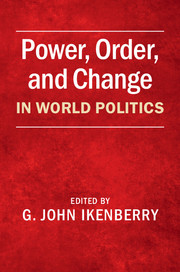
BOOK REVIEW: Nuno Monteiro (Yale) reviews John IKENBERRY (ed.), Power, Order, and Change in World Politics. Cambridge: Cambridge University Press, 2014. 308 pp. $32.99, ISBN 978-1-107-42106-6 (H-Diplo)


(image source: H-Diplo)

The discussion forum H-Diplo (HNet) features a review by Nuno Monteiro (Yale) of John Ikenberry's collective work Power, Order and Change in World Politics (CUP, 2014).

(image source: Cambridge UP)


First paragraph:
The ninth of Walter Benjamin’s 1940 theses “On the Concept of History” consists of the following controversial observation about Paul Klee’s drawing Angelus Novus (1920): “A Klee painting named Angelus Novus shows an angel looking as though he is about to move away from something he is fixedly contemplating. His eyes are staring, his mouth is open, his wings are spread. This is how one pictures the angel of history. His face is turned toward the past. Where we perceive a chain of events, he sees one single catastrophe which keeps piling wreckage upon wreckage and hurls it in front of his feet. The angel would like to stay, awaken the dead, and make whole what has been smashed. But a storm is blowing from Paradise; it has got caught in his wings with such violence that the angel can no longer close them. The storm irresistibly propels him into the future to which his back is turned, while the pile of debris before him grows skyward. This storm is what we call progress.”
 Read the fulltext here.