ESIL Interest Group History of International Law

ESIL Interest Group History of International Law

Tuesday, 14 March 2017

BOOK: C.H. ALEXANDROWICZ (ed. David ARMITAGE & Jennifer PITTS), The Law of Nations in Global History. Oxford: OUP, 2017, 464 p. ISBN 9780198766070, £ 80

(image source: OUP)

Oxford University Press publishes an edition of the work of C.H. Alexandrowicz, edited by David Armitage and Jennifer Pitts (The Law of Nations in Global History).

Book summary: 
The history and theory of international law have been transformed in recent years by post-colonial and post-imperial critiques of the universalistic claims of Western international law. The origins of those critiques lie in the often overlooked work of the remarkable Polish-British lawyer-historian C. H. Alexandrowicz (1902-75). This volume collects Alexandrowicz's shorter historical writings, on subjects from the law of nations in pre-colonial India to the New International Economic Order of the 1970s, and presents them as a challenging portrait of early modern and modern world history seen through the lens of the law of nations. The book includes the first complete bibliography of Alexandrowicz's writings and the first biographical and critical introduction to his life and works. It reveals the formative influence of his Polish roots and early work on canon law for his later scholarship undertaken in Madras (1951-61) and Sydney (1961-67) and the development of his thought regarding sovereignty, statehood, self-determination, and legal personality, among many other topics still of urgent interest to international lawyers, political theorists, and global historians.

Table of contents:
1: 'This Modern Grotius': An Introduction to the Life and Thought of C.H. Alexandrowicz, David Armitage and Jennifer Pitts
PART ONE: THE EARLY HISTORY OF THE LAW OF NATIONS
2: Kautilyan Principles and the Law of Nations (1965-66)
3: Paulus Vladimiri and the Development of the Doctrine of the Coexistence of Christian and Non-Christian Countries (1963)
4: Mogul Sovereignty and the Law of Nations (1955)
PART TWO: ASIA AND THE LAW OF NATIONS
5: 'Jus Gentium' and the Law of Nature in Asia (1956)
6: Some Problems in the History of the Law of Nations in Asia (1963)
7: Le Droit des Nations aux Indes Orientales: Aux XVIe, XVIIe, XVIIIe siècles (1964)
8: Grotius and India (1954)
9: Freitas Versus Grotius (1959)
10: The Discriminatory Clause in South Asian Treaties in the Seventeenth and Eighteenth Centuries (1957)
11: A Persian-Dutch Treaty in the Seventeenth Century (1958)
12: Puffendorf-Crull and the Afro-Asian World (1968-69)
13: A Treatise by J. H. G. Justi on Asian Government (1960-61)
14: Doctrinal Aspects of the Universality of the Law of Nations (1961)
15: G. F. de Martens on Asian Treaty Practice (1964)
16: The Continuity of the Sovereign Status of China in International Law (1956)
17: The Legal Position of Tibet (1954)
18: Is India a Federation? (1954)
PART THREE: AFRICA AND THE LAW OF NATIONS
19: Le Rôle des Traités dans les Relations entre les Puissances Européennes et les Souverains Africains (Aspects historiques) (1970)
20: The Partition of Africa by Treaty (1974)
21: The Role of Treaties in the European-African Confrontation in the Nineteenth Century (1975)
22: The Role of German Treaty Making in the Partition of Africa (1980)
23: The Juridical Expression of the Sacred Trust of Civilization (1971)
PART FOUR: THE RECOGNITION OF NEW STATES IN INTERNATIONAL LAW
24: Empirical and Doctrinal Positivism in International Law (1974-75)
25: The Theory of Recognition in Fieri (1958)
26: The Quasi-Judicial Function in the Recognition of States and Governments (1952)
27: Israel in Fieri (1951)
28: New and Original States: The Issue of Reversion to Sovereignty (1969)
29: The New States and International Law (1974)
30: The Charter of Economic Rights and Duties of States (1975)
Bibliography of the Writings of C. H. Alexandrowicz
On the author and the editors:
Charles Henry Alexandrowicz (1902-1975) was a Polish scholar who pioneered research in the critical history of international law in the 1950s and 1960s. His works included World Economic Agencies, Law and Practice (1962); An Introduction to the History of the Law of Nations in the East Indies (1967); The Law of Global Communications (1971); and The Law-Making Functions of the Specialised Agencies of the United Nations (1973).
David Armitage is the Lloyd C. Blankfein Professor of History at Harvard University, where he teaches intellectual and international history. He is also an Affiliated Faculty member at Harvard Law School and an Affiliated Professor in Harvard's Department of Government. Among his publications are The Ideological Origins of the British Empire (2000), The Declaration of Independence: A Global History (2007), Foundations of Modern International Thought (2013), The History Manifesto (co-auth., 2014), and Civil Wars: A History in Ideas (2017).
Jennifer Pitts is Associate Professor of Political Science at the University of Chicago. She is author of A Turn to Empire: the rise of imperial liberalism in Britain and France (2005) and editor and translator of Alexis de Tocqueville: writings on empire and slavery (2001). She is currently completing a book,Boundaries of the International, that explores European debates over legal relations with extra-European societies during the eighteenth and nineteenth centuries. 
More information with OUP

Friday, 10 March 2017

CONFERENCE: Training, ideas and practice. The Law of Nations in the Long Eighteenth Century (Paris, 18/19 May 2017)

COLLOQUE JUNIOR CIERA - Training, Ideas and Practice
The Law of Nations in the Long Eighteenth Century


Day 1: 18 May 2017 (Maison de la Recherche/CIERA)

12:45
Welcoming

13:20
Keynote lecture by Luigi Nuzzo (Università del Salento)

14:00
Session 1: Training (president: Luigi Nuzzo - Università del Salento)

Zülâl Muslu (Université Paris Ouest Nanterre), Language and Power: the Spread of European Diplomatic Cuture in the Ottoman Empire through the Ecole de jeunes de langues 

Dante Fedele (KULeuven), La formation diplomatique dans la littérature sur l’ambassadeur et l’art de négocier (fin XVIIe-début XVIIIe siècle)  

Annika Haß (Université de la Sarre/EPHE), Librairie internationale et diplomatie (1789-1830)  

Raphael Cahen (VUB/FWO), Hauterive et l’École des diplomates

17:10-17:20
Coffee Break

17:20-18 :50  Session 2 : Circulation of Ideas and Diplomatic Networks (president: Christine Lebeau) 
Benjamin Durst (Universität Augsburg), Gedruckte Vertragssammlungen als Medien des Völkerrechts in Theorie und Praxis  

Stephan F. Mai (Universität Wien), Diplomatic Immunity between Theory and Practice: Abraham de Wicquefort (1606-1682) as a Case Study 

19:30  Conference dinner (presenters only)  

Day 2: 19 May 2017 (Fondation Biermans-Lapôtre/CIUP)

08:00-08:30
Welcome and coffee


08:30-10:00 Session 2 (part 2): Circulation of Ideas and Diplomatic Networks (president: Christine Lebeau, Université Paris I Panthéon-Sorbonne)  Frederik Dhondt (VUB/UAntwerpen/UGent-FWO), A Pragmatic Utopian ? Saint-Pierre’s vision on Perpetual Peace and its Practical Legal Background in Regency Diplomacy  
Alice 
Bairoch de Sainte-Marie (Université de Genève), La conception des devoirs du négociateur en Nouvelle-France: heritage métropolitain ou cas particulier ? 


10 :00-10 :10
  Coffee Break 


10 :10-13 :20
  Session 3 : Transformation of the Law of Nations (president: Miloš Vec, Universität Wien/IWM)  Patrick Milton (Freie Universität Berlin), The Guarantee of the Peace of Westphalia in the Law of Nations and its Impact on European Diplomacy  
Elisabetta Fiocchi Malaspina (Universität 
Zürich): Trans-forming the Law of Nations in Diplomacy: the Case of the 18th Century Italian Peninsula  
Omer 
Duran (Istanbul University): The Legal Status of the ‘Memleketeyn’ (Wallachia and Molodvia) according to the Ottoman-Islamic Law of Nations  Victor Simon (Université de Reims Champagne-Ardenne): La dignité impériale des rois de France en Orient: titulatures et traductions dans la diplomatie franco-ottomane


13:20-14:30
Lunch

14:30-15:15  Final debate - Conclusion
(
Miloš Vec-Universität Wien/IWM)


Organising Committee

Raphael Cahen (Orléans/VUB-FWO)

Frederik Dhondt (VUB/UAntwerpen/UGent-FWO)

Elisabetta Fiocchi Malaspina (Zürich)

Scientific Committee
Jacques Bouineau (Université de La Rochelle)
Paul De Hert (VUB)
Dirk Heirbaut (UGent)
Christine Lebeau (Université Paris I Panthéon-Sorbonne)
Gabriella Silvestrini (Università del Piemonte Orientale)
Matthias Schmoeckel (Universität Bonn)
Antonio Trampus (Università di Venezia)
Miloš Vec (Universität Wien/IWM)

Venue  Day 1: Maison de la Recherche (28, Rue Serpente ; 75006 PARIS)  Day 2 : Fondation Biermans-Lapôtre (9A, Boulevard Jourdan ; 75014 PARIS) 


Sunday, 5 March 2017

DIGITIZED SOURCES: The French Foreign Affairs Library on Gallica


The Library and Archives of the French Ministry of Foreign Affairs count among the most famous and precious on earth. Besides the evident political or cultural information on the relationship between France and the rest of the world, many documents of an indirectly or directly relevant legal nature are kept in the Ministry's dépôts in either La Courneuve or Angers (consular archives).

In 2010 and 2011, the Ministry signed a cooperation agreement with Gallica, the Bibliothèque nationale de France's praised and omnipresent digital library. Within this framework, 312 "livres jaunes" have been scanned, ranging from 1799 to 1947. These series contains reports on French foreign policy to parliament and French or foreign leaders.

This only adds to the importance of Gallica as a source for historians of international law. Many standard manuals on public international law, but also journals (Revue de droit étranger, Revue de droit international et de législation comparée, Revue d'histoire diplomatique) are available in fulltext, for free, from anywhere in the word. A precious resource in a time of predatory pricing for commercial databases.

Friday, 3 March 2017

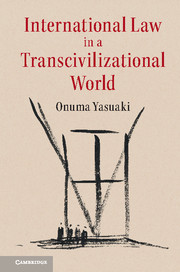
BOOK: ONUMA Yasuaki, International Law in a Transcivilizational World. Cambridge: CUP, 2017, forthcoming. ISBN 9781139175951

(image source: Cambridge UP)

Professor ONUMA Yasuaki (University of Tokyo) publishes International Law in a Transcivilizational World with Cambridge University Press.

Book abstract:
With the resurgence of Asian nations such as China, current West-centric international law is changing in the twenty-first century. There is a pressing need to address these changes within international legal studies and overcome potential conflicts between existing and emerging powers. This structural transformation also demands a change in understanding of existing ideas and institutions. This book explores a 'trans-civilizational' approach to international law, supplementing and modifying two other prevalent perspectives: international and transnational. By considering these three layered viewpoints, this book highlights the complex phenomena surrounding the history and development of international law. The author also considers how international law operates and functions within diverse forums such as diplomatic negotiation, international organizations, and domestic political processes. This book will appeal to international law scholars and students, as well as those interested in the rise of non-Western powers and its impact on the prevalent ideas and institutions of the world.
More information on the Cambridge University Press website.

Sunday, 19 February 2017

BOOK AND PROJECT WEBSITE: Global History of International Ideas - Histoire globale des idées internationales


Prof. dr. Emmanuelle Tourme-Jouannet (Sciences Po Law School), dr. Dominique Gaurier (Université de Nantes, emeritus) and Prof. dr. Alix Toublanc (Paris I Panthéon-Sorbonne) launched the website of the bilingual project Global History of Public International Ideas/Histoire globale des idées internationalistes.

Project description (in English):
We have long been convinced that it is both necessary and useful to assemble a new collection of texts relating to the field of public international law. Such a collection would go further than previous compilations, such as the one assembled in 1927 by Louis Le Fur and Georges Chklaver, or Pierre-Marie Dupuy and Yann Kerbrat’s more recent collection which essentially focusses on post-World War II positive international law.
Our text collection will be different. It will look at international law from a global perspective, leaving behind the Eurocentric perspective that Western internationalists have imposed upon the rest of the world, as part of what Jack Goody famouly coined as The Theft of History (CUP, 2006). Our goal will be to provide our readers with the tools to develop a global history of international law. Being more global and more open to influences from all over the world, this history of international law will draw non-European ideas, both ancient and new. Thus, it will allow for the kind of comparisons, connexions, and oppositions which have always played a central part in the global history of international ideas – a history which cannot be written any longer by resorting only to Western categories and concepts.
Together, the selected texts will form a global panorama of internationalist ideas. They will be part of an evolving project which will rely upon a global network of co-ordinators. These co-ordinators will gradually assemble the texts that will complement our first, then our second, collection.
Rather than aiming at being exhaustive – a thing of the impossible in our field – the panorama we have in mind will be a simple one. Inevitably, some of the basic choices we made at the outset might appear arbitrary, such as using a lineary time-frame typical of Western cultures – although we might eventually be able to integrate other approaches. We proceeded by collecting texts that seemed particularly relevant to us. Other texts, which we were not able to include, are just as relevant. However, all three of us being French, we necessarily only have limited access to non-European sources. This is why we intend to rely heavily on all members of our network to enrich our collection in the future.We prefer using the term ‘internationalist ideas’, rather than ‘great authors in the field of international law’, for two reasons. Firstly, because the history of internationalist thought goes back to internationalist ideas that were not produced by European ‘internationalists’ in the current sense of the word, but by politicians, philosophers, theologians, thinkers discussing war and peace, commerce and currency, and many other things common to different peoples.
We feel that acknowledging these early histories and presenting them to the reader is indispensable in order to understand which kind of concerns led to the birth of international law. Secondly, the very idea of ‘great authors’ is problematic and over-simplifying, as it would have led us to make arbitrary choices which, from a scientific perspective, would have been rather questionable. It leaves out the intricacies, nuances, and subtle distinctions made by other texts which, despite being less well-known, are just as relevant than those written by more prominent authors.
At this point, two volumes have already been conceived in this fashion. The first volume, which will be presented hereafter, will present texts ranging from Antiquity to the beginning of the modern period (in the European sense of the word), i.e. the end of the 18th century. This period saw a decisive change in the evolution of internationalist ideas. As a matter of fact, it was at the end of the 18th century that the European inter-state law of nations began spreading to the rest of the world. However, this European law of nations, once imitated, translated, and taught in regions colonized or dominated by European powers, also started opening up to the influences other cultures.
We hope that this first volume of our series will provide large readership with direct access to internationalist ideas. We organized the relevant sources thematically and presented them in their original forms, without any accompanying interpretation. Nothing will ever beat direct access to original texts, although presenting these texts in a translated form (i.e. in French and, eventually, at least also in English and Spanish) might already be considered a form of betrayal. 
Translated by Michel Erpelding
Max Planck Institute Luxembourg
The open access e-book Une histoire globale des idées internationalistes, associated with the project, can be downloaded here.

Full information and the text of the two first online contributions, as well as maps and documents drawn from recent scholarship can be found on the website.

Thursday, 16 February 2017

JOURNAL: Jus Gentium. Journal of International Legal History II (2017), No. 1

(image source: Lawbook Exchange)

Jus Gentium: Journal of International Legal History published its first issue for 2017.

Table of Contents:
ARTICLES 
The International-Legal Ideology Pre-Slavic Chiefdoms of the Ukrainian Ethnos (Part Two)VG.Butkevych  
The Limits of International Agreement: Belligerent Rights vs. Submarine Cable Security in the Nineteenth CenturyDouglas Howland  
The Means to the End and the End of the Means:  Self-Determination, Decolonization, and International LawMiriam McKenna  
NOTES AND COMMENTS 
Piracy in the United States Supreme Court: United States v. PalmerV. Vasquez  
United States v. Smith: The Influence of Commodore John Daniel DanelsJ. G. Gorman, III  
The Malek Adhel and Shipowner Liability for PiracyB. J. Forgue  
Worcester v. Georgia and Native American Tribal SovereigntyR. L. Armezzani  
On the Russian Society of International Law (1880)W. E. ButlerV. S. Ivanenko  
Samuel Crandall and Treaty-Making in the United StatesTaylor J. Wolf  
REVIEWS 
Arnulf Becker Lorca, Mestizo InternationalLaw: A Global Intellectual History (2014)A. P. Useche   
DOCUMENTS AND OTHER EVIDENCE OF STATE PRACTICE 
Federal Law on the Ambassador Extraordinary and Plenipotentiary of the Russian Federation in a Foreign State and Permanent Representative (or Permanent Observer) of the Russian Federation or Attached to an International Organization (or in a Foreign State)W. E. Butler  
United States v. Smith (1820):Transcript RecordJ. G. Gorman, III  
A Brief Calendar of International Practice for Spain and Portugal: 1297 to 1641P. Macalister-SmithJ. Schwietzke  
A Brief Calendar of State Practice for Russia During the First World War: 1914 to 1924 (Part One 1914—1918)P. Macalister-SmithJ. Schwietzke  
FROM THE LITERATURE

Tuesday, 14 February 2017

BOOK: Sonja SCHILLINGS, Enemies of All Humankind. Fictions of Legitimate Violence [Re-Mapping the Transnational]. Lebanon (NE): UPNE, 2016, 302 p. ISBN 978-1-5126-0016-2

(image source: UPNE)


Book abstract:
Hostis humani generis, meaning “enemy of humankind,” is the legal basis by which Western societies have defined such criminals as pirates, torturers, or terrorists as beyond the pale of civilization.Sonja Schillings argues that the legal fiction designating certain persons or classes of persons as enemies of all humankind does more than characterize them as inherently hostile: it supplies a narrative basis for legitimating violence in the name of the state. The book draws attention to a century-old narrative pattern that not only underlies the legal category of enemies of the people, but more generally informs interpretations of imperial expansion, protest against structural oppression, and the transformation of institutions as “legitimate” interventions on behalf of civilized society. Schillings traces the Anglo-American interpretive history of the concept, which she sees as crucial to understanding US history, in particular with regard to the frontier, race relations, and the war on terror.
Table of contents here.