ESIL Interest Group History of International Law

ESIL Interest Group History of International Law
Showing posts with label seminar. Show all posts

Tuesday, 16 September 2025

ONLINE BOOK DISCUSSION: Hendrik SIMON & Lauri MÄLKSOO in conversation about "A Century of Anarchy? War, Normativity, and the Birth of Modern International Order" (OUP, 2024), 22 October 2025

Source: OUP
Book discussion: A Century of Anarchy? War, Normativity, and the Birth of Modern International Order

The Interest Group on the History of International Law of the European Society of International Law (ESIL) warmly invites you to an online discussion with Hendrik Simon (Frankfurt University / PRIF) and Lauri Mälksoo (University of Tartu) on Hendrik Simon’s recent book A Century of Anarchy? War, Normativity, and the Birth of Modern International Order (Oxford University Press, 2024).

The book challenges the conventional narrative that the nineteenth century was a period of unlimited warfare until the emergence of the League of Nations, the Kellogg-Briand Pact, and the UN Charter. Instead, Simon demonstrates how the concept of a “free right to go to war” (liberum ius ad bellum) was a construct of Imperial German legal realism, later universalized in international historiography. His work redefines our understanding of modern international order and the justifications of war. Hendrik Simon and Lauri Mälksoo will discuss the
book together, addressing current issues in the history of international law.

Speakers:
•       Hendrik Simon is Principal Investigator at the Research Institute Social Cohesion (RISC) at Frankfurt University and Senior Researcher at the Peace Research Institute Frankfurt (PRIF). His book A Century of
Anarchy? has received the Jost Delbrück Prize 2024 and the Helmuth James von Moltke Prize 2025.
•       Lauri Mälksoo is Professor of International Law at the University of Tartu, member of the Institut de Droit International, the Venice Commission of the Council of Europe, and the Estonian Academy of Sciences. He is co-editor of The Oxford Handbook of International Law in Europe (2024) and author of the forthcoming Russia, the Soviet Union, and Imperial Continuity in International Law (OUP).

Date: 22 October 2025
Time: 2:00 PM (CET)
Venue: Online via Zoom
We look forward to your participation!

Jaanika Erne - Anastasia Hammerschmied - Sze Hong Lam (Ocean) - Florenz Volkaert

Thursday, 10 October 2024

SEMINAR: "France, Europe, empires, XVIe – début XIXe siècle" (École Normale Supérieure de Paris, October 2024 - May 2025)

Source: IDHES


Description:

France, Europe, empires, XVIe – début XIXe siècle

Dates

Du 18 octobre 2024 au 16 mai 2025
Annuel en quinzaine (sauf exception), le vendredi, 16 h – 18 h
Lieu
ENS
bâtiment Jaurès, aile Ulm, 2e étage, Salle Ferdinand Berthier (U207)
29 rue d’Ulm
75005 Paris
RER B : Luxembourg

Attention : entrée du public par le 24, rue Lhomond (et long parcours intérieur fléché)
Organisation

IDHES, UMR 8533 :
Michela Barbot (CNRS), Anne Conchon (Université Paris 1), Laurence Croq (Université Paris Nanterre), Vincent Demont (Université Paris Nanterre), Vincent Milliot (Université Paris 8), Daniel Velinov (CNRS) et Julien Villain (Université Évry Paris-Saclay)
Programme
Vendredi 18 octobre 2024

Séance introductive
Vendredi 8 novembre 2024

Catherine Denys, Université de Lille
Comment naît une police coloniale d’Ancien Régime ? L’exemple de l’île de France (île Maurice) au XVIIIe siècle
Vendredi 22 novembre 2024

Simon Castanie, docteur de l’Université Sorbonne Université
L’emprisonnement pour dette à Paris dans la seconde moitié du XVIIIe siècle
Vendredi 6 décembre 2024

Jean-Paul Zuniga, CRH, EHESS
Catégorie fiscale et identification sociale : dire l’appartenance à Santiago du Chili (fin XVIIe – début XVIIIe siècle)
Vendredi 24 janvier 2025

Giorgio Riello, Warwik University, IUE Florence
The Workshop of the World: Factories and Capitalism in Early Modern Global Asia
Vendredi 7 février 2025

Marie Houllemare, Université de Genève
Masculinités esclavagistes : genre et violence dans la Caraïbe française au XVIIIe siècle
Vendredi 21 février 2025

Laurence Croq, Université Paris Nanterre
La police des femmes de lettres à Paris au XVIIIe siècle
Vendredi 14 mars 2025

Guillaume Garner, ENS Lyon
Le caméralisme : une économie politique du capitalisme ? (vers 1740 – vers 1800)
Vendredi 28 mars 2025

Thomas Pasquier, doctorant, Université Paris 8
Par-delà verrous et clôtures. Criminalité, ordre et propriété pendant la Révolution française 
Vendredi 11 avril 2025

Juliette Françoise, doctorante, Université de Genève, Université Paris 1 Panthéon-Sorbonne
La régulation de la monnaie : un élément de la formation des empires modernes ? L’exemple de l’Empire français en Asie au XVIIIe siècle
Vendredi 25 avril 2025

Donia Menghini, doctorante, Université Paris 8
Maintenir l’ordre et policer la vallée du Saint-Laurent, de la Nouvelle-France au Canada anglais
Vendredi 16 mai 2025

Domitille de Gavriloff, doctorante, CENA, EHESS
Les missionnaires, éléments perturbateurs ou régulateurs de l’ordre esclavagiste et racial dans les colonies de la Caraïbe française, XVIIe-XVIIIe siècles ?


Dans la première quinzaine de juin aura lieu une journée d’études « carte blanche » organisée par les doctorants.

More info with IDHES.

Thursday, 18 February 2021

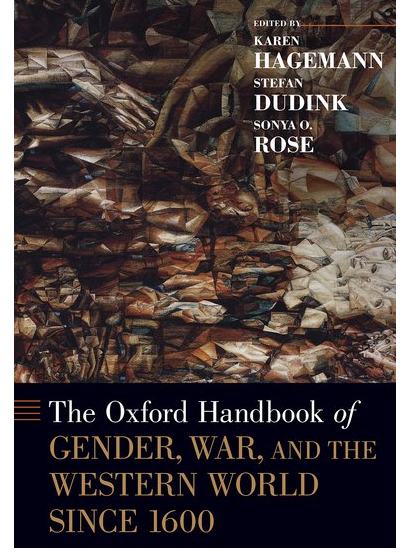
ONLINE SEMINAR: Transatlantic Roundtable to Launch the Oxford Handbook of Gender, War, and the Western World since 1600 (University of North Carolina; 5 MAR 2021)


(image source: UNC)

Event description:

This transatlantic roundtable launches the publication of The Oxford Handbook of Gender, War, and the Western World since 1600 a comprehensive historical overview of the entangled relationships between gender, war and military culture, and remembers one of its three editors, Sonya O. Rose (1935-2020), who sadly died weeks before the book was published.

The roundtable will focus on the intersection of gender, war and citizenship, which is not only one of the major themes of the Oxford Handbook, but also of Sonya Rose’s work. It starts from her suggestion, to think of citizenship as ‘’a framework that serves as a basis for claims-making.” Citizenship, she wrote, is a discursive framework that enables people to make various political and other claims and shapes political subjectivities that get enacted in the process of claims-making. Deeply marked by gender, race and class, this framework of citizenship produces exclusions—and offers tools to contest these. War often comes with a particularly intense discourse and politics of citizenships, in which claims made by, and on, people get linked to the issue of national survival. The roundtable will explore the politics of citizenship in the context of military and war and ask how transformations of modern warfare have affected notions of citizenship and gender, and vice versa how historical and changing notions of citizenship and gender shaped military and war.

The participants of the roundtable will explore the wartime politics of citizenship in various historical and geographical contexts, ranging from late eighteenth-century Wars of Revolution and Independence to Word War II. Three sets of questions are central to their exploration:

  1. How have specific gender orders informed specific historical wars and types of war? How have, vice versa, specific historical wars and types of war shaped gender orders and gendered politics of citizenship in particular?
  2. How have wartime politics of citizenship been shaped by the intersection of categories of difference and inequality such as gender, race, and class?
  3. What were the long-term effects on gender orders of wartime politics of citizenship? What explains the persistence or subsiding of wartime reconfigurations of gender and citizenship?

Program:

Program

  • Welcome
    Berit Ebert, 
    Vice President, American Academy Berlin
    Jan Willem Duyvendak,
     Director, Netherlands Institute for Advanced Study in the Humanities and Social Sciences
  • IntroductionThe Oxford Handbook of Gender, War, and the Western World since 1600—A Global Project
    Karen Hagemann,
     University of North Carolina at Chapel Hill
  • Commemorative Address: Sonya O. Rose: A Transatlantic Gender Historian
    Susan Grayzel, Utah State University

Roundtable: Gender, War and Citizenship

  • Moderation: Karen Hagemann, University of North Carolina at Chapel Hill
  • Participants
    • Gender, War and Citizenship
      Thomas Kühne,
       Clark University
    • Masculinity, War and Citizenship in 18th and 19th Century Europe
      Stefan Dudink
      , Radboud University Nijmegen
    • Colonial Soldiers, Empire, and Male Citizenship  in the Age of the World Wars
      Richard Smith, Goldsmiths, University of London
    • The North American Home Front, Race and Citizenship
      Kimberly Jensen, Western Oregon University

(source: UNC

Wednesday, 20 May 2020

SEMINAR SERIES: Global History and International Law – Online (April-June 2020)


We recently learned of an online seminar series on “Global History and International Law”, with weekly sessions. The sessions are also uploaded on a dedicated Youtube channel here.

Sessions:

The Nuremberg Moment, April 29, 2020
Genocide and Crimes Against Humanity in Historical Perspective, May 6-7, 2020
Theory and History of International Law, May 13, 2020
Imperial Origins of the World Order, May 20, 2020
International Law and Global Governance, May 27, 2020
International Law and Imperial Constitutions, June 3, 2020
Colonial Law and Assimilation Policies, June 10, 2020
International Law, Slavery and Forced Labor, June 17, 2020
Concluding Thoughts, June 24, 2020

More info about the Seminar series can be found on the dedicated website globalhistoryandil.com

(source: ESCLH Blog)

Monday, 22 April 2019

CONFERENCE REPORT: ESIL IGHIL Pre-Conference Event, Research Forum (Göttingen: University of Göttingen, 3 APR 2019) (by Jan LEMNITZER, IGHIL President)


The ESIL Interest Group History of International Law held its pre-conference workshop on "The Rule of Law and International Law in Historical Perspective" at the University of Goettingen on 3 April 2019.

The presenters moved backwards in chronology, with Denise Wohlwend (University of Fribourg (CH)) exploring the recent past of the ‘rule of law’ concept within the United Nations. The concept was established as an UN priority at the World Summit in 2005 (that famously also birthed the concept of R2P), which led to the founding of the rule of law assistance unit in the Secretariat and a series of debates in the 6th Committee of the General Assembly. Predictably, the fact that there is no agreed definition of what ‘rule of law’ means led to a series of debates within the committee as to what precisely the concept entails. While some states saw it as one of the main principle of political morality, others favoured a more legalistic approach and insisted it was primarily about the foundations of a functioning legal order, such as states following court decisions, the separation of power or adherence to international law. The more detailed the debates got, the more disagreements appeared: should the rule of law be seen as a key tool to establishing stability in transitional justice processes, or does that denigrate the concepts since it should always be seen as a value in itself? Wohlwend ended by suggesting the framework of a ‘contested concept’ to further the debate while acknowledging the obvious disagreements. In a lively and well-informed exchange with the presenter, Hannah Birkenkötter (Humboldt University Berlin) pointed out that a lot of the real action on the rule of law was not in the GA debates, but the annual reports of the General Secretary, and that the secretariat had managed to hide a number of activities under the rule of law label that would otherwise have been controversial among member states. Both agreed that ‘rule of law’ seems to have replaced the earlier ubiquitous use of ‘democracy’, perhaps since it was deemed more appropriate to a post-Iraq War world.

The next presenter, Premislaw Tacik (Jagellionian University, Cracow), explored the ways in which the ‘rule of law’ concept has been employed in the jurisdiction of the European Court of Human Rights. Given the traditional disputes with Russia, but especially the more recent conflicts with the governments in Poland and Hungary, this is a highly political question. Tacik argued that the Court avoided legal theory on the issue, but often invokes the preamble of the Convention as a ‘guiding principle of interpretation’. In practice, this can mean both the identification of the rule of law as basic equality before the law and the provision of legal protections, but also the endorsement of ‘thick’ interpretations of the concept that see the rule of law as the guarantor of democracy and human rights. In the discussion, session chair and IG convenor Jan Lemnitzer (University of Southern Denmark) noted that the court seemed to sometimes engage in the defence of lofty principles while at other times focused its decisions on seemingly small procedural details. Tacik agreed that we need a conceptual bridge between both levels, since in reality they can not be separated in the court’s struggle with those governments that are determined to disrespect the rule of law.

In the second panel, Ryan Mitchell (Chinese University of Hong Kong) explored the political thinking of Hans Kelsen and pointed out that scholars tend to focus too much on his early writings establishing a vision of the rule of law built around the pacta sunt servanda principle, while ignoring his later works. Here, Kelsen needed to deal with the tension that he supported the Nuremberg trials and the ideas behind them, but that his endorsement of a legal system that is capable of defining a new crime (aggression) and establishing individual guilt of those who had committed it before the binding definition meant a real crisis for his system of legal thought. After initially publishing rather poor arguments such as that those who committed particularly horrific crimes lose the right not to be prosecuted in dubious ways, Kelsen changed his thinking (partly influenced by his controversial positions during the Korean War) and now highlighted the fact that a norm without a sanction is not a norm in a meaningful sense.

Finally, Alan Nissel began by pointing out that the history of arbitration as it currently stands focuses on a small number of prominent cases involving the United States or Britain. He argued that the large number of cases in Latin America in the 19th and early 20th century are particularly revealing since they often involved disputes between Western investors or creditors and local interests. The pattern that emerges upon a closer look is a rule of law mask for capitalist interests that strongly favoured European or American investors while expecting the locals to be pleased that arbitration had begun to replace armed state intervention. These developments are not just of historical interest since the logic employed in these cases became highly influential in the formation of the modern doctrine of state responsibility, a cornerstone of contemporary international law. As Jan Lemnitzer pointed out in his panel summary, this type of research is particularly welcome since it add  to our empirical foundation for two separate developments in our field: a rethinking of the history of arbitration, and a lifting of the boundary between public international law and the history of private international law and investment disputes.

The next meeting of the IG History of International Law will take place just before the Annual conference in Athens in September and look at ‘New Histories of Sovereigns and Sovereignty’ – the call for papers is still open until 30 April!

Monday, 25 February 2019

SEMINAR: Les midis du Centre de droit international de l'ULB (Brussels, FEB-MAY 2019)

(image source: CDI ULB)

The Centre de droit international (ULB) published the programme of its lunchtime lectures.

One contribution adresses an historical perspective: the lecture on 16 May 2019 by dr. Agatha Verdebout (UC Lille): « L’impact de la théorie de la ‘guerre juste’ de Grotius sur la doctrine des siècles suivants : sur la trace des notes de bas de page ».

More information here.

Thursday, 31 January 2019

WORKSHOP: MILC Emerging Scholars (Manchester, 25 JUN 2019); DEADLINE 15 MAR 2019

(image source: Mancester University)
MILC Emerging Scholars Workshop
Call for applications
The Manchester International Law Centre (MILC) is holding its first Emerging Scholars Workshop on 25 June 2019 in Manchester. The aim of the Workshop is to bring together a carefully selected group of eight doctoral students. During the workshop, the participants will receive tailored feedback on their research project through closed roundtable discussions with Jean d’Aspremont, Iain Scobbie and John Haskell. In addition to the roundtable discussions, the event will also include sessions on publishing in international law and how to prepare for a job interview and compose postdoc applications.
Applicants are expected to be at an advanced stage of their PhD studies and must be focusing their doctoral research on a question related to international law, international legal practice, and/or international legal theory. Successful applicants must submit a paper of no more than 3.000 words that will be shared with other participants. The selection process will be very competitive as only eight participants will be selected.
Submission of applications
Abstracts of no more than 500 words and a one-page CV should be submitted to isil.aral@manchester.ac.uk by 15 March 2019. The subject line of the email must read “MILC PhD Workshop” followed by the surname of the author. Applicants will be notified by 15 April 2019. The deadline for submission of the papers by the selected participants is 10 June 2019.
Unfortunately, MILC is unable to offer any financial support and participants will have to bear their own expenses. Lunch and refreshments throughout the day will be provided.

Thursday, 22 November 2018

SEMINAR: Patrick CAPPS, 'Act of State' [Legal Histories Beyond the State Seminar] (Cambridge: Lauterpact Centre for International Law, 28 NOV 2018)

(image source: LCIL)

The Lauterpact Centre announced in its newsletter dated today a seminar by Prof. dr. Patrick Capps (Liverpool) on Act of State in the Legal Histories Beyond the State Seminar, to be held on 28 November 2018, 17:15 GMT.

More information here.

Tuesday, 9 October 2018

SEMINAR: Martti KOSKENNIEMI, "Les relations entre droit public et droit privé dans l'histoire du droit des gens" (Nanterre: Université Paris Ouest, 11 OCT 2018)


(image source: Paris-Nanterre)

Prof. Martti Koskenniemi (Helsinki) will speak at a seminar of the CDR Théorie et Analyse du Droit (Université Paris-Nanterre), on the relationship between Private and Public Law in the History of the Law of Nations.

The event will take place from 10:00 to 12:00.

More information here.

Wednesday, 31 May 2017

SEMINAR: Neue Kriege ? (Vienna: Universität Wien, 1-2 Jun 2017)


The University of Vienna (Institute for Constitutional and Legal History, prof. dr. M. Vec) organizes a two-day seminar on "New Wars".

More information in the elaborate program here.

Thursday, 28 January 2016

REMINDER: Lecture by Prof. Martti Koskenniemi, "Sovereignty and Property: A History of International Law" (Ghent University, Faculty of Law; International Order and Justice Lecture Series), 15 Feb 2016


(image source: hs.fi)

On Monday 15 Februari, the Lecture Series International Order and Justice (Ghent University, Faculty of Law) has the honour to welcome Prof. Martti Koskenniemi (Helsinki) for a lecture and doctoral seminar. Professor Koskenniemi will address the audience in the Academic Council Room on “Sovereignty and Property: A History of International Law” (15:00, not 10:00 as announced earlier). 

Afterwards, prof. Koskenniemi will attend a doctoral seminar and comment on presentations by PhD-researchers from the universities of Ghent, Liège and Leuven. 

The International Order and Justice Lecture Series is supported by the Vrije Universiteit Brusssel (VUB), the Katholieke Universiteit Leuven (KUL) and was made possible thanks to the financial support of  the UGent Doctoral School of Arts, Humanities and Law, the Belgian Branch of the International Law Association as well as the Belgian Society for International Law. 

Practical information and registration with Kristien.Ballegeer@UGent.be or on the Website of the Gustave Rolin Jaequemyns Institute of International Law.

Thursday, 14 May 2015

SEMINAR: International Law and Arbitration. From the Hague Conferences to the League of Nations. Global and Belgian Perspectives (University of Antwerp, 2 June 2015)

 (image source: dentriangel.be)

The Research Unit Political History at the University of Antwerp organizes a seminar on 2 June 2015 on the theme "International Law and Arbitration. From the Hague Conferences to the League of Nations. Global and Belgian Perspectives".

Programme and abstracts:

Seminar organized by PoHis (UAntwerpen)
2 June 2015
University of Antwerp, Prinsstraat 10, 2000 Antwerp, room P.002
9:45 Welcome

10:00 Maartje Abbenhuis (University of Auckland): A Global History of the Hague Peace Conferences, 1898 – 1914

The two Hague conferences of 1899 and 1907 have a contested historiography. Depending on the historical tradition, the conferences are presented as either irrelevant, mere footnotes ‘en route to the First World War’, or as foundational moments shaping twentieth-century international law and order. Based on a variety of published and archival sources, this talk explains how contemporaries looked to The Hague conferences as golden opportunities to shape the international law and organisation and explains why these events are so important to understanding global realities of the time.

10:40 Vincent Genin (Université de Liège): Juristes, parlementaires et diplomates en Belgique dans le processus menant aux Conférences de la Paix de La Haye de 1875 à 1899/1907

Il n’est pas inintéressant de souligner que la manière dont la Belgique a appréhendé les Conférences de la Paix de La Haye de 1899 et 1907 mérite encore une étude solide. Notre ambition, dans le cadre de ce séminaire, est d’analyser les circonstances qui ont entouré ce rapport entre un pays déterminé et un phénomène défini, à savoir un aboutissement du processus de diffusion de l’arbitrage obligatoire entre les États. Promu en Belgique par diverses institutions, depuis 1870, et défendu de manière plus ferme par le Parlement dès 1875, cet arbitrage ou la volonté, par extension, de mettre sur pied un tribunal arbitral international, sont l’objet de débats importants en Belgique, tant au Ministère des Affaires étrangères, qu’au Parlement ou dans les écrits et correspondances privées des juristes de droit international. L’étude de ce phénomène et de la manière dont il a été représenté et accueilli, est l’objet de notre contribution.

11 :00 Maarten Van Alstein (Vlaams Vredesinstituut): A Realist View: The Belgian Diplomatic Elite and the League of Nations

After the First World War, principles such as collective security and arbitration were enhanced in international politics, not in the least because they formed the cornerstones of new international organizations such as the League of Nations. After nearly eighty decades of neutrality, Belgian policymakers and diplomats were determined to pursue a more activist foreign policy and engage in international organizations and alliances. Although Belgium became a member of the new League of Nations and provided the first president of its general assembly, Belgian policymakers and diplomats’ attitudes towards principles such as collective security and arbitration ranged from cautiousness to clear skepticism. Although an evolution towards increased trust in collective security and arbitration can be observed between 1919 and 1929, Belgian policymakers’ and diplomats’ views during this period remained predominantly based on realist premises and beliefs.

Participation is free, but registration is required. Please send an email to : henk.desmaele@uantwerpen.be.
Source: newdiplomatichistory.org.