ESIL Interest Group History of International Law

ESIL Interest Group History of International Law
Showing posts with label lecture. Show all posts

Thursday, 11 February 2021

ONLINE LECTURE: Thomas SPIJKERBOER, Confronting the colonial structure of international migration law (Gent: UGent, Human Rights Centre, 20 JAN 2021)

(image source: UGent, HRC)
 

Lecture abstract:

Legal doctrine in the global North asserts that it is well-established in international law that states have the right to control migration, as a consequence of which individuals have an international law-based claim to admission or non-removal only in exceptional cases. This legal doctrine has been shaped by colonialism and continues to have a colonial deep structure. Legal doctrine in formerly colonized parts of the world does not necessarily share Northern doctrine. How can legal academics confront this pluralist and contested character of the field they are working in?

Lecturer bio:

Thomas Spijkerboer is professor of Migration Law at the Vrije Universiteit Amsterdam as well as the Raoul Wallenberg Visiting Professor of Human Rights and Humanitarian Law at Lund University. He is a member of the Royal Holland Society of Sciences and Humanities and of the Royal Netherlands Academy of Arts and Sciences. Having studied law at the University of Amsterdam, Thomas first worked in practice before writing his PhD at the Catholic University Nijmegen and becoming a Lecturer in Migration Law there in 1993. He founded the Amsterdam Centre for Migration and Refugee Law on his moving in 2000 to the Vrije Universiteit Amsterdam. His research and teaching focuses on border deaths and human rights; gender and sexuality in asylum law; and the externalisation of European migration policy. 

Watch the recorded lecture on Ghent University's website

(source: HRC, UGent

Monday, 8 February 2021

ONLINE EVENT: Paper Chains or Lilliputian Cords? Towards an Intellectual History of Treaties with David Armitage and Piers Ludlow (LSE, 18 MAR 2021)


(image source: LSE)

Lecture abstract:

There are currently over 55,000 treaties in force around the world, covering almost every aspect of life on earth as well as the ocean floor and outer space. Yet just how we became global Gullivers, enmeshed in worldwide webs of treaties, is a problem surprisingly little studied by historians, political scientists or scholars of International Relations. This lecture tackles this question with the tools of intellectual history and examines how treaties have been thought about and argued over, what cultural traces they have left, and how the corpus of treaties might become a resource for intellectual historians.

 On the speaker:

David Armitage is the Lloyd C. Blankfein Professor of History at Harvard University and an Affiliated Faculty Member at Harvard Law School. A prize-winning writer and teacher, he is the author or editor of eighteen books, among them Civil Wars: A History in Ideas (Knopf, 2017); The History Manifesto (Cambridge UP, 2014), one of the Chronicle of Higher Education’s most influential books of the past twenty years; The Declaration of Independence: A Global History (Harvard UP, 2007), a Times Literary Supplement Book of the Year; and The Ideological Origins of the British Empire (Cambridge UP, 2000), which won the Longman/History Today Book of the Year Award. He has held visiting positions in the US and the UK, Australia, China, France, Germany, and South Korea and is currently an Honorary Fellow of St Catharine’s College, Cambridge University, and an Honorary Professor of History at both Queen’s University Belfast and the University of Sydney.

On the commenter:

Piers Ludlow is Professor of International History and Head of Department of International History at LSE.

(source: LSE

Monday, 4 January 2021

VIRTUAL MEETING: Raphaël CAHEN, Socio-Cultural History of International Lawyers (Orléans, Le Studium, 7 JAN 2021, 16:00 CET)


(image source: Le Studium)

Meeting abstract:
International law is said to be a distinct profession with institutions and journals first in the 1870's (Koskenniemi, Genin, Vec/Nuzzo). Nevertheless, from the Vienna Congress (1815) to the Franco-Prussian Wars (1870-1871), international lawyers have initiated professional practices that related to the development of International Law. They were involved in foreign offices, scientific academies, and universities, they wrote textbooks and articles and formed networks. This project aims to investigate the interaction between foreign offices and international lawyers as well as the link between political migration of lawyers and their implication in the making of international law. This research will therefore shed a new light on the discourses and processes leading to the institutionalisation of International Law. For the first time, it will also analyse closely the interactions between foreign offices and International Law as well as the juridification of international affairs in the 19th century. In this presentation, I will concentrate myself upon a prosopography of the international lawyers in the French foreign affairs ministry. Furthermore, I will investigate the consultative litigation committee of the Foreign affairs ministry that had been established in 1835.

On the speaker: 

Dr. Raphaël Cahen is postdoctoral research fellow of the University Research Council at the Research Group Contextual Research in Law and Guest Lecturer at the Faculty of Law and Criminology (VUB). In 2020-2021, he is Fellow in residence at the Loire Institute of Advanced Studies (Le Studium). 

(source: Le Studium

Tuesday, 3 December 2019

LECTURE: David ARMITAGE, George III and the Law of Nations [2nd Arthur Berriedale Keith Lecture] (Edinburgh: University of Edinburgh, 5 DEC 2019)

(image source: Edinburgh Uni)

Lecture abstract:
The British Crown is the apex of the British Commonwealth as it was of the British Empire—a fact of which A. B. Keith, author of the monumental The King and the Imperial Crown (1936), was particularly aware. Yet just how British monarchs experienced ruling such vast and heterogeneous territories and peoples and what tools they used to navigate the challenges of imperial (and, later, Commonwealth) constitutionalism are understudied subjects. This lecture focuses on George III, the monarch who oversaw both the empire’s greatest expansion— in South Asia and North America after the Seven Years’ War—and its first major anticolonial rupture, the American Revolution. In particular, it examines how from his early years as Prince of Wales in the 1750s through to the twilight of his active rulership in the early nineteenth century, George III was educated in constitutionalism and the law of nations, how he gathered and processed information about imperial and international affairs, and how this constitutional and juridical knowledge shaped his understanding of international relations, the American Revolution, and the abolition of slavery, among other pressing contemporary questions. The conclusion will reflect on how the experiences of the first Hanoverian monarch who “gloried in the name of Briton” might be relevant for conceivably the last monarch to rule over a United Kingdom of Great Britain and Northern Ireland.
On the speaker:
DAVID ARMITAGE is the Lloyd C. Blankfein Professor of History at Harvard University and an Affiliated Professor at Harvard Law School. He is also an Honorary Professor of History at both the University of Sydney and Queen’s University Belfast and an Honorary Fellow of St Catharine’s College, Cambridge. He is the author or editor of eighteen books, among them The Ideological Origins of the British Empire (2000), The Declaration of Independence: A Global History (2007), Foundations of Modern International Thought (2013), The History Manifesto (2014, co-auth.), and Civil Wars: A History in Ideas (2017). He has held fellowships and visiting positions in Australia, Britain, China, France, Germany, South Korea, and the United States, and this year he is the Sons of the American Revolution Visiting Professor at King’s College London in association with the Georgian Papers Programme and the Royal Archives 
(source: University of Edinburgh)

Wednesday, 13 November 2019

LECTURE: The Fifth Annual Asser Lecture 2019 with Prof. Anne ORFORD: the social question in international law (The Hague: 28 NOV 2019)

(image source: Wikimedia Commons)

Event abstract:
While international law has played a central role in creating the conditions for market liberalisation on a global scale, many international lawyers have paid less attention to the social question, leaving human welfare, social unrest, labour relations, or migration to be addressed by economists, criminologists, sociologists, or demographers. According to Prof. Orford, the current situation of people who are dispossessed or impoverished by economic liberalisation, and the exhaustion of the world’s resources have become inescapable barriers to the continuation of ‘global business as usual’. In our Fifth Asser Annual Lecture, Prof. Orford puts the social question back on the international law table. How might international economic law-making and adjudication be re-embedded within political processes? And how can foundational political questions about property, security, survival, and freedom be returned to democratic control? We are very honoured that Sigrid Kaag, Minister for Foreign Trade and Development Cooperation in The Netherlands will join us to celebrate the fifth year anniversary of the Annual T.M.C. Asser Lecture (to be confirmed).
On the speaker:
Anne Orford is Redmond Barry Distinguished Professor, Michael D Kirby Chair of International Law, and an Australian Laureate Fellow at Melbourne Law School, where she directs the Laureate Program in International Law. Anne Orford is also an elected Fellow of the Academy of the Social Sciences in Australia. She has held visiting positions at Lund University, University Paris 1 (Panthéon-Sorbonne), the University of Gothenburg, NYU School of Law and Harvard Law School. Her work combines the study of history and theory of international law with an engagement with central debates in social theory, history, economics and philosophy. Orford aims to grasp the changing nature and function of international law and its relation to social, political, and economic transformation. Her major publications include International Authority and the Responsibility to Protect (Cambridge University Press 2011), Reading Humanitarian Intervention (Cambridge University Press 2003), the edited collection International Law and its Others (Cambridge University Press 2006), and, as co-editor, The Oxford Handbook of the Theory of International Law (Oxford University Press 2016). A collection of her essays in French, entitled Pensée Critique et Droit International, is forthcoming with Pedone. Her latest monograph International Law and the Politics of History, will be published by Cambridge University Press in 2019. Her work has been recognised by numerous honorary doctorates of laws. 
(source: Asser Institute$)

Wednesday, 10 April 2019

LECTURE VIDEO: Grotius Lecture 2019 (American Society of International Law) by Prof. Martti KOSKENNIEMI: Enchanted by the Tools? International Law and Enlightenment


The Grotius Lecture 2019, delivered by Prof. Martti Koskenniemi at the 113th Annual Meeting of the American Society of International Law on Enchanted by the Tools ? International Law and Enlightenment, has appeared on Youtube. Click on the embedded video above.

See also the 2017 Grotius Lecture by Prof. David Armitage on Civil War Time:

Tuesday, 5 March 2019

LECTURE: Hersch Lauterpacht Memorial Lecture 2019 – Professor Tom Ginsburg on “Democracies and International Law” (Cambridge, 12/13/14 March 2019)


(Source: Lauterpacht Centre)

As the Hersch Lauterpacht Memorial Lecture 2019, Professor Tim Ginsburg (UChicago) is holding a three-part lecture on how democracies have behaved in international law.

A series of three lectures by Professor Tom Ginsburg, Leo Spitz Professor of International Law, Ludwig and Hilde Wolf Research Scholar, Professor of Political Science, The University of Chicago Law School.

All lectures are held at the Lauterpacht Centre at 6 pm on Tuesday 12 March, Wednesday 13 March and Thursday 14 March with a Q&A at 1 pm on Friday 15 March (sandwich lunch from 12.30 pm).

Lecture summary: Since at least the time of Immanuel Kant, scholars and diplomats have speculated that democracies act differently on the international plane, with consequences for both international and domestic governance.  The most recent manifestation of this view is the so-called “liberal” theory of international law, prominent in the late 1990s and early 2000s, which argued that democracies were especially likely to cooperate with each other in deep and meaningful ways. Because electoral cycles introduce some uncertainty in policy, placing some issues “beyond the state” would allow for more stability in policy. International law was thought to be especially attractive to new democracies, as domestic institutions were weak and not likely to be particularly credible.

Liberal theory had something of a teleological quality in terms of its predictions.  As the number of democracies expanded, and as their economies became more integrated, it was assumed that there would be further incentive for other states to join the club.  The view suggested that international law would contribute to the expansion of democracy itself, a view that was advanced by Thomas Franck’s famous argument about an international right to democratic governance.  When viewed from our current moment, these aspects of liberal theory appear naive.  Most notably, we have been facing, in the rich industrial democracies of the world, a rise in populism, which has taken as its primary target the international institutions associated with globalization.  Brussels and Luxembourg are the bogeymen in Europe; the International Monetary Fund and the The Inter American Court of Human Rights are the targets in Venezuela and La Paz.  The anti-globalist backlash is, very largely, a backlash against international law and the imposition of norms that originate from outside the territorial nation state, to be deployed by cosmopolitan elites at the expense of the decisional freedom of the single sovereign people. 

In these lectures, I conduct a comprehensive empirical examination of whether and how democracies actually do behave differently with regard to the core activities of international law.  Next I examine whether and how international legal institutions actually are supporting democracies in an era of backsliding, in accord with the predictions of liberal theory.  Finally, I speculate on the implications of the above for the future of international law, by looking at recent examples of authoritarian use of international agreements.

The Hersch Lauterpacht Memorial Lecture is an annual three-part lecture series given in Cambridge to commemorate the unique contribution to the development of international law of Sir Hersch Lauterpacht. These lectures are given annually by a person of eminence in the field of international law. 

More info here
(source: ESCLH Blog)

Tuesday, 26 February 2019

LECTURE: 'Double Amnesia: Zionism and Human Rights in History and Memory' by Prof James Loeffler (Cambridge: Lauterpact Centre for International Law, 1 MAR 2019)

(image source: Lauterpact Centre)

Lecture summary:
2018 marks the seventieth anniversary of two momentous events in twentieth-century history: the birth of the State of Israel and the creation of the UN Universal Declaration of Human Rights. Both remain tied together in the ongoing debates about the Israeli-Palestinian conflict, global antisemitism, and American foreign policy. Yet the surprising connections between Zionism and the origins of international human rights are completely unknown today. Drawing on his recent book, Professor Loeffler will discuss how the forgotten Jewish past of human rights holds timely lessons for thinking about the intertwined futures of global justice and Jewish politics.
On the speaker:
James Loeffler is the Berkowitz Professor of Jewish History at the University of Virginia, where he teaches courses in Jewish, European, and international history and the history of human rights. He received his BA from Harvard and his MA and PhD from Columbia University. He also studied Jewish thought as a Dorot Postgraduate Fellow at the Hebrew University. He is the author of Rooted Cosmopolitans: Jews and Human Rights in the Twentieth Century (Yale, 2018), which was a finalist for the Jewish Book Council’s Natan Prize for Best Jewish Book of 2018. His first book, The Most Musical Nation: Jews and Culture in the Late Russian Empire (Yale, 2010), won eight major awards and honors. Other publications include the forthcoming anthology, The Law of Strangers: Jewish Lawyers and International Law in Historical Perspective (Cambridge, 2019), and the new special issue of the journal Law & Contemporary Problems on “The Future of Human Rights Scholarship.” He is the co-founder of the University of Virginia Human Rights Research Network, Former Dean’s Visiting Scholar at the Georgetown University Law Center, and former Fellow of the United States Holocaust Memorial Museum. His writing on contemporary Jewish politics, antisemitism, and human rights has appeared in the New York Times, the Wall Street Journal, Slate, and The New Republic. For ten years he curated a concert series of Jewish classical music at the Kennedy Center in Washington, DC. He is currently at work on two books: a study of how the Holocaust became Genocide, and a biography of the author of “Hava Nagila.”
(more details: Lauterpacht Centre for International Law)

Monday, 19 November 2018

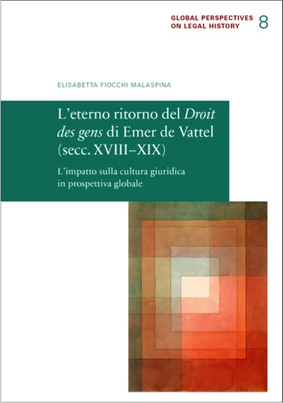
LECTURE: Elisabetta FIOCCHI MALASPINA, The Impact of Vattel's Law of Nations in the Eighteenth and Nineteenth centuries: A Global Perspective (Brussels: VUB, 28 NOV 2018)

(image source: storiadeldiritto)

Lecture abstract:
Elisabetta Fiocchi Malaspina will present her monography L'eterno ritorno del Droit des gens di Emer de Vattel (secc. XVIII-XIX). L'impatto sulla cultura giuridica in prospettiva globale, published as volume 8 of the Global Perspectives on Legal History Series by the Max Planck Institute for European Legal History (Frankfurt am Main). See fulltext here.
On the speaker:
Elisabetta Fiocchi Malaspina is Assistant Professor of Legal History at the Law Faculty of the University of Zurich (Switzerland). Her interests concern the history of international law in the 18th and 19th centuries.
More information here.


Friday, 9 November 2018

LECTURE: Martti KOSKENNIEMI, International law and the far right: Reflections on law and cynicism (The Hague: Peace Palace, 29 NOV 2018)

(image source: Asser)

Introduction:
The fourth Annual T.M.C. Asser lecture will be delivered by Prof. Martti Koskenniemi on 29 November at the Peace Palace. In his lecture, Prof. Koskenniemi will address the role of international law in dealing with the rising far right, as the backlash against global rule and the international institutions of the liberal 1990s continues. 

Lecture abstract:
"Since the emergence of the profession in the 1870s, international lawyers have lent themselves to supporting various political projects, from ruling of empire to decolonisation, from supporting national self-determination to arguing in favour of global governance of the transnational economy. They have celebrated sovereignty and supported human rights. The recent backlash against global rule and the international institutions of the liberal 1990s should be viewed as a political attack from a relatively privileged part of the world on the system of values and distributive power that have governed post-1968 internationalism. This backlash is often treated as a social pathology, arisen from the anger felt by European and American middle classes “left behind” by globalisation. I do not share this analysis. Whatever the social composition of the “backlash”, the policies of its leaders are neither reformist nor “conservative”. They are reactionary, and the question is, how to devise an effective policy to counter them. The coming struggle will be about whether reactionary, colonialist, white and male supremacist values will play a role in the international world after globalisation. If international law is not to become a servant to far right policies, or fall into irrelevance, it had better sharpen its strategic insights. Alongside self-criticism, this involves taking a break from the interminable production of minor reforms. Greater openness is needed. Not to “populist” leaders, but to problems of global inequality."
Registration here.

(Source: Asser Institute)

Friday, 26 October 2018

LECTURE: ‘Le pacte Briand-Kellog à l’heure de ses 90 ans – La consécration d’une idée révolutionnaire’ by Professor Giovanni Distefano (University of Geneva, 27 November 2018)


(Source: Wikipedia)

We learned that Professor Giovanni Distefano will give a public lecture on the Kellog-Briand pact in Geneva next month:

The ESIL Lecture Series hosts broadcasts of presentations on international law topics held at partner institutions, enabling the presentation to reach a wider audience of ESIL members and non-members alike.

Giovanni Distefano (Professor at the Faculty of Law at the University of Neuchâtel) will give a lecture on Le pacte Briand-Kellog à l’heure de ses 90 ans – La consécration d’une idée révolutionnaire, on 27 November 2018 at 18.15 at the University of Geneva


More information here.
(Source: ESCLH Blog)

Wednesday, 26 September 2018

LECTURE: LLM in European and International Law opening Lecture by Prof. dr. Hélène Ruiz Fabri (MPI Luxemburg) (Brussels: VUB, 3 OCT 2018)

Universality in Practice 

A Lecture on International Dispute Settlement
Prof. Dr. Hélène RUIZ-FABRI

Wednesay 3 Octobre 2018, 18u – aula D2.01 (Promotion Room)


The LLM in International and European Law at the Faculty of Law and Criminology of the Vrije Universiteit Brussel organizes its yearly opening lecture. This year, Prof. dr. Hélène Ruiz Fabri, Director of the Max Planck Institute for International, European and Regulatory Procedural Law (Luxemburg) will address the audience on the topic "Universality in Practice (a lecture on international dispute settlement)".

The event will take place on Wednesday 3 October at 18:00.

No registration is required.

Further information here.

Saturday, 15 September 2018

LECTURE: IES Opening Lecture by Martti Koskenniemi (IES, Brussels, 27 September 2018)

(image source: IES/VUB)

The Institute of European Studies (Vrije Universiteit Brussel) has the following announcement:
The IES Inaugural Lecture on Thursday 27 September at 18:00 at the IES premises in Brussels marks the start of the academic year for our LLM and EuroMaster programmes. It is our great pleasure to host one of the most prominent international law scholars of our time: Martti Koskenniemi (picture), Professor of International Law at the University of Helsinki and Director of the Erik Castrén Institute of International Law and Human Rights. So save the date for this special occasion! The lecture will take place at the Institute for European Studies-VUB. If you wish to participante please register using the following link. If you have any questions, do not hesitate to contact us at events@ies.be.
(source: IES)

Wednesday, 13 April 2016

REMINDER: Robert Kolb on Changes and continuity in the peaceful settlement of disputes by the League of Nations and the United Nations (Ghent, 3 May 2016)

(image source: Wikimedia Commons)

On Tuesday 3 May, the Lecture Series International Order and Justice (Ghent University, Faculty of Law) has the honour to welcome Prof. Robert Kolb (Genève) for a lecture and doctoral seminar. Professor Koskenniemi will address the audience in the Academic Council Room on “Changes and continuity in the peaceful settlement of disputes by the League of Nations and the United Nations” (09:00). 

Afterwards (11:00-12:00) prof. Kolb will attend a doctoral seminar (Faculty Council Room) and comment on presentations by PhD-researchers. 

The International Order and Justice Lecture Series is supported by the Vrije Universiteit Brusssel (VUB), the Katholieke Universiteit Leuven (KUL) and was made possible thanks to the financial support of  the UGent Doctoral School of Arts, Humanities and Law, the Belgian Branch of the International Law Association as well as the Belgian Society for International Law. 

Practical information and registration with Kristien.Ballegeer@UGent.be or on the Website of the Gustave Rolin Jaequemyns Institute of International Law.

Tuesday, 15 March 2016

LECTURE: World War One and the End of Neutrality: A Question Asked in the Wrong Way ? (Royal Flemish Academy of Belgium, Committee for Legal History/VUB CORE, 7 Apr 2016)


The Royal Flemish Academy of Belgium (Committee for Legal History) and the Research Group CORE (Contextual Research in Law) of the Vrije Universiteit Brussel (VUB) invite prof. dr. Eric Schnakenbourg (Université de Nantes/CRHIA/Institut Universitaire de France) for a lecture on the topic:


"World War One and the End of Neutrality:
A Question Asked in the Wrong Way ?"

Prof. dr. Eric Schnakenbourg is full-time professor of History at the University of Nantes and Director of the Research Center on International and Atlantic History. He published his Habilitation à diriger des recherches with the Presses Universitaires de Rennes in 2013 (Entre la guerre et la paix. Neutralite et relations internationales, XVIIe-XVIIIe siècles), and, earlier, his doctoral dissertation on France and Northern Europe in the early 18th Century with Honoré Campion.

The event will take place in the Academy Palace (Simon Stevin-Room), from 12:30 to 14:00.


Registration is mandatory, since the number of seats is limited. Click here for the event page.

Thursday, 28 January 2016

REMINDER: Lecture by Prof. Martti Koskenniemi, "Sovereignty and Property: A History of International Law" (Ghent University, Faculty of Law; International Order and Justice Lecture Series), 15 Feb 2016


(image source: hs.fi)

On Monday 15 Februari, the Lecture Series International Order and Justice (Ghent University, Faculty of Law) has the honour to welcome Prof. Martti Koskenniemi (Helsinki) for a lecture and doctoral seminar. Professor Koskenniemi will address the audience in the Academic Council Room on “Sovereignty and Property: A History of International Law” (15:00, not 10:00 as announced earlier). 

Afterwards, prof. Koskenniemi will attend a doctoral seminar and comment on presentations by PhD-researchers from the universities of Ghent, Liège and Leuven. 

The International Order and Justice Lecture Series is supported by the Vrije Universiteit Brusssel (VUB), the Katholieke Universiteit Leuven (KUL) and was made possible thanks to the financial support of  the UGent Doctoral School of Arts, Humanities and Law, the Belgian Branch of the International Law Association as well as the Belgian Society for International Law. 

Practical information and registration with Kristien.Ballegeer@UGent.be or on the Website of the Gustave Rolin Jaequemyns Institute of International Law.

Thursday, 9 October 2014

INAUGURAL LECTURE: "The Pirate and the Admiral" by Prof. dr. L. Sicking (VU Amsterdam) (Amsterdam, 14 November 2014)


Prof. dr. F.A. van der Duyn Schouten (rector magnificus) and Prof. mr. E. van Sliedregt (dean) invite all persons interested to the inaugural lecture on 14 november 2014 by Prof. dr. L Sicking, member of our Interest Group, as Aemilius Papinianus-Professor of the History of Public International Law at the Vrije Universiteit Amsterdam

The lecture ("De piraat en de admiraal", "The Pirate and the Admiral") will be held in Dutch.

The event, followed by a reception, will take place in the Vrije Universiteit's Aula, at 15:45. Togati are kindly invited to present themselves in formal dress.

Address: De Boelelaan 1105, Amsterdam.