ESIL Interest Group History of International Law

ESIL Interest Group History of International Law
Showing posts with label human rights. Show all posts

Thursday, 11 February 2021

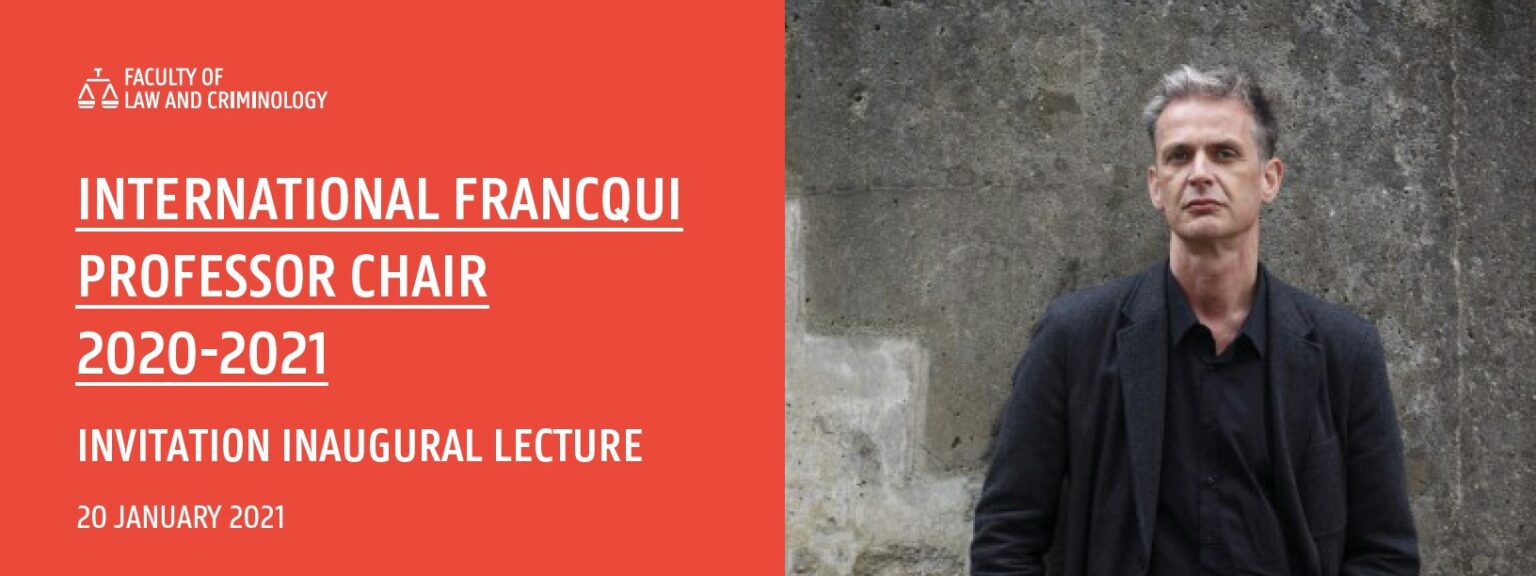
ONLINE LECTURE: Thomas SPIJKERBOER, Confronting the colonial structure of international migration law (Gent: UGent, Human Rights Centre, 20 JAN 2021)

(image source: UGent, HRC)
 

Lecture abstract:

Legal doctrine in the global North asserts that it is well-established in international law that states have the right to control migration, as a consequence of which individuals have an international law-based claim to admission or non-removal only in exceptional cases. This legal doctrine has been shaped by colonialism and continues to have a colonial deep structure. Legal doctrine in formerly colonized parts of the world does not necessarily share Northern doctrine. How can legal academics confront this pluralist and contested character of the field they are working in?

Lecturer bio:

Thomas Spijkerboer is professor of Migration Law at the Vrije Universiteit Amsterdam as well as the Raoul Wallenberg Visiting Professor of Human Rights and Humanitarian Law at Lund University. He is a member of the Royal Holland Society of Sciences and Humanities and of the Royal Netherlands Academy of Arts and Sciences. Having studied law at the University of Amsterdam, Thomas first worked in practice before writing his PhD at the Catholic University Nijmegen and becoming a Lecturer in Migration Law there in 1993. He founded the Amsterdam Centre for Migration and Refugee Law on his moving in 2000 to the Vrije Universiteit Amsterdam. His research and teaching focuses on border deaths and human rights; gender and sexuality in asylum law; and the externalisation of European migration policy. 

Watch the recorded lecture on Ghent University's website

(source: HRC, UGent

Thursday, 26 November 2020

BOOK: Stefan-Ludwig HOFFMANN, Geschichte Der Menschenrechte - Ein Rückblick (Frankfurt: Suhrkamp Verlag, 2020). ISBN 978-3-518-42838-2, 25.00 EUR


(Source: Suhrkamp Verlag)

Suhrkamp Verlag is publishing a new book on the history of human rights.

ABOUT THE BOOK

Die Menschenrechte gehören zu den unbestrittenen Grundsätzen liberaler Demokratien. Dass alle Menschen »frei und gleich an Würde und Rechten geboren« sind, kommt uns als selbstverständlich vor. In seiner Geschichte der Menschenrechte zeigt Stefan-Ludwig Hoffmann, wie neu diese Sichtweise ist.

Der Glaube an die Universalität der Menschenrechte, so Hoffmann, ist selbst historisch, entstanden aus den sozialen und politischen Konflikten der letzten Jahrhunderte: Kolonialismus und imperiale Weltbeherrschung, Aufstieg des Nationalstaats und einer internationalen Staatenwelt, Globalisierung und neue Ungleichheit. Nur im Rückblick wird erkennbar, dass zu unterschiedlichen Zeiten mit den Menschenrechten oft ganz Gegensätzliches verhandelt wurde. In seiner brillanten Studie zeichnet Hoffmann diese spannungsreiche Entwicklung nach und stellt die unbequeme Frage, ob der Menschenrechtsidealismus des späten 20. Jahrhunderts gegenwärtig an sein Ende kommt.

ABOUT THE AUTHOR

Stefan-Ludwig Hoffmann, geboren 1967 in Berlin, ist Associate Professor for Late Modern European History an der University of California Berkeley. Zuletzt erhielt er den Guggenheim Forschungspreis und war Fellow am Wissenschaftskolleg zu Berlin.

More info here

(source: ESCLH Blog)

Friday, 21 August 2020

BOOK: Paul TIEDEMANN, Philosophical Foundation of Human Rights (Cham: Springer, 2020). ISBN 978-3-030-42261-5, 74,89 EUR


(Source: Springer)

Springer is publishing a new book on the philosophical foundation of human rights.

ABOUT THE BOOK

This textbook presents a range of classical philosophical approaches in order to show that they are unsuitable as a foundation for human rights. Only the conception of human dignity –based on the Kantian distinction between price and dignity – can provide a sufficient basis. The derivation of human rights from the principle of human dignity allows us to identify the most crucial characteristic of human rights, namely the protection of personhood. This in turn makes it possible (1) to distinguish between real moral human rights and spurious ones, (2) to assess the scope of protection for many codified human rights according to the criteria of “core” and “yard,” and (3) offers a point of departure for creating new, unwritten human rights. This philosophical basis supports a substantial reassessment of the case law on human rights, which will ultimately allow us to improve it with regard to legal certainty, clarity and cogency.

The textbook is primarily intended for advanced law students who are interested in a deeper understanding of human rights. It is also suitable for humanities students, and for anyone in the political or social arena whose work involves human rights and their enforcement.

Each chapter is divided into four parts: Abstracts, Lecture, Recommended Reading, and Questions to check reader comprehension. Sample answers are included at the end of the book.

More info here

(source: ESCLH Blog)

Friday, 12 June 2020

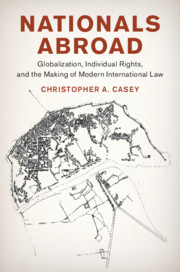
BOOK: Christopher A CASEY, Nationals Abroad: Globalization, Individual Rights, and the Making of Modern International Law (Cambridge: Cambridge University Press, 2020). ISBN 9781108489454, £ 29.99


(Source: CUP)

Cambridge University Press is publishing a new book on the history of international business interests and the creation of the international human rights regime in the late 19th and 20th century.

ABOUT THE BOOK

It is a fundamental term of the social contract that people trade allegiance for protection. In the nineteenth century, as millions of people made their way around the world, they entangled the world in web of allegiance that had enormous political consequences. Nationality was increasingly difficult to define. Just who was a national in a world where millions lived well beyond the borders of their sovereign state? As the nineteenth century gave way to the twentieth, jurists and policymakers began to think of ways to cut the web of obligation that had enabled world politics. They proposed to modernize international law to include subjects other than the state. Many of these experiments failed. But, by the mid-twentieth century, an international legal system predicated upon absolute universality and operated by intergovernmental organizations came to the fore. Under this system, individuals gradually became subjects of international law outside of their personal citizenship, culminating with the establishment of international courts of human rights after the Second World War.

ABOUT THE AUTHOR

Christopher A. Casey, University of California, Berkeley: Christopher A. Casey received his BA, MA, PhD, and JD at the University of California, Berkeley.

TABLE OF CONTENTS

Introduction
Part I .Mise en scène: The International Legal World, 1850-–1914:
1. The Walls of Gilgamesh
2. Making Nations, Breaking Nationality
Part II. Mise en scène: The International Legal World, 1919-–1939:
3. Sovereign Nations
4. Sovereign Persons
5. Sovereign Commerce
Part III. Mise en scène: The International Legal World, 1945-–Present:
6. Cosmopolitans and Capitalists
Conclusion

More info here

(source: ESCLH Blog)

Wednesday, 8 April 2020

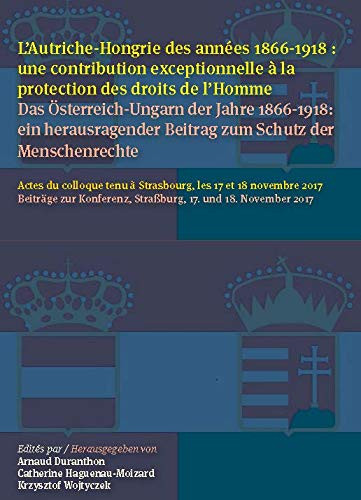
BOOK: Catherine HAGUENAU-MOIZARD, Arnaud DURANTHON, and Krzysztof WOJTYCZEK, eds., L’Autriche-Hongrie des années 1866-1918 : une contribution exceptionnelle à la protection des droits de l’homme (Nijmegen: Wolf Legal Publishers, 2020). ISBN 978-9-4624-0534-9, 59.95 EUR


Via the Portail universitaire du droit, we learned of the publication of an edited collection on law in the Austro-Hungarian Empire (with contributions in French and German).

ABOUT THE BOOK

Dans la deuxième moitié du 19e siècle, Vienne et Budapest sont devenues deux grandes capitales intellectuelles de l'Europe. L'Autriche-Hongrie est aussi à l'origine d'évolutions quelque peu oubliées en Europe occidentale, avec notamment une contribution exceptionnelle au développement de la culture juridique européenne. Les juristes de différentes nationalités, actifs dans l'Empire austro-hongrois, jouèrent un rôle majeur dans le développement du droit et de la science du droit en Europe. L'ouvrage, regroupant les rapports presentés au colloque tenu a Strasbourg les 17 et 18 novembre 2017, a pour but de rappeler quelques éléments particulièrement importants de cette contribution.

TABLE OF CONTENTS

Arnaud Duranthon, Catherine Haguenau-Moizard, Krzysztof Wojtyczek, Avant-propos, p. VII

1. Introduction
Krzysztof Wojtyczek, L'Autriche-Hongrie des années 1867-1918 : un phénomène intellectuel et juridique exceptionnel, p. 1

2. La Constitution austro-hongroise de 1866-67
Andrzej Dziadzio, Die Grundrechte der Dezemberverfassung von 1867 in der administrativen Praxis - zwischen Bürokratie und Rechtsstaat, p. 15
Thomas Olechowski, Das Reichsgericht, p. 33
Sebastiaan Van Ouwerkerk, L’Autriche-Hongrie, la doctrine publiciste française et le problème des formes politiques, p. 47

3. La théorie du droit
Nicolas ChifflotAvant Kelsen. Le droit vivant de Eugen Ehrlich, p. 69
Mathias Jestaedt, Die „Entzauberung“ des Rechtsdenkens – Hans Kelsens „Hauptprobleme der Staatsrechtslehre“ aus dem Jahre 1911 –, p. 85
Clemens Jabloner, Zur Entwicklung der Reinen Rechtslehre gegen Ende der Österreichisch - Ungarischen Monarchie, p. 101
Mate Paksy, La Théorie pure du droit et l’interprétation juridique, p. 121
Johann Helwig, Cercle de Vienne et École viennoise de la théorie du droit, p. 151
Miriam Gassner, Hans Kelsen und die weltweite Verbreitung seiner Rechtslehre, p. 171

4. Le rayonnement du droit austro-hongrois en Europe
Fryderyk Zoll, Das österreichische Recht und die kulturelle Vielfalt der österreichischen Monarchie – eine juristische Geschichte aus Galizien mit einem Ausblick auf das heutige Europa, p. 185
Eszter Cs. Herger, Das Nebeneinanderleben des österreichischen und des ungarischen Privatrechts im Königreich Ungarn und in den Nebenländern der Ungarischen Krone zwischen 1848 und 1918, p. 195
Piotr Czarny, Einfluss des österreichischen öffentlichen Rechts aus der Periode der konstitutionellen Monarchie (1867-1918) auf polnisches Verfassungs- und Verwaltungsrecht in der Zwischenkriegszeit und in der Gegenwart, p. 217

More info here

(source: ESCLH Blog)

Tuesday, 31 March 2020

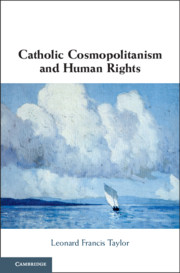
BOOK: Leonard Francis TAYLOR, Catholic Cosmopolitanism and Human Rights (Cambridge: Cambridge University Press, 2020). ISBN 9781108486125, £ 85.00


(Source: CUP)

Cambridge University Press is publishing a new book on catholic cosmopolitanism and human rights. 

ABOUT THE BOOK

It is because Catholicism played such a formative role in the construction of Western legal culture that it is the focal point of this enquiry. The account of international law from its origin in the treaties of Westphalia, and located in the writing of the Grotian tradition, had lost contact with another cosmopolitan history of international law that reappeared with the growth of the early twentieth century human rights movement. The beginnings of the human rights movement, grounded in democratic sovereign power, returned to that moral vocabulary to promote the further growth of international order in the twentieth century. In recognising this technique of periodically returning to Western cosmopolitan legal culture, this book endeavours to provide a more complete account of the human rights project that factors in the contribution that cosmopolitan Catholicism made to a general theory of sovereignty, international law and human rights.

ABOUT THE AUTHOR

Leonard Francis TaylorNational University of Ireland, Galway
Leonard Taylor is a graduate of the Irish Centre for Human Rights in National University of Ireland, Galway, where he lectures in human rights law. He is also an assistant lecturer at the Institute of Technology, Sligo.

TABLE OF CONTENTS

Introduction
1. Catholic cosmopolitan and the birth of human rights
2. Catholic cosmopolitanism from the centre to the periphery
3. Catholic cosmopolitanism from the periphery to international concern
4. Locating a modern Christian cosmopolitanism
5. An imperfect cosmopolitan project
Conclusion.

More info here

(source: ESCLH Blog)

Tuesday, 17 March 2020

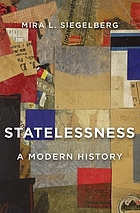
BOOK: Mira L. SIEGELBERG, Statelessness. A Modern History (Cambridge (Mass.): Harvard University Press, 2020), 336 p. ISBN 9780674976313, 28,95 GBP

(image source: Worldcat)

Book abstract:
Two world wars left millions stranded in Europe. The collapse of empires and the rise of independent states in the twentieth century produced an unprecedented number of people without national belonging and with nowhere to go. Mira Siegelberg's innovative history weaves together ideas about law and politics, rights and citizenship, with the intimate plight of stateless persons, to explore how and why statelessness compelled a new understanding of the international order in the twentieth century and beyond. In the years following the First World War, the legal category of statelessness generated novel visions of cosmopolitan political and legal organization and challenged efforts to limit the boundaries of national membership and international authority. By linking the emergence of mass statelessness to a revolution in legal consciousness, Siegelberg shows how the rights regime created after the Second World War ultimately empowered the territorial state as the source of protection and rights, against alternative political configurations. Today, more than twelve million people are stateless and millions more belong to categories of recent invention, including refugees and asylum seekers. As Statelessness makes clear, understanding the ideological origins of the international agreements that define approaches to citizenship and non-citizenship can better equip us to confront the dilemmas of political structure and authority at a global scale.
More information with amazon.

Friday, 14 February 2020

BOOK: Vincenzo FERRONE, The Enlightenment and the Rights of Man (Oxford: Oxford University Press, 2020), ISBN 9781789620368, $99.99.


(Source: OUP)

Oxford University Press is publishing a new book on the enlightenment and the rights of man.

ABOUT THE BOOK

The Enlightenment redefined the ethics of the rights of man as part of an outlook that was based on reason, the equality of all nations and races, and man's self-determination. This led to the rise of a new language: the political language of the moderns, which spread throughout the world its message of the universality and inalienability of the rights of man, transforming previous references to subjective rights in the state of nature into an actual programme for the emancipation of man.

Ranging from the Italy of Filangieri and Beccaria to the France of Voltaire, Rousseau and Diderot, from the Scotland of Hume, Ferguson and Smith to the Germany of Lessing, Goethe and Schiller, and as far as the America of Franklin and Jefferson, Vincenzo Ferrone deals with a crucial theme of modern historiography: one that addresses the great contemporary debate on the problematic relationship between human rights and the economy, politics and justice, the rights of the individual and the rights of the community, state and religious despotism and freedom of conscience.

ABOUT THE AUTHOR

Vincenzo Ferrone has written extensively on the Enlightenment and Ancien régime Europe. He has taught and held fellowships at the Princeton Institute for Advanced Study, Ca' Foscari University in Venice, and the Collège de France in Paris. He is currently Professor of Modern History at the University of Turin.

More info here

(source: ESCLH Blog)

Friday, 24 January 2020

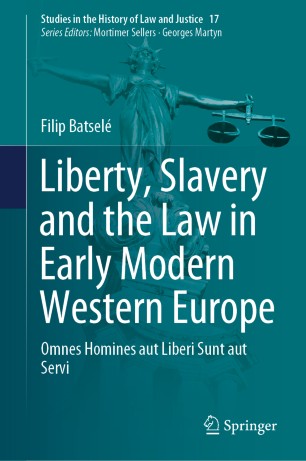
BOOK: Filip BATSELÉ, Liberty, Slavery and the Law in Early Modern Western Europe. Omnes Homines aut Liberi Sunt aut Servi [Studies in the History of Law and Justice, eds. Mortimer SELLARS & Georges MARTYN, vol. 17] (Heidelberg: Springer, 2020), 978-3-030-36854-8, 93,8 EUR

(image source: Springer)

Book abstract:
This book investigates the legal evolution of the “free soil principle” in England, France and the Low Countries during the Early Modern period (ca. 1500–1800), which essentially stated that, as soon as slaves entered a certain country, they would immediately gain their freedom. This book synthesizes the existing literature on the origins and evolution of the principle, adds new insights by drawing on previously undiscussed primary sources on the development of free soil in the Low Countries and employs a pan-Western, European and comparative approach to identify and explain the differences and similarities in the application of this principle in France, England and the Low Countries. Divided into four sections, the book begins with a brief introduction to the subject matter, putting it in its historical context. Slavery is legally defined, using the established international law definition, and both the status of slavery in Europe before the Early Modern Period and the Atlantic slave trade are discussed. Secondly, the book assesses the legal origins of the free soil principle in England, France and the Low Countries during the period 1500–1650 and discusses the legal repercussions of slaves coming to England, France and the Low Countries from other countries, where the institution was legally recognized. Thirdly, it addresses the further development of the free soil principle during the period 1650–1800. In the fourth and last section, the book uses the insights gained to provide a pan-Western, European and comparative perspective on the origins and application of the free soil principle in Western Europe. In this regard, it compares the origins of free soil for the respective countries discussed, as well as its application during the heyday of the Atlantic slave trade. This perspective makes it possible to explain some of the divergences in approaches between the countries examined and represents the first-ever full-scale country comparison on this subject in a book.
Table of contents:
Introduction
The Legal and Institutional Framework of Slavery
The Development of a Legal Freedom Principle, Ca. 1500–1650
England Ca. 1650–1800: Neither Emancipated nor Fully Enslaved
Strains on French Freedom: Turks and Nègres in Metropolitan France
The United Provinces: Abandoning the Freedom Principle Sub Silentio(?)
A Legal Comparison of the Freedom Principle—Similarities and Differences
General Conclusion—The Soil of Europe: Free or Unfree?
More information with the publisher.

(source: ESCLH Blog)

Thursday, 30 May 2019

BOOK: Anne PETERS, Humanisme, constitutionnalisme, universalisme : Etude de droit international et comparé (Paris: Pedone, 2019), 240 p. ISBN 9782233009128, € 36

(image source: Blogger)

Abstract:
Le droit international et sa doctrine sont en pleine crise existentielle. C’est à leur chevet que se porte ce recueil d’articles signés par Anne Peters. Il faut repenser le droit international, écrit-elle. Pour cela, cependant, il faut repartir des fondamentaux, c’est-à-dire de l’épistémologie. Ici, les qualités et l’érudition de l’auteure comme internationaliste, constitutionnaliste et comparatiste apportent un regard original et très riche qui revisite non seulement le droit international mais également la manière dont il se pense. En particulier, l’auteure se livre à une critique des critiques faites au modernisme. S’il y a de vrais apports de la part de la critique post-moderne, elle y voit également des limites, contradictions et exagérations. Il faudrait donc tenir compte de ce mouvement pour le dépasser pour un « post-postmodernisme » qui emprunte ce qu’il y a de bon dans les divers courants de doctrine(s). Deux des directions proposées sont une nouvelle approche du constitutionnalisme mondial et une reformulation du droit international fondée sur le respect des droits de la personne humaine.
(source: ESCLH Blog)

Wednesday, 22 May 2019

BOOK: Kasey McCALL-SMITH, Jan WOUTERS & Felipe GÓMEZ ISA (eds.), The Faces of Human Rights (Oxford: Hart, 2019), 376 p. ISBN 9781509926923, 20 GBP

(image source: Bloomsbury)

Book abstract:
As human rights discourse increasingly focuses on analysing states and the institutions that promote and support the human rights machinery that states have created, this volume serves to recall that despite the growing size of the machinery and unwieldy nature of states, human rights began with real people. It samples a broad range of actors and localities where everyday people fought to ensure that the basic principles of human rights became a reality for all. This volume will give a face to the everyday people to whom credit is due for shaping human rights. It also responds to the perennial question of how to begin a career in human rights by highlighting that there is no single path into this dynamic field, a field built on the back of small initiatives by people across a broad spectrum of career paths.

Table of contents:
1. The Faces of Human Rights – An Introduction
Kasey McCall-Smith, Jan Wouters and Felipe Gómez Isa
PART I
LAYING THE FOUNDATIONS FOR HUMAN RIGHTS THROUGH THE LAW OF NATURE AND THE PRISM OF EQUALITY
2. Bartolomé de las Casas (1485–1566): A Radical Humanitarian in the Age of the Great Encounter
Ignacio de la Rasilla3. John Locke (1632–1704): The Natural Law Philosopher
Cristina de la Cruz-Ayuso4. Olympe de Gouges (1748–1793): Impressively Ahead of Her Time:A Visionary, Daring Activist and Martyr
Teresa Pizarro Beleza and Helena Pereira de Melo5. Mary Wollstonecraft (1759–1797): The Undutiful Daughter of the Enlightenment and Her Loud Demands for Justice
Dolores Morondo Taramundi6. Henry Dunant (1828–1910): Paving the Way for Contemporary International Humanitarian Law
Joana Abrisketa Uriarte7. Mahatma Gandhi (1869–1948): Advocate of Duty, Pioneer of Human Rights
George Ulrich
PART II
IN THE SHADOW OF WAR: DEVELOPING UNIVERSAL HUMAN RIGHTS
8. Hersch Lauterpacht (1897–1960): The Visionary: Preparing the World for Human Rights
Eva Maria Lassen9. Raphael Lemkin (1900–1959): Father of the Genocide Convention
Adam Redzik10. Eleanor Roosevelt (1884–1962): Driver of the Universal Declaration of Human Rights
Anya Luscombe and Barbara Oomen11. René Cassin (1887–1976): The Foot Soldier of Human Rights
Jan Wouters12. John Peters Humphrey (1905–1995): The Man Behind the First Draft of the Universal Declaration of Human Rights
William Schabas
PART III
THE FIGHT AGAINST DISCRIMINATION IN THE PLACES CLOSE TO HOME
13. Rosa Parks (1913–2005): Tired of Giving In
Kasey MCCall-Smith14. Dr Martin Luther King, Jr (1929–1968): A Visionary Citizen of the American South and the World
Vivek Bhatt15. Nelson Rolihlahla Mandela (1918–2013): Free at Last
Narnia Bohler-Muller16. Faith Bandler (1918–2015): Striving to Make Rights a Reality for All Human Beings
Michelle Burgis-Kasthala17. Angélica Mendoza Almeida de Ascarza (1929–2017): The Struggle of Mamá Angélica for the Victims of Enforced Disappearance in Peru
Elizabeth Salmón18. Rigoberta Menchú Tum (1959–): Daughter of Corn
Felipe Gómez Isa19. Victoria Lucia Tauli-Corpuz: A Life Spent Peacefully Advocating for Indigenous Peoples' Rights
Davinia Gómez-Sánchez20. Asma Jahangir (1952–2018): A Saviour of Democracy and Human Rights
Mikel Mancisidor
PART IV
NAVIGATING THE POLITICS OF INTERNATIONAL ACTIVISM
21. Seán MacBride (1904–1988): A Life at the Frontline
Dimitrios Kagiaros22. Peter Benenson (1921–2005): Pioneer of Contemporary Human Rights Activism
Stefaan Smis23. Max van der Stoel (1924–2011): The Indefatigable Traveller for Human Rights
Antoine Buyse24. Tadeusz Mazowiecki (1927–2013): The Human Rights Envoy of the Former Yugoslavia
Roman Wieruszewski25. James Earl 'Jimmy' Carter Jr (1924–): 'But ye brethren, be not weary in well doing': A Continuing Faith and Persistence in the Cause of Human Rights
Michael Stohl26. Peter Leuprecht (1937–): Human Dignity as a Lifetime Compass
Wolfgang Benedek27. Juan E Méndez (1944–): A Figurehead of the Fight Against Impunity for Grave Rights Violations
Elaine Webster28. Mary Robinson (1944–): A Woman of Meitheal
Rebecca Smyth
PART V
HUMAN RIGHTS AND THEIR DEFENDERS: MOVING FORWARD
29. Radhika Coomaraswamy (1953–): Standing Up for the Oppressed and Neglected
Ingrid Westendorp30. Gerard Quinn (1958–): A Powerhouse for Disability Human Rights
Anna Bruce and Anna Lawson31. David Kato (1964–2011): A Life Spent Defending the Human Rights of LGBTI People in Uganda
Aimar Rubio Llona32. Malala Yousafzai (1997–): A Portrait in Courage and Conviction
Gamze Erdem Türkelli33. Theo van Boven (1934–): Passing the Torch because People Matter
Manfred Nowak
More information here.

Friday, 17 May 2019

JOB: Research Position on “Non-territorial autonomy elements in international minority protection in the twentieth century (ERC Project NTAutonomy, University of Vienna; DEADLINE 27 MAY 2019)

Research Position on “Non-territorial autonomy elements in international minority protection in the twentieth century“
(image source: Wikimedia Commons)
The European Research Council funded research project „Non-Territorial Autonomy as Minority Protection in Europe: An Intellectual and Political History of a Travelling Idea, 1850–2000“ (NTAutonomy) invites prospective candidates to join a team of five researchers.
The Project in its Entirety
NTAutonomy explores the history of non-territorial autonomy, which was a means of granting cultural rights to a national group as a corporate body within a state. Without any normative intention, our project investigates this form of national self-rule as both an intellectual concept and an applied policy across Europe. We will examine the origins of this idea in both parts of the Habsburg Empire and conduct research on how this concept travelled to the interwar period. Starting from the assumption that non-territorial autonomy was not specific to a particular political current, we will analyse how this concept translated into the early Soviet Union, the socialist Ukrainian People’s Republic, the liberal democracies in the Baltic States, and the far-right Sudeten German Party in Czechoslovakia. Finally, we want to trace non-territorial autonomy elements in the policies of European minority protection institutions until the end of the twentieth century.
For more information, please refer to our project website: https://ntautonomy.oeaw.ac.at/en/
Job Description
You will be in charge of the project’s work package that analyses continuities and breaks in the ways non-territorial autonomy has been considered in international minority protection throughout the twentieth century. Ideally, you cover the period of the interwar period and the period after WWII. Yet, applications with a focus on either period are also possible.
You should collect and analyse material on transnational minority networks, like the Congress of European Nationalities or the Federal Union of European Nationalities, pertaining to the topic of non-territorial autonomy. Furthermore, you should collect and analyse material of international organisations’ position towards non-territorial arrangements, including e.g. the League of Nations, the United Nations, the OSCE and/or the Council of Europe.
You are expected to participate in the bi-monthly meetings of the project team, discuss your findings, make them accessible in our EndNote database, help to organise a conference, participate in editing the conference proceedings, and assist in the maintenance of our website.
If you apply as a doctorate student, you should complete a PhD thesis on a topic in the wider field of your work package and publish preliminary results. If you apply as a post-doctoral researcher, you are expected to publish your findings in leading peer-reviewed journals and produce a draft of a book / habilitation on a topic in the wider field of your work package.
Starting date is autumn 2019. You are expected to take your permanent residence in Vienna.
We Offer
We offer a 12 months contract, renewable for 30 months (PhD students) or 24 months (post docs) after an interim evaluation. PhD students will receive a gross salary of approx. 30,000 € per year, corresponding to 75% (30 h) of a full position. Post-doctoral researchers will receive a gross salary of approx. 42,000 € per year, corresponding to 80% (32 hours) of a full position. The total duration of employment and the extent of part-time employment is negotiable.
You will have a fully equipped workspace at the Institute in Vienna. Funding for research missions and participation to international conferences will also be provided.
You will be part of a research team of six scholars in an intellectually ambitious and challenging project funded by the European Union in one of Europe’s most pleasant cities.
The Austrian Academy of Sciences is an equal opportunity employer.
Your Qualifications
You must hold at least an MA degree (or equivalent), ideally with a scholarly background in modern, contemporary and/or legal history or in nationalism studies. You should demonstrate a strong interest in minority issues as well as in historical and comparative research questions. You need very good language skills in English and good reading skills in German and French. You should like working in teams and be familiar with the reference management software EndNote.
How to Apply
You can apply in German or English not later than 27 May 2019. Please send the following documents as a single PDF document (entitled: SURNAME, NTAutonomy, application 2019) to barbara.saringer-bory@oeaw.ac.at
1) Short motivation letter.
2) Curriculum vitae, including a list of publications (if applicable).
3) Name, email and telephone number of at least two referees (no recommendation letters).
4) An exposé of your planned doctoral thesis / monograph. Please outline how your sketched project relates to the objectives of NTAutonomy in general and to your specific work package in particular (approx. 1000 words, excluding bibliography).
5) A writing sample (e.g. an article, or a significant chapter of your MA/PhD thesis). It is not necessary that it has already been accepted for publication.
6) A certificate of your degrees.
You will be informed of the outcome of the selection process by early June 2019. Shortlisted candidates will be invited for interviews on 25 June 2019.

For any further information, do not hesitate to contact the project’s principal investigator:
Dr. Börries Kuzmany
ERC-Projekt NTAutonomy
ÖAW / INZ
Hollandstraße 11-13, 1. Stock
A-1020 Wien / Austria
Tel.: +43-1-51581-7332

Tuesday, 26 February 2019

LECTURE: 'Double Amnesia: Zionism and Human Rights in History and Memory' by Prof James Loeffler (Cambridge: Lauterpact Centre for International Law, 1 MAR 2019)

(image source: Lauterpact Centre)

Lecture summary:
2018 marks the seventieth anniversary of two momentous events in twentieth-century history: the birth of the State of Israel and the creation of the UN Universal Declaration of Human Rights. Both remain tied together in the ongoing debates about the Israeli-Palestinian conflict, global antisemitism, and American foreign policy. Yet the surprising connections between Zionism and the origins of international human rights are completely unknown today. Drawing on his recent book, Professor Loeffler will discuss how the forgotten Jewish past of human rights holds timely lessons for thinking about the intertwined futures of global justice and Jewish politics.
On the speaker:
James Loeffler is the Berkowitz Professor of Jewish History at the University of Virginia, where he teaches courses in Jewish, European, and international history and the history of human rights. He received his BA from Harvard and his MA and PhD from Columbia University. He also studied Jewish thought as a Dorot Postgraduate Fellow at the Hebrew University. He is the author of Rooted Cosmopolitans: Jews and Human Rights in the Twentieth Century (Yale, 2018), which was a finalist for the Jewish Book Council’s Natan Prize for Best Jewish Book of 2018. His first book, The Most Musical Nation: Jews and Culture in the Late Russian Empire (Yale, 2010), won eight major awards and honors. Other publications include the forthcoming anthology, The Law of Strangers: Jewish Lawyers and International Law in Historical Perspective (Cambridge, 2019), and the new special issue of the journal Law & Contemporary Problems on “The Future of Human Rights Scholarship.” He is the co-founder of the University of Virginia Human Rights Research Network, Former Dean’s Visiting Scholar at the Georgetown University Law Center, and former Fellow of the United States Holocaust Memorial Museum. His writing on contemporary Jewish politics, antisemitism, and human rights has appeared in the New York Times, the Wall Street Journal, Slate, and The New Republic. For ten years he curated a concert series of Jewish classical music at the Kennedy Center in Washington, DC. He is currently at work on two books: a study of how the Holocaust became Genocide, and a biography of the author of “Hava Nagila.”
(more details: Lauterpacht Centre for International Law)

Monday, 10 December 2018

CONFERENCE: Hommage à René Cassin "1948-2018 - 70e anniversaire de la Déclaration universelle des droits de l’homme" (Paris: Quai d'Orsay, 11-2 DEC 2018)

(image source: Wikimedia Commons)

Conference abstract:
À l’occasion du 70e anniversaire de la Déclaration universelle des droits de l’homme et du cinquantième anniversaire de l’attribution du prix Nobel de la paix à René Cassin, ces journées d’études proposent de revenir sur l’émergence des droits de l’homme dans les relations internationales et sur leur place dans le monde contemporain. Que ce soit à l’issue des deux conflits mondiaux, avec l’adoption historique de la résolution 217 A III de l’Assemblée générale des Nations Unies le 10 décembre 1948, pendant la décolonisation ou à la fin de la guerre froide, le progrès des droits de l’homme est en jeu. La Conférence mondiale sur les droits de l’homme réunie à Vienne du 14 au 25 juin 1993 réaffirme avec force l’universalité et l’indivisibilité des droits de l’homme qui constituent désormais, avec la paix et le développement, l’un des trois piliers des Nations Unies. Cette inscription des droits de l’homme dans un temps long, associant diplomates, historiens et juristes, sera abordée au cours de ce colloque en s’appuyant notamment sur la présentation de sources et d’archives méconnues ou récemment ouvertes sur le sujet.
Conference programme here.
More information here.

Friday, 30 November 2018

CALL FOR PAPERS: White Slavery in Transnational and International Context, 21 June 2019 (University of Warwick, Deadline: 31 January 2019)


Via Legal History Blog, we learned of a CFP on “White Slavery in Transnational and International Context”.

White Slavery in Transnational and International Context, 1880-1950.  June 21, 2019, University of Warwick (UK).  Keynote: Brian Donovan ((University of Kansas)

This is a call for abstracts for paper, poster and creative presentations for a one day interdisciplinary conference on white slavery, as trafficking in women was historically called. The conference seeks to question how white slavery manifested in transnational and international contexts but welcomes papers on any localities.

We welcome papers exploring different aspects of white slavery from nationalism to visual representations, and their impact on anti-white slavery legislation. The conference seeks to investigate white slavery and its legacies from conceptual, legal, popular culture perspectives. It also seeks to place it in relation to wider themes of nationalism, race, gender, and labour, and question how white slavery relates to critiques of modernity.

We invite paper and poster presentations from range of disciplines that explore how white slavery manifested in these different contexts, in different localities, during the years 1880- 1950. The conference is particularly interested in exploring white slavery through the following themes:

* Race, nationality and nationalism
* Regulation / criminalisation of white slavery in domestic and international sphere
* Rhetoric of slavery and neo-abolitionism
* Age, innocence and purity
* Agency, autonomy and free will
* Gender; trafficking in boys / men
* Migration and gendered labour
* Critique of modernity
* White slavery in popular culture / media

We also welcome creative responses to the subject, and in particular poster presentations that engage the audience and foster debate on the conference themes. PG students at any stage of their studies are particularly encouraged to submit proposals for posters or other visual presentations. Poster presentations must be printed in advance of the conference and be size A1, either portrait or landscape (H: 84.1cm x W: 59.4cm); and you have to present in person. Poster session participants populate boards with pictures, data, graphs, diagrams, narrative text, and more - and will informally discuss their presentations with conference attendees during an assigned session.

Please send 300-word abstract for papers and 200-word abstracts for posters with a short bio to the organisers. Deadline is 31 January 2019. PG bursaries may be available.

Dr Catherine Armstrong (Loughborough University) C.M.Armstrong@lboro.ac.uk  and Dr Laura Lammasniemi (University of Warwick) laura.lammasniemi@warwick.ac.uk

(source: ESCLH Blog)

Tuesday, 13 November 2018

ARTICLE: Boyd VAN DIJK, "Human Rights in War: On the Entangled Foundations of the 1949 Geneva Conventions", AJIL XCII (2018), Nr. 4, 553-582

(image source: ASIL)

Article abstract:

The relationship between human rights and humanitarian law is one of the most contentious topics in the history of international law. Most scholars studying their foundations argue that these two fields of law developed separately until the 1960s. This article, by contrast, reveals a much earlier cross-fertilization between these disciplines. It shows how “human rights thinking” played a critical generative role in transforming humanitarian law, thereby creating important legacies for today's understandings of international law in armed conflict.
Access the article on Cambridge Core.

Wednesday, 31 October 2018

JOB: Postdoctoral Researcher (University of Helsinki: Centre of Excellence in Law, Identity and the European Narratives)

(image source: Tripadvisor)
The University of Helsinki is the oldest and largest institution of academic education in Finland, an international scientific community of 40,000 students and researchers. In international university rankings, the University of Helsinki typically ranks among the top 100. The University of Helsinki seeks solutions for global challenges and creates new ways of thinking for the best of humanity.
The Faculty of Arts (https://www.helsinki.fi/en/faculty-of-arts) of the University of Helsinki is Finland’s oldest institution for teaching and research in the humanities and the largest in terms of the structure and range of disciplines. It is also a significant international community fostering research, education and cultural interaction.
The Faculty of Arts invites applications for the position of
POSTDOCTORAL RESEARCHER
for a four-year fixed term period from 1 January 2019 onwards (or as agreed) to contribute to the subproject Migration and the narrative of Europe as an “Area of freedom, security and justice” of the Centre of Excellence (CoE) in Law, Identity and the European Narratives (EuroStorie, www.eurostorie.org).
The CoE is a part of the Centre of European Studies at the Department of Political and Economic Studies of the Faculty of Social Sciences. The purpose of the CoE is to launch a new, third generation inquiry that critically explores the emergence of narratives of Europe as responses to the crises of the twentieth century and how these narratives have shaped the ideas of justice and community in Europe. It studies the foundational stories that underlie the contested idea of a shared European heritage in law and culture, such as the ideas of rule of law, equality, tolerance, pluralism and the rejection of totalitarianism, and their relevance for current debates on identity and history.
The subproject Migration and the narrative of Europe as an “Area of freedom, security and justice” constitutes one of three subprojects of the CoE. The subproject tackles such topics as the role of broadly understood forced displacement in the production of the idea of Europe and, on more abstract level, in generating scientific knowledge and cultural and political ideas; the idea of Europe and European democracy, human rights and the rule of law, emerging from the experience of historical and contemporary exiles, refugees and asylum seekers; the idea of Europe developed under the conditions of forced displacement in relation to the official narratives of the policy papers produced under the auspices of the Council of Europe and the European Union.
QUALIFICATIONS
An appointee to the position must hold a doctoral degree in one of disciplines relevant to the project theme (including but not limited to international human rights law, anthropology, human geography), the ability to conduct independent scientific research and possess the teaching skills required for the position. The candidate should preferably have strong experience in ethnographic and post-colonial methodologies. The period following the completion of doctoral degree must not exceed five years, excluding family leave and equivalent periods of absence. An appointee must be able to provide a clear contribution to the theme of the CoE and to its general development, together with full-time researchers, postdocs, visiting faculty, Ph.D. students, and graduate students working as research assistants. To fulfil the research requirements of the position, the applicant chosen is expected to be physically present on a regular basis and actively participate in the research and teaching activities of the CoE. An appointee is expected to contribute 2-5 months of the annual work time to joint projects at the CoE, develop her/his own and our common research agenda, and contribute to collective academic tasks such as teaching, seminars and joint academic papers.
SALARY AND TRIAL PERIOD
Annual gross salary for a postdoctoral researcher varies between 41,000 and 50,000 euros, depending on the appointee’s qualifications and experience. There is a six-month trial period for the position.
Health care services and standard Finnish pension benefits are provided for the University employees.
HOW TO APPLY
Please submit your application, together with the required attachments, through the University of Helsinki Recruitment System via the Apply for the position button below. Applicants who are employees of the University of Helsinki are requested to leave their application via the SAP HR portal.
Applicants are requested to enclose with their applications the following documents in English as a single pdf file:
1) A curriculum vitae (max 4 pages).
2) A numbered list of publications on which the applicant has marked in bold her or his five key publications to be considered during the review.
3) A statement (max 2 pages) outlining how the applicant’s expertise could contribute both to research conducted at the CoE and to this specific subproject.
4) A summary (max 2 pages) on the applicant’s scholarly activities including original research at an international level, international academic networks, local co-operation, success in obtaining research funding, experience in research management.
Instructions to applicants for teaching and research positions, please https://www.helsinki.fi/en/faculty-of-arts/faculty/instructions-to-appli....
FURTHER INFORMATION
Further information on the position, and about research theme Migration and the narrative of Europe as an “Area of freedom, security and justice” may be obtained from Dr. Magdalena Kmak, magdalena.kmak@helsinki.fi. Further information about the recruitment process can be obtained from HR Specialist Anni Kauppinen, anni.kauppinen@helsinki.fi. Technical support for using the University’s electronic recruitment system or the SAP HR portal: rekrytointi@helsinki.fi.
More information here. The application did not contain any specific deadline, but was posted on Monday 29 October 2018.
(source: Twitter)

Tuesday, 16 October 2018

BOOK: Michelle FAUBERT, Granville Sharp’s Uncovered Letter and the Zong Massacre (London: Palgrave Macmillan , 2018). ISBN 978-3-319-92785-5, $69.99


(Source: Palgrave Macmillan)

Next week, Palgrave Macmillan will publish a new book on hitherto unexplored aspects of Granville Sharp’s role in the landmark Zong Case.

ABOUT THE BOOK

This book delineates the discovery of a previously unknown manuscript of a letter from Granville Sharp, the first British abolitionist, to the “Lords Commissioners of the Admiralty.” In the letter, Sharp demands that the Admiralty bring murder charges against the crew of the Zong for forcing 132 enslaved Africans overboard to their deaths. Uncovered by Michelle Faubert at the British Library in 2015, the letter is reproduced here, accompanied by her examination of its provenance and significance for the history of slavery and abolition. As Faubert argues, the British Library manuscript is the only fair copy of Sharp’s letter, and extraordinary evidence of Sharp’s role in the abolition of slavery.

ABOUT THE AUTHOR

Michelle Faubert is Associate Professor of Romantic Literature at the University of Manitoba, Canada, and Visiting Fellow at Northumbria University, UK.

More information here
(source: ESCLH Blog)

Thursday, 27 September 2018

JOURNAL FORUM: Christianity and Human Rights (Journal of the History of Ideas LXXIX (2018), No.3 (July))

(image source: JHI Blog)

The Journal of the History of Ideas published a special forum on "Christianity and Human Rights".

Contents:
Udi Greenberg and Daniel Steinmetz-Jenkins, "Introduction"
Dan Edelstein, "“Christian Human Rights in the French Revolution"
Gene Zubovich, “American Protestants and the Era of Anti-racist Human Rights"
Sarah Shortall, “Theology and the Politics of Christian Human Rights”
Udi Greenberg, “Catholics, Protestants, and the Tortured Path to Religious Liberty”
Paul Hanebrink, “An Anti-totalitarian Saint: The Canonization of Edith Stein”
More information here.

Friday, 21 September 2018

BOOK: Anton WEISS-WENDT (ed.), Documents on the Genocide Convention from the American, British, and Russian Archives (London: Bloomsbury Academic, 2018). ISBN 9781474279796, $315.00


Bloomsbury Academic is publishing a collection of archival documents relating to the 1948 Genocide Convention

ABOUT THE COLLECTION

This document collection highlights the legal challenges, historical preconceptions, and political undercurrents that had informed the UN Genocide Convention, its form, contents, interpretation, and application. Featuring 436 documents from thirteen repositories in the United States, the United Kingdom, and Russia, the collection is an essential resource for students and scholars working in the field of comparative genocide studies.

The selected records span the Cold War period and reflect on specific issues relevant to the Genocide Convention, as established at the time by the parties concerned. The types of documents reproduced in the collection include interoffice correspondence, memorandums, whitepapers, guidelines for national delegations, commissioned reports, draft letters, telegrams, meeting minutes, official and unofficial inquiries, formal statements, and newspaper and journal articles. On a classification curve, the featured records range from unrestricted to top secret. Taken in the aggregate, the documents reproduced in this collection suggest primacy of politics over humanitarian and/or legal considerations in the UN Genocide Convention.

ABOUT THE EDITOR

Anton Weiss-Wendt is Research Professor at the Center for the Study of the Holocaust and Religious Minorities in Oslo, Norway. His recentpublications include Racial Science in Hitler's Europe, 1939-1945(2013)and The Nazi Genocide of the Roma: Reassessment and Commemoration (2013).

TABLE OF CONTENTS

Volume I

Acknowledgements
List of Acronyms and Abbreviations
List of Archival Collections
Introduction
I. Genocide: From a Concept to a United Nations Resolution, 1933–1946
II. The United Nations Secretariat Draft Genocide Convention, 1947
III. Ad Hoc Committee on Genocide, January–August 1948
IV. Debates on the Draft Genocide Convention in the UN General Assembly, September–December 1948
V. Lobbying in Behalf of the Genocide Convention, 1947–1948
United Nations Concention on the Prevention and Punishment of the Crime of Genocide: The Three Drafts, 1947-48
Further Reading
Index

Volume II

VI. The United Kingdom Government Split on the Issue of Accession to the Genocide Convention, 1949–1953
VII. The United States Delays Action on the Genocide Convention, 1949–1962
VIII. The Issue of Reservations to the Genocide Convention, 1949–1952
IX. Indicting Communist Countries for Genocide, 1949–1959
X. The Genocide Convention vs. Nuremberg Principles, Draft Covenants on Human Rights, and/or the Draft Code of Offenses against the Peace and Security of Mankind, 1949–1954
XI. The Korean War, 1950–1953
XII. We Charge Genocide: The Campaign to Indict the United States for Racial Discrimination, 1951–1952
XIII. The Lonely Voice of Raphael Lemkin, 1949–1959
XIV. The United Kingdom Inches Closer to Acceding to the Genocide Convention, 1962–1968
XV. The Public Campaign Pro and Counter US Ratification of the Genocide Convention, 1970–1977
XVI. The “Armenian Question,” 1964–1985
XVII. A Final Push for the UN Genocide Convention, 1983–1988
Further Reading
Index

More information here

(source: ESCLH Blog)