ESIL Interest Group History of International Law

ESIL Interest Group History of International Law
Showing posts with label enlightenment. Show all posts

Wednesday, 25 August 2021

BOOK: Edward JONES CORREDERA, The Diplomatic Enlightenment. Spain, Europe, and the Age of Speculation [History of European Political and Constitutional Thought; 5] (Leiden/Boston: Martinus Nijhoff/Brill, 2021), ISBN 978-90-04-46906-8


(image source: Brill)

Book abstract:

This book reconfigures the study of the origins of the Enlightenment in the Spanish Empire. Challenging dominant interpretations of the period, this book shows that early eighteenth-century Spanish authors turned to Enlightenment ideas to reinvent Spain’s role in the European balance of power. And while international law grew to provide a legal framework that could safeguard peace, Spanish officials, diplomats, and authors, hardened by the failure of Spanish diplomacy, sought instead to regulate international relations by drawing on investment, profit, and self-interest. The book shows, on the basis of new archival research, that the Diplomatic Enlightenment sought to turn the Spanish Empire into a space for closer political cooperation with other European and non-European states and empires.

Table of contents:

Preface 
Acknowledgements 

1 The Missing Century
 The Enlightenment, the Nation, and Modern Spain
 1 Introduction
 2 The Nineteenth-Century Spanish Enlightenment
 3 The Twentieth-Century View of the Absence of the Spanish Enlightenment
 4 Religion and the Spanish Political Elites
 5 The Diplomatic Enlightenment

2 Predicting War and Peace
 1 Introduction
 2 Spain, Europe, and Arbitrary Monarchy
 3 Crisis and Catharsis: The Dawn of the Early Spanish Enlightenment
 4 What News Do You Bring?
 5 Information Overload and Elite Political Debate

3 Investing in the Luces
 1 Introduction
 2 Shorting Diplomacy
 3 Representations of the Spanish Empire
 4 The Assembly of Public Trust
 5 Luces in the Mines
 6 The Seminary of Lawsuits: Law, Trade, and Corporations
 7 José Carvajal y Lancaster and the Arbitration of Europe
 8 Private Vices, Public Virtues, and Diplomatic Cooperation
 9 Coins, Corporations, China, and Europe
 10 The Naval Officer and the Aristocrat

4 Revolts and Returns
Free Trade and the Fear of Independence
 1 Introduction
 2 Investing in a New Timepiece
 3 Mapping Reform in Enlightenment Europe
 4 Free Trade: The Farce of Independence and the Growth of Spanish Political Economic Debate
 5 The Perils of Emulation: Corporations and the Meaning of the Spanish Empire
 6 The Criticism of Carvajal’s Joint-Stock Companies

5 The Lever of the Balance of Power
 1 Introduction
 2 Iberia’s Role in Europe
 3 Borders and Trade
 4 Investing in Peace
 5 A Monarchy without a King

6 Carthage’s Contractors
The Ends of the Spanish Empire
 1 Introduction
 2 The Grain Monopoly and the Voice of the People
 3 The Idea of the Nation: Outsourcing Propaganda and Colonisation
 4 Constitutionalism in the Spanish Empire and the International Order

7 Conclusion

Bibliography
Index

On the author:

Edward Jones Corredera is a Senior Research Fellow at the Max Planck Institute for Comparative Public Law and International Law and a Fellow of the Royal Society of Arts. He completed his doctoral studies at the University of Cambridge in 2020.

(see Brill's site: DOI 10.1163/9789004469099)

Wednesday, 20 January 2021

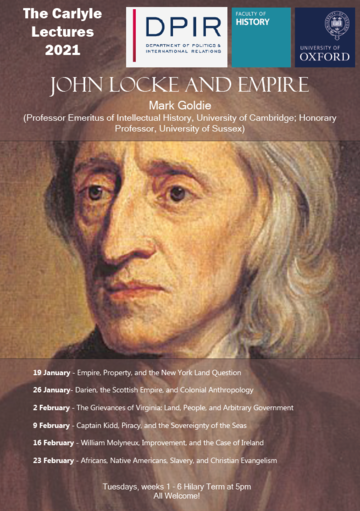
ONLINE LECTURE SERIES: Mark GOLDIE, John Locke and Empire (Oxford: The Carlyle Lectures in Hilary Term 2021)


(image source: University of Oxford)


On the speaker:
Mark Goldie, Professor Emeritus of Intellectual History, University of Cambridge; Honorary Professor, University of Sussex
Watch the full series here.


Thursday, 5 November 2020

ADVANCE ARTICLE: Felix WALDMANN, 'Natural Law and the Chair of Ethics in the University of Naples, 1703–1769' (Modern Intellectual History)

(image source: CUP)

Abstract:

This articles focuses on a significant change to the curriculum in “ethics” (moral philosophy) in the University of Naples, superintended by Celestino Galiani, the rector of the university (1732–53), and Antonio Genovesi, Galiani's protégé and the university's professor of ethics (1746–54). The article contends that Galiani's and Genovesi's sympathies lay with the form of “modern natural law” pioneered by Hugo Grotius and his followers in Northern Europe. The transformation of curricular ethics in Protestant contexts had stemmed from an anxiety about its relevance in the face of moral skepticism. The article shows how this anxiety affected a Catholic context, and it responds to John Robertson's contention that Giambattista Vico's use of “sacred history” in his Scienza nuova (1725, revised 1730, 1744) typified a search among Catholics for an alternative to “scholastic natural law,” when the latter was found insufficiently to explain the sources of human sociability. 

(read the article here: DOI 10.1017/S1479244320000360)

Monday, 11 May 2020

BOOK: Matthew H. EDNEY & Mary SPONBERG PEDLEY (eds.), The History of Cartography, Volume 4. Cartography in the Enlightenment (Chicago: University of Chicago Press, May 2020), 1920 p., ISBN 9780226184753, 500 USD


Book description:
Since its launch in 1987, the History of Cartography series has garnered critical acclaim and sparked a new generation of interdisciplinary scholarship. Cartography in the European Enlightenment, the highly anticipated fourth volume, offers a comprehensive overview of the cartographic practices of Europeans, Russians, and the Ottomans, both at home and in overseas territories, from 1650 to 1800. The social and intellectual changes that swept Enlightenment Europe also transformed many of its mapmaking practices. A new emphasis on geometric principles gave rise to improved tools for measuring and mapping the world, even as large-scale cartographic projects became possible under the aegis of powerful states. Yet older mapping practices persisted: Enlightenment cartography encompassed a wide variety of processes for making, circulating, and using maps of different types. The volume’s more than four hundred encyclopedic articles explore the era’s mapping, covering topics both detailed—such as geodetic surveying, thematic mapping, and map collecting—and broad, such as women and cartography, cartography and the economy, and the art and design of maps. Copious bibliographical references and nearly one thousand full-color illustrations complement the detailed entries.
(source: University of Chicago Press)

Thursday, 2 April 2020

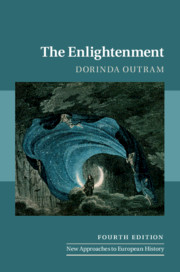
BOOK: Dorinda OUTRAM, The Enlightenment [New Approaches to European History] (Cambridge: CUP, 2020), 196 p. ISBN 9781108440776, 20,99 GBP

(image source: CUP)

Book abstract:
What is the Enlightenment? A period rich with debates on the nature of man, truth and the place of God, with the international circulation of ideas, people and gold. But did the Enlightenment mean the same for men and women, for rich and poor, for Europeans and non-Europeans? In this fourth edition of her acclaimed book, Dorinda Outram addresses these and other questions about the Enlightenment and its place at the foundation of modernity. Studied as a global phenomenon, Outram sets the period against broader social changes, touching on how historical interpretations of the Enlightenment continue to transform in response to contemporary socio-economic trends. Supported by a wide-ranging selection of documents online, this new edition provides an up-to-date overview of the main themes of the period and benefits from an expanded treatment of political economy and imperialism, making it essential reading for students of eighteenth-century history and philosophy.
On the author:
 Dorinda Outram is Clark Professor Emerita of History at the University of Rochester, New York. Her previous publications include Georges Cuvier: Vocation, Science and Authority in Post-Revolutionary France (1982), Uneasy Careers and Intimate Lives: Women in Science, 1789–1979 (1988) and The Body and the French Revolution: Sex, Class and Political Culture (1989).
(more information with CUP)

Friday, 14 February 2020

BOOK: Vincenzo FERRONE, The Enlightenment and the Rights of Man (Oxford: Oxford University Press, 2020), ISBN 9781789620368, $99.99.


(Source: OUP)

Oxford University Press is publishing a new book on the enlightenment and the rights of man.

ABOUT THE BOOK

The Enlightenment redefined the ethics of the rights of man as part of an outlook that was based on reason, the equality of all nations and races, and man's self-determination. This led to the rise of a new language: the political language of the moderns, which spread throughout the world its message of the universality and inalienability of the rights of man, transforming previous references to subjective rights in the state of nature into an actual programme for the emancipation of man.

Ranging from the Italy of Filangieri and Beccaria to the France of Voltaire, Rousseau and Diderot, from the Scotland of Hume, Ferguson and Smith to the Germany of Lessing, Goethe and Schiller, and as far as the America of Franklin and Jefferson, Vincenzo Ferrone deals with a crucial theme of modern historiography: one that addresses the great contemporary debate on the problematic relationship between human rights and the economy, politics and justice, the rights of the individual and the rights of the community, state and religious despotism and freedom of conscience.

ABOUT THE AUTHOR

Vincenzo Ferrone has written extensively on the Enlightenment and Ancien régime Europe. He has taught and held fellowships at the Princeton Institute for Advanced Study, Ca' Foscari University in Venice, and the Collège de France in Paris. He is currently Professor of Modern History at the University of Turin.

More info here

(source: ESCLH Blog)

Monday, 7 October 2019

BOOK: Robert THEIS & Alexander AICHELE (Hrsg.), Handbuch Christian Wolff (Heidelberg: Springer, 2018), ISBN 978-3-658-14736-5 € 86,99

(image source: Springer)

Book abstract:
Mit diesem Buch wird erstmals ein umfassendes und systematisches Referenzwerk zu Christian Wolff vorgelegt, das alle wichtigen Aspekte zu Leben und Werk des Philosophen behandelt. Das Handbuch ist von international renommierten Experten verfasst und behandelt die Biographie, das philosophische und naturwissenschaftlich-mathematische Werk sowie die philosophiegeschichtliche Rolle von Christian Wolff.
On the editors:
 Prof. em. Dr. Robert Theis lehrte Philosophie an der Universität Luxemburg. PD Dr. Alexander Aichele lehrt Philosophie an der Universität Halle.
Read more on SpringerLink.

Tuesday, 16 April 2019

CALL FOR PAPERS: Montesquieu hors d’Europe. Traductions et usages de L’Esprit des lois (Bordeaux: Université Bordeaux-Montaigne, Spring 2020); DEADLINE 1 JUL 2019

(image source: europeanmemories.net)


Conference summary:
De l’Esprit des lois est un monument qui déroute à double titre ; tout d’abord par son ampleur (plus de mille pages pour quatorze ans de travail), ensuite par sa difficulté de lecture. L’œuvre maitresse de Montesquieu a suscité une grande diversité d’interprétations : salué comme le moment fondateur de la science politique, certains voient en lui l’expression du républicanisme moderne alors que d’autres préfèrent le ranger dans le crédo libéral. La multiplicité des thèmes abordés, dans un désordre apparent, ne manque pas de troubler : dans sa recherche des causes physiques et morales des institutions, Montesquieu propose tour à tour une théorie sur la loi, sur les types de gouvernements ; une réflexion sur la liberté politique ainsi qu’une théorie des climats et de « l'esprit général ». Cet ouvrage fut aussi celui par lequel Montesquieu donna matière au concept de despotisme qu’il inventa, rassemblant sous l’adjectif « oriental » associé à ce régime politique, entre autres, les empires Ottoman et Perse, la Chine et le Japon. Comment ce monument des Lumières a-t-il été lu hors d’Europe, notamment dans les pays que Montesquieu rangea dans la catégorie du despotisme ? Quels défis représentèrent la traduction de l’œuvre et la compréhension des thèmes abordés ? Quel en fut l’usage dans un contexte d’introduction de la philosophie politique européenne ? Ces questions qui s’imposent très tôt dans le Japon moderne (où L’Esprit des lois est traduit dès 1875), concernent certainement aussi une bonne partie des pays d’Asie ou d’ailleurs. Du moins tels sont les thèmes que nous invitons tous les spécialistes de langues non-européennes à discuter. La réflexion devra s’orienter vers l’analyse de la traduction de tout ou partie des thèmes constitutifs de l’ouvrage, avec le souci de s’inscrire dans la perspective du transfert culturel et de l’histoire intellectuelle.
Proposals can be sent to eddy.dufourmont@u-bordeaux-montaigne.fr by 1 July 2019.

(source: ESCLH Blog)