ESIL Interest Group History of International Law

ESIL Interest Group History of International Law
Showing posts with label gender. Show all posts

Thursday, 1 July 2021

SSRN PAPER: Alexandra KEMMERER, "Exile and Access: Lilly Melchior Roberts and the Infrastructures of International Law" (forthcoming in: Immi TALLGREN (ed.), Portraits of Women in International Law)


(image source: Wikimedia Commons)

Abstract:

In her two consecutive and yet closely interwoven legal careers, as a corporate lawyer in Berlin’s premier transnational law firm in the years of the decline of the Weimar Republic and as a law librarian and bibliographer in one of the world’s leading law libraries at the height of the Cold War, Lilly Melchior Roberts (1903 – 1966) was part of an intellectual project that encompassed the disciplinary fields of international law, comparative law, and the emerging field of European legal integration, inspired by conceptual frameworks and perspectives of transnational law. In this chapter, on a biographical journey from Hamburg and Berlin to Ann Arbor, challenging well-worn distinctions between content and infrastructures, scholarship and practice, faculty and library, the German-Jewish émigré lawyer Lilly Melchior Roberts will be portrayed as a transformative actor in the emerging field of transnational (and, in particular: European) legal studies as well as in the disciplines of comparative and international law.

Read the paper on SSRN

Tuesday, 9 March 2021

WEBINAR: Janne NIJMAN (Asser Institute/UvA), "Locating Gender and Race in the History of International Law" (Geneva: IHEID, 10 MAR 2021)


(image source: IHEID Law/Twitter)

The IHEID's Law Faculty announced a webinar with Prof. Janne Nijman (Asser/UvA) entitled "Locating Gender and Race in the History of International Law".

The link for the seminar is here. See earlier on this blog for the EJIL article.

Thursday, 18 February 2021

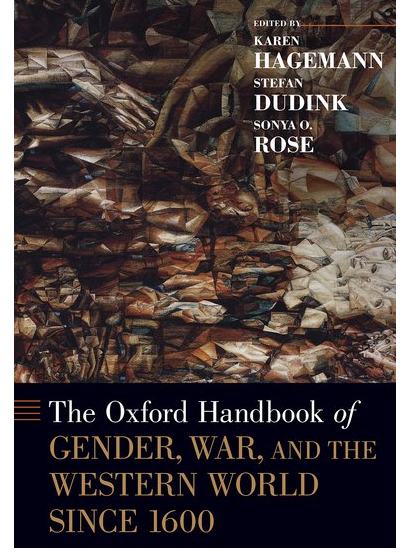
ONLINE SEMINAR: Transatlantic Roundtable to Launch the Oxford Handbook of Gender, War, and the Western World since 1600 (University of North Carolina; 5 MAR 2021)


(image source: UNC)

Event description:

This transatlantic roundtable launches the publication of The Oxford Handbook of Gender, War, and the Western World since 1600 a comprehensive historical overview of the entangled relationships between gender, war and military culture, and remembers one of its three editors, Sonya O. Rose (1935-2020), who sadly died weeks before the book was published.

The roundtable will focus on the intersection of gender, war and citizenship, which is not only one of the major themes of the Oxford Handbook, but also of Sonya Rose’s work. It starts from her suggestion, to think of citizenship as ‘’a framework that serves as a basis for claims-making.” Citizenship, she wrote, is a discursive framework that enables people to make various political and other claims and shapes political subjectivities that get enacted in the process of claims-making. Deeply marked by gender, race and class, this framework of citizenship produces exclusions—and offers tools to contest these. War often comes with a particularly intense discourse and politics of citizenships, in which claims made by, and on, people get linked to the issue of national survival. The roundtable will explore the politics of citizenship in the context of military and war and ask how transformations of modern warfare have affected notions of citizenship and gender, and vice versa how historical and changing notions of citizenship and gender shaped military and war.

The participants of the roundtable will explore the wartime politics of citizenship in various historical and geographical contexts, ranging from late eighteenth-century Wars of Revolution and Independence to Word War II. Three sets of questions are central to their exploration:

  1. How have specific gender orders informed specific historical wars and types of war? How have, vice versa, specific historical wars and types of war shaped gender orders and gendered politics of citizenship in particular?
  2. How have wartime politics of citizenship been shaped by the intersection of categories of difference and inequality such as gender, race, and class?
  3. What were the long-term effects on gender orders of wartime politics of citizenship? What explains the persistence or subsiding of wartime reconfigurations of gender and citizenship?

Program:

Program

  • Welcome
    Berit Ebert, 
    Vice President, American Academy Berlin
    Jan Willem Duyvendak,
     Director, Netherlands Institute for Advanced Study in the Humanities and Social Sciences
  • IntroductionThe Oxford Handbook of Gender, War, and the Western World since 1600—A Global Project
    Karen Hagemann,
     University of North Carolina at Chapel Hill
  • Commemorative Address: Sonya O. Rose: A Transatlantic Gender Historian
    Susan Grayzel, Utah State University

Roundtable: Gender, War and Citizenship

  • Moderation: Karen Hagemann, University of North Carolina at Chapel Hill
  • Participants
    • Gender, War and Citizenship
      Thomas Kühne,
       Clark University
    • Masculinity, War and Citizenship in 18th and 19th Century Europe
      Stefan Dudink
      , Radboud University Nijmegen
    • Colonial Soldiers, Empire, and Male Citizenship  in the Age of the World Wars
      Richard Smith, Goldsmiths, University of London
    • The North American Home Front, Race and Citizenship
      Kimberly Jensen, Western Oregon University

(source: UNC

Tuesday, 16 February 2021

ARTICLES: Henri DE WAELE & Janne NIJMAN on international legal history (EJIL XXXI (2020), Issue 3)

(image source: OUP)


A New League of Extraordinary Gentlemen? The Professionalization of International Law Scholarship in the Netherlands, 1919–1940 (Henri de Waele) (open access)

Abstract:

Despite the historical turn in the study of public international law and the advance of comparative approaches, still too little attention is paid nowadays to specific national traditions. This holds, inter alia, for the scholarly views and practices in the Netherlands during the first half of the 20th century. This article seeks to shed light on the experiences here at the advent of the League of Nations and its tentative ‘new world order’. Offering a meso-level analysis, it portrays the leading protagonists during the 1920s and 1930s, aiming to provide a snapshot of how their discipline and activities underwent an unexpectedly swift professionalization. This process is perceived to have run along three distinct vectors – academic, societal and diplomatic/bureaucratic – which are each examined in turn. Novel opportunities stemming from the rise of the international judiciary, especially the two Permanent Courts established on Dutch soil, are looked at separately. The research delivers a greater insight into the inter-war era and the challenges faced by (academics from) smaller nations, enabling us to situate underexplored local experiences within a global frame, and offering useful lessons for (the writing of) international law history more generally.

Marked Absences: Locating Gender and Race in International Legal History (Janne Nijman) (open access)

Abstract: 

This article was sparked by a critical reading of Henri de Waele’s article ‘A New League of Extraordinary Gentlemen? The Professionalization of International Law Scholarship in the Netherlands, 1919–1940’, and aims to offer an alternative perspective on this period in the history of Dutch international legal scholarship. While it appreciates the author’s examination of Dutch international law scholarship during the interwar period and concurs with the idea that this scholarship needs to be examined more closely, it argues that doing history today requires us first to raise ‘the woman question’, especially in the context of the so-called ‘professionalization’ of international law in the 1920s and 1930s, and second to include Dutch colonialism as an important backdrop to the work of the interwar international law scholars. I will give some pointers and illustrations to support this argument. The specific Dutch material brought to bear aims to show more generally the importance of questioning rather than reproducing traditional historiography, within which ‘the woman question’ and ‘the colonial question’ were left unmentioned. As such this article also deals with the issue of expanding and remaking international legal history as an issue of present and future purport

Tuesday, 4 August 2020

ARTICLE: Ignacio DE LA RASILLA, 'Concepción Arenal and the place of women in modern international law' (Tijdschrift voor Rechtgeschiedenis/Revue d'Histoire du Droit/The Legal History Review LXXXVIII (2020), nr. 1-2, 211-253)

(image source: Brill)

Abstract:
This article examines the long-forgotten first book-length treatise on international law ever published by a woman in the history of international law. The first part places Concepción Arenal’s Ensayo sobre el Derecho de gentes (1879) in the historical context of the dawn of the international legal codification movement and the professionalisation of the academic study of international law. The second part surveys the scattered treatment that women as objects of international law and women’s individual contributions to international law received in international law histories up to the early twentieth century. It then draws many parallels between Arenal’s work and the influential resolutions of the first International Congress of Women in 1915 and surveys related developments during the interwar years. The conclusion highlights the need of readdressing the invisibility of women in international legal history.
Read the full article on Brill's website.

Friday, 8 February 2019

BLOGPOST: Franck LATTY on Christine de Pisan


(Source: Wikipedia)


EJIL: Talk!, the blog of the European Journal of International Law, recently published a text by Professor Latty on Christine de Pisan.

At the start of 2019 and the year long campaign designed around International Women’s Day on 8 March 2019, it may be particularly apt for the readers of EJIL: Talk! to consider Christine de Pisan (around 1365 – around 1430), a medieval woman of letters, as one of the founders of international law – even if somewhat surprising for several reasons […]

Read the full post here

(source: ESCLH Blog)

Tuesday, 1 November 2016

WORKSHOP: Girls Trade and International Law. Processes of Juridification from the 19th Century Onwards (Leipzig, 4-5 Nov 2016)

(image source: uni-leipzig)

Kathleen Zeidler (University of Leipzig) and Sonja Dolinsek (University of Erfurt) co-organise a workshop on Girls Trade and International Law. Processes of Juridification from the 19th Century onwards. The event takes place from 4 till 5 November 2016.

Summary:
Das Phänomen „Mädchenhandel“ hat Konjunktur. Es wurde am Ende des 19. Jahrhunderts zum Gegenstand transnationaler Verhandlungen, internationaler Regelungen und überstaatlicher Vereinbarungen und stellt bis heute ein wichtiges Feld für grenzüberschreitende Rechtsan- gleichung und Vereinheitlichung rechtlicher Normen dar. Im Workshop wollen wir uns den internationalen Verrechtlichungsprozessen vom 19. Jahrhundert bis zur Gegenwart aus unterschiedlichen Perspektiven annähern. Ausgehend von der Entdeckung des Mädchenhandels als internationales Phänomen diskutieren wir die Praktiken der Ermittlung, Politik und Recht im staatlichen Kontext bis hin zu den aktuellen Debatten und Problemen.
Programme:
 Freitag, 4. November
14:00-14:00
Begrüßung und Einführung Sonja Dolinsek (Universität Erfurt) und Kathleen Zeidler (GWZO)
14:00–15:30
Keynote: Die Stellung der Frauen im Völkerbund: Internationale Normierungs- und Standardisierungsprozesse in der Zwischenkriegszeit
Regula Ludi (Universität Bern)
Moderation: Dietlind Hüchtker (GWZO)
16:00–17:30
Panel I: Entdeckung – Mädchenhandel als internationales Phänomen
Moderation: Dietmar Müller (GWZO)
Historisierung der transnationalen Diskurse zu Mädchenhandel
Ruth Ennis (Universität Leipzig)
Der Völkerbund und die völkerrechtliche Regelung zur freien Bewegung von Frauen und Mädchen sowie der Versuch eines internationalen Verbotes des Prostitutionsgewerbes
Thomas S. Carhart (Universität Freiburg)
18:00–20:00
Filmsichtung mit Diskussion
Bibliothèque Pascal
Regie: Szabolcs Hajdu, Ungarn 2010 Ungarisch/Rumänisch mit deutschen Untertiteln Einführung: Kathleen Zeidler (GWZO) Moderation: Sonja Dolinsek (Universität Erfurt)

Samstag, 5. November 2016
9:30–11:00
Panel II: Ermittlung – Suche nach dem Mädchenhandel
Moderation: Katarina Ristić (Universität der Bundeswehr Hamburg)

Marcus Braun – Ein US-special immigrant inspector auf den Spuren des Mädchenhandels in Europa (1908–1909)
Jakob Lanman Niese (Leipzig/Magdeburg)
„... unser Volk rekrutiert selten Ware für die Prostitution“: Mädchenschutz im Königreich SHS/ Jugoslawien der Zwischenkriegszeit
Svetlana Stefanović (Belgrad)
11:30–13:00
Panel III: Verrechtlichung – Mädchenhandel im staatlichen Kontext
Moderation: Kathleen Zeidler (GWZO)

Gouvernementalisierung und/oder Verrechtlichung? Überlegungen am Beispiel des Kampfes gegen Prostitution und Mädchenhandel in Luxemburg um 1900
Heike Mauer (Universität Duisburg-Essen)
Frauenhandel im 19. Jahrhundert in Deutschland und im deutschsprachigen Österreich
Jürgen Nautz (Hochschule Ostwestfalen-Lippe / Universität Wien)
14:00–16:00
Panel IV: Fortsetzung – „Mädchenhandel“ zwischen internationalem Recht und internationaler Kritik
Moderation: Claudia Kraft (Universität Siegen)
Nach der „Abolition“: Wie der Frauen- und Mädchenhandel in Vergessenheit geriet (1949–1975)
Sonja Dolinsek (Universität Erfurt)
Investigating Human Trafficking: Troubles and Development of Law Enforcement in Hungary
Tamas Bezsenyi / Noémi Katona (Budapest)
Mädchenhandel, Menschenhandel, moderne Sklaverei: Liegt der Teufel im Begriff?
Janne Mende (Universität Kassel)
16:00–17:30
Resümee und Diskussion
Dietlind Hüchtker (GWZO) und Claudia Kraft (Universität Siegen)

More information on HSozKult.

Thursday, 12 May 2016

BOOK: Emmanuelle TOURME-JOUANNET, Laurence BURGORGUE-LARSEN, Horatia MUIR WATT, Hélène RUIZ FABRI (dir.), Féminisme(s) et droit international. Études du réseau Olympe [Collection de l'Institut des sciences juridique et philosophique de la Sorbonne]. Paris: Société de Législation Comparée, 2016, 498 p. ISBN 978-2-36517-059-8, € 37

(image source: Multipol)
 
The Société de législation comparée published a collective work on feminism and (the history of) international law.

Abstract:
Féminisme(s) et droit international. Études du réseau Olympe est le premier ouvrage issu du programme de recherche du réseau Olympe d’études francophones féministes et de genre en droit international. Créé en 2014, ce programme a pour buts premiers de faire connaître les approches féministes du droit international, historiquement développées en langue anglaise, et d’y contribuer en français par divers projets de recherche, en sus de fournir une plateforme institutionnelle de mise en réseau des chercheuses et chercheurs intéressé-e-s. Recueil collectif, Féminisme(s) et droit international. Études du réseau Olympe réunit ainsi les contributions de 19 chercheuses et chercheurs dans le domaine et offre un salutaire premier panorama de l’état des recherches féministes sur le droit international en français.

Table of contents:
Emmanuelle Tourme Jouannet, Laurence Burgorgue-Larsen, Hélène Ruiz Fabri, Bérénice K. Schramm, Ouverture 
Bérénice K. Schramm, (Re)voir Phryné devant l’aréopage de Jean-Léon Gérôme (1861)  
Oriane-Jill Aoust, Droits des femmes et sphère privée en Afrique : le constat d’une défaillance des instruments régionaux africains 
Charalambos Apostolidis, Le marxisme et la cause féminine 
Rémi Bachand, Les apports de la théorie féministe du positionnement dans une théorie (critique) du droit (international) 
Laurence Burgorgue-Larsen, La lutte contre la « violence de genre » dans le système interaméricain de protection des droits de l’homme. Décodage d’une évolution politique et juridique d’envergure 
Anne-Marie D’Aoust et Anne Saris, Femmes, genre et sécurité en relations internationales et en droit international : un dialogue en construction 
Martin Gallié et Maxine Visotzky-Charlebois, Le droit des femmes tel qu’il a été enseigné par les Pères fondateurs du droit international public et leurs héritiers. Notes de lecture sur les ouvrages et les manuels du XVIe au XXIe siècle 
Dominique Gaurier, Quelle place faite aux femmes dans l’ordre international de l’Antiquité et du début de l’époque moderne 
Stéphanie Hennette-Vauchez et Diane Roman, Du sexe au genre : le corps des femmes en droit international 
Dzovinar Kévonian, L’histoire des femmes juristes en France jusqu’aux années 1960 : état des lieux et sources de recherche 
Anne Lagerwall, La prostitution, le port du voile et l’avortement devant la Cour européenne des droits de l’Homme : une affaire de femmes ? 
Isabelle Masson, (Re)penser les relations constitutives de la gouvernance néolibérale : quelques pistes de réflexion féministes pour les relations internationales et le droit international 
Frédéric Mégret, Féminisme et droit international : le « féminisme de gouvernance » à l’épreuve du « féminisme critique » 
Anne-Sophie Tabau, Féminismes et droit international de l’environnement 
Emmanuelle Tourme Jouannet, Les différentes étapes pour la reconnaissance des droits des femmes. Droits des femmes et droit international de la reconnaissance 
Anne-Charlotte Martineau, Odysée d’une toubabou

(source: Multipol)