ESIL Interest Group History of International Law

ESIL Interest Group History of International Law

Monday, 19 June 2023

BOOK: Priyasha SAKSENA, "Sovereignty, International Law, and the Princely States of Colonial South Asia", Series: The History and Theory of International Law (CUP, 2023)


Image source: CUP

Description:
What constitutes a sovereign state in the international legal sphere? This question has been central to international law for centuries. Sovereignty, International Law, and the Princely States of Colonial South Asia provides a compelling exploration of the history of sovereignty through an analysis of the jurisdictional politics involving a specific set of historical legal entities.

Governed by local rulers, the princely states of colonial South Asia were subject to British paramountcy whilst remaining legally distinct from directly ruled British India. Their legal status and the extent of their rights remained the subject of feverish debates through the entirety of British colonial rule. This book traces the ways in which the language of sovereignty shaped the discourse surrounding the legal status of the princely states to illustrate how the doctrine of sovereignty came to structure political imagination in colonial South Asia and the framework of the modern Indian state.

Opening with a survey of the place of the princely states in the colonial structures of South Asia, Sovereignty, International Law, and the Princely States of Colonial South Asia goes on to illustrate how international lawyers, British politicians, colonial officials, rulers and bureaucrats of princely states, and anti-colonial nationalists in British India used definitions of sovereignty to construct political orders in line with their interests and aspirations. By invoking the vernacular of sovereignty in contrasting ways to support their differing visions of imperial and world order, these actors also attempted to reconfigure the boundaries among the spheres of the national, the imperial, and the international. Throughout the eighteenth, nineteenth, and early twentieth centuries, debates and disputes over the princely states continually defined and redefined the concept of sovereignty and international legitimacy in South Asia.


Using rich material from the colonial archives, Sovereignty, International Law, and the Princely States of Colonial South Asia conveys an understanding of the history of sovereignty and the construction of the modern Indian nation-state that is still relevant today. A riveting read, this book will be of considerable interest and importance to scholars of international law and South Asia, legal historians, and political scientists.

  • Places the princely states of colonial South Asia at the heart of debates over the boundaries of international law
  • Examines debates over the legal status of the princely states to analyse the relationship between colonialism and international law in South Asia
  • Draws on extensive archival research to present legal arguments made by international lawyers, British politicians, colonial officials, rulers and bureaucrats of princely states, and anticolonial nationalists in British India
  • Explores the changing meaning of sovereignty in colonial South Asia

Table of Contents:

1:Introduction
2:Setting the Stage: The Legal Construction of British Paramountcy
3:Jousting Over Jurisdiction: Sovereignty Debates in the Aftermath of the 1857 Rebellion
4:The Controversy Over Divisible Sovereignty: The Princes and the Indian States Committee
5:Political Negotiations: The Princes in the Federation Debates
6:Building the Nation: The Princely States in the Age of Decolonization
7:Epilogue

Author Information:

Priyasha Saksena, Lecturer in Law, University of Leeds

Priyasha Saksena is a lecturer at the School of Law, University of Leeds, UK. Her research focuses on the historical development of legal concepts and institutions within the British empire and their contemporary effects. She is particularly interested in exploring how legal doctrines such as sovereignty have shaped the relationship between international law and colonialism.

Tuesday, 13 June 2023

BOOK: Simon HINRICHSEN, "When Nations Can't Default: A History of War Reparations and Sovereign Debt" (CUP, 2023)

Image courtesy: CUP


Description:

War reparations have been large and small, repaid and defaulted on, but the consequences have almost always been significant. Ever since Keynes made his case against German reparations in The Economic Consequences of the Peace, the effects of transfer payments have been hotly debated. When Nations Can't Default tells the history of war reparations and their consequences by combining history, political economy, and open economy macroeconomics. It visits often forgotten episodes and tells the story of how reparations were mostly repaid - and when they were not. Analysing fifteen episodes of war reparations, this book argues that reparations are unlike other sovereign debt because repayment is enforced by military and political force, making it a senior liability of the state.
  • Provides a thorough review of recent war reparations, which has not been compiled before
  • Makes sovereign debt theory accessible to readers without specialized training in economics
  • Gives readers an understanding of why countries pay reparations, even if it makes no economic sense and has disastrous consequences

Table of Contents:

1. Introduction
2. A framework for war reparations
3. Sovereign debt
4. Napoleonic Wars reparations
5. Haiti indemnity and sovereign debt
6. Franco-Prussian War indemnities
7. Smaller 19th century war reparations
8. German World War I reparations
9. Russian and Bulgarian World War I reparations
10. World War II reparations to the Soviet Bloc.

Visit CUP's website for more information.

Thursday, 8 June 2023

WORKSHOP: "New international histories of decolonisation and the United Nations", (EUI/Zoom, 14 June 2023)

Description:

This workshop will explore new research into international histories of decolonisation, with a focus on the United Nations. Bringing together academics and experts on both topics, the workshop will examine the various ways in which the UN facilitated and hindered decolonisation in the mid-twentieth century and demonstrate how colonial and neo-colonial behaviours persist in present times.

The workshop will consist of two panel discussions, both providing an opportunity for the invited academics to share their research through presentations, followed by a Q&A.

The first discussion will focus on three specific UN structures to better understand how different, often peripheral parts of the UN, dealt with decolonisation campaigns in the past. The second panel invites scholars who examine cases of ongoing colonisation, including the Rwenzururu Kingdom in western Uganda, West Papua and Palestine. This discussion will explore the international dimensions of decolonisation in the present, captivating not only historians but researchers and experts across the EUI who are interested in the UN from a variety of perspectives.

Please register in order to get a seat or the ZOOM link.


Scientific Organiser(s):

Siobhan Amelia Smith (European University Institute)


Contact(s):

Siobhan Amelia Smith (European University Institute)


Speaker(s):

Emma Kluge (EUI)

Alessia Tortolini (University of Pisa/the Institute of Security and Global Affairs of Leiden University in The Hague)

Yusra Abdullahi (University of Leiden)

Alanna O Malley (University of Leiden)

Margot Tudor (University of Exeter)

Anne Irfan (University College London)

Consult the EUI event page for more information.

Wednesday, 7 June 2023

CALL FOR PAPERS: XXVIIth Annual Forum of Young Legal Historians, "Meetings of Legal Culture" (University of Sarajevo, 21-23 September 2023, DEADLINE: 1 July 2023)


Image source: email by organizers
 

Description:

MEETINGS OF LEGAL CULTURES

XXVIIth Annual Forum of Young Legal Historians Sarajevo, (21 - 23 September 2023)

CALL FOR PAPERS 2023

We are pleased to announce a call for papers for our upcoming gathering, which aims to explore the convergence of legal cultures. This event seeks to provide a platform for young legal historians to share their latest research on the meeting of legal cultures. We welcome papers that examine the challenges and opportunities presented by cross-cultural encounters, and that shed light on the ways in which legal systems have evolved and adapted to new contexts. 

The convergence of legal cultures between the Orient and Occident has played a pivotal role in the development of law throughout history. As the East and West have interacted and exchanged ideas, legal systems have adapted and evolved to new contexts. However, these encounters have also presented significant challenges, particularly when reconciling conflicting norms and protecting fundamental values. The ongoing encounter of legal cultures between the Orient and Occident remains a critical aspect of legal history, shaping the evolution of law and promoting a more interconnected and just legal system that embraces both Eastern and Western perspectives.

The study of the convergence of legal cultures is crucial for legal history because it sheds light on the ways in which legal systems have developed and interacted with each other over time. By examining how legal systems have evolved through cross-cultural encounters, legal historians can gain insight into the complex dynamics of legal change and devel
opment. Moreover, the study of the convergence of legal cultures can help legal historians to uncover the diverse range of legal traditions that have existed throughout history, and to appreciate the unique contributions that different legal systems have made to the evolution of law. Ultimately, by studying the convergence of legal cultures, legal historians can better understand the complex and dynamic nature of law, and can contribute to the development of a more inclusive and diverse legal history.

The following are not an exhaustive list of topics we would like to see submissions fall under:

1. Meeting of legal cultures

2. Religious law

3. Roman law 

4. Modern legal systems

We believe that the conference gives young legal historians a unique opportunity to present their research in the field and to get acquainted with the interdisciplinary approaches presented by their colleagues from around the world. If you would like to present a paper during the conference, please send an application including an abstract of not more than 250 words and your CV to centerforlegalcultures@gmail.com before 1st of July. Presentations have to be in English and should not exceed 20 minutes each. 

The conference fee will be € 150 (for online participants €100) - and does not include travel and accommodation. After 1st of July accepted papers will be informed and will be contacted further to complete the registration by paying the conference fee.

Best Regards,

Organizing Committee

For more details, visit the AYLH website.


Wednesday, 31 May 2023

CALL FOR PAPERS: "De-centering the history of international organisations" (KULeuven, 29 November - 1 December 2023, DEADLINE: 4 July 2023)


Source: KADOC conference page
Description:

International and transnational organisations have been prominent actors in histories of the long 20th century, histories often marked by methodological innovations, which have generated new insights and reframed our understanding of, for instance, the Cold War, global civil society, and decolonisation. However, there has been little reflection on how historians can apply those same methodological perspectives to the use of these organisation’s archives. This workshop seeks to explore how different methodological approaches to international and transnational organisations can bring new histories into view. Rather than approaching international and transnational organisations from a strictly institutional point of view, we, instead, wonder how these organisations and their archives can become the basis for telling other, local, regional or international, stories that shift the focus to the broader context in which these organisations operated. By going beyond the institutional histories the workshop probes to re-evaluate the historiographical position of these organisations, while maintaining a clear view of the historian’s placement, challenges and limits.
In order to discuss such “de-centering” of the history of international and transnational organisations, this workshop focusses on methodological and epistemological reflections, and aims to bring together scholars working on all different strands of internationalism – from intergovernmental to non-governmental and civil society organisations, from religious internationals to trade union confederations and financial institutions. We welcome contributions that are based on a critical evaluation of experiences in the field, particularly in archives, that highlight how researchers have considered the methodological implications of de-centring their examination of these international organisations.

Some of the questions that might prompt contributions include:
  • How can the de-centering of international and transnational organisations and their archives engender new insights on a broad range of historical topics?
  • How has the recent emphasis in transnational history on disconnections informed methods and project design? What has the concept of disconnections brought to the previous emphasis on connections and flows? How have we managed the relationship between connections and disconnections?
  • The spatialization of transnational history: how can we write an international history from the local level? Conversely, how can we narrate local history by making use of international sources?
  • What new international organisations or networks are brought into view when our starting point is local contexts? How are understandings of what is an international organisation challenged by recent developments in the field?
  • Archiving and archival practices reflect certain internal visions and understandings of the international organisation, shaping the sources with which we can tell stories. How can we challenge and supplement these understandings through alternative source collections or archival projects, and what are the methodological implications of doing so?
  • What are the promises and perils of newer materials such as born-digital materials and what insights do they offer for understanding current forms of international organisations?
Please submit a max. 350-word proposal by 4 July 2023.

Participants will be asked to submit a max. 4 page paper by 14 November, 2023. This paper should be a substantial outline of what a future full paper arising from your presentation will (or is envisaged to) look like. These will complement the 12-15 min oral presentations given during the workshop. They will also serve the basis for future collaborations, be it an edited collection/journal special editions or a collective research network grant. A particular aim of the workshop is to generate one or more ongoing collaborative projects, and time will be devoted to exploring these options.

Organising committee
Michelle Carmody, KADOC, KU Leuven
Manuel Herrera Crespo, KADOC, KU Leuven
Sam Kuijken, KADOC, KU Leuven

Scientific committee
Kim Christiaens, KADOC, KU Leuven
Karin Hoffmeester, International Institute for Social History, Amsterdam
Michelle Carmody, KADOC
Manuel Herrera Crespo, KADOC
Sam Kuijken, KADOC

Monday, 29 May 2023

CONFERENCE: ESIL IG History of International Law preconference workshop, "Historical Perspectives on Fairness in International Law" (Aix-Marseille University, 2023 ESIL Annual Conference Aix-en-Provence, 31 August 2023)


IG History of International Law preconference workshop program - August 31st, 9:30 am -12:30 pm

Historical Perspectives on Fairness in International Law

Word of welcome - Prof. Markus Beham (University of Passau)

---

Panel 1: Chinese perspectives on fairness in the history of international law

1. Lam Sze Hong (Leiden University): Unequal Treaties: China’s approach toward colonial injustice revisit

2. Prof. Ryan Mitchell (The Chinese University of Hong Kong): International Law as a "Discourse Among Equals": Changing Chinese Perceptions of the Fairness of Global Order Between Colonialism and Great Power Competition

Moderator: Florenz Volkaert (Ghent University)

Panel 2: Fairness and decolonization

1. Dr. Wim Zimmerman (University of Salzburg): On virtue and vanity in international law: the making of self-determination in the General Assembly 1945-1960

2. Jacqueline Espenilla (Utrecht University): The promise of fairness: The development of the “common heritage of mankind” principle in international law

                                            Moderator: Prof. Markus Beham (University of Passau)

---

                                         Concluding remarks: Jaanika Erne (University of Tartu)

In light of the upcoming elections for coordinators of the IG History of International Law, the workshop will be followed by an interest group meeting. All IG members are kindly invited to attend to discuss the work of the IG, provide feedback and contribute to developing a new mission statement for the IG. The present mission statement can be found here.

For the call for papers, consult our initial blog post or click here.

Tuesday, 23 May 2023

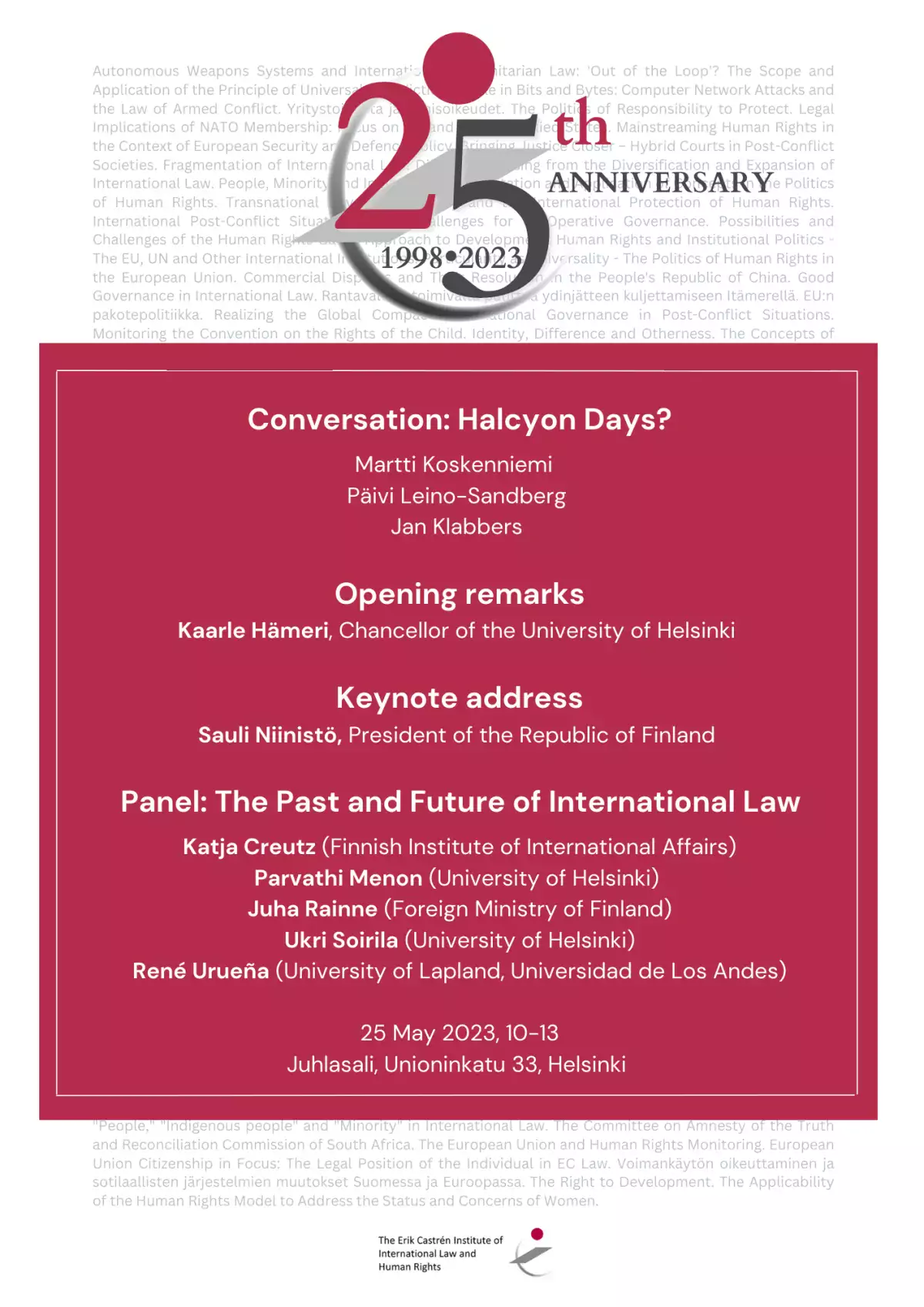
EVENT: Erik Castrén Institute 25th Anniversary (University of Helsinki, 25 May 2023)

Image source: UHelsinki


Description:

ECI’s 25th Anniversary

The Erik Castrén Institute of International Law and Human Rights has the pleasure to invite you at its 25th Anniversary taking place on 25 May 2023, 10-13 at JuhlasaliUnioninkatu 33, Helsinki. 

In the Spring of 2023, it has been 25 years since the Erik Castrén Institute of International Law and Human Rights (widely known as ECI) was established. Over these 25 years, ECI has hosted many research projects, organized a multitude of events, and housed dozens of researchers, including academic visitors. Some might even say ECI has helped set the global research agenda in the discipline of international law. In order to mark the occasion, ECI organizes a public event, looking at the academic and professional landscape and the way it has evolved during these 25 years.

Those attending in person are kindly asked to register here by May 18.

For more details, visit the blog of the University of Helsinki