ESIL Interest Group History of International Law

ESIL Interest Group History of International Law

Thursday, 2 May 2019

DEADLINE EXTENDED: ESIL Interest Group History of International Law event at the ESIL Annual Conference ‘New Histories of Sovereigns and Sovereignties’ (Athens, 12 SEP 2019) (DEADLINE 31 MAY 2019)


ESIL Annual conference in Athens 2019
Call for papers
for the
ESIL Interest Group History of International Law event on 12 September 2019
‘New Histories of Sovereigns and Sovereignties’

(image source: Wikimedia Commons)

Sovereigns and sovereignty have long been key aspects for histories of international law. Doctrinal definitions of sovereignty have been instrumentalized in political struggles throughout history. In the era of revolutions, instrumental uses of leading law textbooks like Vattel’s even led to constitutional overthrows. Therefore, changing ideas of sovereignty, the emergence and disappearance of particular sovereign states, and the sovereignty of international organisations inspired much debate among lawyers, and between lawyers and politicians in the last centuries. More recently, many of the major works in the contemporary revival of international legal history took sovereigns, their empires, their equality or inequality or even their property as starting points for new critical histories of the discipline and the role of international law in the expansion of the European state model or the rise of imperialism.

For our Interest Group meeting at the ESIL Annual Conference in Athens we are soliciting paper presentations that continue this path and promise novel ways of thinking about sovereigns and sovereignty. Potential topics may include (but are not limited to):
·         Potential paths for the field to explore now that the critical works have become the new mainstream literature. For example, what might a revisionist history of sovereignty look like?
·         The hybrid nature of legal argumentation in specific political and constitutional struggles and their transnational reverberations.
·         Papers exploring to what extent the centrality of sovereignty in the history of international law is warranted.
·         Examples of resistance to interpretations of sovereignty, or the concept itself.
·         Forgotten sovereigns and interpretations of sovereignty.

Papers using underexploited primary sources or involving archival work will receive our special attention. We particularly welcome proposals from and about women, and encourage early career scholars or those without current university affiliations to apply. We consider submissions written in French and English.

Abstracts of up to 500 words must be submitted no later than 31 May 2019 to esilighil@gmail.com on behalf of the Steering Committee of the Interest Group, which shall collectively supervise the blind peer-review process. The Interest Group is unable to provide funding for travel and accommodation. Please see the ESIL website for information about travel grants and carers’ grants offered to ESIL members (deadline: 5 June), and other relevant information about the conference.
Selected speakers are strongly encouraged to become members of the Society and to register for the Annual Conference; please note, however, that the Society is unable to offer reduced conference registration fees to speakers at pre-conference events (please do not register as agora speakers).

Selected speakers can indicate their interest in being considered for the ESIL Young Scholar Prize, if they meet the eligibility conditions as stated on the ESIL website. The ESIL Secretariat must be informed of all speakers who wish to be considered for the Prize by 15 May at the very latest.

BOOK: Pierre DUBOIS, De la reconquête de la Terre sainte. Suivi de De l'abrègement des guerres et procès du Royaume des Francs (Paris: les belles lettres, 2019), LXVIII + 540 p. ISBN 9782251448794, € 65

(image source: Les belles lettres)

Book description:
Paix universelle, création d’une union européenne, établissement d’un tribunal d’arbitrage international, cessation des guerres et fin des litiges, une armée paneuropéenne pour pacifier le Proche-Orient, la papauté réduite au rôle de guide spirituel suite au démantèlement des États du Pape, sécularisation des biens ecclésiastiques, promotion des femmes dans l’éducation, formation de femmes-chirurgiens, enseignement des langues orientales – autant de projets qui seraient d’actualité aujourd’hui encore, mais qui datent de 1307 !Le présent volume vise à faire connaître au lecteur les plus importants écrits politiques du légiste normand Pierre Dubois (c. 1255 - c. 1321), De la reconquête de la Terre Sainte et De l’abrègement des guerres et procès du royaume des Francs.Sa vision de reconquête de la Terre Sainte lui suggère une série de réformes touchant à tous les aspects de la vie de la chrétienté : de l’établissement de la paix universelle et la réforme des rapports entre l’Église et l’État, jusqu’à la fondation d’écoles de type nouveau.
Contributors:
Pierre DUBOIS Pierre Dubois vit le jour dans les années 1250 et étudia à Paris. Il reçut une formation en droit romain et canonique avant d’entrer au service du roi comme avocat royal. Il prit la plume à l’occasion de différents conflits et événements politiques : campagne aragonaise de Philippe III, conflit entre Boniface VIII et Philippe le Bel, suppression de l’Ordre du Temple… « Ni théologien de l’Eglise, ni philosophe de l’Université, Dubois marque une des premières manifestations européennes de l’esprit laïc, quoiqu’il s’exprime encore en des termes théologiques et perçoive le monde à travers leur grille. » Marianne SÁGHY Marianne Sághy est professeur des Études médiévales à l’Université de l’Europe Centrale (Budapest). Alexis LÉONAS Alexis Léonas est maître de conférences à l’Université Gáspár Károli de l’Église Réformée de Hongrie (Budapest). Pierre-Anne FORCADET Pierre-Anne Forcadet est docteur en histoire du droit et maître de conférences à l’Université d’Orléans. 
(more with: Les belles lettres)

(source: ESCLH Blog)

Wednesday, 1 May 2019

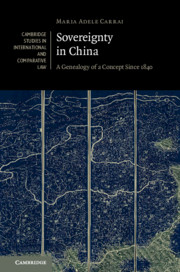
BOOK PRESENTATION: Maria Adele CARRAI, Sovereignty in China: And the Long Legacies of History (Cambridge: CUP, 2019) (Cambridge (Mass.): Harvard Asia Center, 3 MAY 2019)


Dr. Maria Adele Carrai (Marie Curie senior researcher at the Center for Global Governance/KULeuven) will discuss her forthcoming book with Cambridge University Press with Professor Anne Orford (Visiting Professor of Law/John Harvey Gregor Lecturer on World Organisation, Harvard Law School). The discussion will be chaired by Professor William P. Alford.

This presentation will take place on 3 May, at 12:15 pm.

Book abstract:
A quest for sovereignty characterizes China’s modern history: charting an uninterrupted course since the nineteenth-century Opium Wars, it reflects the country’s tortuous journey within the history of international law. The current territorial disputes in the South and East China Seas, the reunification with Taiwan, and the difficulties with the autonomous regions are all related to the most recent definition of China as a sovereign state, and to the introduction of international law. During the nineteenth century, Qing officials started to use sovereignty not only against the encroachment of Western powers, but also to unite under one single sovereign authority the vast territory that was colonized and inscribed within a ritual geography in the course of the two previous centuries of imperial expansion. In a way, the vast Qing multiethnic and multinormative empire continues to haunt the Chinese modern nation: the Chinese Communist Party’s endeavor, as specified in the Constitution, is still the reunification of the motherland. While remaining a hard-won prize after what has been rhetorically called the ‘century of humiliations,’ more recently with the official codification of the Five Principles of Peaceful Coexistence in 1954, sovereignty has become the cornerstone of China’s foreign policy. How did these sovereign claims come about? When did they start, and why? How are these claims different from or similar to those made in the nineteenth and early twentieth centuries, and what can the continuities and discontinuities in usage tell us about the current and future trajectory of China in international society? These are among the questions that the presentation will address.
More information with Harvard's Asia Center.

Tuesday, 30 April 2019

CALL FOR PARTICIPANTS : Critical Approaches to International Law (Dublin, 1-4 August 2019) (DEADLINE: 15 MAY 2019)


(Source: Griffith College)

We learned of a symposium on critical approaches to international law in Dublin. Here the call for applicants:

With the increasing presence of international law in the global order, different theoretical engagements have emerged to explain the international legal system, its actors, processes, norms and values. The Symposium intends to bring academics, researchers, practitioners and students together at Griffith College in Dublin, Ireland for several days to focus on four main strands within international legal scholarship:

  • Colonial Legacies of International Law and Lasting Consequences of Imperialism 
  • Feminist Theories and Epistemologies from the Global South 
  • Ecologies of Law
  • Corporations in a Global Society
The strands will be broken into various panels, workshops, reading groups and roundtable discussions focusing on locating the international critically. The symposium program targets lawyers, activists, academics, policy makers, and students who are interested in analysing and situating debates about the nature of international law, its function and values through critical legal theory, third world approaches to international law and feminist legal theory. 

To Apply

Please send a CV, one recommendation letter and a cover letter outlining your interests in participating and relevant experience in the field to Dr. Thamil Ananthavinayagan by the 15th of May, 2019. Participants from institutions and organisations in the Global South are particularly encouraged to participate.

Successful applicants will be notified by 1st of June 2019. The seminar will be convened at Griffith College Dublin, Ireland from 1st to 4th of August 2019. The regular registration fee is €350. Other rates apply for Griffith College Dublin alumni and students. The registration fee includes all conference materials, lunch, refreshments, a social activity and a closing dinner.

Scholarships

We will be offering ten funded scholarships to participants from institutions and organisations in the Global South to cover a waiver of conference fees, flights and accommodation. Please indicate in your cover letter that you want to be considered for the scholarship.

Organised By:

  • Dr. Thamil Ananthavinayagan, Lecturer Griffith College Dublin, Ireland
  • Rohini Sen, Assistant Professor Jindal Global University, India
  • Jay Ramasubramanyam, PhD Candidate, Carleton University, Canada
  • Dr. Jimena Sierra, Lecturer, Universidad del Rosario Bogotá, Colombia
  • Farnush Ghadery, Visiting Lecturer and PhD Candidate, King’s College London, UK
  • Shaimaa Abdelkarim, PhD Candidate and Tutor, Leicester University, UK
  • Dr. Amritha Viswantah Shenoy, Assistant Professor, Kathmandu School of Law, Nepal
  • Helyeh Doutaghi, PhD Student, Carleton University, Canada
  • Kanad Bagchi, Research Fellow, Max Planck Institute for Comparative Public Law and International Law, Heidelberg, Germany
To Register

For registration to this seminar, please visit our payment system and use the following reference to pay your registration fee: Symposium on Critical Approaches to International Law – 3008760
  • Regular registration fee:                €350
  • Registration per day:                      €150
  • GCD students and alumni:            €250
Group bookings upon request.

Please note: rooms on the campus of Griffith College Dublin are available and can be booked separately.

Please follow us on Facebook or Twitter for updates. Should you have any queries regarding group bookings and room bookings etc., please e-mail Dr. Thamil Ananthavinayagan.  
We are pleased to recognise our program sponsors:

                Griffith College Dublin, Faculty of Law
                Irish Aid 

More information here

(source: ESCLH Blog)

Monday, 29 April 2019

CHAPTER: Ignacio DE LA RASILLA DEL MORAL, "Grotian Revivals in the Theory and History of International Law", in: Randall LESAFFER & Janne NIJMAN (eds.), The Cambridge Companion to Hugo Grotius (Cambridge: CUP, forthcoming)

(image source: Wikimedia Commons)

Abstract:
This chapter examines how the title of founder of the law of nations was bestowed upon Grotius and how the liberal internationalist interpretation of the existence of a Grotian tradition in international law came into being. It also reviews the extent to which both historical constructs have been challenged by new historical research and contemporary re-interpretations of Grotius’ works and figure. The chapter is divided into three parts. The first part accompanies the reception of Grotius by international lawyers from the time of the discovery of his De Jure Praedae in 1864 to the establishment of the Grotius Society in England during the First World War. The second part examines the revivals of Grotius among international lawyers in the aftermaths of both world wars and considers a number of Grotius-related historiographical developments during the Cold War period. The third part examines how, in recent decades, on the one hand Grotius has become more mainstreamed and further institutionalised as a global symbol of international law while on the other hand his reputation has suffered from him being labelled a handmaiden of European colonialism and exploitation. The concluding section reflects on the lasting fame of the ‘miracle of Holland’ among international lawyers and suggests that the history of international law as a research field should now take a break from Hugo Grotius.
Read the fulltext on SSRN.
(source: International Law Reporter)

Friday, 26 April 2019

PODCAST: La Grande-Bretagne, l'Europe et les autres: Le choix du monde ? (France Culture/La Fabrique de l'Histoire, 27 MAR 2019)

France Culture's La Fabrique de l'Histoire made a broadcast on the British Empire, British internal politics and "Global Britain". With Pierre Singaravélou (Paris I), Guillemette Crouzet (Warwick) and Clarisse Berthezène.

Introduction:
En quelques siècles le Royaume-Uni s'est imposé comme une puissance coloniale, adoptant tour à tour le rôle de policier du monde faisant régner la Pax Britannica et la posture du "splendide isolement", en observateur détaché des guerres intestines européennes. Le Royaume-Uni ne s'est pourtant jamais construit sans l'Europe ou en dehors de l'Europe, loin s'en faut. Le Brexit n'est que la dernière occurrence d'une longue histoire de relations complexes et fluctuantes, une histoire elle-même sujette à de nombreuses polémiques et à autant de décentrages que l'Empire britannique compta de territoires.


More information with France Culture.

Thursday, 25 April 2019

SCHOLARSHIPS: MPI Luxemburg for International, European and Regulatory Procedural Law (DEADLINE 31 MAY 2019)

(image source: MPI Luxemburg)

Max Planck Luxembourg PhD Scholarships 2020

Among the goals pursued by the Max Planck Institute Luxembourg for International, European and Regulatory Procedural Law is to promote research and academic exchange with foreign scholars. In this framework, to assist particularly young scholars further advance their research activity, the Max Planck Institute Luxembourg offers a limited number of scholarships for foreign doctoral candidates to support their research stay at the Institute for up to six months in the calendar year 2020.

Eligibility

To be eligible for the scholarship, applicants must be doctoral candidates carrying out research activity within the Institute’s various areas of research, and intend to be affiliated either to the Department of European and Comparative Procedural Law or the Department of International Law and Dispute Resolution only. While proficiency in English is compulsory, the call is also open to doctoral candidates writing their thesis in a language other than English.

Application

To apply, the interested candidates meeting the requirements of the call must submit the following documents, in English:
  • a cover letter (max. 1 page), stating the motivation for their application, the correlation between the topic of their research and the Institute's areas of research, and the desired time frame for the scholarship stay in the calendar year 2020;
  • an up-to-date curriculum vitae, with an indication of the class of degree awarded (undergraduate and postgraduate, if relevant);
  • a summary of the PhD project (max. 2 pages), including subject, description and work plan;
  • two letters of recommendation (including one from the PhD supervisor, with his/her contact details).

Grant and benefits

The scholarship is paid in monthly instalments of 1.500 €.
The selected applicants will be offered a workstation in the reading room. They will also have the opportunity to participate in the regular scientific events hosted at the Institute, other activities and access to the Institute’s library. During the funding period, the presence of the Scholarship Holder at the Institute is required.

Deadline for applications

31 May 2019
(more information on the Institute's website)