ESIL Interest Group History of International Law

ESIL Interest Group History of International Law
Showing posts with label china. Show all posts

Tuesday, 6 October 2020

ADVANCE ARTICLE: Jenny Huangfu DAY, "Mediating Sovereignty: The Qing legation in London and its diplomatic representation of China, 1876–1901" (Modern Asian Studies)

(image source: Cambridge Core)

Abstract:

In 1896, Sir Halliday Macartney, counsellor of the Qing London legation, detained the revolutionary Sun Yat-sen on legation grounds in an attempt to deport him back to China. Since then, the image of the legation as an ossified extension of a despotic government has dominated public imagination. This article proposes a new way of understanding the legation's action: it exemplifies the legal activism of Qing diplomats in recovering judicial sovereignty that had been compromised by the presence of extraterritoriality and colonialism. Legations represented a broad range of interests of China through diplomatic negotiations and legal mediations, and brought unresolved disputes between foreign ministers and the Zongli Yamen in Beijing to the attention of their home governments. This article analyses the mediation and collaboration performed by the London legation between the various levels of the Qing government and the British Foreign Office. It argues that Qing legations and their diplomatic representation abroad were essential to the construction and imagination of China as a sovereign state. 

(read more on Cambridge Core: DOI 10.1017/S0026749X2000030X)

Monday, 14 September 2020

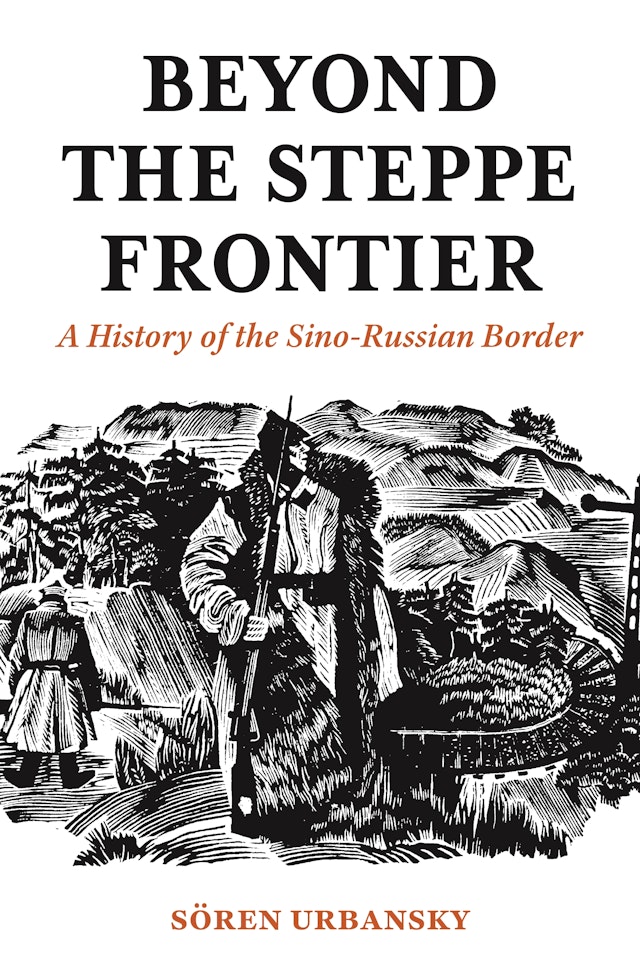
BOOK: Sören URBANSKY, Beyond the Steppe Frontier: A History of the Sino-Russian Border (Princeton: Princeton University Press, 2020), 390 p. ISBN 9780691181684, € 39,95


(image source: Princeton UP)

Abstract:
The Sino-Russian border, once the world’s longest land border, has received scant attention in histories about the margins of empires. Beyond the Steppe Frontier rectifies this by exploring the demarcation’s remarkable transformation—from a vaguely marked frontier in the seventeenth century to its twentieth-century incarnation as a tightly patrolled barrier girded by watchtowers, barbed wire, and border guards. Through the perspectives of locals, including railroad employees, herdsmen, and smugglers from both sides, Sören Urbansky explores the daily life of communities and their entanglements with transnational and global flows of people, commodities, and ideas. Urbansky challenges top-down interpretations by stressing the significance of the local population in supporting, and undermining, border making. Because Russian, Chinese, and native worlds are intricately interwoven, national separations largely remained invisible at the border between the two largest Eurasian empires. This overlapping and mingling came to an end only when the border gained geopolitical significance during the twentieth century. Relying on a wealth of sources culled from little-known archives from across Eurasia, Urbansky demonstrates how states succeeded in suppressing traditional borderland cultures by cutting kin, cultural, economic, and religious connections across the state perimeter, through laws, physical force, deportation, reeducation, forced assimilation, and propaganda. Beyond the Steppe Frontier sheds critical new light on a pivotal geographical periphery and expands our understanding of how borders are determined.

On the author:

Sören Urbansky is a research fellow at the German Historical Institute in Washington, DC. He is the author of Kolonialer Wettstreit: Russland, China, Japan und die Ostchinesische Eisenbahn. 

(source: Princeton UP

Wednesday, 19 February 2020

ARTICLE: Guida JIA, New China and International Law: Practice and Contribution in 70 Years (Chinese Journal of International Law XVIII (2019), No. 4 (Dec))

(image source: blogger)

Extract:
This year marks the 70th anniversary of the founding of the People’s Republic of China. Several days ago, Chinese people all across the nation celebrated the anniversary. Over the past 70 years, under the strong leadership of the Communist Party of China, the Chinese people, with great courage and relentless exploration, have made remarkable achievements. China has not only successfully lifted more than seven hundred million people out of poverty, but also made great contributions to world economic growth.
(source: OUP)

(source: ILReports)

Wednesday, 1 May 2019

BOOK PRESENTATION: Maria Adele CARRAI, Sovereignty in China: And the Long Legacies of History (Cambridge: CUP, 2019) (Cambridge (Mass.): Harvard Asia Center, 3 MAY 2019)


Dr. Maria Adele Carrai (Marie Curie senior researcher at the Center for Global Governance/KULeuven) will discuss her forthcoming book with Cambridge University Press with Professor Anne Orford (Visiting Professor of Law/John Harvey Gregor Lecturer on World Organisation, Harvard Law School). The discussion will be chaired by Professor William P. Alford.

This presentation will take place on 3 May, at 12:15 pm.

Book abstract:
A quest for sovereignty characterizes China’s modern history: charting an uninterrupted course since the nineteenth-century Opium Wars, it reflects the country’s tortuous journey within the history of international law. The current territorial disputes in the South and East China Seas, the reunification with Taiwan, and the difficulties with the autonomous regions are all related to the most recent definition of China as a sovereign state, and to the introduction of international law. During the nineteenth century, Qing officials started to use sovereignty not only against the encroachment of Western powers, but also to unite under one single sovereign authority the vast territory that was colonized and inscribed within a ritual geography in the course of the two previous centuries of imperial expansion. In a way, the vast Qing multiethnic and multinormative empire continues to haunt the Chinese modern nation: the Chinese Communist Party’s endeavor, as specified in the Constitution, is still the reunification of the motherland. While remaining a hard-won prize after what has been rhetorically called the ‘century of humiliations,’ more recently with the official codification of the Five Principles of Peaceful Coexistence in 1954, sovereignty has become the cornerstone of China’s foreign policy. How did these sovereign claims come about? When did they start, and why? How are these claims different from or similar to those made in the nineteenth and early twentieth centuries, and what can the continuities and discontinuities in usage tell us about the current and future trajectory of China in international society? These are among the questions that the presentation will address.
More information with Harvard's Asia Center.