ESIL Interest Group History of International Law

ESIL Interest Group History of International Law
Showing posts with label trade. Show all posts

Monday, 19 April 2021

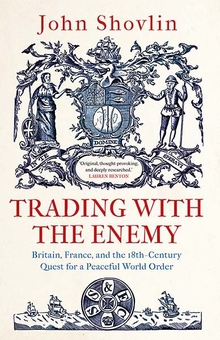
BOOK: John SHOVLIN, Trading with the Enemy. Britain, France, and the 18th-Century Quest for a Peaceful World Order (New Haven (Conn.): Yale UP 2021), 352 p.


(image source: Yale UP)

Abstract:

Britain and France waged war eight times in the century following the Glorious Revolution, a mutual antagonism long regarded as a “Second Hundred Years’ War.” Yet officials on both sides also initiated ententes, free trade schemes, and colonial bargains intended to avert future conflict. What drove this quest for a more peaceful order? In this highly original account, John Shovlin reveals the extent to which Britain and France sought to divert their rivalry away from war and into commercial competition. The two powers worked to end future conflict over trade in Spanish America, the Caribbean, and India, and imagined forms of empire-building that would be more collaborative than competitive. They negotiated to cut cross-channel tariffs, recognizing that free trade could foster national power while muting enmity. This account shows that eighteenth-century capitalism drove not only repeated wars and overseas imperialism but spurred political leaders to strive for global stability.

On the author:

John Shovlin is associate professor of history at New York University and the author of The Bordeaux–Dublin Letters, 1757 and The Political Economy of Virtue. 

 (source: Yale UP)

Tuesday, 2 February 2021

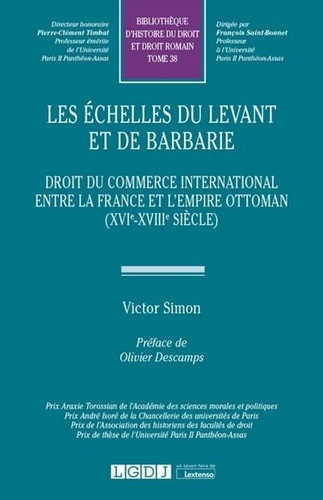
BOOK: Victor SIMON, Les échelles du Levant et de barbarie - Droit du commerce international entre la France et l'Empire ottoman, XVIe-XVIIIe siècle [Bibliothèque d'histoire du droit et droit romain; 38] (Paris: LGDJ, 2021), 380 p. ISBN 978-2-275-08394-0, €57


(image source: Furet)

Book abstract:
Au coeur des grandes recompositions géopolitiques de la première moitié du XVIe siècle, François Ier tisse d'étroites relations avec l'Empire ottoman de Soliman. Cette "alliance impie" avec le grand seigneur se prolonge par l'octroi d'importants privilèges commerciaux, désignés sous le terme de capitulations, au profit des sujets du roi de France. En se fondant sur ces textes, des négociants provençaux développent alors des réseaux commerciaux complexes en Méditerranée orientale et en Afrique du Nord. Ceux-ci établissent en effet des maisons de commerce dans les principales cités ottomanes qu'ils qualifient d'échelles du Levant et de Barbarie, comme autant de têtes de pont du négoce européen. A partir du ministère de Colbert, ce lucratif commerce international est peu à peu envisagé comme un facteur stratégique, permettant de soutenir la puissance de l'Etat. La monarchie s'insinue dès lors toujours plus loin dans la direction des affaires, en orientant l'activité des marchands au moyen d'une réglementation de plus en plus rigide qui entrave les initiatives individuelles. En réaction, les négociants impliqués dans le commerce méditerranéen formulent des thèses libérales très critiques vis-à-vis de la politique royale. A la confluence du droit international public, de la législation royale et des usages commerciaux, l'histoire juridique des échelles du Levant et de Barbarie est, dès lors, traversée d'insolubles tensions entre milieux d'affaires et grands administrateurs du royaume. Prix Araxie Torossian de l'Académie des sciences morales et politiques Prix André Isoré de la Chancellerie des universités de Paris Prix de l'Association des historiens des facultés de droit Prix de thèse de l'Université Paris II Panthéon-Assas.

On the author:

Victor Simon est professeur à l'Université de Lille. 

(source: Furet

Monday, 28 January 2019

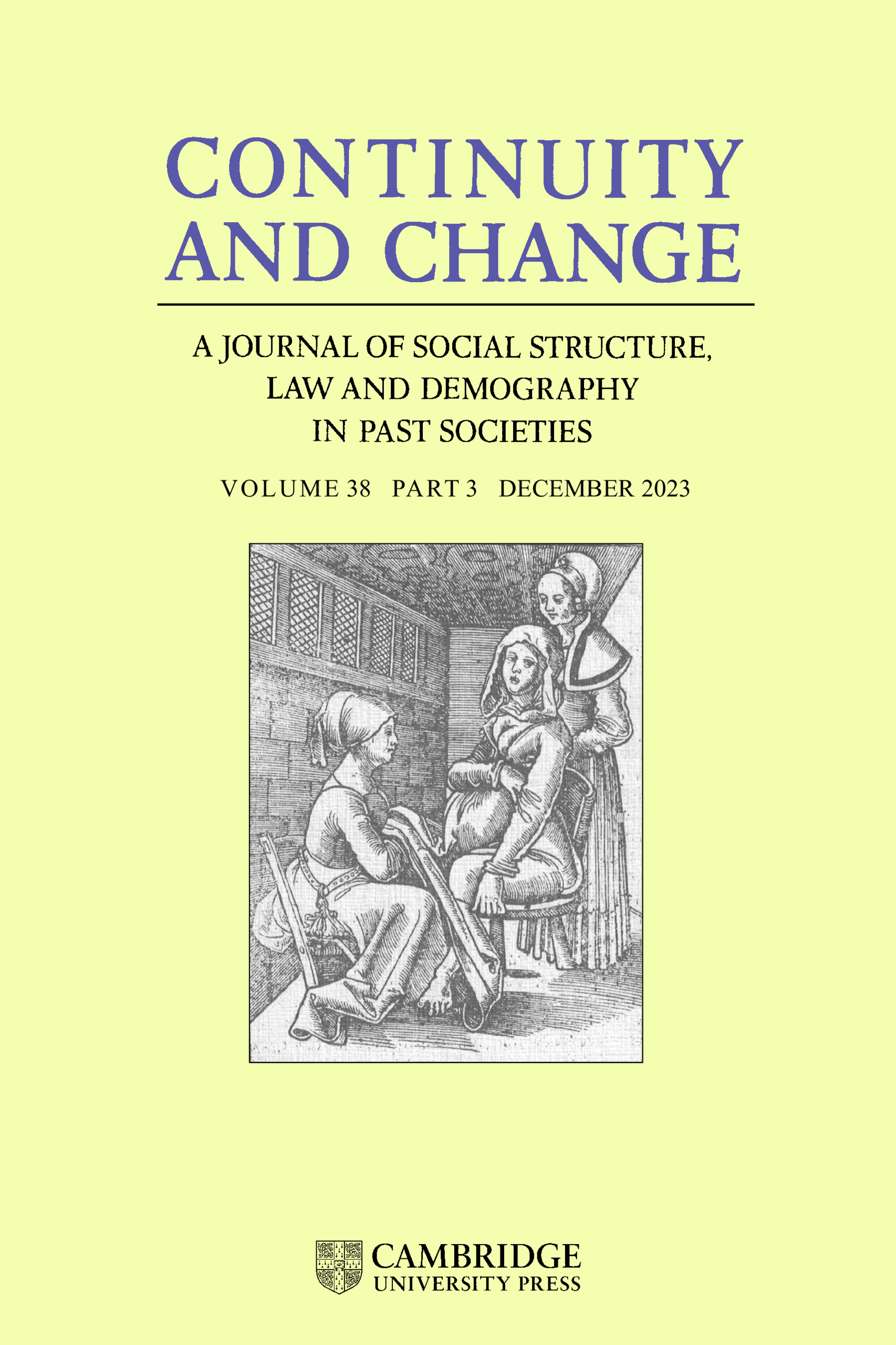
JOURNAL: Thematic Issue "Merchants and commercial conflicts in European History" (Continuity and Change, A Journal of Social Structure, Law and Demography in Past Societies XXXIII (2018), No. 3)

(image source: Cambridge Core)

Alain Wijffels, Introduction: Commercial quarrels--and how (not) to handle them
Abstract:
The settlement of structural commercial conflicts of interest cannot be exclusively subsumed under the heading of dispute resolution. Even when a particular conflict opposing specific individuals or groups of interests could be settled, the broader underlying conflicts of interest would subsist and re-emerge. Both commercial and institutional or political actors would therefore rely on various techniques of conflict management, a process imposing restraint on the opposing parties while allowing sufficient leeway for business to be continued. Both conflict resolution and conflict management were devices of public and corporate governance, and therefore, following the late medieval tradition, instruments more or less based on established patterns of legal or quasi-legal models legitimised by accepted or conventional parameters of ‘justice’
Flávio Miranda, Conflict Management in western Europe: the case of the Portuguese merchants in England, Flanders and Normandy, 1250-1500
Abstract:
Recent historiography argues that the legal autonomy of municipal governments created the necessary conditions for successful commercial transactions and economic growth in certain parts of Europe in the later Middle Ages, and that these features attracted foreign merchants. This article uses empirical data from England, Flanders and Normandy to test the following questions: were there significant differences in rules, laws and institutions between one place and another in late medieval western Europe? Were the Portuguese merchants drawn to markets that hypothetically had more effective institutions? The findings demonstrate that legal institutions and conflict management were very similar across western Europe, and that there is no evidence that the Portuguese opted for trading in a certain market because of its effective institutions. Moreover, the article claims that the merchants seemed to prioritise protection and privilege while trading abroad, and it highlights the role of commercial diplomacy in conflict management.
Thomas K. Heebøll-Holm, Law, order and plunder at sea: a comparison of England and France in the fourteenth century
Abstract:
This article addresses the management of maritime plunder and conflict in the waters of England and France in the fourteenth century. It argues that during this century a fundamental change occurred. Around 1300, maritime conflict was handled by recourse to the strictly civil law merchant and law maritime, or by Marcher law. However by the 1350s and 1360s the kings of England and France, moved by contemporary political events and theories of sovereignty at sea, created courts of Admiralty that challenged the previous systems’ jurisdiction. These initiatives eventually paved the way for the criminalisation of private maritime conflict.
Justyna Wubs-Mrozewicz, The late medieval and early modern Hanse as an institution of conflict management
Abstract:
Ever since research on the Hanse began in the nineteenth century, there have been repeated efforts to redefine the boundaries and the core of the phenomenon. Views of the Hanse have evolved, and it has been seen by turns as a profoundly German league of towns, and as a network or organisation of towns and traders that was present in commercial centres and harbours from Novgorod to Portugal, and from Norway to Italy. In more general discussions on the institutional development of commerce in Europe, many of them influenced by the New Institutional Economics, the Hanse has even appeared as a mega-guild. The revival of the field of institutional economics and the history of commerce in pre-modern Europe has recently spawned a reappraisal of Hanseatic sources. The present article contributes to this debate by arguing that from the perspective of conflict management, the late medieval and early modern Hanse was an institution. There were several institutional mechanisms, such as a strong preference for mediation and arbitration in conflicts between individuals, as well as a mediation strategy for internal conflicts between towns. All of these mechanisms combined in a multifaceted institution of conflict management, which represented the added value of Hanse membership for traders, and for their towns.
Andrea Caracausi, A reassessment of the role of guild courts in disputes over apprenticeship contracts: a case study from early modern Italy
Abstract:
This article analyses the mechanisms of conflict resolution in apprenticeship contracts using a large database of disputes from early modern Italy. It finds that the guild court under investigation (the Padua Woollen Guild court) did not enforce training contracts, but rather sought to improve on incomplete contracts by adding clauses, thereby helping individuals renegotiate and redefine the contractual arrangements into which they had decided to enter. However, power relations within the court operated largely in favour of employers, both merchants and master craftsmen. The article concludes that alternative contract enforcement systems, such as municipal or state courts, were probably better suited than corporative systems for resolving disputes surrounding apprenticeship.
Read more on Cambrige Core.

(source: Legal History Blog)

Tuesday, 9 October 2018

CALL FOR PAPERS: A Global History of Free Ports. Capitalism, Commerce and Geopolitics (Venice/Helsinki, APR/JUN 2019) (DEADLINE 31 OCT 2018)

(image source: University of Helsinki)
The history of free ports research network is organising a number of conferences in the next years, in order to work towards a standard publication and interactive research platform for the history of free ports from the 16th to the early 20th century. Please check our website (www.helsinki.fi/a-global-history-of-free-ports) for an impression.
The first two meeting will take place in Venice (April 2019) and in Helsinki (June 2019).
For the call for papers of both the Venice and Helsinki meetings, see:
 
We are looking for case studies that engage with the transformations of the various functions of free ports over time and the spread of free ports from Italy and the Mediterranean to the Atlantic, Asia and the global level. The research may open up to the wider international development of trade and its institutions by taking a perspective that can be long-term, comparative or comprehensive (involving a combination of intellectual, policy, and economic angles). Papers may also address cultural, religious, diplomatic and network perspectives.
 
Texts that are presented at conferences may be published as a ‘dossier’/ special issue in the Intellectual History Archive open access working paper series of the Helsinki Centre for Intellectual History. A selection of revised papers will be included in a book publication.
 
Abstracts (of ca. 500 words) and titles may be sent by email tokoen.stapelbroek@helsinki.fi and ctazzara@scrippscollege.edu by 31 October 2018. Invited speakers are subsequently requested to provide short papers (ca. 5,000 words) that will be pre-circulated among participants. For further information, see the ‘Call(s) for papers’. For those who do not possess their own research budgets or travel funds, we can try to contribute towards your travel and accommodation costs.

Tuesday, 3 February 2015

BOOK: Michael FAKHRI, Sugar and the Making of International Trade Law (CUP, 2014, 276 p., ISBN 9781107040526)

(image source: CUP)

 Michael Fakhri (Oregon) published a book on Sugar and the Making of International Trade Law (CUP, 2014).

Abstract:
This book traces the changing meanings of free trade over the past century through three sugar treaties and their concomitant institutions. The 1902 Brussels Convention is an example of how free trade buttressed the British Empire. The 1937 International Sugar Agreement is a story of how a group of Cubans renegotiated their state's colonial relationship with the US through free trade doctrine and the League of Nations. And the study of the 1977 International Sugar Agreement maps the world of international trade law through a plethora of institutions such as the ITO, UNCTAD, GATT and international commodity agreements – all against the backdrop of competing Third World agendas. Through a legal study of free trade ideas, interests and institutions, this book highlights how the line between the state and market, domestic and international, and public and private is always a matter of contest.
 Source: International Law Reporter.

Friday, 10 October 2014

CONFERENCE: Treaties of Commerce. Balance of Trade and the European Order of States (Pisa, 26-27 November 2014)


(image: the harbour of Leghorn, Wikimedia Commons)

The University of Pisa organises a very promising conference on the history of international law and trade on 26-27 November, at the palazzo Manfreducci. 

Program:

Wednesday 26 November
9:00-9:15, Antonella Alimento, Università di Pisa, Introduction: The PRIN Project on ‘The Liberty of the Moderns’ and Commercial Treaties
First Session 
Chair: Antonella Alimento, Università di Pisa
9:15-9:30, Koen Stapelbroek, Erasmus University Rotterdam, Commercial Treaties and the Historiography of Eighteenth-Century Politics and Trade: Preliminary Considerations
9:30-10:00, Eric Schnakenbourg, Université de Nantes, Les conditions de l’échange marchand: traités de commerce et droit maritime au XVIIIe siècle
Coffee break
10:30-11:00, Guillaume Calafat, Université de Paris I, Faut-il traiter avec les «Barbaresques»? Commerce, compétition et pouvoir au XVIIIe siècle 
11:00-12:00, Discussion
Lunch
Second Session 
Chair : John Shovlin, New York University
14:30-15:00, José Luís Cardoso, Institute of Social Sciences Lisbon, The Anglo-Portuguese Treaties of Commerce of 1703 and 1810: Opportunities and Constraints of Economic Development
15:00-15:30, Maria Virginia León, Universidad Complutense de Madrid, El Tratado hispano-británico del asiento durante la primera mitad del siglo XVIII
Coffee break
16:00-16:30, Doohwan Ahn, Seoul National University, The Treaty of Utrecht Revisited: The Balance of Trade or the Balance of Power?
16:30-17:00, Koen Stapelbroek, Erasmus University Rotterdam, Global Trade and the Commercial Treaties of the Dutch Republic
17:00-18:00, Discussion
Thursday 27 November
Third Session 
Chair: Koen Stapelbroek, Erasmus University Rotterdam
9:00-9:30, Antonella Alimento, Università di Pisa, From the Balance of Power to the Balance of Commerce Strategy: the French Rejection of the Treaties of Commerce Policy (1713-1763) 
9:30-10:00, John Shovlin, New York University, Remaking the Franco-British Rivalry in India: The Godeheu–Saunders Treaty and the Political Economy of Peaceful Competition
Coffee Break
10:30-11:00, Pascal Dupuy, Université de Rouen, Jeux et enjeux autour du traité de commerce franco-britanique de 1786: les représentations françaises
11:00-11:30, Marc Belissa, Université de Paris 10, Quel commerce pour un peuple républicain? Les débats révolutionnaires sur les traités de commerce de la République française (1792-1799)
11:30-12:30, Discussion
Lunch
Fourth Session 
Chair: José Luís Cardoso, Institute of Social Sciences Lisbon
14,30-15,00 Marco Cavarzere, Ludwig-Maximilian Universität (Munich), The ‘Convention préliminaire de commerce’ between France and Prussia (1753) and the Rise of a New Commercial Nation
15:00-15:30, Christine Lebeau, Université de Paris I, Négocier un traité de commerce en contexte impérial. L’exemple de la Monarchie des Habsbourg dans la deuxième moitié du XVIIIe siècle
Coffee break
16:00-16:30, Biagio Salvemini, Università di Bari, Dans le silence des traités: l’interventionnisme institutionnel dans le commerce entre le Royaume de France et le Royaume de Naples au XVIIIe siècle 
16:30-18:00, Final Discussion 
More information here: http://hsozkult.geschichte.hu-berlin.de/termine/id=26048.