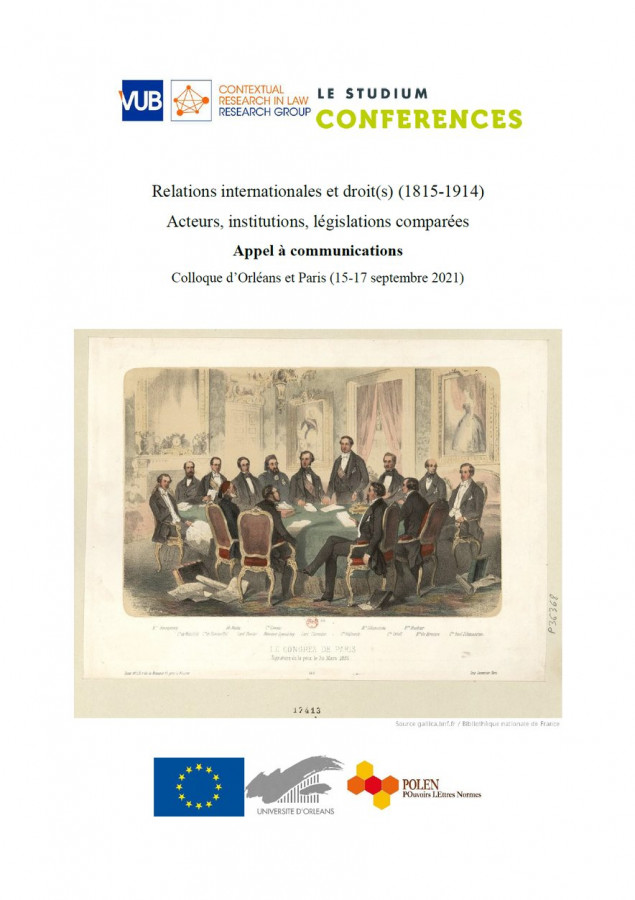
In the last twenty years, the study of the history of international law and of international relations has witnessed something of a renaissance. Historians have adopted novel approaches to investigate diplomatic relations, the international system, and the discipline of international law. Fruitful perspectives from cultural, social, global and transnational histories as well as from gender studies, Third World approaches to international law, and postcolonial and imperial histories have all shed new light on the evolution of international law in the nineteenth century. The bicentenary of the Congress of Vienna (1814-1815) also led to several new publications on the Congress System and on the “security culture” that was established in the aftermath of Napoleon. Nevertheless, many lacunae remain, especially regarding the relationship between law(s) and international relations during the long nineteenth century and in the sociocultural history of international law as a discipline with its own actors, networks, venues, institutions and power circles. The years 1815-1869 have been relatively neglected in the historiography, doubtless because they have generally been seen as a time when world governance rested more on political relationships than on juridical rules. Historian David Kennedy has thus written provocatively: “For international law, as for much of the rest of twentieth-century legal thought, it is really only the last five minutes of the nineteenth century that count.” And indeed, it is true that many recent and inspiring research works pay scant attention to the first half of the nineteenth century, such as the volumes of Juristes et relations internationales (Relations Internationales 2012/1) and Profession, juristes internationalistes ? (Monde(s) 2015/1).
International law was first institutionalized in 1873 with the foundation in Belgium of the Institut de Droit International and the Association pour la réforme et la codification du droit des gens (known from 1895 onwards as the International Law Association). But the basic premises of this development occurred much earlier with the publication of several textbooks on both private and public international law in the 1830s and 1840s. Moreover, legal advisers were already employed in the foreign offices of many European nation-states and empires (as well as their colonies) in the United States, South America and Asia. International law was also spread through various scientific academies across the world, some of which organized contests on international law, such as the competitions organized by the Académie des sciences morales et politiques in France for 1839-1840, 1856-1857, 1892, and 1908. Many scientific journals also contained articles on international law in this earlier period, including the Thémis ou bibliothèque des jurisconsultes (1820-1830), the Kritische Zeitschrift für Rechtswissenschaft und Gesetzgebung des Auslands (1829-1856), the Revue de législation et de jurisprudence (1834-1853), the various journals edited by Jean-Jacques Gaspard Foelix (1834-1850), the Archives de droit et de législation (1837-1841), the Belgique judiciaire (1843-1914) and the Revue historique de droit français et étranger (1855-2021).
The aim of the present conference is to deepen our study of the interconnections between law(s) and international relations through the eyes of a plurality of actors (e.g., legal advisers, lawyers, judges, activists, publicists, journalists, editors), institutions (e.g., foreign offices, courts, universities, academies of science, associations, libraries) and works on comparative law.
Three focuses will be especially addressed by this conference. The first is the plurality of actors. We welcome proposals on legal advisers within governments, foreign offices and national or colonial administrations; on civil and administrative judges, admiralty courts and prize laws; and on lawyers, academics, peace activists, international thinkers, journalists and editors, including women as well as men. A prosopography of a group of actors is invited as well as individual biographies. The theme of the birth and professionalization of “international lawyers” will be studied as well as the various editors and the book market for international law.
Our second focus will be on institutions. We especially invite papers studying the treatment of law(s) in foreign offices in a comparative perspective. For example, in Great Britain, legal issues were dealt by the Queens Lawyers until 1872 and afterwards by the Legal Adviser of the Foreign Office. In France after 1835, it was the Comité consultatif du contentieux that dealt with legal issues. But what about the foreign offices of other countries? Other institutions (similar to the Conseil d’état in France) may have also had their own “Foreign Office Committee.” How were these organized? Did they cooperate with the foreign office? What role was played by scientific academies in the diffusion of international law? By the universities? By popular libraries?
Our third and final focus is on the study of comparative law and its link to the development of international law. The Société de législation comparée, founded in 1869, was full of members of the first generation of the Institut de Droit International, while many comparativists were, vice versa, members of the Institut de Droit International. Scientific journals such as the Revue historique de droit français et étranger and the Revue de droit international et de législation comparée dealt with both comparative and international law. Papers on the progressive autonomy of the discipline and on the networks of the founding members are especially welcome.
Proposals in French, English or Spanish may be sent by email to raphael.cahen@vub.be, to pierre.allorant@univ-orleans.fr or to walter.badier@univ-orleans.fr. All applications must be sent by 31 March 2021 with a proposal of at least 3,000 characters. The proceedings will appear in a peer-reviewed publication. Transportation and accommodation costs will be covered by organizing institutions.
Short List of Literature
-Allorant Pierre and Walter Badier, « La Société de législation comparée : boîte à idées du parlementarisme libéral de l’Empire libéral à la République opportuniste », Clio@Themis, vol. 13, 2017.
-Alexandrowicz Charles Henry, David Armitage, Jennifer Pitts (ed.), The Law of Nations in Global History, Oxford, Oxford University Press, 2017.
-Arcidiacono Bruno, Cinq types de paix : une histoire des plans de pacification perpétuelle, XVIIe-XXe siècles, Paris, PUF, 2011.
-Armitage David, Foundations of modern international thought, New York, Cambridge University Press, 2013.
-Audren Frédéric, Jean-Louis Halpérin, La culture juridique française. Entre mythes et réalités. XIXe-XXe siècles, Paris, CNRS éditions, 2013.
-Badel Laurence (ed.), Histoire et relations internationales, Paris, Presses de la Sorbonne, 2020.
-Baillou Jean (ed.), Les affaires étrangères et le corps diplomatique français, Paris, CNRS éditions, 1984.
-Becker Lorca Arnulf, Mestizo International Law: A Global Intellectual History, 1842-1933, Cambridge, CUP, 2015.
-Benton Laura and Lisa Ford, Rage for Order. The British Empire and the Origins of International Law, Cambridge, HUP, 2016.
-Bois Jean-Pierre, La paix : histoire politique et militaire, 1435-1878, Paris, Perrin, 2012.
-Bruley Yves, Le quai d’Orsay impérial. Histoire du ministère des Affaires étrangères sous le Second Empire, Paris, A. Pedone, 2012.
-« Le Concert européen à l’époque du Second Empire », Relations internationales, 90, 1997, p. 145-163.
-Cahen Raphaël, « The Mahmoud ben Ayad case and the Transformation of International Law », International Law in the Long Nineteenth Century (1776-1914). From the Public Law of Europe to Global International Law?, Inge Van Hulle, Randall Lesaffer (ed.), Leiden, Brill, 2019, p. 126-139.
-« Hauterive et l’école des diplomates (1800-1830) », Clio@Themis, vol. 18, 2020.
-Cahen Raphaël, Frederik Dhondt, Elisabetta Fiocchi-Malaspina, « l’essor récent de l’histoire du droit international », Clio@themis, 18, 2020.
-Dhondt Frederik, « Recent research in the history of international law », Revue d’histoire du droit, 84, 2016, p. 313-334.
-« Portalis le jeune et le droit des gens », Joseph-Marie Portalis (1778-1858) : diplomate, magistrat et législateur, R. Cahen, N. Laurent-Bonne (ed.), Aix-en-Provence, PUAM, 2020, p. 153-182.
-Drocourt Nicolas, Eric Schnakenbourg (ed.), Thémis en diplomatie. Droits et arguments juridiques dans les relations internationales, Rennes, PUR, 2016.
-Fassbender Bardo and Anne Peters (ed.), The Oxford Handbook of the History of International Law, Oxford, OUP, 2012.
-Fiocchi Malaspina Elisabetta, L'eterno ritorno del Droit des gens di Emer de Vattel (secc. XVIII-XIX): L'impatto sulla cultura giuridica in prospettiva globale, Frankfurt, MPI for European Legal History, 2017.
-Gaurier Dominique, Histoire du droit international. De l’Antiquité à la création de l’ONU, Rennes, PUR, 2014.
-Genin Vincent, Le laboratoire belge du droit international : une communauté épistémique et internationale de juristes (1869-1914), Bruxelles, Académie royale de Belgique, 2018.
-Ghervas Stella, Conquering Peace : From the Enlightenment to the European Union, Cambridge, HUP, 2021.
-Graaf Beatrice De, Ido de Haan, Brian Vick (ed.), Securing Europe after Napoleon: 1815 and the New European Security Culture, Cambridge, CUP, 2019.
-Graaf Beatrice de, Fighting Terror after Napoleon. How Europe Became Secure after 1815, Cambridge, CUP, 2020.
-Hellmann Gunther, Andreas Fahrmeir, Milos Vec (ed.), The transformation of Foreign Policy, Drawing and Managing Boundaries from Antiquity to the Present, Oxford, OUP, 2016.
-Jarrett Mark, The Congress of Vienna and its Legacy War and Great Power Diplomacy after Napoleon, London, Tauris, 2014.
-Jones Kate, « Marking Foreign Policy by Justice: the Legal Advisers to the Foreign Office, 1876-1953 », in Robert McCorquodale, Jean-Pierre Gauci (ed.) British Influences on International Law, 1915-2015, Leiden, Brill, 2016, p. 28-55.
-Keller-Kemmerer Nina, Die Mimikry des Völkerrechts Andrés Bellos 'Principios de Derecho Internacional', Baden-Baden, Nomos Verlag, 2018.
- Kennedy David, « International Law and the Nineteenth Century: History of an Illusion », Nordic Journal of International Law, vol. 65/3-4, 1996, p.385-420.
-Kévonian Dzovinar, Jean-Michel Guieu (ed.), « Juristes et relations internationales », Relations internationales, 149/1, 2012.
-Kévonian, Dzovinar and Philippe Rygiel (ed.), « Profession, juristes internationalistes? », Monde(s), vol. 7/1, 2015.
-Kévonian, Dzovinar and Philippe Rygiel (ed.), « Histories of International Lawyers between Trajectories, Practices, and Discourses », Jus Gentium, vol. 5/2, 2020.
-Koskenniemi Martti, The Gentle Civilizer of Nation : the Rise and Fall of International Law 1870-1960, Cambridge, Cambridge University Press, 2002.
-« Why history of international law today? », Rechtsgeschichte, 4, 2004, p. 61-66.
-« What should international legal history become? », in System, Order and International Law. The Early History of International Legal Thought from Machiavelli to Hegel, Stefan Kadelbach et al. (ed.), Oxford, OUP, 2017, p. 381-397.
-Koskenniemi Martti, Walter Rech, Manuel Jimenez Fonseca (ed), International Law and Empire. Historical Explorations, Oxford, OUP, 2017.
-Nuzzo Luiggi and Miloš Vec (ed.), Constructing International Law. The Birth of a Discipline, Francfort/M. 2012.
-Nuzzo Luiggi, Origini di una scienza : diritto internazionale e colonialismo nel XIX secolo, Francfort, MPI, 2012.
-Obregon Liliana, « Peripheral Histories of International Law », Annual Review of Law and Social Science, 15, 2019, p. 437-451.
-Owens Patricia and Katharina Rietzler (ed.), Women’s International Thought: A New History, Cambridge, CUB, 2021
-Rasilla Ignacio de la, “A Very Short History of International Law Journals (1869–2018)”, EJIL, 29/1, 2018, 137–168.
-Rygiel Philippe, « De savants juristes au service de la France. Les experts du droit international auprès du Quai d’Orsay, 1874-1918 », Experts et expertise en diplomatie. La mobilisation des compétences dans les relations internationales du congrès de Westphalie à la naissance de l’ONU, Stanislas Jeannesson, Éric Schnakenbourg, Fabrice Jesné (ed.), Rennes, PUR, 2018, p. 205-222.
-Sédouy Jacques-Alain de, Le Concert européen. Aux origines de l’Europe, Paris, Fayard, 2009.
-Schroeder Paul, The Transformation of European Politics, 1763-1848, Oxford, Clarendon Press, 1994.
-Sluga Glenda and Carolyn James (ed.), Women, diplomacy and international politics since 1500, London, Routledge, 2016.
-Soutou Georges-Henri, L’Europe de 1815 à nos jours, Paris, PUF, coll. « Nouvelle Clio », 2007.
-Vick Brian, The Congress of Vienna - Power and Politics after Napoleon, Cambridge, HUP, 2014.
Organising Committee
Pierre Allorant (Université d’Orléans)
Walter Badier (Université d’Orléans)
Raphaël Cahen (Le Studium Orléans/Vrije Universiteit Brussel).
Scientific Committee
Pierre Allorant (Université d’Orléans)
Éric Anceau (Sorbonne Université)
Yves Bruley (Ecole Pratique des Hautes Etudes)
Noëlline Castagnez (Université d’Orléans)
Nicolas Cornu Thénard (Paris II)
Frederik Dhondt (Vrije Universiteit Brussel)
Jean Garrigues (Université d’Orléans)
Stella Ghervas (Newcastle University)
Martti Koskenniemi (University of Helsinki)
Milos Vec (University of Vienna)
(source: univ-droit)