ESIL Interest Group History of International Law

ESIL Interest Group History of International Law
Showing posts with label arbitration. Show all posts

Tuesday, 18 August 2020

BOOK: Wolfram BUCHWITZ, Schiedsverfahrensrecht in Antike Und Mittelalter - Eine Historische Grundlegung (Göttingen: Vandenhoeck & Ruprecht, 2020). ISBN 978-3-412-51933-9, 60,00 EUR


Vandenhoeck & Ruprecht is publishing a new book on arbitration during Antiquity and the Middle Ages.

ABOUT THE BOOK

Schiedsverfahren waren auch in Antike und Mittelalter verbreitete Mittel der außergerichtlichen Konfliktlösung. Das römische Recht hat viele konzeptionelle Grundlagen gelegt, auf denen spätere Epochen aufgebaut haben. Aus dem Mittelalter stammt die Einbettung in das Verfahrensrecht. Auf diesen historischen Vorläufern beruhen selbst noch einige Grundsätze des modernen Schiedsverfahrensrechts. In diesem Buch wird ein weiter Bogen geschlagen, der erstmalig die entsprechenden Unterschiede, Gemeinsamkeiten und Entwicklungslinien aufzeigt. Dabei werden die wichtigsten epochenübergreifenden dogmatischen Fragen des Schiedsverfahrensrechts thematisiert, aber auch die in der Praxis entwickelten Vertragsformulare in die Deutung mit einbezogen. Zeitlich umfasst die Darstellung die Periode vom 1. Jahrhundert v.Chr. bis zum 13. Jahrhundert n.Chr.

ABOUT THE AUTHOR

Wolfram Buchwitz ist Ordinarius für Bürgerliches Recht, Römisches Recht, Historische Rechtsvergleichung und Zivilprozessrecht an der Julius-Maximilians-Universität Würzburg und Richter am Oberlandesgericht Frankfurt.

More info here
(source: ESCLH Blog)

Tuesday, 2 June 2020

ENTRY: Michel ELPERDING & Fernando IRURZUN, Arbitral Tribunal for Upper Silesia, in: Hélène RUIZ FABRI (ed.), Max Planck Encyclopedia of International Procedural Law (Oxford: OUP, 2020)

(image source: OPIL)

First paragraph:
Due to historical context, composition, and organizational aspects, some sections of this entry are based on another entry regarding the Mixed Commission for Upper Silesia. Owing to the shared origins and complementary nature of the Arbitral Tribunal and the Mixed Commission, other sections might also comprise sentences that mirror those of that entry. 2 The Arbitral Tribunal for Upper Silesia (‘Arbitral Tribunal’ or ‘Tribunal’), sometimes also referred to as Upper Silesian Arbitral Tribunal (‘Tribunal arbitral de Haute-Silésie’), was an international tribunal...
(read more on MPEiPro)

Tuesday, 16 July 2019

CALL FOR PAPERS: Mixed Arbitral Tribunals, 1919–1930: An Experiment in the International Adjudication of Private Rights (Luxemburg: MPI, 23-24 APR 2020) (DEADLINE 1 OCT 2019)

(image source: brandsoftheworld)

The creation of a system of Mixed Arbitral Tribunals (MATs) was a major contribution of the post-WWI peace treaties to the development of international adjudication. Numerically speaking, the 36 MATs were undoubtedly the busiest international courts of the interwar period. Taken together, they decided on more than 70,000 cases, mostly covering private rights. This caseload is even more impressive if one considers that their existence generally did not exceed 10 years, as most of the MATs were discontinued pursuant to the 1930 Young Plan. The MATs are similarly remarkable from a procedural point of view. First, their respective rules of procedure were so detailed that contemporaries described them as ‘miniature civil procedure codes’. Second, in a departure from most other international courts and tribunals, they also allowed individuals whose rights were at stake to become involved in the proceedings before them. Although the MATs failed to produce a universally consistent body of case-law, their collection of published decisions was a major source for legal doctrine in the 1920s and 1930s and remains of interest for international lawyers today. The MATs themselves served as a source of inspiration for other international and supranational courts and tribunals, including the European Court of Justice. Their example might similarly inspire potential future negotiations over institutionalized investment tribunals.

And yet, like many other international ‘experiments’ of the interwar period, the MATs are often barely mentioned in post-WWII accounts of international law. Despite (or perhaps because of) the amount of cases they handled and the vastness of archival records they generated, they have not given rise to a single major monograph after 1945.

By organizing a conference specifically dedicated to the MATs and their impact on international adjudication of private rights, the Max Planck Planck Institute Luxembourg for Procedural Law would like to provide researchers with the opportunity to shed new light on this often overlooked chapter in the history of international law.

The call is interested in legal, historical, and sociological research addressing issues such as:
- How the MATs contributed to the development of public international law;
- How the MATs contributed to private international law;
- How the MATs contributed to intellectual property law;
- How the MATs contributed to the foreign legal policies of individual states (both within and outside Europe);
- How the MATs contributed to the professionalisation of international law academics and practitioners;
- The role and sociology of non-state actors before the MATs;
- The relations between the MATs and other international institutions;
- The differences between the MATs and other dispute settlement mechanisms of the interwar period (notably the German–US Mixed Commission);
- The perception of the MATs by the press and the broader public at the time of their operation;
- The subsequent use of case law produced by the MATs by international institutions, legal scholars and practitioners;
- The subsequent impact of the MATs on international adjudication

From a methodological point of view, the call welcomes papers based on archival sources and/or on doctrinal writings and the case law of MATs.

Abstracts of no more than 600 words, written in English or French and including the author’s name, e-mail address and a one-page curriculum vitae, should be submitted to secretariatprof.ruizfabri@mpi.lu by 1 October 2019. Successful applicants will be notified via e-mail by 15 October 2019 and are expected to produce a draft paper by 10 April 2020. The organizers will cover/reimburse travel (economy) and accommodation costs.

Friday, 12 April 2019

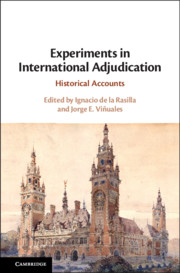
BOOK: Ignacio DE LA RASILLA Y DEL MORAL & Jorge VIÑUALES (eds.), Experiments in International Adjudication. Historical Accounts (Cambridge: CUP, 2019), XII + 328 p. ISBN 9781108565967, GBP 110

(image source: CUP)

Book abstract:
The history of international adjudication is all too often presented as a triumphalist narrative of normative and institutional progress that casts aside its uncomfortable memories, its darker legacies and its historical failures. In this narrative, the bulk of 'trials' and 'errors' is left in the dark, confined to oblivion or left for erudition to recall as a curiosity. Written by an interdisciplinary group of lawyers, historians and social scientists, this volume relies on the rich and largely unexplored archive of institutional and legal experimentation since the late nineteenth century to shed new light on the history of international adjudication. It combines contextual accounts of failed, or aborted, as well as of 'successful' experiments to clarify our understanding of the past and present of international adjudication.
Contributors:
 Jorge E. Viñuales, Ignacio de la Rasilla, Inge Van Hulle, Jan Lemnitzer, Gerard Conway, Frédéric Mégret, Jean d'Aspremont, Cesare P. R. Romano, Andrei Mamolea, Freya Baetens, Donal Coffey, Angelo Junior Golia, Ludovic Hennebel, Morten Rasmussen.
More information with CUP.

This book is the result of the ESIL IGHIL Pre-Conference Workshop at the ESIL Conference in Oslo in September 2014 (cf. program earlier on this blog).

Monday, 25 March 2019

ARTICLE: John Fabian WITT & Bennett OSDIEK, "The Czar and the Slaves: Two Puzzles in the History of International Arbitration" (American Journal of International Law, forthcoming)

(image source: Wikimedia Commons)

Abstract:
In 1822, the Russian Czar Alexander decided an arbitration between the United Kingdom and the United States over the fate of 5,000 enslaved persons who fled to British lines at the end of the War of 1812. American observers have asserted for more than a century that the Czar’s decision, which has gone down in history as one of the canonical Anglo-American arbitrations of the Early Republic, favored the United States. But did the U.S. really win? Secretary of State John Quincy Adams complained at the time that the decision was not sufficiently clear. And new debate has broken out in the historical literature. This article resolves the question, relying in part on new evidence from diplomatic archives in the United States and the United Kingdom. We show that, as a formal matter, the Czar sided with the United States, though the arbitration proved useful to U.K. statesmen as well. The curious case of the Czar and the slaves also poses a second puzzle about the relationship between slavery and the emergence of modern international law. Even as the U.K. was beginning to use international law to oppose the slave trade, the United States aimed to turn some of international law’s institutions into powerful bastions of support for slavery.
Read the fulltext on SSRN.

Tuesday, 22 January 2019

BOOK: Antonio R. PARRA, The History of ICSID, 2nd ed. (Oxford: Oxford University Press, 2018). ISBN 9780198834083, $38.95


(Source: OUP)

Oxford University Press has recently published the paperback version of “The History of ICSID”

ABOUT THE BOOK

Now available in paperback, the second edition of The History of ICSID details the history and development of the International Centre for Settlement of Investment Disputes (ICSID) and its constituent treaty, the Convention on the Settlement of Investment Disputes between States and Nationals of Other States.

Antonio Parra, the first Deputy Secretary-General of ICSID, traces the immediate origins of the Convention, in the years 1955 to 1962, and gives a stage-by-stage narrative of the drafting of the Convention between 1962 and 1965. He recounts details of bringing the Convention into force in 1966 and the elaboration of the initial versions of the Regulations and Rules of ICSID adopted at the first meetings of its Administrative Council in 1967. The four periods 1968 to 1988, 1989 to 1999, 2000 to 2010, and 2011 to 2015 are covered in separate chapters which examine the expansion of the Centre's activities and changes made to the Regulations and Rules over the years. There are also overviews of the conciliation and arbitration cases submitted to ICSID in the respective periods, followed by discussions of selected cases and key issues within them. A concluding chapter discusses some of the broad themes and findings of the book, examines how ICSID might meet several large new challenges facing it, and outlines several possible further changes of its rules and procedures
The book offers unique insight into the establishment and design of ICSID, as well as into how the institution evolved and its relationship with the World Bank over the 50 years since the establishment of ICSID. It is essential reading for those involved in this field.

ABOUT THE AUTHOR

Antonio R. Parra, Consultant with the Corporate Secretariat of the World Bank

Antonio R. Parra served as the first Deputy Secretary-General of the International Centre for Settlement of Investment Disputes (ICSID) from 1999 to 2005 and was Legal Adviser at ICSID from 1990 to 1999. His earlier positions include Senior Counsel, ICSID; Counsel, Office of the Senior Vice President and General Counsel, World Bank; Counsel, Policy and General Affairs, World Bank; Assistant Legal Counsel, OPEC Fund for International Development; and Research Staffer, OPEC Secretariat. At the World Bank's Legal Vice Presidency and ICSID, Mr Parra worked on the establishment of the Multilateral Investment Guarantee Agency and the preparation of the World Bank Guidelines on the Treatment of Foreign Direct Investment. He is an Honorary Secretary-General of the International Council for Commercial Arbitration (having been Secretary General from 2004 to 2010) and a Fellow of the Chartered Institute of Arbitrators.

TABLE OF CONTENTS

1. Introduction
2. Origins of the Convention
3. Broches's "Working Paper"
4. The Preliminary Draft of the Convention
5. Finalizing the Text of the Convention
6. Establishment and Launch of the Centre
7. ICSID's First Two Decades
8. Aspects of the Early Cases
9. ICSID from 1989 to 1999
10. ICSID from 2000 to 2010
11. "The Premier International Arbitration Facility in the World"
12. Conclusion

More information here
(source: ESCLH Blog)

Thursday, 5 July 2018

ARTICLE: Nineteenth Century Arbitrators’ Powers—Has There Been Any Progress to Date? The Law & Practice of International Courts and Tribunals XVII (2018), Nr. 1, 217-235

(image source: Brill)

Abstract:
Investment arbitrators’ authority has been a focus of attention today, e.g. regarding the extent of their powers to interpret and apply the law, to conduct arbitral proceedings, to dissent from their fellow co-arbitrators, and with regard to their duty to be impartial and independent. Two hundred years ago, practitioners, arbitrators and states confronted similar challenges, and through legal doctrines, treaties and practices a path was laid out for future generations of practitioners and arbitrators, where clear legal lines were drawn to distinguish between arbitrators’ procedural and substantive powers and their duties with regard to each of them. The consent and sovereignty of states were duly deferred to by arbitrators and umpires, limiting their job to settle a case. Thus, arbitrators had the duty of impartially interpreting and applying the law of nations, i.e. the natural law, and to deliver a final and binding award. Arbitrators were not bound by precedents, and if they made an unjust or unfair decision, beyond the law, countries could refrain from complying with it, which limited arbitrators’ interpretive powers. In conclusion, not much has changed to date with regard to the procedural powers given to arbitrators. The authority delegated to them by states was to strictly settle the case; no power to develop the law was ever given, which still applies now. Hence, the only important change that has been introduced today is that of claiming the so-called inherent power to help in the development of investment law, which is being driven mainly by arbitrators, and not by states.
On the author:
 Professor of International Economic Law, Externado University of Colombia. Sole practitioner in trade and investment areas involving local regulation jose.alvarez@uexternado.edu.co
More information with the publisher.

Thursday, 18 August 2016

BOOK: Jakob ZOLLMANN, Naulila 1914. World War I in Angola and International Law: A Study in (Post-)Colonial Border Regimes and Interstate Arbitration [Studien zur Geschichte des Völkerrechts; 35]. Baden-Baden: Nomos Verlag, 2016, 516 p. ISBN 978-3-8487-2547-2, € 98.

(image source: blogger)

 Jakob Zollmann published Naulila 1914. World War I in Angola and International Law: A Study in (Post-)Colonial Border Regimes and Interstate Arbitration in Nomos' collection Studien zur Geschichte des Völkerrechts.

Abstract:
In 1885, Germany and Portugal became neighbours in Africa. The newly founded colony of German Southwest Africa prevented the southwards expansion of the ancient colony of Angola. The border along the Cunene and Kavango Rivers remained under dispute. After the outbreak of World War I in Europe, Portugal’s neutrality was questioned in German Southwest Africa, and when a group of German officials waiting near the border of Angola for food transports were shot in the Angolan fortress Naulila, a state of war between both colonies seemed inevitable. German troops launched several military reprisals against fortresses in southern Angola, most significantly against Naulila in December 1914. After their victory at Naulila, the Germans retreated to GSWA. However, African powers, most notably Kwanyama forces led by King Mandume, used the weakness of the defeated Portuguese army to expel the colonial troops from southern Angola. In 1915, a counter-offensive was launched with troops from Portugal that ended with the complete occupation of Kwanyama territories. After the war, a Luso-German arbitration procedure according to the Treaty of Versailles (1919) assessed the damages in Angola and Germany’s responsibility to pay reparations. The arbitration award of 1928 that established Germany’s responsibility for the violation of international law when attacking Naulila became a landmark case. It still holds relevance for modern international law. The final part of this book analyses the memorial culture that developed in Angola, Namibia, Germany and Portugal around the war in 1914/15.
More information here.
Source: International Law Reporter.