ESIL Interest Group History of International Law

ESIL Interest Group History of International Law
Showing posts with label advance article. Show all posts

Wednesday, 19 May 2021

ADVANCE ARTICLE: Dzavid DZANIC, ''France's Informal Empire in the Mediterranean, 1815–1830" (Historical Journal)

(image source: CUP)

Abstract: 

Recent works on France's informal projection of power have begun remapping French imperialism during the nineteenth century. More studies in this vein could broaden our understanding of informal empire as an analytical category by decentring it from its roots in British imperial studies. This article argues that between 1815 and 1830, French diplomats remoulded the Regency of Tunisia into an informal imperial periphery. Although they lacked the military and economic leverage of their British counterparts, French consuls coerced the Tunisian rulers into submission by wielding threats and treaties. This strategy unfolded in three stages. First, the consuls used rumours of a possible invasion in order to impose a new vision of international law and dismantle the corsair system in the Regency. Second, they claimed French territorial sovereignty over a part of the Tunisian coast by appealing to the international legal norms enshrined in the existing treaties. And, third, the Tunisian ruler accepted most consular demands following the French invasion of Algeria in 1830. Tunisia's entrance into the French imperial orbit in turn led French diplomats to seek the establishment of French economic ascendency in Tunisia during the early 1830s.

(DOI 10.1017/S0018246X21000340

Tuesday, 17 November 2020

ADVANCE ARTICLE: Wouter DE RYCKE, "Legislating Utopia. Louis Bara (1821–1857) and the Liberal-Scientific Restatement of International Law in the Nineteenth Century Peace Movement" (Journal of the History of International Law/Revue d'histoire du droit international)


(image source: Brill)

Abstract:

This article deals with the contribution of one exponent of the first generation of institutional pacifist internationalism to the rise of ius contra bellum. Traditionally associated with events from the late nineteenth century onwards, this significant paradigm shift knew an extensive prehistory. Legal scholarship has long dismissed the ‘peace friends’ of the mid-century as either not legalistic or solely focussed on arbitration. The article will argue that this longstanding bias has precluded a profound engagement with legal discourse within the early international peace movement. It will do so through a contextual legal analysis of the works of Louis Bara, a young Belgian lawyer who won first prize for his lengthy and controversial peace essay at the famous Paris peace conference of 1849. This neglected jurist articulated an enduring popular desire to develop a liberal international legal project, which both the peace movement and international law as a discipline increasingly internalized.

(read more with Brill; DOI 10.1163/15718050-12340146 

Thursday, 4 June 2020

ADVANCE ARTICLE: Giulio BARTOLINI, 'World War I and the Italian International Law Scholars', Journal of the History of International Law/Revue d'histoire du droit international

(image source: Brill)

Manufacturing International Law: Pre-printed Treaties in the ‘Scramble for Africa’ (Steven M. Harris)
Abstract:
The centennial anniversary of World War I has generated renewed interest in the complex relationship between this event, international law and its community of scholars. In this regard the largely unexplored Italian context may represent a stimulating source of material from the point of view of both contemporary scholarly debate and current research, as Italy was one of the leading states involved in the conflict and boasts a vibrant and influential community of scholars of international law. As a result this article will focus on the shifting and active role played by Italian scholars in relation to the conflict, not only in their traditional academic and scientific activities, but also through their involvement in public debate, propaganda activities, contributions to newspapers and non-specialized journals, as well as their support to the Government..
Read more with Brill.

Wednesday, 29 May 2019

ADVANCE ARTICLE: Brad HINSHELWOOD, Punishment and Sovereignty in De Indis and De iure belli ac pacis (Grotiana, 2019)

(image source: Brill)

Abstract:
Grotius’s theory of punishment provides a unique lens through which to view his evolving thought on sovereignty between De Indis and De iure belli ac pacis and the implications of that evolution for Grotius’s theory of the ius in bello. Throughout both works, Grotius attempted to leave open the possibility of private punishment and private warfare, a position not easily squared with prevailing views of sovereign authority. Initially, Grotius was content with a theory marrying the private right of punishment with more traditional Scholastic views of sovereignty through a transfer of the private right from individuals into the hands of the sovereign. This theory also adopted traditional views of subject responsibility for sovereign acts—and, by extension, the exposure of subjects to punishment for the acts of their sovereign. By the time of his mature work, however, Grotius turned away from natural law justifications for collective responsibility and collective punishment, denying that subjects had to answer for the acts of their sovereign as a necessary incident of the compact creating civil society. This led Grotius to refer virtually all forms of collective responsibility, such as reprisal or punishment exacted through war, to the law of nations. This sharp reduction of the natural consequences of the creation of sovereign power also enabled Grotius’s argument that the private right of war, and in particular the private right of punishment, remained available after the creation of civil society.
Real the full article with Brill.

Thursday, 14 March 2019

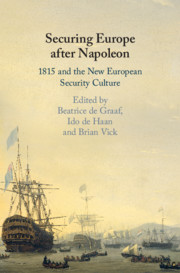
BOOK: Beatrice DE GRAAF, Ido DE HAAN & Brian VICK (eds.), Securing Europe after Napoleon. 1815 and the New European Security Culture (Cambridge: CUP, 2019), xix + 316 p. ISBN 9781108597050, 75 GBP

(image source: CUP)

Book abstract:
After the French Revolution and the Napoleonic Wars, the leaders of Europe at the Congress of Vienna aimed to establish a new balance of power. The settlement established in 1815 ushered in the emergence of a genuinely European security culture. In this volume, leading historians offer new insights into the military cooperation, ambassadorial conferences, transnational police networks, and international commissions that helped produce stability. They delve into the lives of diplomats, ministers, police officers and bankers, and many others who were concerned with peace and security on and beyond the European continent. This volume is a crucial contribution to the debates on securitisation and security cultures emerging in response to threats to the international order
On the editors:
Beatrice de Graaf, Universiteit Utrecht, The Netherlands Beatrice de Graaf is Professor of History of International Relations and Global Governance at Universiteit Utrecht, The Netherlands. She leads an ERC project on security history in Europe and beyond, is an expert on history of terrorism, and is a member of the Royal Netherlands Academy of Arts and Sciences and the ECFR. Ido de Haan, Universiteit Utrecht, The Netherlands Ido de Haan is Professor of Political History at Universiteit Utrecht, The Netherlands. He has written extensively about the aftermath of war and collective violence in modern European history, notably after the Napoleonic Wars and the Holocaust. Brian Vick, Emory University, Atlanta Brian Vick is Professor of History at Emory University, aTLANTA. He has written widely on the Congress of Vienna and its aftermath. His book The Congress of Vienna: Power and Politics After Napoleon (2014) won the Hans Rosenberg Book Prize of the Central European History Society of the American Historical Association.
Table of contents:
Vienna 1815: introducing a European security culture Beatrice de Graaf, Ido De Haan and Brian Vick Part I. Conceptualisations: 1. Cultures of peace and security from the Vienna Congress to the twenty-first century: characteristics and dilemmas Matthias Schulz; 2. Historicising a security culture: peace, security and the Vienna system in history and politics, 1815 to present Eckart Conze; 3. The Congress of Vienna as a missed opportunity: conservative visions of a new European order after Napoleon Matthijs Lok; Part II. Interests: 4. The Central Commission for Navigation of the Rhine: a first step towards European economic security? Joep Schenk; 5. From the balance of power to a balance of diplomacy? Peace and security in the Vienna settlement Stella Ghervas; 6. The London Ambassadors' Conferences and beyond: abolition, Barbary corsairs and multilateral security in the Congress of Vienna system Brian Vick; 7. The allied machine: the Conference of Ministers in Paris and the management of security, 1815–18 Beatrice De Graaf; 8. The German Confederation: cornerstone of the new European security system Wolf D. Gruner; Part III. Threats: 9. Constructing an international conspiracy: revolutionary concertation and police networks in the European restoration Ido De Haan and Jeroen Van Zanten; 10. Security and transnational policing of political subversion and international crime in the German confederation after 1815 Karl Härter; 11. The papacy, reform, and intervention: international collective security in restoration Italy David Laven; 12. From Augarten to Algiers: securitising and 'piracy' around the Congress of Vienna Erik De Lange; Part IV. Agents and Practices: 13. Friedrich Von Gentz and his Wallachian correspondents: security concerns in a Southeastern European Borderland (1812–28) Constantin Ardeleanu; 14. Diplomats as power brokers Mark Jarrett; 15. Economic insecurity, 'securities' and a European security culture after the Napoleonic wars Glenda Sluga. 

Read more with CUP.

Wednesday, 6 March 2019

ADVANCE ARTICLE: Jason YACKEE, "Investor-State Dispute Settlement at the Dawn of International Investment Law: France, Mauritania, and the Nationalization of the MIFERMA Iron Ore Operations" (American Journal of Legal History 2019)

(image source: OUP)

Abstract:
The case for the desirability of the modern system of investment treaty arbitration rests on certain stylized historical claims. Those claims serve to demonstrate that the pre-modern system of dealing with investor – state disputes was inferior compared to current arrangements, which allow foreign investors to initiate highly legalized (or “depoliticized”) arbitration against host state governments for alleged violations of investment treaties. The implication of the historical comparison is that we should accept, and perhaps even expand, investment treaty arbitration to avoid a return to a more dangerous practice. This article challenges the historicity of this standard story through an in-depth examination of an important but understudied episode of expropriation from the 1970s, Mauritania’s seizure of the MIFERMA iron ore operations. As I show below, politicized dispute settlement need not entail, nor even risk, resort to force. It can even be successful, especially where home and host state governments and the investor perceive mutual gains from continued cooperation. More generally, the article suggests the utility of micro-historical analysis of investor – state disputes as a methodology for gaining a more realistic understanding of how legal and diplomatic dispute settlement methods can interact to support negotiated outcomes.
Read more here.

Thursday, 1 November 2018

ADVANCE ARTICLE: Edward CAVANAGH, "The Imperial Constitution of the Law Officers of the Crown: Legal Thought on War and Colonial Government, 1719-1774", Journal of Imperial and Commonwealth History, 29 OCT 2018

(image source: Duotrope)

Article abstract:
The rule of conquest came to receive different applications for different parts of the British Empire. How this happened, and who was responsible for it happening, are the interests of this article. Calling upon court reports, parliamentary records, and correspondence between various officeholders in the early Hanoverian government, attention will be drawn in particular to the attorney general and the solicitor general (the law officers of the crown) and the advice they offered upon the governance of colonies between 1719 and 1774. Focusing upon the conventions that pertain to war and conquest in Ireland, the Caribbean, India, and North America, this article reveals inconsistency in doctrine, but consistency in the procedures by which law officers of the crown acquired influence over proceedings in the houses of parliament and in the courts of common law and equity. Just as often in their formal capacities as in their informal capacities, the attorney general and the solicitor general were pivotal to the development of the imperial constitution, in constant response, as they were, to the peculiar demands of various colonies and plantations in the British Empire.
DOI 10.1080/03086534.2018.1539723

Read more here.

Wednesday, 26 September 2018

ADVANCE ARTICLE: Justyna WUBS-MROZEWICZ, 'Neutrality before Grotius: A City, a State and Seven Salt Ships in the Baltic (1564-1567)', Journal of Early Modern History

(image source: Brill)

Abstract:
The article argues on the basis of a case from the 1560s in Danzig that prior to the formulation of the legal concept of neutrality by Hugo Grotius, there was a practice of neutrality. It was expressed in various terms and manners. This practice pertained to both cities and states, and the case discloses the first documented instance when the Netherlands explicitly strove for neutrality also by legal means. The choice for neutrality was rooted in political and economic interests and as such had advantages, but it was also fraught with difficulties. The analysis shows that the actual extent of neutrality depended on the acceptance (or lack thereof) of the warring parties. Also, by excluding the possibilities of the use of violence or economic means of pressure like blockades, neutrals were limited to diplomacy and law during conflicts. This lay the ground for the development of a legal concept of neutrality

More information with Brill.

(source: ESCLH Blog)