ESIL Interest Group History of International Law

ESIL Interest Group History of International Law
Showing posts with label Russian Revolution. Show all posts

Tuesday, 23 February 2021

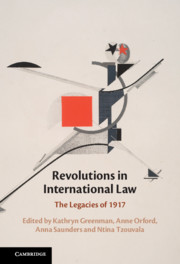
BOOK: Kathryn GREENMAN, Anne ORFORD, Anna SAUNDERS & Ntina TZOUVALA (eds.), Revolutions in International Law. The Legacies of 1917 (Cambridge: CUP, 2021), ISBN 9781108495035


(image source: CUP)

Book abstract:

In 1917, the October Revolution and the adoption of the revolutionary Mexican Constitution shook the foundations of the international order in profound, unprecedented and lasting ways. These events posed fundamental challenges to international law, unsettling foundational concepts of property, statehood and non-intervention, and indeed the very nature of law itself. This collection asks what we might learn about international law from analysing how its various sub-fields have remembered, forgotten, imagined, incorporated, rejected or sought to manage the revolutions of 1917. It shows that those revolutions had wide-ranging repercussions for the development of laws relating to the use of force, intervention, human rights, investment, alien protection and state responsibility, and for the global economy subsequently enabled by international law and overseen by international institutions. The varied legacies of 1917 play an ongoing role in shaping political struggle in the form of international law.

Table of contents:

1. International law and revolution:
1917 and beyond Kathryn Greenman, Anne Orford, Ntina Tzouvala and Anna Saunders
Part I. Imperialism:
2. Looking eastwards: the Bolshevik theory of imperialism and international law Ntina Tzouvala and Robert Knox
3. Lenin at Nuremberg: anti-imperialism and the juridification of crimes against humanity Amanda Alexander
Part II. Institutions and Orders:
4. Excluding revolutionary states: Mexico, Russia and the League of Nations Alison Duxbury
5. Law, class struggle and nervous breakdowns Mai Taha
6. Microcosm: Soviet constitutional internationality Scott Newton
7. Law and socialist revolution: early Soviet legal theory and practice Owen Taylor
Part III. Intervention:
8. Intervention: sketches from the scenes of the Mexican and Russian Revolutions Dino Kritsiotis
9. Mexican revolutionary constituencies and the Latin American critique of US intervention Juan Pablo Scarfi
10. Mexican post-revolutionary foreign policy and the Spanish Civil War: legal struggles over intervention at the League of Nations Fabia Fernandes Carvalho Veçoso
Part IV. Investment:
11. 1917: property, revolution and rejection in international law Kate Miles
12. 1917 and its implications for the law of expropriation Daria Davitti
13. Contestations over legal authority: the Lena Goldfields Arbitration 1930 Andrea Leiter
14. The Mexican Revolution: alien protection and international economic order Kathryn Greenman
Part V. Rights:
15. 'Animated by the European spirit': European human rights as counterrevolutionary legality Anna Saunders
16. Human Rights, revolution and the 'good society': the Soviet Union and the Universal Declaration of Human Rights Jessica Whyte.

(source: IL Reporter - CUP

Tuesday, 4 June 2019

BOOK: Owen TAYLOR, International Law and Revolution [Routledge Research in International Law] (London: Routledge, 2019), 192 p., ISBN 9780367076597, 115 GBP

(image source: Routledge)

Book abstract:
This book explores the historical inter-relations between international law and revolution, with a focus on how international anti-capitalist struggle plays out through law. The book approaches the topic by analysing the meaning of revolution and what revolutionary activity might look like, before comparing this with legal activity, to assess the basic compatibility between the two. It then moves on to examine two prominent examples of revolutionary movements engaging with international law from the twentieth century; the early Soviet Union and the Third World movement in the nineteen sixties and seventies. The book proposes that the ‘form of law’, or its base logic, is rooted in capitalist social relations of private property and contract, and that therefore the law is a particularly inhospitable place to advance revolutionary breaks with established distributions of power or wealth. This does not mean that the law is irrelevant to revolutionaries, but that turning to legal means comes with tendencies towards conservative outcomes. In the light of this, the book considers the possibility of how, or whether, international law might contribute to the pursuit of a more egalitarian future. International Law and Revolution fills a significant gap in the field of international legal theory by offering a deep theoretical reflection on the meaning of the concept of revolution for the twenty-first century, and its link to the international legal system. It develops the commodity form theory of law as applied to international law, and explores the limits of law for progressive social struggle, informed by historical analysis. It will therefore appeal to students and scholars of public international law, legal history, human rights, international politics and political history.
On the author:
Owen Taylor is an independent researcher, currently based in Marseille. He completed his doctorate in Law at SOAS, University of London
More information here.

Tuesday, 20 October 2015

CALL FOR PAPERS: Workshop 'A Century after Russian Revolution: Its Legacy in International Law' (Heidelberg, 19 May 2016); DEADLINE 10 April 2016

(image source: Mpil)

In the context of the upcoming centennial anniversary of the Russian Revolution in 2017, the Max Planck Institute for Comparative Public Law and International Law in Heidelberg will host a workshop with experts in the field to reflect on the Russian Revolution and its aftermath. The workshop convenes lawyers, historians and political scientists to present a paper which will be published in a focus session of the Journal of the History of International Law (JHIL). The central theme is ‘A Century after Russian Revolution: Its Legacy in International Law’. Issues to be addressed are the international right to self-determination of peoples, the role of revolution for statehood, state succession, recognition and Russian international law in the sense of its historiography and doctrine.

Speakers presenting their papers during the day are Prof. Sabine Dullin (Sciences Po Paris), Prof. John B. Quigley (Ohio State University), Prof. Lauri Mälksoo (University of Tartu), Prof. Veronika Bilkova (Charles University Prague), Dr. Janis Grzybowski (Graduate Institute of International and Development Studies Geneva) and Prof. Vittorio Hösle (University of Notre Dame).

The workshop will take place on Thursday 19 May 2016 in Heidelberg, beginning in the morning and ending on in the afternoon around 17.00.

Scholars and practitioners interested in participating in the workshop as engaged listeners, that is, as audience (and participants in the discussions following the presentations), are invited to respond to this call.
The presentations of invited speakers will relate to the following topics:
  • -  Self-determination
  • -  Statehood and recognition
  • -  Property and sovereignty
  • -  The Russian Revolution from a philosophical and historical perspective
  • -  Secret treaties

    The final programme will be publicized soon.
    If you are interested in participating in the audience (not as a speaker), send an application with a statement of motivation explaining you interest and expertise or current research interest (maximum 1⁄2 to 1 page), and your cv including list of publications (maximum one page) to Dr. Mieke van der Linden (linden@mpil.de).
Participation is at your own expense; the Max Planck Institute cannot contribute to your travel and accommodation costs. Admitted participants must secure their own accommodation, and we advise to do this early. 

Space is limited, and participants will be admitted on a first come-first serve basis, taking into account their demonstrated expertise on the topic. No applications will be admitted after 10 April 2016.

For all inquiries, please contact Dr. Mieke van der Linden (linden@mpil.de).