ESIL Interest Group History of International Law

ESIL Interest Group History of International Law
Showing posts with label theology. Show all posts

Monday, 30 August 2021

BOOK: Dominique BAUER & Randall C.H. LESAFFER (eds.), History, Casuistry and Custom in the Legal Thought of Francisco Suárez (1548-1617). Collected Studies [Legal History Library, 51; Studies in the History of International Law, 19] (Leiden/Boston: Martinus Nijhoff/Brill, 2021), viii + 160 p. ISBN 9789004464803, € 93


(image source: Brill)

Book abstract:
The thought and work of the Jesuit Francisco Suárez (1548-1617) is widely acknowledged as the culmination point of the contribution of the theologians and jurists of the so-called School of Salamanca to the development of modern Western law. This collection of studies on the legal work of Suárez explores some of his major forays into the law. Both his theoretical system-building as well as his interventions in practical questions are covered. Next to discussions on the nature of law and its different categorisations, they extend to various subbranches of the law including family law, property law, the law of obligations, criminal law and international law.

Contributors:

Dominique Bauer, Daniel Schwartz, João Manuel Azevedo Alexandrino Fernandes, Lisa Brunori, Wim Decock, Bart Wauters, Gaëlle Demelemestre, Jean-Paul Coujou, and Cintia Faraco.  

Read more with Brill (DOI 10.1163/9789004464810


Friday, 7 August 2020

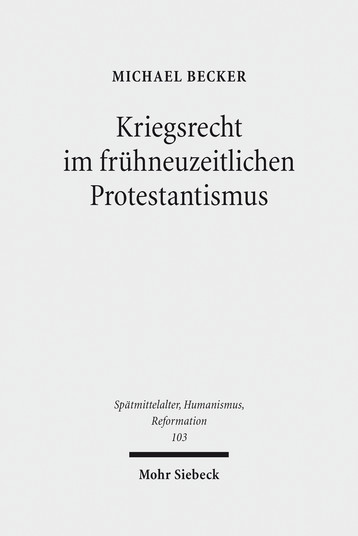
BOOK: Michael BECKER, Kriegsrecht im frühneuzeitlichen Protestantismus Eine Untersuchung zum Beitrag lutherischer und reformierter Theologen, Juristen und anderer Gelehrter zur Kriegsrechtsliteratur im 16. und 17. Jahrhundert [Spätmittelalter, Humanismus, Reformation; 103] (Tübingen: Mohr Siebeck, 2017), XV + 455 p. ISBN 978-3-16-155362-2, € 89

(image source: Mohr Siebeck)

Abstract:
Das 16. und 17. Jahrhundert ist für die Völkerrechtsgeschichte von besonderer Bedeutung. Aufgrund der spanischen Expansion in der Neuen Welt und der konfessionellen Konflikte in Europa wurden völkerrechtliche Fragen kontrovers diskutiert. Während der römisch-katholische Anteil des Völkerrechtsdiskurses bereits Gegenstand zahlreicher Untersuchungen wurde, ist der protestantische Beitrag zur Genese und Ausdifferenzierung des frühneuzeitlichen Völkerrechts weitgehend unbekannt. Michael Becker befasst sich daher mit den Werken protestantischer Theologen, Juristen und anderer Gelehrter, die sich zu Fragen des Völkerrechts geäußert haben. Anhand von spezifischen Problemstellungen aus dem Bereich des Kriegs- und Bündnisrechts (religiöse Offensiv- und Verteidigungskriege, Bündnisse zwischen unterschiedlichen Konfessionen) zeigt er, dass protestantische Gelehrte den Völkerrechtsdiskurs mitgeprägt haben. Die Arbeit wurde mit einem Preis des wissenschsftlichen Beirats zum Reformationsjubiläum ausgezeichnet.
(source: Mohr Siebeck)

Tuesday, 9 April 2019

BOOK: David MCILROY, The End of Law : How Law’s Claims Relate to Law’s Aims. (Cheltenham: Edward Elgar Publishing, 2019). ISBN 978 1 78811 399 1, £63.00


Edward Elgar is publishing a new book that deals with natural law theory and the significance of St. Augustine.

ABOUT THE BOOK

Augustine posed two questions that go to the heart of the nature of law. Firstly, what is the difference between a kingdom and a band of robbers? Secondly, is an unjust law a law at all? These two questions force us to consider whether law is simply a means of social control, distinguished from a band of robbers only by its size, or whether law is a social institution justified by its orientation towards justice.

The End of Law applies Augustine’s questions to modern legal philosophy as well as offering a critical theory of natural law that draws on Augustine’s ideas. McIlroy argues that such a critical natural law theory is realistic but not cynical about law’s relationship to justice and to violence, can diagnose ways in which law becomes deformed and pathological, and indicates that law is a necessary but insufficient instrument for the pursuit of justice. Positioning an examination of Augustine’s reflections on law in the context of his broader thought, McIlroy presents an alternative approach to natural law theory, drawing from critical theory, postmodern thought, and political theologies in conversation with Augustine.

This insightful book will be fascinating reading for law students and legal philosophers seeking to understand the perspective and commitments of natural law theory and the significance of Augustine. Readers with an interest in interdisciplinary approaches to legal theory will also find this book a stimulating read.

ABOUT THE AUTHOR

David McIlroy, Barrister and Visiting Professor, CCLS, Queen Mary University of London, UK

TABLE OF CONTENTS

Contents: 1. What is the difference between a kingdom and a band of robbers? 2. What on earth are we talking about? 3. An end to war 4. The rule of law and the law of rules 5. The stable door 6. The good ending 7. Critical natural law 8. Justice: the terrible truth? 9. The agony of the law 10. The final judgment

More information here

(source: ESCLH Blog)

Monday, 25 February 2019

OPEN ACCESS ARTICLE: Daniel S. ALLEMANN, "Empire and the Right to Preach the Gospel in the School of Salamanca, 1535-1600", Historical Journal 2018

(image source: Cambridge Core)

The Historical Journal published an article in open access by Daniel S. Allemann (Gonville & Caius College, Cambridge) on "Empire and the Right to Preach the Gospel in the School of Salamanca".

Abstract:
The sixteenth-century theologians of the School of Salamanca are well known for their sophisticated reflections on the Spanish conquest of the New World. But the nature of their responses seems far from clear and is subject to historiographical debate. Recent studies from the discipline of intellectual history suggest that the Salmantine theologians challenged the legitimacy of Spanish claims to the Americas. Scholars associated with the field of post-colonial studies, on the other hand, forcefully stress their entanglement in Spain's imperial venture overseas. This article, however, argues that these seemingly irreconcilable approaches are not in fact mutually exclusive. It shifts our attention to the sorely neglected ius praedicandi, the right to preach the gospel, which served to translate the Spanish theologians’ deeply rooted belief in the hegemonic truth of the Christian faith into a discourse of otherwise ‘secular’ natural rights. In adopting this novel lens, the article makes a case for assessing the language of the university theologians in its own terms while simultaneously exposing the support of Salamanca for Spain's imperial venture.

This article (20 pages) can be read online for free here.