ESIL Interest Group History of International Law

ESIL Interest Group History of International Law
Showing posts with label symposium. Show all posts

Friday, 5 February 2021

ZOOM SEMINAR: Legal Histories of Empire with Lisa Ford and Jessica Hinchy (Sydney, 5 MAR 2021)

(image source: Wikimedia Commons)

The following announcement circulated on the Legal History Blog and the ANZLHS blog:

Join us for the second of several symposia planned for 2020 and 2021 for Legal Histories of Empire.

Our speakers:

Lisa Ford: ‘The King’s Colonial Peace: Variable subjecthood and the transformation of empire’

This paper is drawn from my forthcoming book, The King’s Peace: Empire and Order in the British Empire. The book uses colonial peacekeeping as a lens through which to examine the shifting parameters of crown prerogative in Empire in the Age of Revolutions. This paper will argue that the legal vulnerability of (and often threats to order posed by) a diverse array of subjects – formerly French Catholics in Quebec, Caribbean slaves and NSW convicts – both prompted and justified the unravelling of the very idea of the freeborn Englishman that had been mobilised by protestant Britons in pre-revolutionary America.

Lisa Ford is Professor of History at the University of New South Wales, Australia. Her major publications include Settler Sovereignty: Jurisdiction and Indigenous People in America and Australia, 1788-1836 (2010) which won the Littleton-Griswold Prize (American Historical Association); the Thomas J. Wilson Prize (Harvard University Press); and the Premiers History Award (NSW). She is also co-author of Rage for Order: The British Empire and the Origins of International Law, 1800-1850 (co-authored with Lauren Benton, 2016) and author of The King’s Peace, which will be published by Harvard later this year. Ford is currently leading a collaborative project funded by the Australian Research Council exploring the role of commissions of inquiry sent throughout the British Empire in the 1820s on which subject she hopes to lead author a book manuscript this year. She also holds a four-year ARC Future Fellowship, during which she will explore the changing use of martial law in the British Empire from the late eighteenth century until 1865.

Jessica Hinchy: ‘Child Removal and the Colonial Governance of the Family: Hijra and “Criminal Tribe” Households in North India, c. 1865-1900’

Historians have primarily examined colonial child removal projects in settler colonial contexts. Yet from 1865, the colonial government in north India forcibly removed children from criminalised communities. Child separation began in the households of gender non-conforming people labelled ‘eunuchs,’ particularly Hijras, and eventually extended to socially marginalised people designated as ‘criminal tribes,’ especially Sansiyas. First, what does a comparison of these child removal schemes tell us about the colonial governance of the family? Patrilineal, conjugal and reproductive household models marginalised Hijras and Sansiyas in differing ways, while the category of ‘child’ was contingently defined. Child separation was attempted to varying ends, including both elimination and assimilation. Yet often, the colonial state could not sustain such intensified forms of intimate governance in the face of resistance from households. Nor could officials simply determine removed children’s futures. Second, what does child removal suggest about the making of colonial law? When children were initially removed from Hijra and Sansiya households, officials admitted that ‘the law may have been somewhat strained,’ since existing laws did not provide police or magistrates with legal powers to separate these children. The Sansiya child removal project, for instance, prompted debates about colonial legal exceptions and the ‘legality’ of the colonial state’s practices among colonial officials and Indian and European non-officials.

Jessica Hinchy is an Assistant Professor of History at Nanyang Technological University in Singapore. She researches the history of gender, sexuality, households and family in colonial north India. In 2019, Cambridge University Press published her first monograph, Governing Gender and Sexuality in Colonial India: The Hijra, c. 1850-1900. Her research has also appeared in Modern Asian Studies, Gender & History and Asian Studies Review, among other journals.

The event will take place by zoom on Friday 5 March (or Thursday 4 March, depending on your timezone – see below). Please register here (via Eventbrite) to attend.

Timezones:

Sydney @ 12.30 pm on 5 March

Singapore @ 9.30 am on 5 March

Auckland @ 2.30 pm on 5 March

New Delhi @ 7.00 am on 5 March

London/Dublin @ 1.30 am on 5 March

Nairobi @ 4.30 am on 5 March

Vancouver @ 5.30 pm on 4 March

New Haven/Toronto @ 8.30 pm on 4 March

(source: Legal History Blog - ANZLHS

Wednesday, 16 December 2020

ESIL IGHIL Online Symposium: JHIL Special Issue "Politics and the Histories of International Law" (18 DEC 2020)

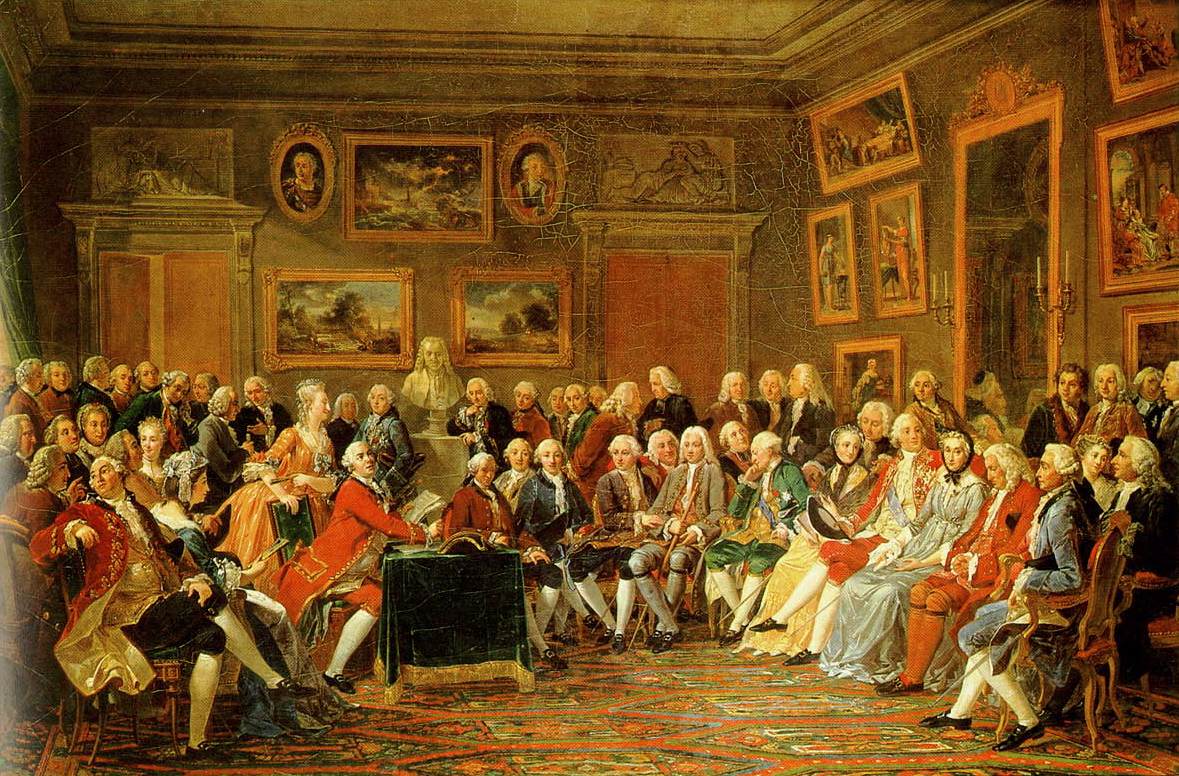
(image: Le salon de Mme Geoffrin by Gabriel Lemonnier (1812); source: Wikimedia Commons)

The ESIL IGHL organizes an MS Teams-symposium on the JHIL Special Issue "Politics and the Histories of International Law" on 09:00 CET. The line-up is as follows:

Panel 1 (09:00-09:45)

  • Florenz Volkaert (UGent-VUB/FWO) on Strength through Diversity? The Paradox of Extraterritoriality and the History of the Odd Ones Out (Madeleine Herren)
  • Daniel Ricardo Quiroga Villamarin (Graduate Institute, Geneva) on Three Wartime Textbooks of International Law (Deborah Whitehall)
  • Wouter De Rycke (VUB/FWO) on Theorising Order in the Shadow of War. The Politics of International Legal Knowledge and the Justification of Force in Modernity (Hendrik Simon)
Panel 2 (09:50-10:35)
  • Rafael Zelesco Barretto (Naval War College of Brazil) on Histories Hidden in the Shadow: Vitoria and the International Ostracism of Francoist Spain (Julia Bühner)
  • Filip Batselé (UGent-VUB/FWO) on A History of International Law in the Vernacular (Jacob Katz Cogan)
  • Jaanika Erne (Tartu) on Turntablism in the History of IL (Jean d'Aspremont)
Conveners:
  • Jan Lemnitzer (Southern Denmark)
  • John Morrs (Deakin University)
  • Markus Beham (Passau)
  • Frederik Dhondt (VUB/UGent)
  • Jaanika Erne (Tartu)

To attend, RSVP with esilighil@gmail.com

Wednesday, 11 March 2020

SYMPOSIUM: AJIL Ubound on Prosper Weil's Analysis of Normativity (OPEN ACCESS)

(image: Prosper Weil; Source: Académie des Sciences Morales et Politiques)

The American Journal of International Law has published a symposium on Prosper Weil's famous article 'Towards Relative Normativity in International Law' ? (1983).

The introduction by Karen Knop can be found here.
The contribution of Pierre-Marie Dupuy is here.
The contribution of José E. Alvarez is here.
The contribution of Paola Gaeta is here.
The contribution of Monica Garcia Salmones-Rovira is here.
The contribution of John Tasioulas is here.
The contribution of Sienhoo Yee is here.

Thursday, 28 November 2019

SYMPOSIUM: Hersch Lauterpacht and Otto Wächter: two law students at the University of Vienna (Vienna, 6 DEC 2019)

(image source: University of Vienna)
Event abstract:
In 1919, two men enrolled at the University of Vienna’s Faculty of Law and later went on to pursue very different careers. Hersch Lauterpacht became one of the most eminent scholars of international law in the 20th century, holding the famous Whewell Chair at the University of Cambridge and being a member of the International Law Commission and Judge at the International Court of Justice. Otto Wächter, on the other hand, rose to the upper ranks of the Nazi party. Wächter was involved as an illegal Nazi in the 1934 assassination of Dollfuss in Vienna, later became Governor of Krakow and then Lemberg, and went on to become a commander in the Waffen-SS Division Galicia. In Lemberg, Lauterpacht’s town of origin, Wächter was responsible for the administration of the Holocaust, in which large parts of Lauterpacht’s family perished. Lauterpacht was a prosecutor at the Nuremberg trials, while Wächter was indicted for international crimes. However, Wächter died in 1949 while on the run. The keynote speech by Philippe Sands will juxtapose these different life paths, based on his book East-West Street and his new project The Ratline.
On the speaker:
Philippe Sands QC is Professor of Law at University College London and a practising barrister at Matrix Chambers. He appears as counsel before the ICJ and ICC and sits as an arbitrator at ICSID, the PCA and the CAS. He is author of Lawless World (2005) and Torture Team (2008) and several academic books on international law, and has contributed to the New York Review of Books, Vanity Fair, the Financial Times and The Guardian. East West Street: On the Origins of Crimes Against Humanity and Genocide (2016) won the 2016 Baillie Gifford (formerly Samuel Johnson) Prize, the 2017 British Book Awards Non-Fiction Book of the Year, and the 2018 Prix Montaigne. The sequel, The Ratline, will be published in 2020 and is also the subject of a BBC podcast. Sands is President of English PEN and a member of the Board of the Hay Festival. 
 The event takes place from 18:00 to 21:00. Register with rechtsgeschichte@univie.ac.at.