ESIL Interest Group History of International Law

ESIL Interest Group History of International Law
Showing posts with label africa. Show all posts

Thursday, 18 March 2021

ARTICLE: Jullia GAFFIELD, "The Racialization of International Law after the Haitian Revolution: The Holy See and National Sovereignty" (American Historical Review CXXV (2020), No. 3, 841-868)

(image: Toussaint Louverture; source: Wikimedia Commons)


Abstract:

The Haitian state shaped international definitions of sovereignty and national legitimacy after the Declaration of Independence in 1804. Haiti’s nineteenth century was not a period of isolation and decline; its first six decades were globally connected because the country’s leaders challenged their postcolonial inequality with diplomacy and state formation. This strategy aimed to establish Haiti’s membership in the “family of nations,” a central metaphor in European and American diplomatic, legal, and religious decision-making. In doing so, the Haitian state forced the Atlantic powers to redefine the boundaries of international relations. Haiti’s decades-long negotiations with the Catholic Church were tied to the racialization of the global hierarchy. After its Declaration of Independence, the Haitian state began clearing a theoretical path toward recognized sovereignty based on the dominant narrative that a society must be considered “civilized” on the world stage. But, as it cultivated internal policies and practices that rejected the dominant racist assumptions, these discriminatory ideologies became increasingly more explicit in international law. 

(read more with OUP Journals: DOI 10.1093/ahr/rhz1226)

Tuesday, 16 March 2021

JOB OFFER: 3 PhD Students (m/f/d) (Dr. Inge VAN HULLE, Legal Connectivities and Colonial Cultures in Africa; Frankfurt: MPILHLT, DEADLINE 1 MAY 2021)

(image source: MPI for Legal History and Legal Theory)
 

Project description:

The legal history of colonialism has for a long time been embedded in the paradigm of the nation state, where the focus lies on investigating the history of individual colonies within a single colonial or national legal tradition. State-centrism in colonial legal history means that the colonies and metropole are often separated from developments that took place on a regional or international level. However, insights from global history, histoire croisée and entangled history, have illustrated the impact on historical developments of the movement and the spatial interconnectedness of people, goods and ideas. This project starts from the premise that the same may be said for the movement of legal concepts and ideas in and about Africa during the colonial period of the late nineteenth- and twentieth centuries. The project maps the connectivities of legal developments in colonial Africa across the local, regional and international level by identifying normative exchanges, for example, between international treaty- and diplomatic negotiations, lobby groups, colonial governments and local actors. Here, the actions of and networks between historical actors who often held plural and conflicting allegiances take centre-stage.

Duties and responsibilities:

 Your key responsibility is to develop and complete a doctoral dissertation within the confines of the research group in one of the three themes described above. Doctoral students are expected to publish and disseminate their research findings in close co-operation with the other members of the research group.

Your profile:

A university degree in law, humanities or social sciences that has been completed with above-average success is required. You have an excellent command of English, both spoken and written and are proficient in either French or German. Knowledge of African languages is not a requirement but will be considered as an asset. Your curriculum vitae shows the potential to conduct research at an internationally high level. You work meticulously and are able to handle deadlines. You work independently and have a strong interest in interdisciplinary, archival and comparative work. You have the ability to play an active collaborative role in the research group.

Job: 

The PhD positions (39 hours per week) are paid the equivalent of 65% of the German Civil Service Collective Agreement (TVöD Bund), level E13, and are primarily intended to enable the preparation of a doctoral thesis. The positions are fixed-term appointments for three years; in exceptional cases, a position can be extended for one additional year. The Max Planck Society is committed to increasing the number of individuals with disabilities in its workforce and therefore encourages applications from such individuals. Furthermore, the Max Planck Society seeks to increase the number of women in those areas where they are underrepresented and therefore explicitly encourages women to apply. The Max Planck Society strives for gender equality and diversity. We welcome applications from all backgrounds.

 Application process:

 Your application must be submitted online via the link below by the closing date of May 1, 2021. Please forward your application documents to your indicated reviewers. If you are shortlisted, we will request a review. If your application is convincing, we will invite you to a selection interview.

The application should be in English or German and should contain the following documents:

  • Names and addresses (by post and electronically) of three researchers who have agreed to issue you with a letter of reference
  • Detailed CV containing a list of any publications you might have
  • Copies of your school leaver’s certificate and degree certificate
  • Preliminary research project (up to five pages) fitting within one of the three themes; Cover letter naming your research project and explaining to what extent your profile meets the selection criteria
  • Written sample of approx. 20 printed pages (e.g. master thesis sample, journal articles, book chapters, etc.)

Contact:

Informal enquiries may be directed to Dr. I. Van Hulle (vanhulle@rg.mpg.de). For questions as to the terms and conditions of employment please contact Ms. Anna Heym (jobs@rg.mpg.de).

Link to application here

Wednesday, 7 November 2018

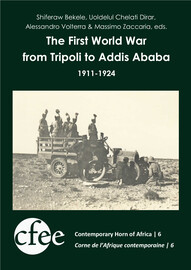
BOOK: Shiferaw BEKELE, Uoldelul Chelati DIRAR, Alessandro VOLTERRA & Massimo ZACCARIA (eds.), The First World War from Tripoli to Addis Ababa (1911-1924) [Corne de l'Afrique contemporaine/Contemporary Horn of Africa, vol. 6] (Addis Abeba: Centre français des études éthiopiennes, 2018), ISBN 9791036523786

(image source: openedition)

Book abstract:
For a long time now it has been common understanding that Africa played only a marginal role in the First World War. Its reduced theatre of operations appeared irrelevant to the strategic balance of the major powers. This volume is a contribution to the growing body of historical literature that explores the global and social history of the First World War. It questions the supposedly marginal role of Africa during the Great War with a special focus on Northeast Africa. In fact, between 1911 and 1924 a series of influential political and social upheavals took place in the vast expanse between Tripoli and Addis Ababa. The First World War was to profoundly change the local balance of power. This volume consists of fifteen chapters divided into three sections. The essays examine the social, political and operational course of the war and assess its consequences in a region straddling Africa and the Middle East. The relationship between local events and global processes is explored, together with the regional protagonists and their agency. Contrary to the myth still prevailing, the First World War did have both immediate and long-term effects on the region. This book highlights some of the significant aspects associated with it.
Table of contents:

  •  Introduction (Shiferaw Bekele, Uoldelul Chelati Dirar, Alessandro Volterra & Massimo Zaccaria)

    International and Regional Politics/Developments
  • Great War Intrigues in the Horn of Africa (Patrick Gilkes & Martin Plaut)
  • WWI in the Middle East and Africa: Nationalist Movements in a Formative Age (Haggai Erlich)
  • Aftershocks of the First World War in the Nile Valley (Anne-Claire de Gayffier-Bonneville)
  • Transnationalism from Below after the First World War: The Case of the 1924 Revolution in Anglo-Egyptian Sudan (Elena Vezzadini)
  • Ethiopia, International Law and the First World War. Considerations of Neutrality and Foreign Policy by the European Powers, 1840-1919 (Jakob Zollmann)

    Colonial Policies
  • Why did the Italians go to Libya? (Andrea Ungari)
  • Askaris and the Great War. Colonial Troops Recruited in Libya for the War but Never Sent to the Austrian Front (Alessandro Volterra)
  • Feeding the War: Canned Meat Production in the Horn of Africa and the Italian Front (Massimo Zaccaria)
  • The First World War Seen from Djibouti: Controlling, Recruiting, Enlisting (Laurent Jolly)
  • Living the War Far Away from the Front: Creating Territories around Djibouti (Simon Imbert-Vier)

    Local Agencies and the War
  • Claiming Islamic Authenticity. The Ḫatmīya Sufi order confronting WWI (Silvia Bruzzi)
  • “Our delight is for the amir of the English”: a Bornoan history of the First World War (North-Eastern Nigeria) (Rémi Dexière & Vincent Hiribarren)
  • World War I and the Perspective of a Hashemite Order in Yemen. Study of the Chronicle of Ismā‛īl b. Muḥammad al-Washalī (Juliette Honvault)
  • Writing WWI with African Gazes. The Great War Through the Writing of Tigrinya Speaking Expatriates (Uoldelul Chelati Dirar)
  • The Italian community of Tunisia: From Libyan Colonial Ambitions to the First World War (Gabriele Montalbano)
The book is available in open access (HTML-version). The PDF and print versions are dependent on library subscriptions to the openedition-platform.

More information here.